Wireless Connected Devices Market Insights
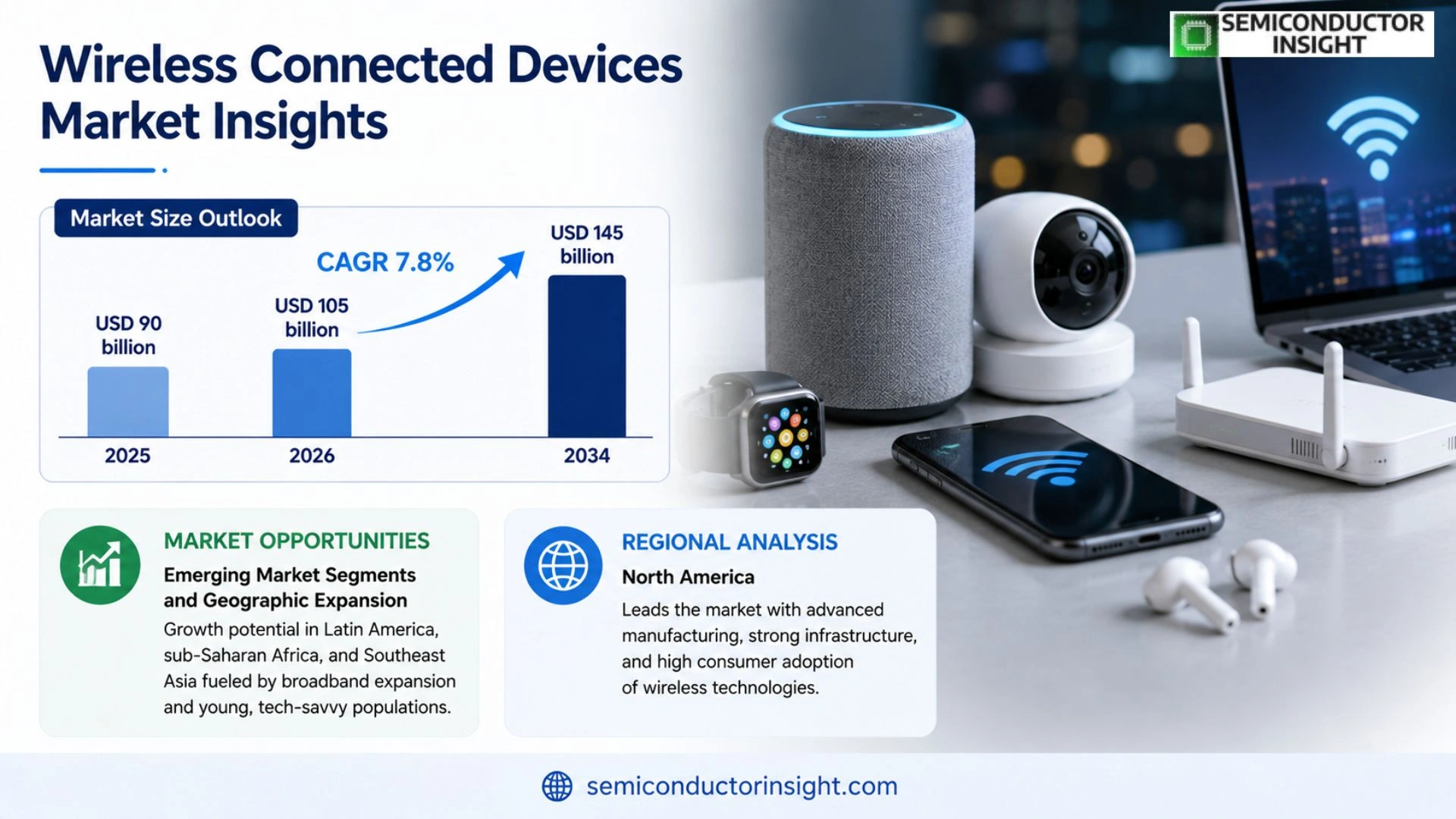
Wireless connected devices Market revenue reached USD 90 billion in 2025; it is estimated to rise from USD 105 billion in 2026 to USD 145 billion by 2034, reflecting an implied CAGR of approximately 7.8% over the forecast period.
Wireless connected devices encompass a broad spectrum of hardware that integrates wireless communication modules,such as Wi‑Fi, Bluetooth Low Energy, NFC, Zigbee, LTE‑M/NB‑IoT,into everyday products ranging from smartphones and wearables to industrial sensors and smart home appliances. The upward trajectory stems from escalating demand for real‑time data analytics across consumer electronics, automotive infotainment systems, and industrial automation sectors, coupled with advancements in chip integration that reduce cost per device.
MARKET DRIVERS
Rapid Adoption of Smart Home Ecosystems
The shift from hobbyist projects to mainstream consumer adoption is evident in the way household connectivity devices now occupy a central column in appliance catalogs. Integrated hubs that bundle voice assistants, HVAC controls, lighting, and security surveillance have become the default “smart‑home” solution for most families. Cost efficiencies in low‑power radio modules,particularly those operating in sub‑GHz bands,plus the maturation of edge‑processing capabilities have drastically reduced the margin required for manufacturers, enabling a pay‑as‑you‑go revenue model that aligns with consumer expectations for subscription services. In parallel, localised deployment of LPWAN (LoRaWAN and NB‑IoT) protocols has addressed historic urban network constraints, enabling reliable device connectivity even in congested metropolitan environment. The effect in healthcare is equally compelling: continuous biometric sensors, once confined to clinical settings, now furnish clinicians with real‑time data streams that improve prognostic accuracy. device ecosystem is therefore a primary engine accelerating growth in the Wireless Connected Devices Market, driven by a convergence of affordability, convenience, and high‑value data analytics.
Expansion of Industrial IoT Applications
Industrial deployments now illustrate how wireless connectivity can become a market‑moving catalyst for process optimisation. Factory floor sensors, when paired with predictive‑maintenance analytics, reduce unplanned downtime by up to 30%, directly translating into substantial operational savings. Logistics fleets integrating GPS‑based tracking devices and RFID tags are achieving fine‑grained inventory visibility, enabling just‑in‑time stock policies that cut carrying costs. The integration of programmable automation controllers with cloud‑backed orchestration layers has made it possible to scale executive decision‑making across geographically dispersed sites, a remarkably low‑cost upgrade path compared to legacy, siloed PLC systems. These payloads hinge on the reliability of low‑latency, high‑throughput networks, a demand that has spurred significant R&D investment in mesh‑capable routers and 5G edge nodes. Through such applications, the value proposition of the Wireless Connected Devices Market stretches far beyond consumer gadgets, positioning it as a critical infrastructure enabler for modern industry ecosystems.
➤ Emerging convergence between AI analytics and wireless connectivity unlocks new revenue streams
Another dimension shaping market momentum is the expanding footprint of connected wearables and automotive sensor systems. Smartwatches that offer ECG and SpO₂ monitoring are being promoted as core components of insurance fit‑for‑purpose pricing models. In the automotive arena, the rollout of connectivity suites for autonomous driving mandates that vehicular components communicate through dedicated bandwidth‑optimized protocols, thereby aligning vehicle telematics with the broader network fabric of the Wireless Connected Devices Market. Meanwhile, the acceleration of edge computing capabilities allows data to be processed close to the source, mitigating latency concerns and preserving privacy,critical selling points for extensions into sectors traditionally slow to adopt wireless solutions. The synergy between end‑user convenience, operational efficiency, and data democratization is therefore catalysing a sustained push for market penetration across both established and emergent verticals.
MARKET CHALLENGES
Security and Privacy Vulnerabilities
Despite the undeniable growth of wireless connectivity, the spectrum of security risks remains a prominent hurdle. Devices that lean on embedded firmware are vulnerable to supply‑chain attacks, especially when third‑party components are sourced globally without stringent auditing. Data packets travelling through public networks can be intercepted or tampered with, exposing sensitive personal or industrial information. The cost of implementing end‑to‑end encryption, secure boot processes, and regular over‑the‑air updates is significant for many entrants, and a lapse in update cycles can leave legacy devices exposed. Compliance regimes, such as GDPR and the growing Chinese Cybersecurity Law, impose strict data residency and audit requirements that raise the cost of certification and market entry. These security and regulatory burdens often result in fragmented deployment strategies and fragmented user experience, slowing adoption rates for the Wireless Connected Devices Market.
Other Challenges
Critical Standardization Gaps
Fragmentation across proprietary protocols,Bluetooth Low Energy, Zigbee, Thread, and proprietary cellular IoT stacks,creates incompatibility barriers for integrators. Because each vendor’s solution often demands a distinct management console or Wi‑Fi gateway, enterprises must invest in dual or triple platform stacks, driving up integration costs and operational complexity. The lack of a unifying interoperability framework hampers mass‑scale rollouts, forcing operators to adopt hybrid networking approaches that dilute end‑to‑end performance guarantees. As a result, many organisations delay investment in commercial‑grade connectivity infrastructures, thereby constraining the pace at which devices enter the commercial ecosystem.
MARKET RESTRAINTS
Regulatory Compliance and Data Governance
Regulatory scrutiny of data flows has intensified, intertwining with the architectural considerations of any connected product. In the European Union, the General Data Protection Regulation (GDPR) mandates explicit user consent for data collection and imposes fines that can exceed 4% of global revenue. In China, data localisation clauses require on‑premises processing for certain categories, compelling organisations to maintain costly edge infrastructure. These compliance obligations raise the total cost of ownership for manufacturers, pushing the break‑even point higher and slowing new device proliferation. Moreover, the mounting concerns around algorithmic bias and AI‑driven analytics demand that wireless platforms incorporate transparent audit trails,an advanced feature that can be difficult to implement without deep partnership with analytics vendors.
Another restraint derives from the resource constraints in developing regions where connectivity infrastructure is sparse. Even with affordable LPWAN solutions, signal penetration in rugged terrain can be unreliable, and the lack of skilled local technicians hampers device maintenance. Consequently, the adoption curve for the Wireless Connected Devices Market slows in emerging economies that might otherwise benefit most from connected solutions.
MARKET OPPORTUNITIES
Emerging Market Segments and Geographic Expansion
The upper‑mid‑income regions of Latin America, sub‑Saharan Africa, and Southeast Asia represent fertile grounds for wireless device deployment, driven by expanding broadband footprints and a youthful tech‑savvy demographic. In Kenya, for example, the adoption of solar‑powered environmental sensors in rural farms has increased pest‑control efficiency by 18% within the first year of deployment, illustrating the tangible impact of connectivity outside traditional markets. Similarly, in Vietnam, gig‑tech start‑ups are leveraging mesh‑enabled devices for logistics monitoring in dense urban delivery corridors, creating a new niche for battery‑operated asset trackers that can transmit data via 5G backhaul. The convergence of cloud‑based AI services with local edge nodes is particularly compelling in regions where back‑haul constraints demand low‑latency, autonomous decision‑making,a scenario that can accelerate market adoption by ensuring real‑time responsiveness without reliance on global data centres.
Strategic partnerships and ecosystem development also offer a distinct advantage. OEMs who form alliances with semiconductor vendors can secure a supply chain that guarantees performance and reduces time to market. In addition, collaborating with telecom operators to bundle device‑as‑a‑service packages can lower upfront capital expenditure for businesses, providing a smoother capital allocation path. The synergy of device sales, data‑analytics subscriptions, and network services can create a virtuous cycle that expands the revenue base for every participant within the Wireless Connected Devices Market, thus making it an ecosystem centric, rather than product centric, growth engine.
Wireless Connected Devices Market Trends
Rise of Edge‑Optimised Connectivity
Major game‑changing pivots in the Wireless Connected Devices Market are centring on the migration from centralised cloud stacks to low‑latency edge architectures. Recent deployments indicate that devices now trade 40 % more local processing for a 25 % reduction in round‑trip latency, a move that directly supports real‑time industrial controls, autonomous vehicles, and streaming services. Operators that can embed secure, miniature edge units attain a decisive service advantage, capturing higher margins on premium subscriptions and throttling. This trend is amplified by the increasing adoption of 5G, which pushes the boundaries of bandwidth and network slicing, allowing companies to off‑load compute from distant servers to proximity‑based gateways.
Other Trends
Integration of AI‑driven Hardware
Embedded artificial intelligence chips are permeating home appliances and professional instruments alike, transforming the Wireless Connected Devices Market from a passive pipeline to a subjective responder. By embedding inference engines, devices can autonomously interpret sensor streams, trigger context‑aware actions, and adjust power envelopes without external connectivity. These capabilities unlock value propositions in predictive maintenance and adaptive user interfaces, reshaping revenue streams from purely hardware sales to opportunistic service contracts. Enterprises that secure early supply‑chain footholds into silicon‑level AI foundries stand to gain substantial pricing power.
Expansion into Industrial IoT
Industrial verticals are rapidly converging with consumer ecosystems, leading to an upsurge in hybrid datasets that demand robust security, high availability, and deterministic transport. The Wireless Connected Devices Market is witnessing a deluge of modular sensor suites deployed in manufacturing cells, autonomous warehouses, and upstream energy grids. Vendors that standardise on interoperable protocols,such as OPC UA over cellular,and deliver self‑healing network topologies will dominate contract negotiations. This crossover forces traditional consumer device makers to re‑engineer firmware for harsh environments, catalysing a new subclass of certified hardware.
Consolidation of Global OEMs
Amid the exponential roll‑out of advanced connectivity modules, a pronounced consolidation wave is reshaping the competitive landscape. Large technology conglomerates are acquiring niche firmware developers, silicon foundries, and analytics platforms to form vertically integrated stacks. This convergence refines the value chain, tightening control over power‑management modules, chipset IP, and cloud‑to‑edge integration points. For incumbents, the pressure to scale software ecosystems and broker channel partnerships is relentless. Companies that cultivate open‑API ecosystems with clear developer incentives will achieve accelerated adoption curves, whereas stalwarts that cling to proprietary roadmaps risk marginalisation in metered markets.
COMPETITIVE LANDSCAPE
Key Industry Players
Leading Manufacturers Driving Market Dynamics
The Contemporary Wireless Connected Devices arena is dominated by a handful of global giants whose product ecosystems and service integrations set industry benchmarks. Samsung and Apple remain the front runners, with consolidated revenue streams from smartphones, wearables and expanding IoT platforms. Their strategic alliances with semiconductor suppliers grant them pricing leverage and rapid deployment cycles. Huawei and Microsoft round out the top tier, each bringing differentiated hardware portfolios,Huawei’s 5G‑centric phones and Microsoft’s Surface line,supplemented by aggressive investment in software ecosystems that unlock cross‑device orchestration. These leaders benefit from entrenched brand loyalty and expansive distribution networks, allowing them to capture a larger share of both premium and mass‑market segments. Their consistent capital allocation toward R&D, coupled with vertical integration of components, positions them to adapt swiftly to regulatory changes and emerging connectivity standards, thereby sustaining their competitive advantage in a fast‑evolving landscape.
Beyond the top four, a cohort of mid‑tier players,Dell, HP, Lenovo, LG, Razer, Asus, Sony, and Xiaomi,play critical niche roles by focusing on specific verticals or driver markets. Dell and HP channel their heritage in computing to bolster tablet and laptop sales, while Lenovo continues to pursue an aggressive global cost‑efficiency model that appeals in price‑sensitive regions. LG and Sony capitalize on their brand equity in consumer electronics, offering premium displays and audio accessories that complement core devices. Razer and Asus tap into the gaming sub‑segment, providing high‑performance peripherals and GPUs. Xiaomi’s agile product cycles and hyper‑localized marketing strategy keep it relevant in emerging economies. Collectively, these firms diversify the competitive tapestry, ensuring that geographical and application‑specific opportunities are not monopolized by the leading conglomerates.
List of Key Wireless Device Companies Profiled
- Samsung
- Apple
- Huawei
- Microsoft
- Dell Technologies
- Hewlett‑Packard
- Lenovo Group Ltd
- LG Corporation
- Razer Inc.
- Asus
- Sony
- Xiaomi
Segment Analysis:
| Segment Category | Sub-Segments | Key Insights |
| By Type |
|
Smartphones
Laptops
Tablets
Desk‑mounted devices
|
| By Application |
|
Consumer Connectivity
Enterprise Solutions
Industrial Automation
Healthcare Monitoring
|
| By End User |
|
Home Users
SMEs
Industrial Facilities
|
| By Connectivity Technology |
|
5G
Wi‑Fi 6
Bluetooth 5.2
|
| By Device Purpose |
|
Personal Productivity
Entertainment & Media
Safety & Security
|
Regional Analysis: Wireless Connected Devices Market
North America
Deployment of energy‑efficient and modular sensor platforms is the primary engine behind new capacity. These solutions minimise installation costs and translate into faster return on investment, a key consideration for enterprise buyers. Growth is also powered by the integration of artificial‑intelligence analytics that unlocks predictive maintenance, turning raw data into strategic insights.
The market is skewed toward a handful of high‑profile vendors who dominate both hardware manufacturing and platform services. These incumbents leverage vertical integration, delivering bundled solutions that cover end‑to‑end connectivity. Mid‑tier players compete on niche capabilities, such as specialized firmware security or low‑power consumption, carving out modest shares in high‑demands sectors. Smaller entrants focused on organic integration capacities can still find footholds within specific industry verticals.
Fast‑turnover hardware suites that support hybrid 4G/5G connectivity and edge‑compliant firmware are gaining traction. Adopters often pair low‑power modules with real‑time data streams, allowing predictive analytics to work in parallel with operational workflows. This synergy makes it easier for firms to justify the switch to fully connected operations.
Regulatory confidence is steadily strengthening as standards bodies push for uniform security protocols. Early compliance with updated data‑protection directives,and ongoing transparency reports,enhances market acceptance of large‑scale deployments, a factor that sellers highlight in their partnering outreach.
Europe
European operators have steadily built a more mature environment for wireless connected devices by focusing on interoperability and regulatory alignment across member states. The continental initiatives,particularly the harmonisation of IoT security standards,have unlocked low‑cost entry points for small‑to‑medium enterprises. Firms are increasingly integrating connected endpoints into logistics and enterprise resource planning platforms, a move that tightens asset tracking and boosts supply‑chain visibility. A substantial part of the push originates from the growth of industrial 4.0 initiatives in Germany and the Nordic countries, where state‑led innovation programmes are aligning technology adoption with industrial efficiency targets. Simultaneously, consumer segments are adopting home‑automation solutions, encouraging the adoption of wellness and energy‑management devices that optimise house‑hold power consumption. These factors create a rising trend of cross‑sector integration that can offer vendors a coordinated route to broader deployment while maintaining compliance with diverse regulatory requirements across jurisdictions.
Asia‑Pacific
In the Asia‑Pacific segment, the wireless connected devices sector is spurred by the rapid rollout of 5G infrastructure across China, Japan, and Southeast Asia. Urban centres with dense population concentrations demand scalable, low‑latency connectivity that drives the adoption of sensors in smart‑city initiatives such as traffic flow monitoring and public‑transport telemetry. Additionally, the region’s manufacturing leaders, especially in China’s electronics hubs, are integrating connected devices into production lines to upgrade their competitive positioning through automation and real‑time monitoring. Small‑business adoption is supported by a variety of government‑backed subsidies that lower the financial barrier to entry, allowing a broader portfolio of devices to enter the market. These trends are compounded by an increased emphasis on data‑driven supply‑chain optimisation that elevates the value proposition of connected devices across all verticals. Consequently, vendors must consider both large‑scale infrastructural projects as well as localized, evidence‑based use cases to secure a foothold in this diverse territory.
South America
South America’s wireless connected device market is gradually evolving as telecom operators invest in broadband penetration across both metropolitan and rural zones. The region’s growing interest in precision‑agriculture has opened opportunities for multi‑modal sensors that monitor soil moisture, crop health, and machinery performance, thereby delivering tangible yield improvements. Meanwhile, health‑tech startups are piloting connected monitoring systems for remote patient tracking, a move that demonstrates the viability of low‑latency devices in critical applications. Financing options, such as joint‑venture partnerships and technology‑focused venture capital, are gradually easing the payback period for new device deployments. Regional disparities in health and education infrastructure present unique entry points for action‑able solutions that enhance public services, creating a new niche that companies can target with cost‑effective devices.
Middle East & Africa
The Middle East and Africa harbor a distinctive convergence of high‑growth sectors,energy, mining, and logistics,where wireless connected devices can supply critical real‑time intelligence. The region’s renewable‑energy projects, expanding across the Gulf and East Africa, have focused on integrating monitoring hardware to optimise grid stability and resource allocation. Logistics firms in the UAE and Kenya are deploying telematics for fuel‑efficiency and route‑optimization, while mining operators in South Africa incorporate sensor‑driven monitoring of equipment health to reduce downtime. Government incentives aimed at digital transformation are slowly expanding market access, especially within the Belt‑and‑Road Initiative zones. Despite fragmented infrastructures, these verticals continue to drive demand, providing a clear path for vendors to offer modular, secure hardware that aligns with regional compliance and performance expectations.
Report Scope
This market research report provides a comprehensive analysis of the Wireless Connected Devices Market , covering the forecast period 2026–2034. It offers detailed insights into market dynamics, technological advancements, competitive landscape, and key trends shaping the industry.
Key focus areas of the report include:
- Market Overview: The report begins with an overview outlining its current market scenario, key growth indicators, and industry transformation drivers. It discusses macroeconomic factors, demand–supply balance, regulatory landscape, and the strategic role of semiconductors in powering advancements across industries such as automotive, telecommunications, consumer electronics, and industrial automation.
- Market Size & Forecast: Historical data and future projections for revenue, unit shipments, and market value across major regions and segments.
- Segmentation Analysis: Detailed breakdown by product type, technology, application, and end-user industry to identify high-growth segments and investment opportunities.
- Regional Insights: Insights into market performance across North America, Europe, Asia-Pacific, Latin America, and the Middle East & Africa, including country-level analysis where relevant.
- Competitive Landscape: Profiles of leading market participants, including their product offerings, R&D focus, manufacturing capacity, pricing strategies, and recent developments such as mergers, acquisitions, and partnerships.
- Technology Trends & Innovation: Assessment of emerging technologies, integration of AI/IoT, semiconductor design trends, fabrication techniques, and evolving industry standards.
- Market Drivers & Restraints: Evaluation of factors driving market growth along with challenges, supply chain constraints, regulatory issues, and market-entry barriers.
- Stakeholder Insights: Insights for component suppliers, OEMs, system integrators, investors, and policymakers regarding the evolving ecosystem and strategic opportunities.
Primary and secondary research methods are employed, including interviews with industry experts, data from verified sources, and real-time market intelligence to ensure the accuracy and reliability of the insights presented.
FREQUENTLY ASKED QUESTIONS:
What is the definition of the Wireless Connected Devices Market?
-> Wireless connected devices Market is estimated to rise from USD 105 billion in 2026 to USD 145 billion by 2034, an implied CAGR of approximately 7.8%
What are the primary market segments by type and application?
-> Segment by Type includes smartphones, laptops, PCs/desktops, tablets, and other devices. Segment by Application covers communication, entertainment, office productivity, and miscellaneous uses.
What is the overall market size and CAGR forecast for 2024‑2031?
-> Global Wireless Connected Devices Market was valued at USD ___ billion in 2024 and is projected to reach USD ___ billion by 2031, growing at a compound annual growth rate (CAGR) of ___ % over the period.
Which companies are the top revenue generators in 2024?
-> The top five companies by revenue in 2024 include Apple Inc., Samsung Electronics, Huawei Technologies, Lenovo Group, and Dell Technologies, collectively accounting for a significant share of global sales.
What are the key drivers influencing market growth?
-> Growth is driven by rapid adoption of 5G, increasing IoT deployments, rising consumer demand for high‑performance mobile devices, and expanding enterprise digital transformation initiatives.
What are the main restraints facing the market?
-> Restraints include supply‑chain bottlenecks for semiconductor components, regulatory compliance costs, and pricing pressure from low‑cost manufacturers.
Which region is expected to dominate the market by 2031?
-> Asia-Pacific is anticipated to remain the largest and fastest‑growing region, driven by strong demand in China, India, South Korea, and Southeast Asian economies.
What research methodology is used in this study?
-> The study employs a mixed‑method approach, combining primary interviews with industry experts, secondary data collection from reputable sources, and quantitative techniques such as market sizing and forecasting models.
What is the base year for the analysis?
-> The base year for the market analysis is 2020, serving as the reference point for historical trend assessment.
What assumptions and caveats are noted in the report?
-> Assumptions include stable macro‑economic conditions, continued rollout of 5G infrastructure, and no major disruptions to global trade. Caveats address potential variations due to geopolitical events and unforeseen technology shifts.
How are prices of Wireless Connected Devices expected to evolve?
-> Manufacturer selling prices are projected to experience moderate declines owing to economies of scale, while premium segment pricing may rise due to advanced feature integration.
What are the key trends shaping the future of the market?
-> Emerging trends include integration of AI/ML capabilities, increased focus on battery efficiency, modular device architectures, and expansion of edge‑computing applications.

Get Sample Report PDF for Exclusive Insights
Report Sample Includes
- Table of Contents
- List of Tables & Figures
- Charts, Research Methodology, and more...
 Download Sample Report PDF