Common Mode Inductor Filters Market Insights
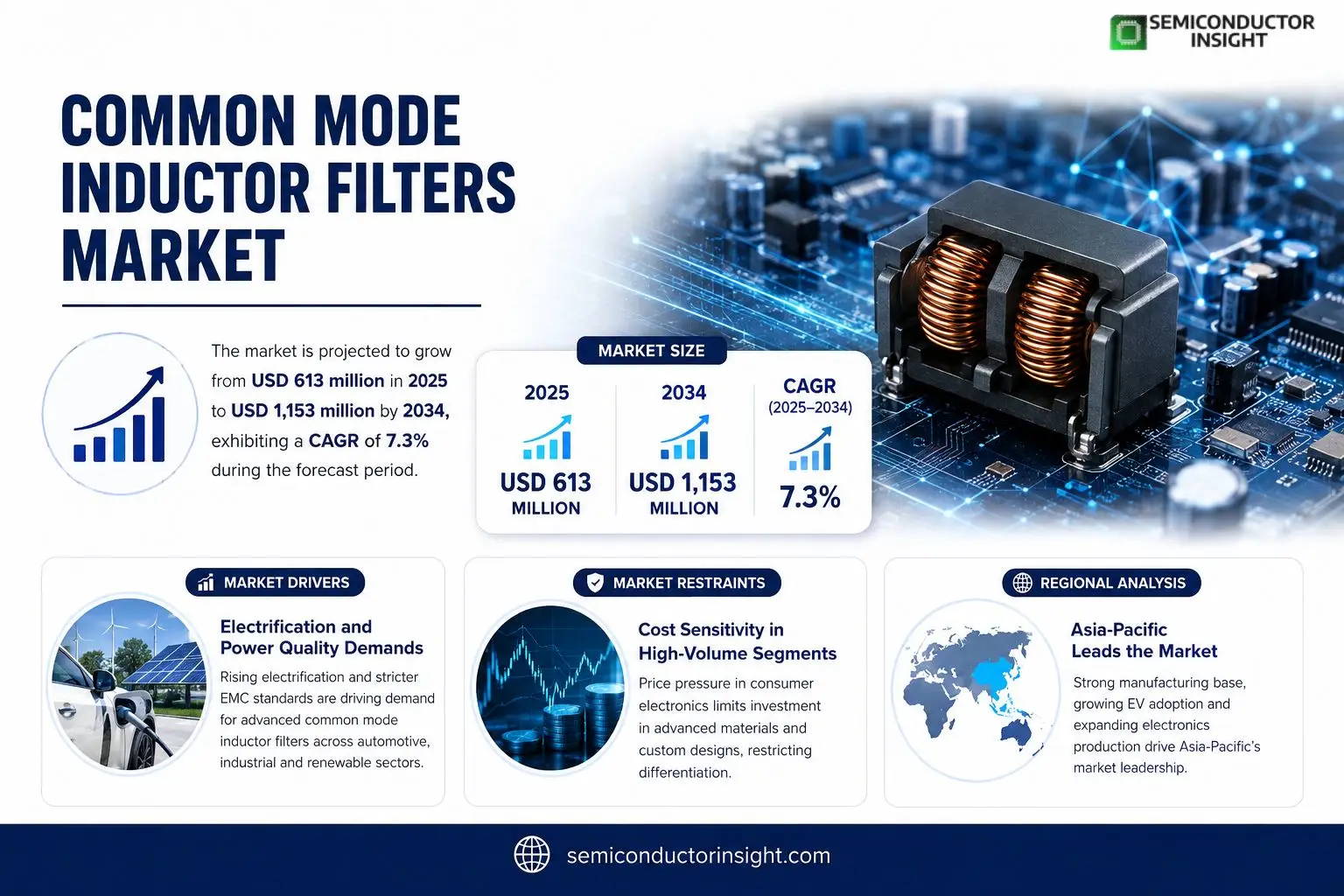
Common Mode Inductor Filters market size was valued at USD 613 million in 2025. The market is projected to grow from USD 613 million in 2025 to USD 1,153 million by 2034, exhibiting a CAGR of 7.3% during the forecast period.
Common mode inductor filters consist of two or more insulated‑wire windings mounted on a single magnetic core, each winding placed in series with a separate conductor so that their magnetic fields combine and present high impedance to unwanted noise signals. These choke coils are widely employed in switching power‑supply equipment to suppress common‑mode electromagnetic interference (EMI) while allowing low‑frequency direct current (DC) to pass unhindered. Constructed from insulated wire wound around efficient magnetic cores, modern designs have become increasingly compact, delivering superior EMI and radio‑frequency interference (RFI) mitigation across consumer electronics such as smartphones, tablets, laptops and IoT devices as well as automotive, industrial automation and renewable‑energy applications.
MARKET DRIVERS
Electrification and Power Quality Demands
The surge in electrified transportation and renewable integration has heightened the need for precise noise suppression. Common Mode Inductor Filters Market participants are observing that tighter electromagnetic compatibility (EMC) standards compel OEMs to embed more sophisticated filtering solutions directly into vehicle powertrains and grid‑connected inverters.
Shift Toward Compact Modular Designs
Design engineers are prioritizing footprint reduction without sacrificing performance. This trend pushes suppliers toward multi‑layer wound architectures that deliver higher inductance in a smaller package, thereby creating a competitive edge for firms that can balance thermal management with magnetic efficiency.
➤ Manufacturers that integrate AI‑assisted design tools are shortening prototype cycles, enabling faster response to emerging compliance timelines.
Finally, the expansion of Industry 4.0 ecosystems introduces real‑time monitoring of filter health. Companies that embed diagnostics into their inductors can offer value‑added services, turning a traditional component into a data‑rich asset for end users.
MARKET CHALLENGES
Stringent Regulatory Landscape
EMC directives vary across regions, demanding that each product batch meet distinct test regimes. This regulatory mosaic forces manufacturers to maintain multiple certification pipelines, inflating engineering overhead and extending time‑to‑market.
Other Challenges
Material Supply Volatility
The reliance on high‑purity ferrite and specialty alloys creates exposure to commodity price swings. Fluctuations in raw‑material costs can compress margins, especially for low‑volume, application‑specific designs.
MARKET RESTRAINTS
Cost Sensitivity in High‑Volume Segments
Commoditization of basic filter forms in consumer electronics pressures suppliers to drive down unit pricing. When cost considerations dominate, investment in advanced magnetic materials or bespoke tooling becomes harder to justify, limiting differentiation opportunities.
MARKET OPPORTUNITIES
Smart Grid and Energy Storage Integration
As utilities deploy distributed energy resources and high‑power converters, the demand for reliable common mode suppression grows. Firms that tailor inductors for the unique harmonic spectra of battery‑management systems stand to capture a niche yet expanding revenue stream.
Common Mode Inductor Filters Market Trends
Rising Demand in Consumer Electronics
The surge in smartphones, tablets, laptops and an expanding portfolio of IoT gadgets has placed tighter constraints on electromagnetic compatibility. Manufacturers are integrating more compact filter designs to meet stricter EMI limits while preserving board real‑estate. Because the noise generated by high‑speed switching regulators grows with power density, customers are opting for common‑mode choke solutions that combine two windings on a single core, delivering high impedance to unwanted signals without adding excessive bulk. This shift is reflected in the latest sales data, which show a noticeable uptick in orders for surface‑mount device (SMD) formats, especially in regions where consumer‑grade devices dominate production. The trend signals a strategic opportunity for component suppliers that can deliver smaller, higher‑performance cores at competitive pricing.
Other Trends
Automotive Adoption of Noise Suppression
Electrified power‑train architectures in modern vehicles introduce new sources of common‑mode noise, particularly from DC‑DC converters and onboard chargers. As safety‑critical systems such as Advanced Driver Assistance rely on clean signal pathways, OEMs are specifying inductive filters that can operate across a wide temperature envelope while maintaining low loss. Recent design cycles reveal a preference for through‑hole constructions in power distribution modules, given their robustness under vibration. This preference aligns with the broader industry push toward higher voltage platforms, where effective EMI mitigation becomes a prerequisite for meeting regulatory emission standards.
Advances in Magnetic Core Materials
Material science breakthroughs have produced ferrite and nanocrystalline cores with markedly reduced core loss and improved saturation characteristics. These developments enable filter manufacturers to shrink overall component dimensions without sacrificing attenuation performance. The downstream effect is a faster design cycle for original equipment manufacturers, who can now meet aggressive miniaturization targets while still complying with electromagnetic compliance (EMC) testing. For players in the Common Mode Inductor Filters Market, investing in next‑generation core technologies translates into differentiated product portfolios and stronger negotiating leverage with high‑volume customers.
COMPETITIVE LANDSCAPE
Key Industry Players
Competitive dynamics shaping the Common Mode Inductor Filters market
The market is anchored by a handful of multinational manufacturers whose scale and breadth of product portfolios give them leverage over pricing and technology road‑maps. Murata Manufacturing leads with a strong focus on automotive‑grade modules, leveraging its deep R&D capabilities to integrate ultra‑low profile designs into electric vehicle power converters. TDK follows closely, differentiating through its proprietary magnetic core formulations that enable higher current handling while maintaining compactness, a trait prized by data‑center power supplies. YAGEO (Chilisin) and TAIYO YUDEN round out the tier‑one segment, each offering a blend of high‑volume production capacity and application‑specific customization that appeals to OEMs in consumer electronics and industrial automation. The concentration of revenue among these firms creates a competitive moat, compelling smaller entrants to pursue niche segments or specialized engineering services to stay viable.Beyond the leading quartet, a diverse set of specialists contributes to the market’s depth. Sunlord Electronics and Cyntec have carved out positions in cost‑sensitive segments, supplying high‑volume through‑hole and SMD components to Asian contract manufacturers. Coilcraft and AVX Corporation emphasize innovation in magnetic material science, delivering choke solutions that address emerging challenges in 5G infrastructure and high‑frequency EMI suppression. European players such as Schaffner and Laird Performance Materials focus on compliance‑driven markets, providing filters that meet stringent EMC standards for medical and aerospace equipment. Meanwhile, niche manufacturers like TABUCHI ELECTRIC and TAMURA CORPORATION sustain regional relevance by tailoring products to local automotive and renewable‑energy projects. This configuration of tier‑two and tier‑three firms generates a fertile environment for collaborative development, joint ventures, and technology licensing, which collectively enrich the competitive fabric of the industry.
List of Key Common Mode Inductor Filters Companies Profiled
- Murata Manufacturing
- YAGEO (Chilisin)
- TDK Corporation
- TAIYO YUDEN
- Sunlord Electronics
- Cyntec
- Coilcraft
- Vishay Intertechnology
- Schaffner Holding AG
- Laird Performance Materials
- TABUCHI ELECTRIC
- AVX Corporation
- Hitachi Metals, Ltd.
- Sumida Corporation
- Eaton Corporation
Segment Analysis:
| Segment Category | Sub-Segments | Key Insights |
| By Type |
|
SMD Type – Preferred for space‑constrained designs, offering easier automation in assembly; – Delivers consistent performance across high‑frequency applications; – Aligns with industry shift toward miniaturized power modules. |
| By Application |
|
Consumer Electronics – Drives demand for compact, low‑profile filters; – Critical for ensuring electromagnetic compatibility in portable devices; – Supports rapid product cycles where noise suppression is a key differentiator. |
| By End User |
|
Automotive Systems – Emphasizes robust EMI protection for electric powertrains; – Integrates with safety‑critical modules where interference can affect functional reliability; – Aligns with growing electrification and advanced driver‑assistance systems. |
| By Technology |
|
Ferrite Core – Offers high permeability and low loss at high frequencies; – Preferred for compact modules where thermal performance is critical; – Supports emerging high‑speed power conversion topologies. |
| By Environmental Impact |
|
Energy‑Efficient Designs – Focus on reducing core losses to enhance overall system efficiency; – Aligns with sustainability goals of OEMs across sectors; – Encourages adoption of advanced magnetic composites that minimize material waste. |
Regional Analysis: Common Mode Inductor Filters Market
North America
The shift toward plug‑in hybrids and fully electric vehicles forces designers to address higher dV/dt currents, prompting a surge in demand for low‑profile common mode inductors that can suppress broadband noise without adding bulk to tight engine‑bay layouts.
Smart factories depend on precise motor drives, and the need to meet increasingly tight EMI limits is driving the selection of high‑Q inductors that can isolate common‑mode currents within modular PLC assemblies.
Certification hurdles in aerospace demand inductors that survive extreme temperature cycles; suppliers that can prove reliability under MIL‑STD testing earn long‑term contracts for avionics and missile guidance systems.
Recent joint ventures between filter manufacturers and semiconductor foundries are shortening lead times, enabling OEMs to integrate newer topologies while keeping inventory buffers modest.
Europe
European markets exhibit a nuanced approach, blending stringent regulatory frameworks with a strong emphasis on sustainability. Automotive manufacturers across Germany and France are prioritizing lightweight, high‑efficiency power‑conversion modules, which elevates the need for compact common mode inductors that can operate across wide temperature ranges. Energy‑grid modernization projects in the Nordic region also foster demand for inductors that can mitigate harmonic distortion in large‑scale renewable‑energy converters. Suppliers that can demonstrate compliance with the EU’s EMC Directive while delivering cost‑effective solutions stand to secure multi‑year contracts with utilities and Tier‑1 automotive partners.
Asia-Pacific
The Asia-Pacific landscape is defined by rapid scale‑up in consumer electronics and a burgeoning electric‑vehicle ecosystem, particularly in China, India, and Southeast Asia. Manufacturers in these jurisdictions are balancing price sensitivity with the need for reliable filtering as device densities climb. The region’s extensive manufacturing base encourages incremental innovation in printed‑circuit‑board (PCB) integrated inductors, allowing local firms to iterate quickly and address market feedback. However, fragmented standards across countries create a testing burden, making it advantageous for players to offer harmonized design kits that simplify certification across multiple markets.
South America
South American adoption of common mode inductors is driven chiefly by the expansion of renewable‑energy installations and the rollout of smart‑grid initiatives in Brazil and Argentina. Utilities are confronting legacy grid architectures that struggle with increased inverter penetration, prompting a search for filters that can tolerate high surge currents while preserving power‑quality metrics. The region’s comparatively modest industrial base means that price competitiveness remains a decisive factor, yet firms that can provide localized engineering support often differentiate themselves in this market.
Middle East & Africa
In the Middle East & Africa, growth is anchored in large‑scale infrastructure projects, notably data‑center clusters and oil‑field automation. Harsh climatic conditions demand inductors with robust thermal performance, and the emphasis on energy‑efficiency standards in GCC nations pushes manufacturers toward solutions that minimize loss while maintaining suppression capabilities. African markets, still in early adoption phases, show promise as telecommunications rollouts create new venues for filtering components in base‑station equipment. Players that tailor product portfolios to both high‑temperature resilience and cost‑effective mass production are better positioned to capture emerging demand.
Report Scope
This market research report provides a comprehensive analysis of the Common Mode Inductor Filters Market , covering the forecast period 2026–2034. It offers detailed insights into market dynamics, technological advancements, competitive landscape, and key trends shaping the industry.
Key focus areas of the report include:
- Market Overview: The report begins with an overview outlining its current market scenario, key growth indicators, and industry transformation drivers. It discusses macroeconomic factors, demand–supply balance, regulatory landscape, and the strategic role of semiconductors in powering advancements across industries such as automotive, telecommunications, consumer electronics, and industrial automation.
- Market Size & Forecast: Historical data and future projections for revenue, unit shipments, and market value across major regions and segments.
- Segmentation Analysis: Detailed breakdown by product type, technology, application, and end-user industry to identify high-growth segments and investment opportunities.
- Regional Insights: Insights into market performance across North America, Europe, Asia-Pacific, Latin America, and the Middle East & Africa, including country-level analysis where relevant.
- Competitive Landscape: Profiles of leading market participants, including their product offerings, R&D focus, manufacturing capacity, pricing strategies, and recent developments such as mergers, acquisitions, and partnerships.
- Technology Trends & Innovation: Assessment of emerging technologies, integration of AI/IoT, semiconductor design trends, fabrication techniques, and evolving industry standards.
- Market Drivers & Restraints: Evaluation of factors driving market growth along with challenges, supply chain constraints, regulatory issues, and market-entry barriers.
- Stakeholder Insights: Insights for component suppliers, OEMs, system integrators, investors, and policymakers regarding the evolving ecosystem and strategic opportunities.
Primary and secondary research methods are employed, including interviews with industry experts, data from verified sources, and real-time market intelligence to ensure the accuracy and reliability of the insights presented.
FREQUENTLY ASKED QUESTIONS:
What is the current market size of Common Mode Inductor Filters Market?
-> Common Mode Inductor Filters Market was valued at USD 571 million in 2024 and is expected to reach USD 928 million by 2031, at a CAGR of 7.4% during the forecast period.
Which key companies operate in Common Mode Inductor Filters Market?
-> Key players include Murata, YAGEO (Chilisin), TDK, TAIYO YUDEN, Cyntec, Sunlord Electronics, Vishay, TAI-TECH Advanced Electronic, Sumida, Eaton, Schaffner, Laird Performance Materials, TABUCHI ELECTRIC, TAMURA CORPORATION, Hitachi Metals, Coilcraft, Nippon Chemi-Con Corporation, Bourns, AVX Corporation.
What are the key growth drivers?
-> Key growth drivers include rising demand for noise reduction in automotive, transportation and consumer electronics, increasing adoption of common mode choke coils in industrial automation, growing emphasis on clean energy solutions such as solar and wind, and continuous technological advancements that improve efficiency and compactness of magnetic cores.
Which region dominates the market?
-> Asia-Pacific is the dominant and fastest‑growing region, driven by strong demand in China, Japan, South Korea and emerging markets across Southeast Asia.
What are the emerging trends?
-> Emerging trends include development of more compact and efficient magnetic cores, integration of common mode choke technology with AI/IoT enabled devices, and continual improvements in EMI/RFI suppression performance to meet stricter regulatory standards.
Get Sample Report PDF for Exclusive Insights
Report Sample Includes
- Table of Contents
- List of Tables & Figures
- Charts, Research Methodology, and more...
 Download Sample Report PDF