Semiconductor Disk Lasers Market Insights
Semiconductor Disk Lasers market size was valued at USD 120 million in 2024. The market is forecasted to increase from USD 130 million in 2026 to USD 210 million by 2034, exhibiting a CAGR of 9.0% during the forecast period.
Semiconductor Disk Lasers combine the most important advantages of semiconductor and thin‑disk lasers. They operate primarily as near‑infrared sources for laser cooling and spectroscopy, while emerging applications include telecommunications and precision manufacturing.
The market is expanding because industrial processing increasingly relies on compact high‑power lasers for metal cutting and additive manufacturing. Recent product launches by II‑VI and Lumentum illustrate this trend; II‑VI introduced a high‑efficiency disk laser platform aimed at metal‑processing customers in March 2024, and Lumentum released a wavelength‑tunable model for medical imaging later that year. Such developments, together with growing adoption of IoT‑enabled sensing equipment that depends on stable infrared sources, are likely to sustain the upward trajectory.
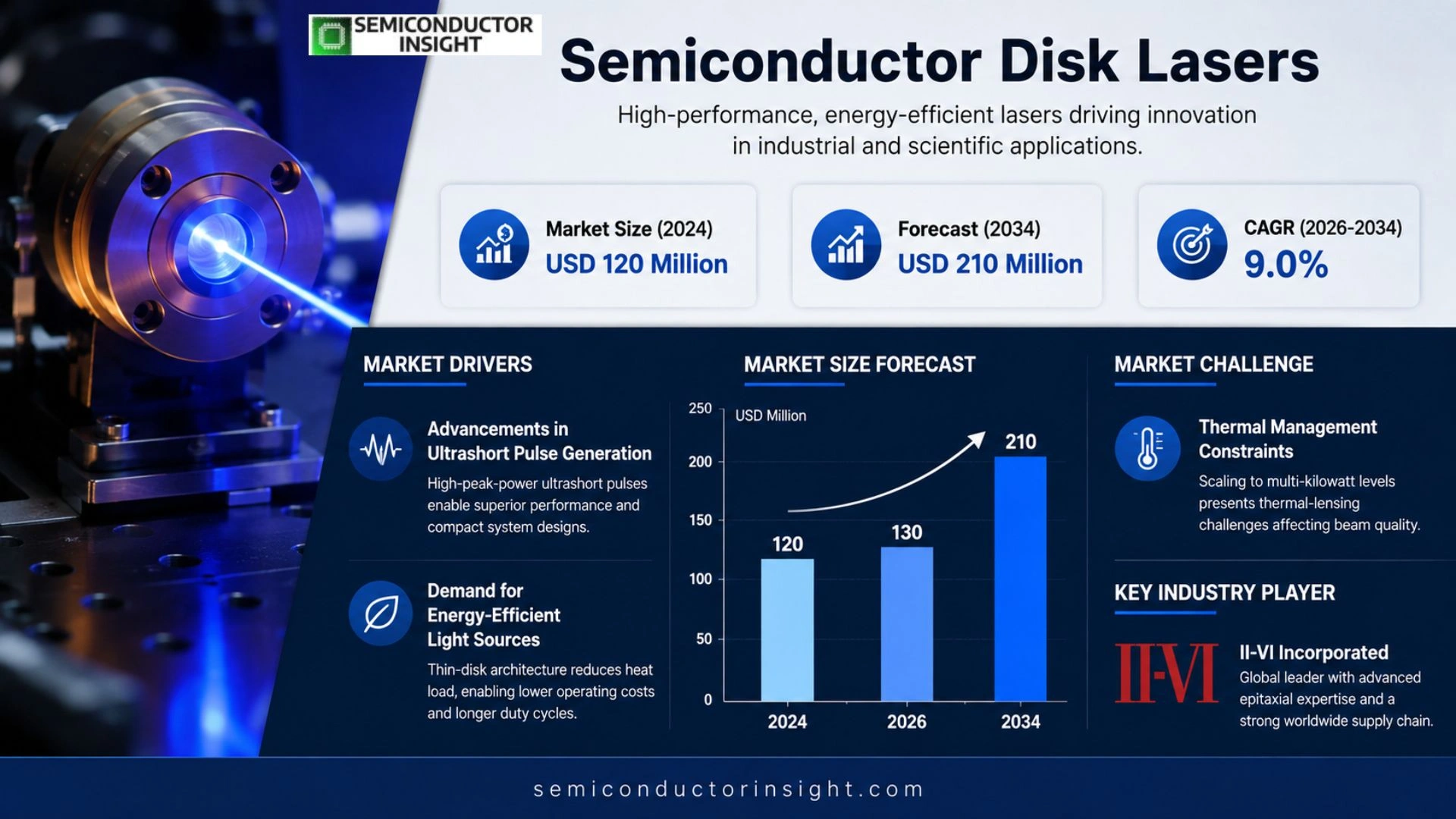
MARKET DRIVERS
Advancements in Ultrashort Pulse Generation
The emergence of high‑peak‑power ultrashort pulses has reshaped system designs across material processing and biomedical imaging. Semiconductor Disk Lasers Market players that integrate thin‑disk architecture are capturing the advantage of superior beam quality while maintaining compact footprints, a combination that appeals to manufacturers seeking both performance and space efficiency.
Demand for Energy‑Efficient Light Sources
Corporate sustainability agendas are translating into procurement specifications that privilege low‑wattage, high‑output lasers. The thin‑disk configuration inherently reduces heat load, enabling longer duty cycles without costly cooling infrastructure. This operational economy is prompting OEMs to favor semiconductor‑disk solutions over bulkier alternatives.
➤ “The thin‑disk approach offers a pathway to 30% lower total cost of ownership compared with traditional solid‑state lasers, a compelling figure for cost‑sensitive end‑users.”
Beyond cost, the ability of semiconductor‑disk emitters to operate across a broad wavelength range is spurring adoption in spectroscopy and quantum‑technology research. Companies that can demonstrate wavelength agility are positioning themselves to serve niche but fast‑growing scientific segments.
MARKET CHALLENGES
Thermal Management Constraints in High‑Power Applications
While thin‑disk designs mitigate heat, scaling to multi‑kilowatt regimes still confronts engineers with thermal‑lensing effects that degrade beam uniformity. Manufacturers lacking advanced heat‑sink engineering face longer development cycles and higher failure rates.
Other Challenges
Supply‑Chain Volatility
Fluctuations in semiconductor wafer availability and specialty optics components have introduced lead‑time uncertainties. Firms that cannot secure stable inputs risk missing key product launch windows, especially in sectors with rapid adoption cycles.
Regulatory scrutiny over laser safety classifications adds another layer of complexity. Certification processes differ across regions, compelling suppliers to maintain multiple compliance pathways, which inflates engineering overhead.
MARKET RESTRAINTS
High Initial Capital Outlay
Deploying semiconductor‑disk laser platforms requires precision‑machined mounts and customized driver electronics. The upfront investment often exceeds that of conventional diode arrays, discouraging smaller firms from transitioning despite long‑term efficiency gains.
Legacy infrastructure entrenched in older laser technologies further dampens migration. Facilities that have capitalized heavily in bulk‑solid-state equipment encounter sunk‑cost considerations that delay retrofit decisions.
Finally, the niche expertise needed to design and maintain thin‑disk systems narrows the talent pool. Companies struggling to attract qualified thermal‑optics engineers may experience prolonged time‑to‑market, curbing overall market momentum.
MARKET OPPORTUNITIES
Integration with Photonic Integrated Circuits
Embedding semiconductor‑disk emitters directly onto photonic chips promises a leap in system miniaturization. Early pilots in defense lidar and portable spectroscopy indicate that such integration could unlock new revenue streams for vendors that master wafer‑level bonding techniques.
Parallel to integration, the rise of AI‑driven manufacturing quality control creates demand for lasers that deliver repeatable pulse parameters. Thin‑disk lasers, with their stable output, are well‑suited to serve AI‑enhanced inspection lines, opening cross‑industry partnership possibilities.
Geographically, emerging high‑tech clusters in Southeast Asia are allocating funds to next‑generation laser research. Companies that establish local R&D footholds stand to benefit from government incentives and faster market feedback loops.
Semiconductor Disk Lasers Market Trends
Integration of Thin‑Disk Architecture in Near‑Infrared Systems
The convergence of semiconductor gain media with thin‑disk geometry is reshaping performance baselines for near‑infrared emitters. By spreading the active region over a larger area while maintaining a compact footprint, manufacturers achieve higher output powers without sacrificing beam quality. This technical advantage translates into more efficient laser‑cooling modules and tighter spectral resolution for spectroscopic instruments. Customers in research laboratories and advanced manufacturing are upgrading legacy sources, creating a measurable uptick in procurement cycles. The shift also pressures vendors to refine thermal management strategies, prompting investments in high‑conductivity substrates and precision bonding techniques. Consequently, firms that master the thin‑disk production workflow can differentiate themselves through lower failure rates and longer service intervals.
Other Trends
Expanding Footprint in Telecommunications
Telecom operators are experimenting with semiconductor disk lasers for wavelength‑division multiplexing in high‑capacity fiber networks. The devices’ narrow linewidth and rapid tunability make them suitable for channel‑locking in dense‑wave division multiplexing (DWDM) environments, especially as 5G back‑haul demands grow. Early field trials indicate lower power consumption relative to traditional fiber lasers, a factor that aligns with operators’ sustainability targets. As network architects incorporate these sources into coherent‑optics modules, the market sees a modest but steady influx of orders, nudging suppliers to certify their products against telecom reliability standards.
Shift Toward Modular Manufacturing and Supply‑Chain Consolidation
Recent years have witnessed a regrouping of the semiconductor disk laser ecosystem around a handful of tier‑one manufacturers. Companies such as II‑VI, Lumentum, and Thorlabs are pursuing modular assembly lines that separate the thin‑disk wafer processing from the final packaging stage. This separation reduces lead times and allows downstream integrators to customize driver electronics without retooling the core laser component. The ripple effect includes tighter component pricing, accelerated introduction of new wavelength variants, and a clearer roadmap for end‑users planning multi‑year equipment upgrades. For customers, the modular approach diminishes inventory risk, while for producers it creates a scalable platform that can absorb fluctuations in demand across medical, industrial, and research segments.
COMPETITIVE LANDSCAPE
Key Industry Players
Semiconductor Disk Lasers: Competitive Pressures and Emerging Opportunities
II‑VI Incorporated dominates the semiconductor disk laser arena, leveraging its deep portfolio of epitaxial growth expertise and a robust supply chain that spans Europe, North America, and Asia‑Pacific. The company’s ability to integrate thin‑disk architecture with high‑power semiconductor gain chips has secured it a leading share among OEMs targeting high‑precision material processing and scientific spectroscopy. Lumentum and Furukawa Electric follow closely, each capitalising on distinct verticals,Lumentum in telecom‑grade near‑infrared sources, Furukawa in high‑reliability modules for industrial cooling. Consolidation activity, such as strategic joint ventures and selective acquisitions, has reinforced market concentration, while still leaving space for specialist firms that address niche wavelength bands or bespoke form‑factors.
Beyond the top tier, a cohort of agile innovators sustains competitive tension. Polytec GmbH supplies custom‑engineered disk assemblies for laboratory instrumentation, whereas 3SP Technologies focuses on compact, turnkey solutions for medical imaging. DoGain Laser Technology and Lumics are expanding their footprint in European research consortia, promoting hybrid diode‑disk platforms that promise higher wall‑plug efficiency. Oxxius, Thorlabs, InnoLas, Vexlum, NLight, and Photonics International round out the ecosystem, each carving out relevance through either wavelength‑specific products (e.g., 976 nm or 1480 nm lines) or value‑added services such as on‑site integration and performance guarantees. Their collective presence mitigates monopoly risk and fuels continual incremental innovation across the sector.
List of Key Semiconductor Disk Lasers Companies Profiled
- II‑VI Incorporated
- Lumentum Holdings Inc.
- Furukawa Electric Co., Ltd.
- Polytec GmbH
- 3SP Technologies
- DoGain Laser Technology
- Lumics
- Oxxius
- Thorlabs, Inc.
- InnoLas
- Vexlum
- NLight, Inc.
Segment Analysis:
| Segment Category | Sub-Segments | Key Insights |
| By Type |
|
976 nm enjoys strong preference among researchers due to its reliable performance and mature manufacturing base.
|
| By Application |
|
Medical application is gaining momentum as clinicians explore non‑invasive diagnostic tools.
|
| By End User |
|
Research Laboratories remain the primary driver for innovation and early adoption.
|
| By Technology |
|
Thin‑Disk Architecture continues to dominate due to its proven thermal management.
|
| By Market Trend |
|
High‑Power Scaling is a strategic focus for manufacturers seeking new application frontiers.
|
Regional Analysis: Semiconductor Disk Lasers Market
European fabs combine high‑precision optics with automated wafer handling, delivering consistent beam quality. The region’s expertise in cleanroom processes and thin‑film deposition translates into tighter control over gain medium uniformity, a decisive advantage for customers demanding reproducible performance.
Medical diagnostics, aerospace component testing, and semiconductor inspection dominate demand. Each sector values the compact footprint and high peak power of disk lasers, which enable portable diagnostic devices and in‑situ quality checks on production lines.
Harmonized EU directives on laser safety and electromagnetic compatibility streamline certification. Companies can leverage a single compliance pathway to access multiple national markets, reducing time and cost associated with product approvals.
Venture capital and public research grants increasingly target photonics start‑ups that integrate disk‑laser modules into emerging quantum sensing platforms, signaling confidence in future revenue streams beyond traditional applications.
North America
North America’s strength lies in its deep pool of defense contractors and semiconductor manufacturers that value the high pulse energy of disk lasers for micro‑machining. Collaborative programs between defense laboratories and private firms accelerate the adaptation of laser systems for rugged field use, while a vibrant venture ecosystem funds niche players exploring ultrafast pulse generation for next‑generation lidar. The region’s focus on integrated photonic circuits creates opportunities for hybrid platforms that combine disk lasers with silicon photonics, fostering a new class of compact, high‑performance devices.
Asia‑Pacific
The Asia‑Pacific arena benefits from large‑scale electronics assembly hubs and a growing emphasis on precision manufacturing. Countries such as Japan and South Korea have cultivated advanced material research that feeds directly into gain‑medium improvements, while emerging economies invest in skill‑development programs to support local laser‑tooling firms. Market participants find a receptive audience in automotive and consumer‑electronics sectors where high‑speed material removal aligns with cost‑efficiency goals.
South America
In South America, adoption is driven by expanding scientific research infrastructure and a nascent interest in high‑resolution spectroscopy for environmental monitoring. Regional universities partner with equipment distributors to pilot disk‑laser based analyzers, creating proof‑points that encourage broader governmental procurement. Although the overall volume remains modest, the emphasis on localized training helps build a foundation for future commercial uptake.
Middle East & Africa
Middle East & Africa exhibits a measured uptake, largely influenced by oil‑field inspection and aerospace maintenance needs. Strategic initiatives aimed at diversifying energy portfolios have opened doors for advanced laser‑based non‑destructive testing, while emerging aerospace hubs seek reliable sources for component verification. Partnerships with European technology providers facilitate knowledge transfer, positioning the region to gradually expand its footprint in Semiconductor Disk Lasers Market.
Report Scope
This market research report provides a comprehensive analysis of the Semiconductor Disk Lasers Market , covering the forecast period 2026–2034. It offers detailed insights into market dynamics, technological advancements, competitive landscape, and key trends shaping the industry.
Key focus areas of the report include:
- Market Overview: The report begins with an overview outlining its current market scenario, key growth indicators, and industry transformation drivers. It discusses macroeconomic factors, demand–supply balance, regulatory landscape, and the strategic role of semiconductors in powering advancements across industries such as automotive, telecommunications, consumer electronics, and industrial automation.
- Market Size & Forecast: Historical data and future projections for revenue, unit shipments, and market value across major regions and segments.
- Segmentation Analysis: Detailed breakdown by product type, technology, application, and end-user industry to identify high-growth segments and investment opportunities.
- Regional Insights: Insights into market performance across North America, Europe, Asia-Pacific, Latin America, and the Middle East & Africa, including country-level analysis where relevant.
- Competitive Landscape: Profiles of leading market participants, including their product offerings, R&D focus, manufacturing capacity, pricing strategies, and recent developments such as mergers, acquisitions, and partnerships.
- Technology Trends & Innovation: Assessment of emerging technologies, integration of AI/IoT, semiconductor design trends, fabrication techniques, and evolving industry standards.
- Market Drivers & Restraints: Evaluation of factors driving market growth along with challenges, supply chain constraints, regulatory issues, and market-entry barriers.
- Stakeholder Insights: Insights for component suppliers, OEMs, system integrators, investors, and policymakers regarding the evolving ecosystem and strategic opportunities.
Primary and secondary research methods are employed, including interviews with industry experts, data from verified sources, and real-time market intelligence to ensure the accuracy and reliability of the insights presented.
FREQUENTLY ASKED QUESTIONS:
What is the current market size of Semiconductor Disk Lasers Market?
-> Semiconductor Disk Lasers market is forecasted to increase from USD 130 million in 2026 to USD 210 million by 2034, exhibiting a CAGR of 9.0%
Which key companies operate in Semiconductor Disk Lasers Market?
-> Key players include II-VI, Furukawa Electric, Polytec GmbH, Lumentum, 3SP Technologies, DoGain Laser Technology, Lumics, Oxxius, Thorlabs, InnoLas, and Vexlum.
What are the key growth drivers?
-> Key growth drivers include increasing demand for near‑infrared devices in laser cooling and spectroscopy, expanding telecommunications applications, and the rise of IoT‑enabled electronic systems that require high‑performance laser sources.
Which region dominates the market?
-> Asia exhibits the strongest growth potential, driven by major manufacturing hubs in China, Japan, and South Korea, while Europe and North America remain important but comparatively slower markets.
What are the emerging trends?
-> Emerging trends include development of new wavelength categories (e.g., 976 nm, 980 nm, 1480 nm), integration of semiconductor disk lasers with AI‑enabled control systems, and exploration of advanced telecommunications and medical imaging applications.

Get Sample Report PDF for Exclusive Insights
Report Sample Includes
- Table of Contents
- List of Tables & Figures
- Charts, Research Methodology, and more...
 Download Sample Report PDF