PCB Evaluation Boards Market Insights
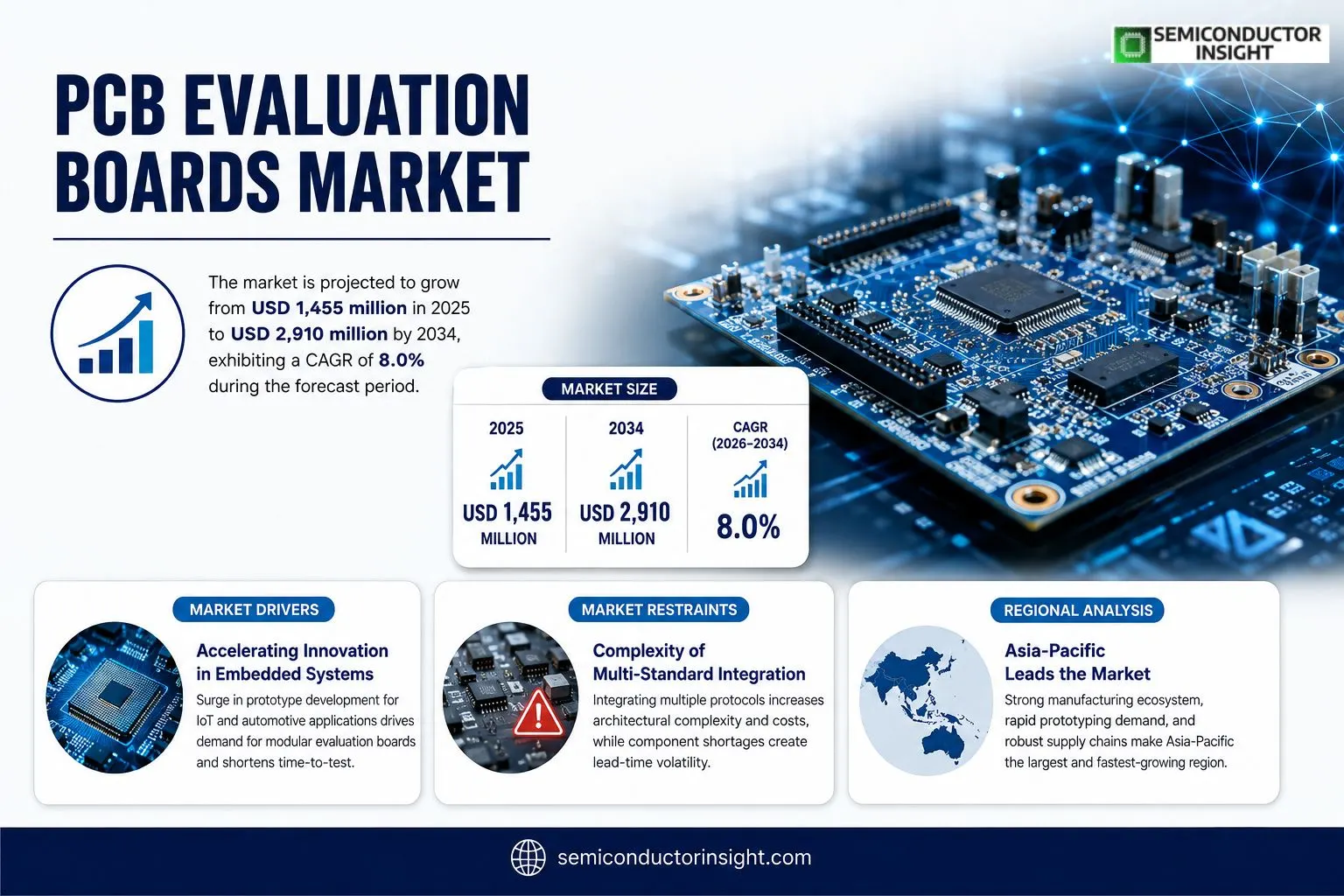
PCB Evaluation Boards market size was valued at USD 1,455 million in 2025. The market is expected to increase from USD 1,455 million in 2025 to USD 2,910 million by 2034, reflecting a compound annual growth rate of roughly 8 % over the period.
A PCB evaluation board is a printed circuit board that incorporates a microprocessor together with minimal supporting logic, enabling engineers to test and measure components such as sensors, transceivers, memory interfaces and displays. Growing demand for smartphones, IoT devices and automotive electronics creates opportunities for vendors of evaluation boards.
MARKET DRIVERS
Accelerating Innovation in Embedded Systems
PCB Evaluation Boards Market is being propelled by a surge in prototype development cycles for IoT and automotive applications. Engineers seek ready‑made platforms that shorten time‑to‑test, allowing design teams to validate functionality without bespoke board fabrication. This urgency translates into higher demand for modular evaluation kits that can be reconfigured across multiple projects.
Growing Adoption of Advanced Connectivity Standards
5G, Wi‑Fi 6E and Bluetooth 5.2 have become baseline requirements for next‑generation devices. Evaluation boards that embed these radios enable manufacturers to certify compliance early in the development stage. The ripple effect is a broader customer base that ranges from startups to established OEMs, each looking for a cost‑effective verification path.
➤ “Design engineers now allocate up to 30 % of project budgets to rapid‑prototype hardware, making evaluation boards a critical line item.”
Beyond connectivity, the rise of AI‑accelerated edge computing drives demand for boards that host powerful processors and high‑speed memory modules. Companies that can integrate these components on a single evaluation platform are positioned to capture a sizable share of PCB Evaluation Boards Market as customers prioritize performance‑first prototypes.
MARKET CHALLENGES
Complexity of Multi‑Standard Integration
Designing evaluation boards that simultaneously support legacy interfaces and emerging protocols introduces architectural complexity. Suppliers must balance component density with signal integrity, a task that inflates engineering effort and production costs.
Other Challenges
Component Shortages
Supply constraints for high‑frequency chips and power management ICs have created lead‑time volatility. When critical parts are back‑ordered, manufacturers struggle to meet the rapid turnover expectations of their clientele.Furthermore, the proliferation of open‑source hardware ecosystems sometimes undermines commercial evaluation board pricing, as developers gravitate toward freely available designs that lack the support services premium offerings provide.
MARKET RESTRAINTS
Regulatory Hurdles Across Regions
Certification requirements for electromagnetic compatibility (EMC) and safety vary widely between North America, Europe and Asia‑Pacific. Vendors must invest in region‑specific testing labs or third‑party services, which adds overhead and can delay time‑to‑market for new evaluation kits.
MARKET OPPORTUNITIES
Customizable, Software‑Defined Platforms
The convergence of hardware flexibility and cloud‑based development tools opens a niche for evaluation boards that can be reprogrammed via software updates. Companies that embed secure OTA (over‑the‑air) capabilities will enable customers to extend the lifespan of a single board across several product generations, thereby deepening brand loyalty.Another promising avenue lies in sustainable design. Boards fabricated with lead‑free solder and recyclable substrates appeal to environmentally conscious firms, especially those operating under strict ESG mandates. Offering certifications for green manufacturing could differentiate suppliers in a crowded market.Finally, strategic partnerships with semiconductor manufacturers to co‑develop reference designs can accelerate time‑to‑launch for new chips. By providing evaluation boards that showcase a processor’s full feature set, vendors position themselves as the preferred entry point for designers adopting the latest silicon.
PCB Evaluation Boards Market Trends
AI‑Enabled Sensor Evaluation Gains Momentum
The worldwide PCB Evaluation Boards Market recorded revenue of approximately $1,347 million in 2024 and is forecast to climb to about $2,282 million by 2031. This upward path reflects the escalating demand for boards that can validate complex sensor arrays used in autonomous systems and industrial IoT gateways. Customers are seeking evaluation platforms that embed micro‑processors alongside high‑speed transceivers, enabling rapid verification of edge‑AI algorithms before full‑scale production. The shift away from legacy test rigs toward programmable evaluation boards shortens development cycles, lowers prototype costs, and improves time‑to‑market for new devices. Suppliers that embed flexible firmware and provide modular I/O options are better positioned to capture design‑win opportunities, especially as OEMs prioritize silicon‑level validation to mitigate costly redesigns later in the product lifecycle.
Other Trends
Miniaturization Pressure Fuels New Form Factors
As smartphones, wearables, and compact medical instruments proliferate, PCB Evaluation Boards Market experiences increasing pressure to shrink board dimensions while retaining robust testing capabilities. Engineers are adopting multi‑layer substrates and fine‑pitch connectors to accommodate tighter form‑factors, which in turn raises the bar for signal integrity and thermal management on evaluation platforms. Companies that invest in advanced laminate technologies and offer built‑in power‑management modules are gaining acceptance among designers who cannot afford performance compromises. The trend also opens avenues for niche suppliers specializing in high‑frequency IGBT and MOSFET evaluation modules, as power‑dense applications demand precise measurement and protection features within a reduced footprint.
Regional Shift Toward Asian Manufacturing Hubs
Geographic analysis shows that Asian nations, particularly mainland China and Taiwan, dominate production capacity for PCB Evaluation Boards Market. Local manufacturers benefit from vertically integrated supply chains, which translate into shorter lead times and competitive pricing for customers. Meanwhile, North American and European players are increasingly outsourcing board fabrication to Asian fabs while focusing on system integration and software support. This reallocation of manufacturing resources intensifies competition on cost but also encourages innovation in value‑added services such as customized firmware stacks and rapid prototyping kits. Clients that align their sourcing strategies with these regional strengths can achieve a more resilient supply chain and better respond to the accelerating pace of electronic device development.
COMPETITIVE LANDSCAPE
Key Industry Players
PCB Evaluation Boards Competitive Overview 2026-2034
Texas Instruments dominates the PCB Evaluation Boards segment, leveraging its extensive analog‑mixed‑signal portfolio and deep ties with original equipment manufacturers. Its broad catalogue of evaluation kits for IGBT, MOSFET and sensor interfaces allows rapid system prototyping, which translates into a decisive market share advantage. The company’s ability to bundle software support, reference designs and development tooling creates a high‑entry barrier for emerging rivals, cementing a tier‑one position that influences pricing dynamics across the value chain. NXP Semiconductors and STMicroelectronics follow closely, each carving out specialist nichesNXP in high‑frequency transceiver boards for 5G/IoT, STMicroelectronics in automotive power‑module evaluationsthereby sustaining a fragmented yet competitive top tier.Beyond the flagship tier, a series of niche innovators shape the mid‑market. Analog Devices and Infineon Technologies excel in precision measurement and power‑device kits, appealing to medical‑equipment designers and industrial automation firms. Renesas Electronics, Maxim Integrated and ON Semiconductor address the growing demand for low‑power consumer‑electronics boards, while Broadcom and Fujitsu focus on high‑density data‑center and networking evaluation platforms. Smaller yet influential players such as Cypress Semiconductor, Microchip Technology, and the legacy Freescale (now part of NXP) continue to supply customized solutions for embedded‑system developers, ensuring a diversified competitive environment that rewards both scale and specialization.
List of Key PCB Evaluation Boards Companies Profiled
- Texas Instruments
- NXP Semiconductors
- STMicroelectronics
- Analog Devices
- Infineon Technologies
- Renesas Electronics
- Maxim Integrated
- ON Semiconductor
- Broadcom Inc.
- Fujitsu Ltd.
- Cypress Semiconductor
- Microchip Technology
- Freescale (NXP)
Segment Analysis:
| Segment Category | Sub-Segments | Key Insights |
| By Type |
|
IGBT Evaluation Boards are favored for their robustness in power‑intensive domains and their ability to support emerging electric propulsion concepts.
|
| By Application |
|
Automotive Systems drive demand for evaluation boards that can tolerate harsh environments and support rapid iteration of power‑train technologies.
|
| By End User |
|
Device Manufacturers rely on evaluation boards to accelerate component verification and to ensure compatibility across diverse product families.
|
| By Integration Level |
|
Standalone Boards remain the preferred choice for engineers seeking a ready‑to‑use solution that minimizes integration effort.
|
| By Performance Requirement |
|
High‑Speed Evaluation is critical for designers targeting data‑intensive applications and next‑generation communication interfaces.
|
Regional Analysis: PCB Evaluation Boards Market
Asia‑Pacific
Companies are experimenting with modular evaluation boards that integrate mixed‑signal testing capabilities, allowing engineers to validate analog and digital paths in a single setup. This approach shortens the proof‑of‑concept phase and aligns with the region’s focus on compact, high‑performance electronics.
The proximity of semiconductor fabs and passive component factories enables a more responsive procurement model. Firms can replenish critical evaluation board materials within days, reducing the risk of bottlenecks that typically affect longer supply chains.
Universities across the region are embedding hands‑on PCB testing labs into engineering curricula, producing graduates who enter the workforce with immediate familiarity with evaluation board workflows and standards.
Regional standards bodies are harmonizing testing requirements, which encourages multinational vendors to adopt a unified platform strategy rather than maintaining divergent product lines for each market.
North America
In North America, PCB Evaluation Boards Market is anchored by a mature ecosystem of design‑for‑test services. Enterprises often prioritize robust validation to mitigate costly design re‑work, especially in sectors such as aerospace and medical devices where failure is not an option. The presence of leading test equipment manufacturers fuels a culture of high‑precision measurement, prompting customers to adopt evaluation platforms that support extensive signal integrity analysis. While the market does not exhibit the same speed of product turnover as Asia‑Pacific, its emphasis on reliability and compliance drives a steady demand for sophisticated board solutions.
Europe
European players approach PCB Evaluation Boards Market with a clear focus on sustainability and regulatory alignment. The region’s stringent environmental directives encourage the use of reusable evaluation boards, reducing waste across product development cycles. Additionally, the growing adoption of Industry 4.0 principles in manufacturing hubs across Germany and France creates a demand for boards that can integrate seamlessly with digital twins and simulation tools. This convergence of eco‑conscious design and advanced digital workflows shapes a distinct market dynamic that balances performance with long‑term compliance.
South America
South America’s market narrative is characterized by a gradual shift from legacy testing practices toward more contemporary evaluation board offerings. Local manufacturers are increasingly sourcing components from regional distributors, which shortens the procurement loop and supports faster iteration on prototype designs. The automotive sector, expanding in Brazil and Argentina, leverages these boards to validate emerging electric‑vehicle control modules, creating a niche where cost‑efficiency and functional verification intersect.
Middle East & Africa
The Middle East & Africa region showcases a growing interest in developing indigenous design capabilities, spurred by government initiatives aimed at diversifying economies away from commodity reliance. Emerging technology parks in the United Arab Emirates and South Africa encourage startups to adopt PCB Evaluation Boards as a cost‑effective means of testing novel IoT and renewable‑energy devices. Although the market scale remains modest, the strategic emphasis on knowledge transfer and local expertise signals a long‑term trajectory toward increased adoption.
Report Scope
This market research report provides a comprehensive analysis of the PCB Evaluation Boards Market , covering the forecast period 2026–2034. It offers detailed insights into market dynamics, technological advancements, competitive landscape, and key trends shaping the industry.
Key focus areas of the report include:
- Market Overview: The report begins with an overview outlining its current market scenario, key growth indicators, and industry transformation drivers. It discusses macroeconomic factors, demand–supply balance, regulatory landscape, and the strategic role of semiconductors in powering advancements across industries such as automotive, telecommunications, consumer electronics, and industrial automation.
- Market Size & Forecast: Historical data and future projections for revenue, unit shipments, and market value across major regions and segments.
- Segmentation Analysis: Detailed breakdown by product type, technology, application, and end-user industry to identify high-growth segments and investment opportunities.
- Regional Insights: Insights into market performance across North America, Europe, Asia-Pacific, Latin America, and the Middle East & Africa, including country-level analysis where relevant.
- Competitive Landscape: Profiles of leading market participants, including their product offerings, R&D focus, manufacturing capacity, pricing strategies, and recent developments such as mergers, acquisitions, and partnerships.
- Technology Trends & Innovation: Assessment of emerging technologies, integration of AI/IoT, semiconductor design trends, fabrication techniques, and evolving industry standards.
- Market Drivers & Restraints: Evaluation of factors driving market growth along with challenges, supply chain constraints, regulatory issues, and market-entry barriers.
- Stakeholder Insights: Insights for component suppliers, OEMs, system integrators, investors, and policymakers regarding the evolving ecosystem and strategic opportunities.
Primary and secondary research methods are employed, including interviews with industry experts, data from verified sources, and real-time market intelligence to ensure the accuracy and reliability of the insights presented.
FREQUENTLY ASKED QUESTIONS:
What is the current market size of PCB Evaluation Boards Market?
-> PCB Evaluation Boards Market was valued at USD 1,347 million in 2024 and is expected to reach USD 2,282 million by 2031, representing a CAGR of 8.0% during the forecast period.
Which key companies operate in PCB Evaluation Boards Market?
-> Key players include Texas Instruments, NXP Semiconductors, STMicroelectronics, Analog Devices, Infineon Technologies, Renesas Electronics Corporation, Maxim Integrated, ON Semiconductor, Broadcom, Fujitsu, Cypress Semiconductor, Microchip, and Freescale, among others.
What are the key growth drivers?
-> Key growth drivers include the rising demand for smartphones and miniaturized electronic devices, rapid adoption of IoT and wearable technology, expansion of AI, 5G, and new‑energy vehicle applications, and increasing need for IGBT and MOSFET evaluation boards in consumer electronics, industrial and automotive sectors.
Which region dominates the market?
-> Asia leads the market, with China holding the largest share of PCB production and evaluation board demand, followed by strong contributions from Japan, South Korea, and other Asian economies.
What are the emerging trends?
-> Emerging trends include growth of IGBT evaluation boards for high‑power applications, integration of AI‑enabled testing capabilities, and the expansion of evaluation solutions for 5G and autonomous vehicle technologies.
Get Sample Report PDF for Exclusive Insights
Report Sample Includes
- Table of Contents
- List of Tables & Figures
- Charts, Research Methodology, and more...
 Download Sample Report PDF