Key Statistics
Key Takeaways
- IGBT modules are the largest type because traction inverters, renewable-energy converters and medium- to high-power industrial drives require electrically and thermally integrated switches that can be mounted directly into power stages rather than assembled from individual discretes.
- Electric & Hybrid Vehicles is the largest and fastest-growing application, supported by more than 20 million global electric-car sales in 2025 and sustained power-semiconductor content in traction inverters, onboard charging, thermal systems and auxiliary high-voltage functions.
- Asia Pacific leads the market through China’s electric-vehicle manufacturing scale, Japan’s long-established power-semiconductor suppliers, and rapid renewable-energy deployment across China and India; it is also the region with the deepest module packaging and inverter manufacturing ecosystem.
- Silicon carbide is the most important substitution risk at the high-efficiency frontier, especially in premium EV and high-frequency power-conversion systems, but IGBT remains economically strong in cost-sensitive high-voltage applications where switching frequency and efficiency requirements do not justify the wide-bandgap premium.
- Manufacturing investment is shifting toward newer generations and larger power-semiconductor fabs. Infineon’s 2026 Dresden Smart Power Fab and Mitsubishi and Fuji Electric eighth-generation product roadmaps show suppliers simultaneously adding capacity and improving conduction/switching losses.
- Renewable-energy and grid storage provide a second large growth engine, because every new solar, wind and battery-storage project needs power conversion. U.S., EU and Indian official capacity data point to sustained inverter demand beyond the automotive cycle.
IGBT Market Overview
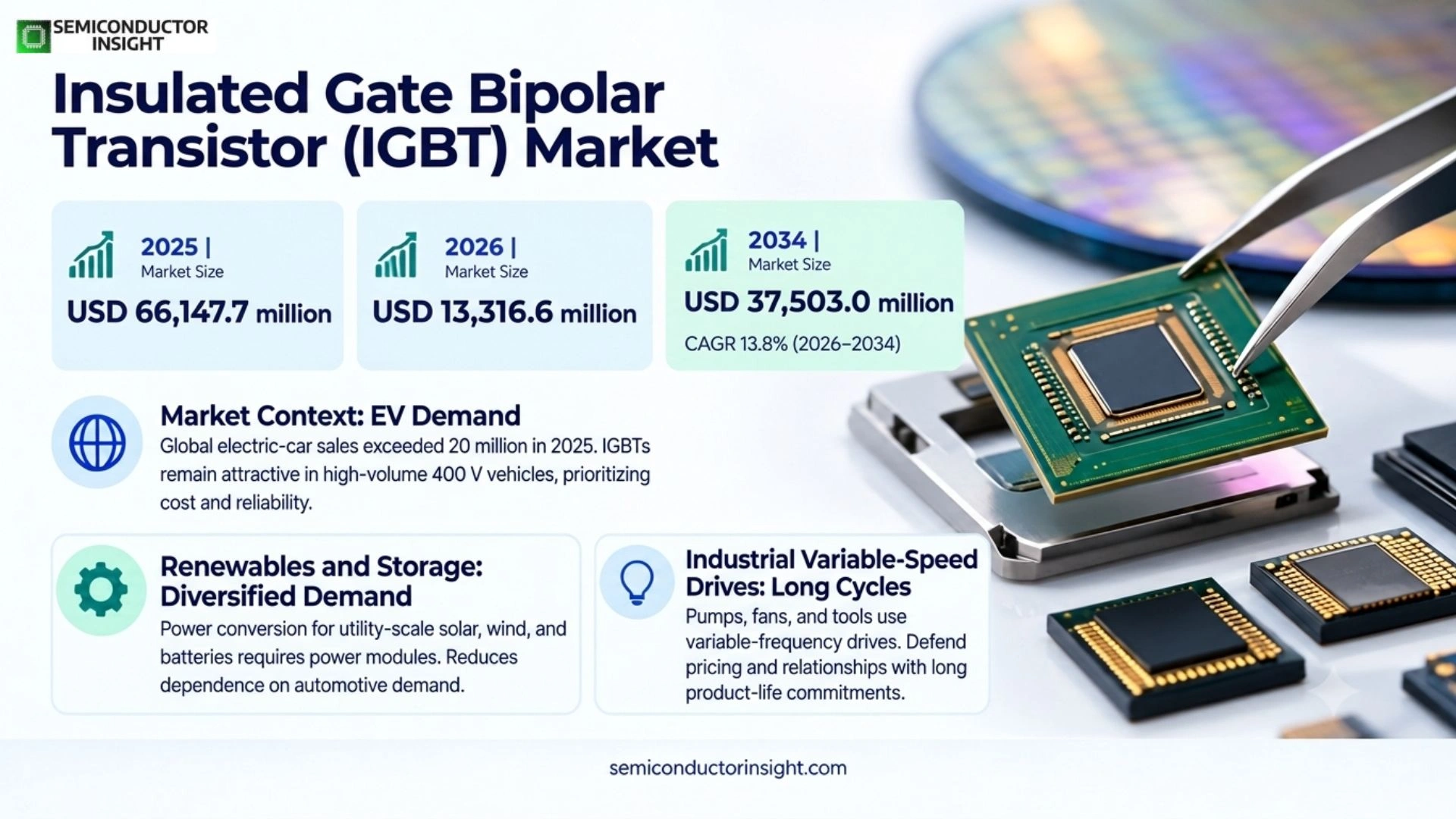
IGBT market was valued at USD 11,700.0 million in 2025, is estimated at USD 13,316.6 million in 2026, and is projected to reach USD 37,503.0 million by 2034. The anchor-implied growth path corresponds to a 13.8% CAGR during 2026–2034, while Asia Pacific is the largest regional market.
An insulated-gate bipolar transistor combines a MOS-gated input structure with a bipolar current path, giving designers voltage-controlled switching with lower conduction loss than many purely unipolar devices at high voltage and current. IGBTs are used as discrete devices and, more importantly at higher power, as modules containing multiple dies, freewheel diodes, substrates, terminals and thermal interfaces. Their commercial role is to switch DC power into controlled AC or vice versa in traction inverters, industrial motor drives, renewable-energy converters, uninterruptible power systems and grid equipment.
The market is changing because three very large end-use systems are electrifying simultaneously. Electric vehicles increase semiconductor content per vehicle, renewable generation requires inverter interfaces to the grid, and industrial equipment continues to replace fixed-speed motors and mechanical control with variable-speed drives. The IEA reports more than 20 million electric cars were sold in 2025, while official U.S., EU and Indian energy statistics show substantial additions of solar, wind and battery storage. Those installations translate into demand for power modules even when vehicle or renewable project cycles fluctuate independently.
Technology competition is not simply IGBT versus silicon carbide. Device choice depends on bus voltage, switching frequency, thermal design, efficiency target, duty cycle and cost. Silicon carbide MOSFETs gain where very high switching frequency, high junction temperature or maximum efficiency have strong system value; IGBTs remain compelling where robust high-voltage switching, mature module ecosystems and lower device cost dominate. Suppliers are therefore improving trench/field-stop structures, reverse-conducting IGBTs, packaging and thermal resistance rather than treating silicon IGBT as a static legacy technology.
The controlling report scopes the market by Discrete IGBT and IGBT Module; applications Electric & Hybrid Vehicles, Renewable Energy Systems, Industrial Motor Drives and Others; end users Automotive, Industrial, and Energy & Utilities; power ratings Low Power, Medium Power and High Power; and packaging Surface-Mount Package, Through-Hole Package and Power Module Package. These axes are preserved exactly even where individual suppliers use different commercial naming conventions.
Segment Analysis: By Type
By type, the IGBT market is segmented into Discrete IGBT and IGBT Module. Modules account for the larger revenue pool because traction, renewable-energy and industrial power stages benefit from integrated switching legs, electrical isolation and engineered thermal paths, while discrete devices remain important in lower-power, cost-sensitive and appliance-oriented designs.
| Type | Technical role | Market position |
|---|---|---|
| Discrete IGBT | A discrete IGBT places one primary switching device in an individual package, giving designers flexibility to build custom half bridges, choppers and inverter stages at relatively modest power. The format is suited to appliances, induction heating, welding, smaller motor drives and selected power supplies where current levels are manageable and board-level assembly provides sufficient thermal performance. | A substantial but more price-sensitive segment. Discretes benefit from high unit volume and broad distribution, yet the highest-value automotive, renewable and industrial converters increasingly use modules for thermal and assembly reasons. Competitive advantage therefore comes from low conduction loss, switching behavior, ruggedness, package options and manufacturing cost rather than system-level integration alone. |
| IGBT Module | An IGBT module integrates multiple IGBT dies, freewheel diodes, insulated substrates, bus connections and a thermal base into one mechanically robust unit. Modules can implement half bridges, six-packs or specialized topologies and simplify high-current layout, isolation and heat extraction in traction inverters, industrial drives, solar inverters and grid converters. | Largest type. Modules concentrate more semiconductor value per design and are preferred when power density, reliability and assembly repeatability matter. New eighth-generation devices, reverse-conducting structures and improved substrate/thermal packaging continue lowering loss and size, allowing IGBT modules to defend applications even as silicon carbide captures selected premium high-frequency designs. |
Power rating and package architecture determine the competitive set
The report further divides demand into low-, medium- and high-power ratings and into surface-mount, through-hole and power-module packages. These axes matter because the same underlying IGBT physics serves very different buying environments. Low-power devices compete through price and board-level convenience; medium-power parts balance switching loss, ruggedness and cooling; high-power modules are qualified as part of complete inverter or converter platforms where thermal cycling, short-circuit withstand, isolation and long field life can be more important than device price.
Segment Analysis: By Application
By application, the market is segmented into Electric & Hybrid Vehicles, Renewable Energy Systems, Industrial Motor Drives and Others. Electric & Hybrid Vehicles represent the largest and fastest-expanding application, while renewable-energy and industrial-drive demand provide diversified volume that reduces dependence on a single automotive cycle.
| Application | Demand characteristics |
|---|---|
| Electric & Hybrid Vehicles | Largest and fastest-growing application. Traction inverters switch battery DC into multi-phase motor power, creating high semiconductor value per vehicle, while auxiliary high-voltage functions add further demand. The IEA reports global electric-car sales exceeded 20 million in 2025, with China above 13 million and Europe above 4 million. IGBTs remain widely used in mass-market 400 V platforms and cost-sensitive models, even as silicon carbide grows in premium and 800 V architectures. |
| Renewable Energy Systems | Solar, wind and battery-storage systems all require power conversion between variable DC or AC sources and grid-compatible electricity. The addressable IGBT content is therefore tied to installed inverter megawatts rather than only equipment unit counts. Official 2025-2026 data from the European Commission, U.S. EIA, IRENA and India’s MNRE show continued renewable and storage additions, supporting medium- and high-power module demand where mature cost, reliability and serviceability remain important. |
| Industrial Motor Drives | Industrial variable-frequency drives use IGBTs to control motor speed and torque in pumps, fans, compressors, machine tools, elevators and factory automation. Demand is replacement- and efficiency-led rather than dependent on one technology boom. Buyers prioritize ruggedness, predictable switching behavior, long availability and compatibility with established gate-drive and cooling systems, making qualification continuity a meaningful barrier to rapid substitution by newer device technologies. |
| Others | Other applications include UPS systems, induction heating, welding, rail traction, medical and scientific power supplies, grid equipment and specialized high-voltage converters. The mix is fragmented, but many applications value the IGBT’s mature high-voltage ecosystem and proven short-circuit robustness. These uses provide a durable replacement base and can favor specialized modules with long lifecycles over the fastest-moving automotive product generations. |
End-user and packaging implications
Automotive is the highest-growth end-user, while Industrial and Energy & Utilities create large, specification-driven demand for modules with long field lifetimes. Power-module packaging captures the greatest value at high current because it combines electrical isolation, low-inductance interconnects and engineered thermal paths. Surface-mount and through-hole packages remain relevant in lower-power products and control subsystems. The market therefore spans consumer-scale unit volumes and infrastructure-grade modules, requiring suppliers to manage very different qualification, channel and warranty economics.
Regional Analysis
Asia Pacific is the largest IGBT market, supported by China’s EV manufacturing scale, Japan’s entrenched power-semiconductor suppliers, and rapid renewable and industrial-electrification investment across the region. Europe is technology- and regulation-led, North America is expanding through EV, solar and storage investment, South America is led by Brazil, and Middle East & Africa are more project-driven.
What makes IGBT demand structurally different across the major regions?
IGBT demand follows where power conversion is built, not only where semiconductor fabs are located. Asia Pacific combines device production with large inverter and vehicle manufacturing. Europe has strong automotive, industrial-drive and renewable-equipment demand and tight efficiency requirements. North America is adding utility-scale solar and storage while rebuilding EV supply chains. South America is smaller but Brazil’s electrified-vehicle and renewable markets are gaining scale. Middle East & Africa are driven more by utility projects, industrial equipment and imported inverter systems.
| Region | Position | Growth outlook | Demand profile | What decides supplier selection |
|---|---|---|---|---|
| Asia Pacific | Largest | High / leading | EV manufacturing + renewable + industrial | Cost-performance, module supply, local OEM qualification and generation roadmap |
| Europe | Second / high value | High | EV + industrial drives + renewable | Efficiency, automotive qualification, reliability and European manufacturing footprint |
| North America | High-growth | High | Solar/storage + EV + industrial | Domestic supply resilience, automotive qualification and inverter platform fit |
| South America | Developing | Moderate-high | Brazil EV + renewable projects | Landed cost, inverter/OEM channel, service support and long lifecycle |
| Middle East & Africa | Smaller base | Moderate-high | Utility renewable + industrial + infrastructure | Project qualification, ruggedness, high-temperature operation and global vendor support |
Competitive Landscape
The IGBT market is led by suppliers with deep process technology, module packaging and multi-year automotive or industrial qualification capability. Infineon, Mitsubishi Electric, Fuji Electric, onsemi, STMicroelectronics, Toshiba, ROHM and others compete not only on die loss but on the complete power-module platform: thermal resistance, inductance, gate behavior, reliability data, package footprint and customer design support.
Infineon, Mitsubishi Electric and Fuji Electric have especially strong positions in high-power industrial, automotive and renewable applications because they combine device generations with engineered module packages. Their competitive advantage is cumulative: customers qualify switching behavior, short-circuit robustness, thermal cycling and mechanical interfaces together, so a proven module family can remain designed into inverter platforms for many years even after a newer die generation is available.
Automotive electrification is intensifying technology competition. Silicon-carbide MOSFETs offer lower switching losses and high-frequency operation, particularly in 800 V traction architectures, but IGBT suppliers are responding with thinner wafers, trench/field-stop structures, reverse-conducting devices and lower-inductance packaging. The commercial decision is system-level. If a silicon IGBT module can meet range, cooling and efficiency targets at materially lower cost, vehicle makers have an incentive to retain it in mass-market platforms.
Industrial and renewable customers create a different competitive environment. They value long product availability, ruggedness, service replacement and compatibility with existing gate-drive and cooling designs. This favors broad suppliers with stable module families and application engineering teams. New entrants can compete on price, but displacing a qualified module is difficult when a redesign would trigger inverter recertification, thermal validation and field-reliability risk.
Capacity strategy is becoming part of supplier positioning. Infineon’s Dresden investment expands European power-semiconductor manufacturing, while Japanese suppliers continue launching eighth-generation IGBT modules. Customers increasingly evaluate not only electrical performance but also geographic manufacturing resilience, wafer supply, packaging redundancy and the supplier’s ability to support automotive or infrastructure demand through cyclical peaks.
| Competitive tier | Companies / roles | Positioning logic |
|---|---|---|
| Global technology leaders | Infineon Technologies; Mitsubishi Electric; Fuji Electric; onsemi; STMicroelectronics | Compete through advanced trench/field-stop generations, automotive and industrial qualification, broad module families and application support. Their strongest moat is the combination of die technology with packaging, reliability databases and multi-year OEM relationships rather than any single electrical specification. |
| Diversified Japanese power specialists | Toshiba; ROHM; Renesas Electronics; Hitachi | Serve automotive, industrial and appliance markets with established silicon power portfolios and, in several cases, complementary silicon-carbide products. This lets them segment applications by system economics and defend IGBT positions where mature silicon remains the lowest-cost way to meet voltage, current and switching-frequency requirements. |
| Module / industrial ecosystem | Semikron Danfoss; Danfoss Group; Littelfuse (IXYS); StarPower Semiconductor; ABB-related power-electronics ecosystem | Compete through module integration, industrial channels, specialized high-power packages and system-level relationships. Their position is strongest where customers buy qualified power stages and long-life industrial platforms rather than commodity discretes, making package compatibility, thermal behavior and service support central purchasing criteria. |
Companies profiled in the source scope
The controlling source scope profiles Infineon Technologies AG, Mitsubishi Electric, Fuji Electric, ON Semiconductor/onsemi, Semikron Danfoss, ABB, STMicroelectronics, Hitachi, Toshiba, ROHM, Renesas Electronics, Danfoss Group, Littelfuse (IXYS) and StarPower Semiconductor. The list spans semiconductor manufacturers, module specialists and industrial power-electronics groups; all are retained in the report scope even though their direct IGBT revenue exposure differs.
Production Capacity Analysis
IGBT production capacity is a two-stage problem: front-end silicon wafer fabrication defines die supply, while back-end module assembly determines how quickly those dies become qualified traction, industrial or renewable-energy products. Large power-semiconductor fabs are expensive and slow to qualify, but module packaging is equally strategic because thermal substrates, bonding, interconnect inductance and reliability testing determine usable power density.
Europe and Japan retain major high-value power-semiconductor manufacturing capability, while China and broader Asia have expanded both device and module production alongside EV and inverter manufacturing. Infineon’s EUR 5 billion Smart Power Fab in Dresden is a visible example of capacity being added close to automotive and industrial customers. Geographic diversity matters because power modules can become bottlenecks when either wafer supply or specialized substrates and packaging lines are constrained.
Modern IGBT generations depend on wafer thinning, backside processing and precise trench or field-stop structures to lower conduction and switching losses. Moving a device generation into production therefore requires process-control learning rather than simply installing more tools. Once good die are available, module makers must maintain low-inductance interconnects, uniform solder or sinter interfaces, high-voltage isolation and repeatable thermal resistance. These manufacturing details directly affect inverter efficiency and field life.
Capacity is also segmented by package. Automotive traction modules require extensive qualification and traceability, renewable and rail modules emphasize high voltage and thermal cycling, and appliance IPMs prioritize low cost and compact integration. A supplier cannot freely redirect all output between these markets. This limits effective fungibility and explains why product-specific shortages can coexist with apparently adequate aggregate IGBT wafer capacity.
Market Dynamics
The IGBT market is pulled by electrification but shaped by device substitution and qualification economics. EVs, renewable energy, storage and industrial efficiency expand the number of power-conversion stages, while silicon carbide competes for the highest-efficiency designs. IGBT growth therefore depends on suppliers continuing to reduce losses and package size fast enough that mature silicon retains a compelling system-cost advantage.
Market Drivers
| Driver | Impact | Commercial mechanism |
|---|---|---|
| Electric-vehicle production | High | More than 20 million electric cars were sold globally in 2025. Each traction platform requires high-power switching, and mass-market 400 V vehicles remain a major addressable base for cost-optimized IGBT modules. |
| Renewable and battery-storage buildout | High | Solar, wind and storage require grid-connected inverters or converters. Official 2025-2026 capacity additions in the U.S., EU and India create demand independent of passenger-vehicle cycles. |
| Industrial motor efficiency | Medium-High | Variable-frequency drives reduce energy use in pumps, fans, compressors and factory equipment. The large installed base creates both new-design and replacement demand for long-lived IGBT module families. |
| New IGBT generations and packaging | Medium | Eighth-generation devices, reverse-conducting IGBTs and smaller low-inductance modules reduce power loss and system size, extending the economic life of silicon in applications that do not need wide-bandgap performance. |
Electric vehicles multiply high-power semiconductor content
The IEA reports global electric-car sales exceeded 20 million in 2025, with China above 13 million and Europe above 4 million. Traction inverters are one of the highest-value power-electronics systems in an EV, and additional high-voltage functions further increase switching-device content. While silicon carbide is gaining in premium and 800 V platforms, IGBTs remain attractive in high-volume 400 V vehicles where manufacturers prioritize cost, proven reliability and a mature module ecosystem.
Renewables and storage create diversified inverter demand
Utility-scale solar, wind and batteries all require power conversion, so installed megawatts translate into demand for power modules, gate drivers and cooling systems. The U.S. EIA expects 86 GW of new utility-scale capacity in 2026, with solar and storage leading, while the EU added close to 70 GW of renewables in 2025 and India continues rapid solar and wind deployment. This diversification reduces dependence on automotive demand alone.
Industrial variable-speed drives sustain a long replacement cycle
Pumps, fans, compressors, conveyors and machine tools increasingly use variable-frequency drives to improve process control and energy efficiency. Industrial customers usually keep equipment much longer than consumer or automotive technology cycles, creating recurring replacement demand for modules that remain compatible with existing gate drivers, busbars and cooling plates. Suppliers with long product-life commitments can therefore defend pricing and customer relationships even when headline unit growth is slower than EV markets.
Device and package innovation protects silicon’s cost position
Fuji Electric and Mitsubishi Electric are commercializing newer IGBT generations that reduce loss and module size. Improvements such as reverse-conducting dies, lower-inductance layouts and better thermal interfaces can reduce system cost without changing to a wide-bandgap architecture. This is commercially important because the relevant comparison is total inverter cost and efficiency, not transistor performance in isolation. Incremental silicon improvements can preserve a large addressable market where switching frequency remains moderate.
Market Restraints
| Restraint | Impact | Commercial mechanism |
|---|---|---|
| Silicon-carbide substitution | High | SiC MOSFETs offer lower switching losses and high-temperature capability, especially valuable in premium EV and high-frequency converters. As SiC cost falls, some high-value IGBT sockets migrate permanently. |
| Automotive qualification cycles | Medium-High | Traction modules require lengthy validation, traceability and reliability testing. New device generations can take years to reach large-volume platforms, delaying revenue even when technical performance is ready. |
| Cyclical EV and industrial demand | Medium | Vehicle incentives, interest rates, industrial capex and inventory corrections can create sharp short-term swings in power-semiconductor utilization and distributor inventories. |
| Thermal and switching-loss limits | Medium | At high frequency or high bus voltage, IGBT switching loss can increase cooling requirements. System designers may choose SiC when efficiency or packaging benefits outweigh the higher device cost. |
Silicon carbide captures the efficiency frontier
SiC MOSFETs switch faster with lower losses in many high-voltage applications, allowing smaller cooling systems and passive components. This creates a real structural restraint on IGBT growth in 800 V EVs, premium fast-charging systems and high-frequency converters. The pressure will increase as SiC wafer and device cost declines. IGBT suppliers must therefore focus on applications where switching frequency is moderate and mature silicon delivers the best combination of cost, robustness and field-proven reliability.
Qualification slows technology migration
A new IGBT generation cannot be inserted into an automotive or rail inverter solely because its datasheet looks better. Customers must validate short-circuit behavior, thermal cycling, insulation, solder or sinter reliability, gate-drive interaction and fault response. These cycles can take years and tie revenue to platform launches. The same barrier protects incumbents once qualified, but it also means suppliers carry development and capacity investment long before full-volume production begins.
Power-semiconductor demand remains cyclical underneath structural growth
EV adoption and renewable construction are structurally positive, yet inventories and factory utilization can still swing sharply. Automakers may revise production schedules, inverter customers can double-order during shortages, and industrial capex responds to macroeconomic conditions. Because power-semiconductor fabs have high fixed costs, a temporary demand correction can create rapid price pressure. Suppliers with diversified automotive, industrial and energy exposure are better positioned to absorb these fluctuations.
IGBT physics imposes loss trade-offs at the highest switching frequencies
The minority-carrier behavior that gives IGBTs low conduction loss at high voltage also contributes to turn-off losses. As systems push switching frequency higher to shrink magnetics and increase power density, this trade-off becomes harder to manage. Better trench structures and packaging reduce the penalty but do not eliminate it. Where smaller passive components or maximum efficiency have high system value, designers may justify the higher cost of wide-bandgap devices.
Market Opportunities
Mass-market EV platforms that prioritize total system cost
Not every EV needs the efficiency frontier. In high-volume 400 V platforms, a well-optimized IGBT traction module can provide adequate efficiency, robust short-circuit behavior and lower semiconductor cost. Suppliers that pair newer low-loss dies with compact, low-inductance packaging can defend substantial volume as EV adoption broadens into lower-priced vehicle segments. The commercial winner will be the module that minimizes total inverter cost while meeting range and cooling targets.
Utility-scale battery storage and renewable conversion
Rapid growth in battery storage adds bidirectional converters to the renewable power system, creating another high-power switching application. The U.S. alone reached nearly 52 GW of utility-scale battery capacity by June 2026 according to EIA. IGBTs can compete effectively in large converters where switching frequency is moderate and service life matters, especially if suppliers offer high-voltage modules, robust thermal cycling and long-term product support.
Eighth-generation modules for industrial efficiency upgrades
Mitsubishi Electric and Fuji Electric are rolling out new IGBT generations with lower losses and smaller packages. Industrial inverter makers can use these improvements to raise efficiency or power density without redesigning around a different semiconductor technology. This creates replacement and redesign opportunities across HVAC, factory automation, pumps, compressors and machine tools, where qualification costs make evolutionary compatibility commercially valuable.
Regional manufacturing and supply resilience
Automotive and infrastructure customers are placing more weight on supply-chain resilience after recent semiconductor shortages. New European capacity such as Infineon’s Dresden fab creates an opportunity for suppliers to differentiate through geographic redundancy, secure long-term capacity and local engineering support. Similar investment in Asian and North American packaging ecosystems can win design programs where procurement teams value continuity nearly as much as incremental device efficiency.
Supply Chain Analysis
Silicon wafers and materials. High-quality silicon substrates, epitaxy, metallization materials and packaging inputs form the upstream base. Although silicon is far more mature and broadly available than silicon-carbide substrate supply, power-device wafers still require tight defect and resistivity control. Module manufacturing additionally depends on ceramic substrates, copper, solder or sinter materials and encapsulants whose thermal and reliability behavior can become qualification-critical.
IGBT front-end fabrication. Device manufacturers create trench gates, field-stop structures, backside collectors and thin wafers that set voltage rating, conduction loss and switching behavior. Process IP is a major source of differentiation. Large fabs can lower unit cost, but transferring an automotive or industrial device to a new line requires process matching and qualification, so nominal wafer capacity cannot always be substituted immediately across products.
Module packaging and qualification. Good die are assembled onto insulated substrates, interconnected, encapsulated and combined with terminals, sensors or control functions. Low parasitic inductance and uniform thermal paths are essential at high current. Automotive, rail and energy modules then undergo extensive thermal-cycling, power-cycling and insulation testing. This stage creates a meaningful barrier to entry because field lifetime depends on packaging as much as transistor electrical performance.
Inverter and equipment integration. Vehicle Tier 1 suppliers, renewable inverter makers and industrial-drive companies design the module into complete power stages with gate drivers, DC-link capacitors, busbars and cooling. Once qualified, the semiconductor becomes embedded in system software, fault behavior and thermal design. That design-in creates recurring revenue but also gives customers bargaining power because platform volumes can be very large and cost-down expectations are continuous.
Recent Developments in the IGBT Market
Developments tracked to September 2026. Entries are dated to the source publication or official milestone.
- 2 July 2026 Capacity expansion
Infineon opened its Smart Power Fab in Dresden, a EUR 5 billion investment aimed at power semiconductors and analog/mixed-signal products for automotive, industrial, renewable-energy and power-grid applications. The facility strengthens European capacity and signals confidence in sustained electrification demand across multiple IGBT end markets.
Source - 5 June 2026 Design enablement
Mitsubishi Electric launched a design-data service supporting IGBT modules that use its latest eighth-generation devices. Providing validated switching and thermal data can shorten inverter development and improve design-in conversion for renewable-energy and industrial power-conversion customers.
Source - 19 May 2026 New product
Mitsubishi Electric announced ten new 1.2 kV NX-type IGBT modules using eighth-generation technology and cited power-loss reductions of up to about 19% for industrial inverter applications. Lower loss extends silicon IGBT competitiveness where customers want efficiency gains without moving to a different wide-bandgap device platform.Source - 5 February 2026 Integrated module
Fuji Electric launched the P641 small IPM using a reverse-conducting IGBT, citing roughly 10% lower loss and a 44% smaller footprint for applications including air conditioners. The product illustrates how integration and package redesign can preserve IGBT value in high-volume appliance motor drives.
Source - 14 January 2025 Renewable power module
Mitsubishi Electric announced a 1.2 kV LV100-type IGBT module using eighth-generation technology for solar and energy-storage power conversion, citing approximately 15% lower inverter power loss. The launch targets an application where silicon IGBT remains economically important despite competition from silicon carbide.
Source
Report Scope & Segmentation
| Attribute | Coverage |
|---|---|
| Market | IGBT Market |
| Base Year | 2025 |
| Estimated Year | 2026 |
| Forecast Period | 2026-2034 |
| By Type | Discrete IGBT; IGBT Module |
| By Application | Electric & Hybrid Vehicles; Renewable Energy Systems; Industrial Motor Drives; Others |
| By End User | Automotive; Industrial; Energy & Utilities |
| By Power Rating | Low Power; Medium Power; High Power |
| By Packaging | Surface-Mount Package; Through-Hole Package; Power Module Package |
| Regions | North America; Europe; Asia Pacific; South America; Middle East & Africa |
| Companies Profiled | Infineon Technologies AG; Mitsubishi Electric; Fuji Electric; ON Semiconductor/onsemi; Semikron Danfoss; ABB; STMicroelectronics; Hitachi; Toshiba; ROHM; Renesas Electronics; Danfoss Group; Littelfuse (IXYS); StarPower Semiconductor |
| Customization Scope | Free customization may add or alter country, regional or segment detail within the agreed analyst-work allocation while retaining the source-defined market boundary and clearly identifying any client-specific extensions. |
Frequently Asked Questions
What is the size of the global IGBT market?
The global IGBT market is presented at USD 11,700.0 million in 2025, estimated at USD 13,316.6 million in 2026, and projected to reach USD 37,503.0 million by 2034, implying a CAGR of 13.8% during 2026-2034. The source page contains conflicting anchors, including USD 10,020 million for 2024 and USD 11,700 million for 2025; the target-base preservation rule uses the published 2025 value and the USD 28,950 million 2032 endpoint.
Which IGBT type holds the largest share?
IGBT modules represent the largest type because high-power traction inverters, renewable-energy converters and industrial motor drives benefit from integrating multiple switching dies, freewheel diodes, insulated substrates and thermal interfaces into one qualified package. Modules reduce busbar inductance, simplify cooling and improve assembly repeatability. Discrete IGBTs remain important in lower-power appliances, smaller drives, induction heating and cost-sensitive systems where board-level integration is sufficient.
What is the largest application for IGBTs?
Electric & Hybrid Vehicles are the largest and fastest-growing application in the controlling scope. The IEA reports more than 20 million electric cars were sold globally in 2025, creating large traction-inverter semiconductor demand. Renewable Energy Systems and Industrial Motor Drives are also major applications and provide important diversification because their purchasing cycles depend on grid investment, factory capex and energy-efficiency upgrades rather than passenger-vehicle production alone.
Which region leads the IGBT market?
Asia Pacific leads the IGBT market because China combines exceptional EV manufacturing volume with large renewable and industrial inverter demand, while Japan hosts long-established power-semiconductor leaders such as Mitsubishi Electric and Fuji Electric. India adds another fast-growing renewable-conversion market. This concentration of end demand, module manufacturing and inverter integration creates a deeper local qualification ecosystem than in other regions and supports both high-volume and high-power IGBT products.
How does silicon carbide affect the IGBT market?
Silicon carbide is the most important structural substitution risk because SiC MOSFETs can switch faster with lower losses and operate efficiently at higher voltage and temperature. Those benefits are especially valuable in premium 800 V EVs and high-frequency converters. IGBTs remain competitive where switching frequency is moderate, short-circuit robustness is important and lower semiconductor cost outweighs the system-efficiency benefit of SiC. The result is application segmentation rather than immediate wholesale replacement.
What is driving IGBT demand outside electric vehicles?
Renewable generation, battery storage and industrial motor drives are the strongest non-automotive demand engines. Solar and wind plants need grid-connected converters, battery systems require bidirectional inverters, and factories use variable-frequency drives to control pumps, fans, compressors and machinery. Official U.S., EU and Indian capacity data show these markets continue expanding, creating a diversified installed base for IGBT modules and reducing the market’s dependence on passenger-EV sales.
Why are newer IGBT generations still important?
New IGBT generations lower conduction and switching losses, improve reverse-conduction behavior and allow smaller or lower-inductance packages. Mitsubishi Electric and Fuji Electric have introduced eighth-generation and reverse-conducting products that target industrial, renewable and appliance applications. These improvements matter commercially because many customers can gain efficiency or power density without redesigning around silicon carbide, preserving qualified cooling, gate-drive and mechanical interfaces and reducing total system-development cost.
What are the main manufacturing constraints for IGBTs?
The principal constraints are qualified wafer-fabrication capacity, thin-wafer and backside process control, module packaging and long reliability qualification. High-power modules depend on uniform thermal interfaces, low-inductance interconnects, insulated substrates and repeatable bonding. Automotive and infrastructure customers then require extensive thermal-cycling, power-cycling and fault testing. As a result, nominal semiconductor capacity cannot always be redirected quickly between products, voltage classes or end-use markets.
Who are the key companies in the IGBT market?
The source scope profiles Infineon Technologies AG, Mitsubishi Electric, Fuji Electric, ON Semiconductor/onsemi, Semikron Danfoss, ABB, STMicroelectronics, Hitachi, Toshiba, ROHM, Renesas Electronics, Danfoss Group, Littelfuse (IXYS) and StarPower Semiconductor. These companies span device fabrication, module integration and industrial power electronics. Competitive advantage depends on device generation, module reliability, application engineering, geographic capacity and the ability to secure long-term automotive or inverter-platform qualifications.
What will determine IGBT growth through 2034?
Growth through 2034 will depend on the balance between rapid electrification and technology substitution. EV production, renewable energy, storage and industrial drives expand the overall number of power-conversion stages, while silicon carbide captures applications where its efficiency and high-frequency benefits justify higher cost. IGBT suppliers can sustain strong growth by reducing losses, shrinking module size, improving thermal performance and targeting mass-market platforms where mature silicon continues to deliver the lowest total system cost.
Research Sources & Evidence Base
Get Sample Report PDF for Exclusive Insights
Report Sample Includes
- Table of Contents
- List of Tables & Figures
- Charts, Research Methodology, and more...
 Download Sample Report PDF