Key Statistics
Key Takeaways
- Silicon carbide is the preferred wide-bandgap platform for high-power renewable conversion, particularly where inverter voltage, switching frequency, thermal conditions and lifetime requirements justify its premium over conventional silicon. The commercial case strengthens as suppliers move SiC production toward 200 mm wafers, because a larger wafer diameter can lower device cost per die once yields and utilization mature.
- Solar photovoltaic inverters are the largest application, supported by a record global deployment base. The IEA reported more than 600 GW of solar PV additions in 2025, representing over three-quarters of new renewable capacity, so inverter makers face a large recurring requirement for high-efficiency switching devices across utility, commercial, residential and hybrid solar-storage platforms.
- Asia Pacific is the largest and fastest-expanding regional demand center. China commissioned nearly 370 GW of solar PV and 117 GW of wind in 2025, while India added almost 50 GW of solar and more than 6 GW of wind. The same region also hosts major SiC and power-module manufacturing assets, giving suppliers unusually close proximity to both device production and renewable-system assembly.
- Grid-scale battery storage is becoming a second structural demand engine. In the United States, utility-scale battery capacity reached 43.6 GW at the end of 2025 and nearly 52 GW by June 2026, while Brazil introduced its first large-scale battery capacity auction framework. Bidirectional storage inverters require power stages that can sustain frequent cycling, high power density and tight thermal control.
- The principal restraint is not end-market demand but conversion economics and qualification. SiC and GaN can reduce switching losses and system size, yet renewable-equipment suppliers must still justify higher semiconductor cost, redesign gate-drive and protection circuits, validate reliability for long field lives and secure stable substrate capacity. That slows adoption in lower-power or aggressively priced equipment.
Renewable Energy Power Semiconductor Market Overview
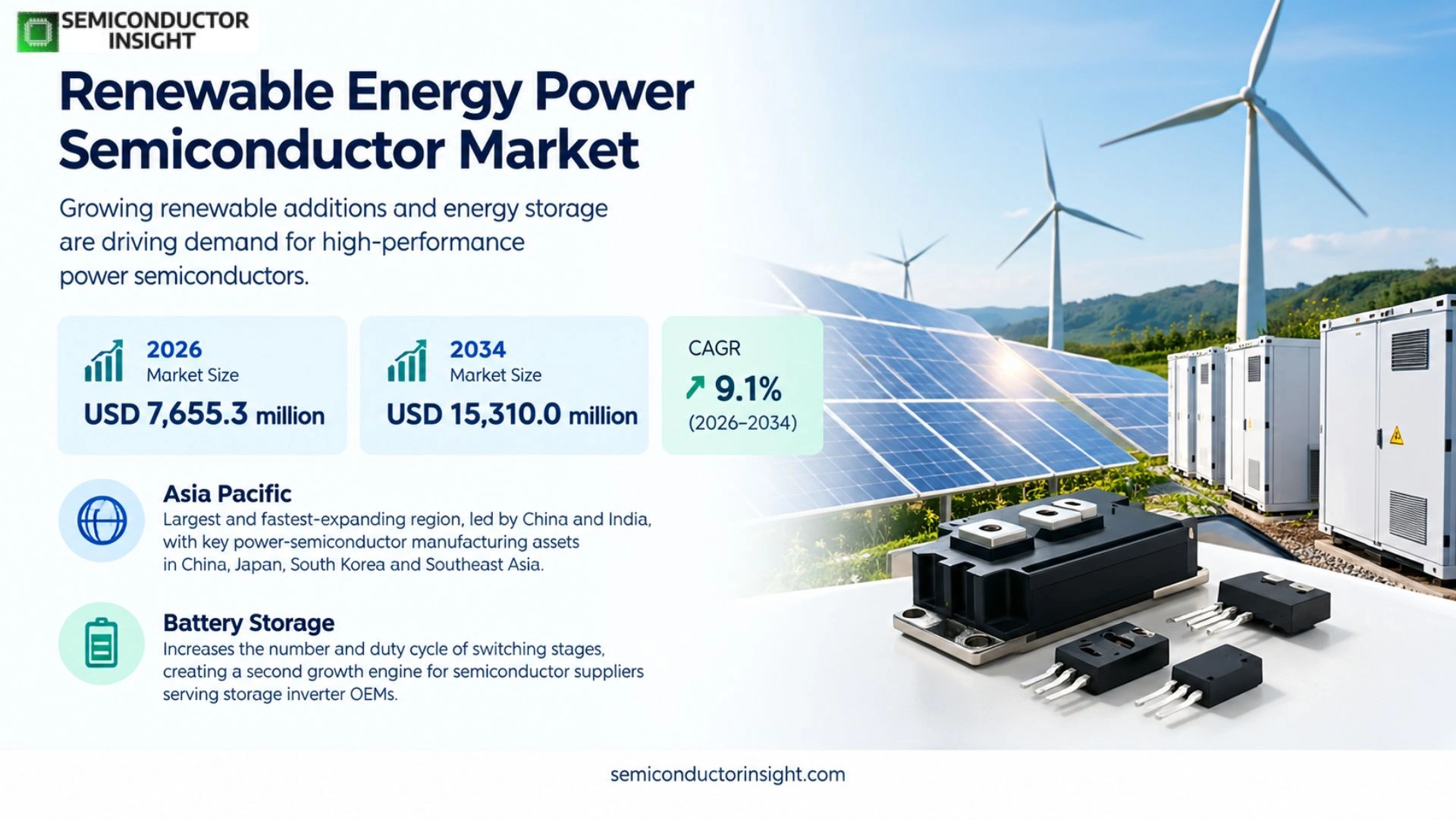
Renewable Energy Power Semiconductor Market was valued at USD 7,020.0 million in 2025. Using the two published market-size anchors produces an estimated USD 7,655.3 million in 2026 and a projected USD 15,310.0 million by 2034, equivalent to a 9.1% CAGR during 2026–2034. Asia Pacific is the largest market because it combines the world’s fastest renewable-capacity additions with a deep power-electronics manufacturing base.
Renewable-energy power semiconductors are the switching and rectification devices that control electrical conversion inside solar inverters, wind converters, battery-energy-storage systems, microgrids and high-power charging equipment. The source scope is centered on silicon-carbide and gallium-nitride devices, including discrete transistors and diodes, integrated power modules and monolithic power ICs. Their role is to move electricity between DC and AC buses while minimizing conduction, switching and thermal losses.
The commercial value of wide-bandgap devices is created at system level rather than at the semiconductor alone. Faster switching can reduce passive-component size, higher junction-temperature capability can simplify cooling, and lower losses can improve the conversion efficiency of equipment that operates for thousands of hours. In a utility-scale solar or storage project, even a small efficiency gain can influence lifetime energy yield, enclosure size, thermal design and maintenance burden, which makes device selection a bankability issue as well as a component-cost decision.
The market is broadening as renewable assets become more power-dense and more bidirectional. Solar plants increasingly incorporate storage, grid-forming functions and higher DC-link voltages; wind systems are moving toward larger turbines and demanding converter architectures; and battery systems must switch power repeatedly in both charging and discharging directions. These requirements favor semiconductors with low switching losses, predictable short-circuit behavior, strong thermal cycling performance and packaging that can handle high current density.
The timing of the market expansion is reinforced by deployment and manufacturing scale occurring together. The IEA recorded about 800 GW of renewable additions in 2025, with solar exceeding 600 GW and wind reaching around 160 GW. At the same time, Infineon began shipping 200 mm SiC products from Villach, ST is building an integrated 200 mm SiC campus in Catania, and Mitsubishi Electric completed a 200 mm SiC factory in Japan. That combination improves both demand visibility and the long-run cost curve.
Segment Analysis: By Type
By type, the source scope divides the market into silicon carbide (SiC) devices and gallium nitride (GaN) devices. SiC is the preferred platform for the highest-power renewable conversion stages because its voltage capability, thermal robustness and switching performance align with utility-scale inverters and storage systems. GaN is expanding where very high switching frequency and compact magnetics matter more than extreme voltage handling.
| Type | Technical-commercial position | Market implications |
|---|---|---|
| Silicon Carbide (SiC) devices | SiC MOSFETs, diodes and modules are suited to high-voltage, high-power converters where lower switching losses and higher operating temperature can materially reduce cooling and passive-component requirements. The source report identifies SiC as the preferred renewable power-conversion technology, and manufacturer investments in 200 mm production show that suppliers are preparing for larger industrial, solar, storage and charging volumes. | The strongest near-term opportunity sits in utility-scale solar, grid-scale storage, wind conversion and high-power charging, where efficiency and thermal performance have measurable lifetime value. As 200 mm SiC manufacturing expands, device economics should improve, but suppliers still compete on reliability data, module integration, gate-drive behavior, availability and application engineering rather than wafer-scale cost alone. |
| Gallium Nitride (GaN) devices | GaN transistors switch extremely quickly and can support smaller high-frequency magnetics, making the technology attractive in compact, high-efficiency power supplies and lower-to-medium voltage conversion stages. In renewable applications its fit is strongest where switching frequency, form factor and power density outweigh the need for the very high blocking voltages and ruggedness commonly associated with large SiC modules. | Commercial growth is likely to be concentrated in residential and commercial inverters, auxiliary power stages, optimizers, chargers and high-frequency DC-DC conversion. GaN suppliers must demonstrate robust protection, thermal management and field reliability while simplifying circuit design. The technology can grow faster from a smaller base, but it does not displace SiC uniformly across multi-hundred-kilowatt and megawatt-class conversion. |
Why is SiC gaining a larger role in renewable-energy conversion?
The requirement is increasingly to convert more power in a smaller enclosure while losing less energy and operating reliably in hot outdoor conditions. SiC responds through lower switching losses, high-temperature capability and strong high-voltage performance. Equipment manufacturers can translate those device characteristics into smaller filters, reduced cooling burden and higher power density. The market implication is a shift from buying a transistor on unit price toward evaluating the total converter bill of materials, efficiency, lifetime and service profile.
Segment Analysis: By Application
By application, the market is segmented into solar photovoltaic inverters, wind turbine converters, grid-scale storage systems and EV charging infrastructure. Solar photovoltaic inverters are the largest application because solar is adding more annual generation capacity than any other renewable technology. Grid-scale storage is the most important adjacent growth vector because bidirectional converters operate intensively and increasingly accompany solar, wind and microgrid projects.
| Application | Demand characteristics |
|---|---|
| Solar photovoltaic inverters | Solar inverter demand scales directly with installed PV capacity and with the transition toward higher-power string and central inverter architectures. The IEA reported more than 600 GW of global solar additions in 2025, including nearly 370 GW in China, almost 70 GW in the European Union and almost 50 GW in India. Device selection therefore emphasizes conversion efficiency, high-voltage switching, field reliability, thermal cycling and the ability to maintain supply across large multi-year deployment programs. |
| Wind turbine converters | Wind converters must manage variable generator output, grid synchronization and increasingly large turbine ratings while operating under demanding thermal and vibration conditions. Global wind additions reached around 160 GW in 2025 according to the IEA, with China accounting for about 117 GW. High-power modules, rugged packaging and long operating life matter more than extreme switching frequency, which gives SiC a credible pathway as turbine power density and offshore service economics raise the cost of conversion losses and maintenance. |
| Grid-scale storage systems | Battery storage creates a bidirectional semiconductor load because the power conversion system must repeatedly charge and discharge the battery while meeting grid-support requirements. U.S. utility-scale battery capacity reached 43.6 GW at the end of 2025 and nearly 52 GW by June 2026. As projects move toward multi-gigawatt and multi-gigawatt-hour scale, semiconductor suppliers gain volume through inverter channels but face tighter requirements for efficiency at partial load, thermal cycling, protection and availability. |
| EV charging infrastructure | High-power DC charging overlaps with renewable infrastructure because stations increasingly combine solar, storage and grid interfaces. SiC can raise charger efficiency and power density, reduce cooling requirements and support high bus voltages, while GaN can address selected high-frequency stages. Demand is influenced not only by charger counts but by output power per dispenser, utilization and integration with site-level energy management, making module reliability and system reference designs commercially important. |
Regional Analysis
Asia Pacific is the largest and fastest-expanding regional market, supported by record renewable additions in China and India and by major power-semiconductor manufacturing assets in China, Japan, South Korea and Southeast Asia. North America is becoming a storage-led market, Europe combines renewable deployment with local SiC industrial policy, South America is opening a grid-storage procurement cycle, and the Middle East & Africa is scaling large solar-plus-storage projects.
How does regional demand differ across the renewable energy power semiconductor market?
The same semiconductor can enter five very different buying environments. Asia Pacific is driven by manufacturing scale and exceptionally high solar and wind additions. North America is increasingly shaped by battery storage, utility interconnection and domestic supply considerations. Europe combines mature inverter demand with efficiency regulation and localized wide-bandgap manufacturing. South America is led by Brazil’s renewable-heavy grid and new storage procurement. The Middle East and Africa are project-led, with very large solar-plus-storage schemes creating concentrated orders for bankable converter platforms.
| Region | Position | Growth outlook | Demand profile | What decides supplier selection |
|---|---|---|---|---|
| Asia Pacific | Largest market | Highest absolute growth | Solar, wind and manufacturing scale | Bankable inverter qualifications, high-volume device availability, local application support, cost-down roadmaps and access to SiC/GaN manufacturing. China and India create unusually large renewable installation pull, while Japan and Southeast Asia contribute power-device production capacity. |
| North America | Large, technology-intensive | Strong | Solar plus fast-growing battery storage | Utility qualification, long-term availability, module reliability, domestic or diversified supply, and the ability to support high-power bidirectional storage and charging architectures. U.S. storage additions make power-stage efficiency and thermal cycling particularly important. |
| Europe | Mature renewable and industrial market | Steady to strong | High efficiency, localization and grid integration | CE-compliant system design, documented reliability, energy-efficiency gains and supply from established European industrial ecosystems. Germany, Spain and Italy are important demand centers, while Austria and Italy are also building SiC manufacturing capability. |
| South America | Smaller base with concentrated opportunities | Emerging | Brazil-led solar, wind and storage | Landed cost, bankability, local service, financing compatibility and ruggedness for utility projects. Brazil’s storage auction framework can create a new procurement channel for high-power bidirectional inverters alongside its large solar and wind base. |
| Middle East & Africa | Project-led emerging market | High from smaller base | Gigascale solar and storage projects | Project bankability, high-temperature performance, desert-environment reliability, guaranteed supply and EPC compatibility. Gulf projects can create very large individual semiconductor demand blocks, while South Africa contributes distributed and utility solar growth. |
Competitive Landscape
Competition is structured around device technology, module integration, manufacturing scale and the depth of application engineering. Infineon, STMicroelectronics, onsemi, Mitsubishi Electric and ROHM compete most directly in high-voltage SiC power devices and modules, while Wolfspeed contributes SiC specialization. Texas Instruments and NXP participate more selectively in control, gate-drive and power-management layers, and ABB, Fuji Electric, Schneider Electric, Hitachi and GE Renewable Energy influence system-level specification through industrial power-conversion platforms.
The highest-value competitive position is a qualified design-in with an inverter or power-conversion OEM. Once a device or module is validated for thermal cycling, switching behavior, electromagnetic compatibility, protection and field reliability, replacement is costly because it can trigger redesign and recertification. Suppliers therefore invest heavily in reference designs, gate drivers, simulation models and application laboratories. This makes engineering support and lifecycle stability a meaningful barrier even when rival devices have similar headline voltage and current ratings.
Manufacturing scale is becoming more important as SiC moves from premium technology into larger renewable volumes. Infineon is transitioning both Villach and Kulim toward 200 mm SiC, ST is building an integrated Catania campus and Mitsubishi Electric completed a 200 mm SiC factory in Japan. The commercial objective is not simply more wafers; it is lower unit cost, improved yield learning, stable substrate access and enough capacity to support multi-year inverter programs without forcing customers to qualify emergency alternatives.
Packaging is another differentiation layer because system performance depends on stray inductance, thermal resistance, current sharing and cooling interface as much as on the semiconductor die. ROHM’s 2025 TOLL SiC launch emphasized a 39% thermal-performance improvement and lower profile, illustrating how packaging can unlock smaller power stages. In utility-scale equipment, module formats with integrated sensors, optimized interconnects and predictable thermal behavior can command premium value because they shorten OEM design cycles.
The source company list also includes system vendors and adjacent semiconductor companies, so competitive roles should not be treated as identical. ABB, Schneider Electric, Hitachi and GE Renewable Energy may influence inverter, grid and industrial architectures rather than sell the same discrete power device as Infineon or ROHM. A defensible competitive view therefore separates device suppliers, module specialists, control/power-management vendors and system integrators instead of forcing every profiled company into a single share ranking.
| Competitive tier | Representative companies | How they compete |
|---|---|---|
| Tier 1 – global power semiconductor platforms | Infineon Technologies; STMicroelectronics; ON Semiconductor; Mitsubishi Electric; ROHM | Broad SiC portfolios, power modules, established industrial qualifications, global application engineering and substantial manufacturing investment. Their advantage is the ability to support high-voltage renewable programs from die technology through packaging and long product lifecycles, which reduces qualification and supply risk for large inverter OEMs. |
| Tier 2 – specialized / adjacent semiconductor suppliers | Wolfspeed; Texas Instruments; NXP Semiconductors; Sumitomo Electric | Wolfspeed brings SiC material and device specialization, while TI and NXP are stronger in control, gate-drive and power-management layers around the main switching stage. Sumitomo Electric contributes materials and power-device expertise. These companies can win where specific architecture, material, control or integration requirements create differentiated value. |
| System and industrial ecosystem | ABB; Fuji Electric; GE Renewable Energy; Schneider Electric; Hitachi | These companies influence specifications through converters, grid equipment, industrial power electronics and renewable systems. Their purchasing decisions can determine which semiconductor platforms achieve volume design-ins. They also create opportunities for module suppliers that can provide co-engineering, long-term availability and region-specific qualification across large installed equipment bases. |
Companies profiled in the source scope
Production Capacity Analysis
Production capacity is shifting from a scarcity-driven wide-bandgap model toward scaled industrial manufacturing, but the transition is uneven. SiC capacity requires crystal growth, wafer preparation, epitaxy, device fabrication, thinning, metallization, packaging and high-voltage test, with yield learning at each stage. Moving from 150 mm to 200 mm can improve die output per wafer, yet the economic benefit only appears when crystal quality, process uniformity, fab utilization and downstream packaging capacity mature together.
Infineon’s manufacturing strategy shows the direction of travel. The company began shipping 200 mm SiC products from Villach in the first quarter of 2025 and is transitioning its Kulim site from 150 mm to 200 mm production. The broader Kulim expansion has been supported by multibillion-euro design wins across automotive, renewable energy and industrial customers. This is significant because long-term customer commitments help suppliers justify capital intensity while giving OEMs clearer supply visibility.
STMicroelectronics is pursuing deeper vertical integration at Catania by combining 200 mm SiC power-device and module manufacturing with substrate production, test and packaging. Integration can reduce exposure to external substrate shortages and accelerate process feedback, but it also concentrates capital and execution risk inside the supplier. Mitsubishi Electric’s new 200 mm SiC plant in Kumamoto adds another capacity node, signaling that Japanese industrial suppliers expect high-voltage SiC demand to extend beyond automotive into grid and industrial power.
GaN capacity follows a different model because many power GaN products can leverage silicon-compatible wafer infrastructure, yet cost, reliability qualification and packaging remain critical. For both technologies, the bottleneck increasingly shifts from nominal wafer starts to qualified output: renewable-equipment makers need consistent parametric performance, traceability and long-term availability. A fab with spare capacity has limited commercial value if devices have not completed the OEM’s inverter-level reliability and protection validation.
Market Dynamics
Market growth is being pulled by record renewable installations, rapid battery-storage deployment and higher converter power density, while the supply side is responding with larger-diameter SiC manufacturing and more integrated module packaging. The strongest positive mechanism is the conversion of renewable megawatts into recurring inverter and storage power-stage demand. The strongest negatives are wide-bandgap device cost, qualification time, supply concentration and the fact that conventional silicon remains economically adequate in many lower-power designs.
Market Drivers
| Driver | Directional impact | Evidence and commercial mechanism |
|---|---|---|
| Renewable capacity additions | High positive | The IEA recorded about 800 GW of global renewable additions in 2025, with solar above 600 GW and wind around 160 GW. Each new renewable asset requires power conversion, so deployment increases the installed base of inverters and converters. The semiconductor value rises further when higher voltage, power density or thermal requirements cause OEMs to shift switching stages from silicon toward SiC or GaN. |
| Grid-scale battery storage | High positive | U.S. utility-scale battery storage reached almost 52 GW by June 2026 and Brazil created a dedicated capacity-auction framework. Storage systems require bidirectional inverters that cycle frequently, creating demanding use cases for low-loss switches, power modules, gate drivers and thermal management. Storage can therefore increase semiconductor content even in markets where solar additions begin to normalize. |
| 200 mm SiC manufacturing | Medium-high positive | Infineon, ST and Mitsubishi Electric are moving toward 200 mm SiC manufacturing. Larger wafers can support lower cost per die and greater output once yields and utilization mature. The commercial effect is broader addressability: inverter OEMs can justify SiC in more product families when device cost falls while supply availability and qualification stability improve. |
| Higher inverter power density | Medium positive | Renewable systems are moving toward higher DC-link voltages, larger string-inverter ratings, denser storage converters and compact charging equipment. This raises switching and thermal requirements. Wide-bandgap devices allow faster switching and lower losses, which can reduce passive-component and cooling size, creating a system-level cost and efficiency case that is stronger than a component-price comparison. |
Record renewable additions translate directly into conversion hardware
The market’s most durable driver is the physical expansion of inverter-based generation. Solar and wind capacity cannot connect to loads or grids without power conversion, so semiconductor demand is embedded in each project. The IEA’s 2025 deployment data shows exceptional scale in China, India, the European Union and the United States. The technology response is higher-efficiency switching, and the commercial response is greater semiconductor value per converter where SiC or GaN reduces lifetime losses or system size.
Battery storage increases the number and duty cycle of switching stages
Storage is not simply another renewable capacity category because its power electronics operate in both directions and can cycle daily. A battery system must control charging, discharging, grid services and protection, often over a wide load range. That raises the value of efficient, thermally robust switching. The commercial implication is a second growth engine for semiconductor suppliers that can serve storage inverter OEMs, especially as U.S., Brazilian and Middle Eastern projects scale.
200 mm SiC improves the long-run cost curve
Wide-bandgap adoption has historically been constrained by substrate cost and manufacturing yield. The transition to 200 mm SiC increases wafer area and can improve the number of usable die per process cycle, but only after process uniformity and defect control mature. Suppliers investing now are building the capacity and learning curve needed for lower-cost future output. Renewable OEMs benefit because falling device cost expands the set of inverter power classes where SiC can clear the system-level return threshold.
Thermal and packaging innovation turns device performance into system value
A fast semiconductor does not create value if package inductance, thermal resistance or gate-drive complexity prevent the inverter from using it effectively. New module and discrete packages are therefore central to adoption. ROHM’s TOLL SiC launch illustrates the mechanism: better thermal performance and a smaller footprint enable denser equipment. Renewable OEMs can convert those gains into lower cooling cost, smaller enclosures and higher power rating, which supports premium semiconductor pricing.
Market Restraints
| Restraint | Directional impact | Evidence and commercial mechanism |
|---|---|---|
| Wide-bandgap cost premium | High negative | SiC substrates, epitaxy and specialized processing remain more expensive than mature silicon. The premium can be justified in high-power systems where efficiency and cooling savings are material, but it is harder to recover in low-power, aggressively priced equipment. This creates a segmented adoption curve rather than a universal transition. |
| Qualification and redesign burden | Medium-high negative | Changing a switching device can require new gate-drive tuning, protection validation, thermal testing, electromagnetic-compatibility work and long-duration reliability qualification. Renewable equipment carries multi-year warranties, so OEMs are conservative about unproven substitutions. The result is slower design turnover and a meaningful barrier for new entrants despite attractive device specifications. |
| Supply concentration and ramp risk | Medium negative | SiC capacity is expanding, but crystal growth, epitaxy and high-quality wafer supply remain technically demanding. A new 200 mm fab does not immediately become fully qualified high-yield output. Renewable OEMs therefore maintain second-source strategies and can delay designs if capacity or yield visibility is uncertain. |
| Silicon remains adequate in many designs | Medium negative | Mature silicon IGBTs and MOSFETs continue to offer attractive cost and established reliability, particularly where switching frequency, voltage and cooling constraints are moderate. Wide-bandgap suppliers must prove a whole-system advantage. If the efficiency gain does not offset device premium and redesign cost, buyers can rationally stay with silicon. |
Cost remains the threshold variable in price-sensitive inverter classes
Renewable project economics are highly competitive, so semiconductor upgrades must be justified through energy yield, smaller cooling systems, higher power density or lower service cost. Where these benefits are small, mature silicon can remain the rational choice. That limits wide-bandgap penetration in lower-power residential equipment and cost-optimized products. Suppliers respond with 200 mm manufacturing, integrated modules and reference designs that reduce both component cost and engineering effort.
Qualification cycles slow supplier switching
Utility and commercial inverters are expected to operate for many years under thermal cycling and outdoor stress. OEMs therefore validate switching behavior, short-circuit response, insulation, thermal interfaces and electromagnetic emissions at system level. A new supplier may offer better nominal specifications yet still require months of qualification. This makes incumbent design-ins sticky and means production capacity alone cannot create market share without application support and long reliability data.
Manufacturing ramps can create temporary oversupply or scarcity
Wide-bandgap capacity is capital intensive and demand is shared across automotive, industrial, data-center and renewable markets. If multiple suppliers ramp 200 mm SiC faster than end demand, pricing pressure can rise; if yields lag or other sectors absorb capacity, renewable OEMs can face allocation risk. The market therefore values flexible multi-site production and contractual supply commitments. Capacity announcements should be judged by qualified output and utilization, not headline wafer diameter alone.
Conventional silicon continues to improve
Silicon power devices benefit from decades of process optimization, broad packaging options and low cost. Their continued improvement raises the performance bar that SiC and GaN must clear. Inverter makers do not adopt a new semiconductor material for novelty; they adopt when a measurable system benefit exceeds redesign and qualification cost. This dynamic keeps the market technology-neutral in principle even as wide-bandgap share grows in the most demanding applications.
Market Opportunities
Solar-plus-storage architectures increase semiconductor content per site
A standalone solar plant needs DC-AC conversion, while a solar-plus-storage site adds bidirectional battery conversion, energy-management interfaces and often more sophisticated grid-support functionality. That raises both the number and duty cycle of power stages. Suppliers that provide coordinated SiC modules, gate drivers, sensing and protection can capture more value per megawatt than a discrete-only vendor. The opportunity is strongest in the United States, Middle East, Australia, India and markets adding capacity auctions for storage.
Hybrid renewable systems create demand for modular, interoperable power stages
The source scope identifies hybrid renewable systems as a strategic integration segment because solar, wind and storage must exchange power smoothly across shared DC and AC buses. The technical requirement is controllable bidirectional conversion with high efficiency and protection. The commercial opportunity is for module platforms and reference designs that can be reused across multiple hybrid configurations, shortening OEM development time and reducing qualification burden as project architectures become more customized.
High-temperature and remote projects reward reliability premiums
Desert solar plants, offshore wind systems and remote microgrids impose high service costs when equipment fails. In those environments, a semiconductor or module that reduces cooling burden and survives thermal cycling can have value well above its purchase premium. Vendors can monetize this through high-reliability modules, condition-monitoring interfaces and long lifecycle support. The opportunity is particularly attractive in the Gulf, offshore wind markets and remote industrial microgrids.
Localized SiC production opens new second-source and co-development pathways
New 200 mm capacity in Europe, Japan and Malaysia gives inverter OEMs more options to diversify a supply chain that has historically depended on a limited set of SiC materials and device fabs. Suppliers can use local capacity to win second-source qualifications, co-develop modules with regional OEMs and reduce lead-time risk. The commercial payoff is not limited to unit sales; qualification can lock a supplier into a converter platform for multiple product generations.
Supply Chain Analysis
Materials and wafers. SiC begins with technically demanding crystal growth and wafer preparation, while GaN can be grown on several substrate platforms depending on device architecture. Defect density, epitaxial quality and wafer diameter strongly influence yield and cost. The move toward 200 mm SiC is intended to increase manufacturing efficiency, but it also requires new equipment, process control and qualification. Upstream material quality therefore remains a strategic determinant of device economics and supply stability.
Power-device fabrication. Device makers convert wafers into MOSFETs, Schottky diodes, GaN transistors and associated control components. Value capture depends on process technology, yield, voltage class, switching performance and the ability to manufacture consistently across multiple sites. Renewable demand competes with automotive and industrial applications for the same wide-bandgap capacity, so suppliers with flexible fabs and long-term substrate agreements can provide stronger supply assurance to inverter OEMs.
Packaging and modules. Packaging translates die capability into usable current, voltage, thermal and reliability performance. High-power renewable systems increasingly use modules because they simplify current sharing, thermal interfaces and assembly, while lower-power stages can favor compact discrete packages. Package inductance, isolation, thermal resistance and cooling interface can determine the inverter’s real switching performance, so module design and application engineering are major sources of differentiation and margin.
Inverters and systems. Solar, wind, storage and charging OEMs perform the final device qualification and determine semiconductor content through topology, switching frequency, voltage class and redundancy. Large design wins can persist for years because changing a qualified switch or module may require extensive redesign and recertification. Distribution matters for smaller commercial and residential products, but utility-scale volume is commonly driven by direct OEM relationships, long-term supply agreements and project bankability.
Recent Developments in the Renewable Energy Power Semiconductor Market
Developments tracked to September 2026. Entries use official agency or manufacturer sources and connect each event to the market mechanism it changes.
- 7 August 2026 MARKET SIGNAL
The U.S. Energy Information Administration reported that utility-scale battery storage had reached nearly 52 GW by June 2026 after ending 2025 at 43.6 GW, with another 54 GW planned over the following two and a half years. The growth expands demand for bidirectional power-conversion systems and strengthens the case for efficient SiC modules in high-duty-cycle storage inverters. Source - 13 July 2026 PROJECT MILESTONE
Masdar reached financial close on a USD 6.1 billion UAE project combining 5.2 GW of solar PV with 19 GWh of battery storage to supply 1 GW of continuous clean power. The design illustrates how renewable projects are adding large storage blocks, increasing power-semiconductor content through bidirectional conversion, grid interface and thermal-management requirements. Source - 4 December 2025 PRODUCT LAUNCH
ROHM announced mass production of TOLL-packaged SiC MOSFETs with about 39% better thermal performance than a comparable conventional package and cited PV inverters and energy-storage systems among target applications. Better package thermal performance can enable smaller, higher-power converters, showing how packaging innovation is becoming as important as die technology in renewable equipment. Source - October 2025 CAPACITY RAMP
Mitsubishi Electric completed a new Shisui-area factory for 200 mm SiC wafers in Kumamoto and began accelerating production-line ramp-up. The investment adds another large-diameter SiC manufacturing node and can improve the long-run cost and availability of high-voltage devices used in industrial and renewable power conversion as qualification progresses. Source - 13 February 2025 CAPACITY MILESTONE
Infineon began releasing the first products manufactured on 200 mm SiC technology from Villach and confirmed the transition of its Kulim facility toward the same wafer diameter. The move targets higher manufacturing efficiency and scale, directly addressing a major commercial barrier to wider SiC adoption in renewable energy, fast charging and industrial power systems. Source
Report Scope & Segmentation
| Attribute | Scope |
|---|---|
| Market | Renewable Energy Power Semiconductor Market |
| Base / estimate / forecast | Base year 2025; estimated year 2026; forecast period 2026–2034. Values are reported in USD million. The source page’s 2025 and 2034 size anchors are retained, and the intervening 2026 estimate and CAGR are derived from the constant annual growth factor implied by those anchors. |
| By Type | Silicon Carbide (SiC) devices; Gallium Nitride (GaN) devices |
| By Application | Solar photovoltaic inverters; Wind turbine converters; Grid-scale storage systems; EV charging infrastructure |
| By End User | Utility-scale power plants; Commercial & industrial installations; Residential solar systems |
| By Device Architecture | Discrete power devices; Integrated power modules; Monolithic power ICs |
| By System Integration | Standalone converters; Hybrid renewable systems; Microgrid solutions; Others |
| Regions | North America; Europe; Asia Pacific; South America; Middle East & Africa |
| Companies profiled | Infineon Technologies, STMicroelectronics, ON Semiconductor, Mitsubishi Electric, Wolfspeed, ROHM, Texas Instruments, NXP Semiconductors, ABB, Fuji Electric, GE Renewable Energy, Schneider Electric, Hitachi, Sumitomo Electric |
| Customization Scope | Country, regional, application, device-architecture and company-level analysis can be expanded where reliable source data exists. The quantitative market series should remain tied to the controlling report scope, while external official and manufacturer evidence is used to explain deployment, capacity, technology, regulation and competitive mechanisms rather than to replace the headline market-size anchors. |
Frequently Asked Questions
What is the current size of the renewable energy power semiconductor market?
The market was valued at USD 7,020.0 million in 2025. Applying the constant annual growth factor implied by the source page’s 2025 and 2034 market-size anchors gives an estimated USD 7,655.3 million in 2026 and a projected USD 15,310.0 million by 2034, equivalent to a 9.1% CAGR during 2026–2034. The source page prints an 8.8% CAGR and USD 7.45 billion for 2026, but those figures are not mathematically consistent with the two size anchors.
Which region leads the renewable energy power semiconductor market?
Asia Pacific is the largest regional market because it combines exceptional renewable deployment with a large power-electronics manufacturing ecosystem. The IEA reported nearly 500 GW of renewable additions in China during 2025, including about 370 GW of solar and 117 GW of wind, while India added almost 50 GW of solar and more than 6 GW of wind. Japan and Malaysia also host major SiC manufacturing investments, reinforcing regional supply depth.
Which semiconductor type is most important for high-power renewable applications?
Silicon carbide devices are the preferred technology in the source scope for high-power renewable conversion because they can deliver low switching losses, high blocking voltage and strong thermal performance. Those attributes are valuable in utility-scale solar, battery storage, wind conversion and fast charging. GaN also has significant potential, especially in compact high-frequency conversion stages, but its application sweet spot is generally different from the largest megawatt-class SiC module opportunities.
What is the largest application for renewable energy power semiconductors?
Solar photovoltaic inverters are the largest application in the source segmentation. The demand mechanism is supported by deployment scale: the IEA reported more than 600 GW of global solar PV additions in 2025, representing more than three-quarters of all new renewable capacity. Every grid-connected PV system requires conversion electronics, and higher-voltage, higher-power inverter architectures create opportunities for SiC devices where efficiency, cooling and power density improve project economics.
Why is battery storage important to this semiconductor market?
Battery storage adds a bidirectional conversion stage that must operate repeatedly during charging and discharging, often while providing grid-support services. In the United States, utility-scale battery capacity reached 43.6 GW at the end of 2025 and almost 52 GW by June 2026. This growth creates demand for high-efficiency switches, modules, drivers and thermal solutions, and it can increase semiconductor value per renewable project when storage is paired with solar or wind generation.
Which companies are profiled in the market scope?
The source scope profiles Infineon Technologies, STMicroelectronics, ON Semiconductor, Mitsubishi Electric, Wolfspeed, ROHM, Texas Instruments, NXP Semiconductors, ABB, Fuji Electric, GE Renewable Energy, Schneider Electric, Hitachi and Sumitomo Electric. Their roles are not identical: some are power-device or module suppliers, some provide control and power-management semiconductors, and others influence semiconductor demand through industrial or renewable-system platforms. Competitive analysis should therefore distinguish device vendors from system integrators.
How is 200 mm SiC manufacturing changing the market?
The move from 150 mm toward 200 mm SiC wafers is intended to increase manufacturing efficiency and output per process cycle. Infineon has begun shipping 200 mm products from Villach and is transitioning Kulim, ST is developing an integrated 200 mm SiC campus in Catania, and Mitsubishi Electric completed a 200 mm factory in Japan. The market benefit is a potential lower long-run device cost and improved supply, but only as yields, utilization and customer qualification mature.
What are the main restraints on renewable-energy SiC and GaN adoption?
The main restraints are the wide-bandgap device cost premium, long inverter-level qualification cycles, limited or concentrated upstream capacity, and continued improvement in conventional silicon power devices. OEMs must redesign gate-drive, protection and thermal systems to exploit SiC or GaN, then validate reliability for long field lives. Adoption therefore occurs first where efficiency, cooling, power density or maintenance savings create a system-level economic benefit large enough to offset device and engineering costs.
How does regional demand differ between Asia Pacific and North America?
Asia Pacific is primarily a scale-and-manufacturing market, led by China’s and India’s very large solar and wind additions and supported by substantial regional power-device production. North America has strong solar demand but is becoming increasingly storage-led: U.S. utility-scale battery capacity approached 52 GW by June 2026, with a large additional pipeline. This changes the semiconductor mix toward bidirectional storageconverters and places greater emphasis on cycling reliability, utility qualification and long-term supply.
What will shape the renewable energy power semiconductor market through 2034?
Growth through 2034 will depend on the pace of global solar, wind and storage deployment; how quickly SiC and GaN manufacturing costs decline; the success of 200 mm SiC ramps; and the degree to which inverter OEMs redesign platforms around higher switching frequency and power density. Solar-plus-storage and hybrid renewable systems are likely to increase semiconductor content per site, while suppliers with qualified multi-site capacity, strong packaging and application engineering should be best positioned to convert technology gains into durable design wins.
Research Sources & Evidence Base

Get Sample Report PDF for Exclusive Insights
Report Sample Includes
- Table of Contents
- List of Tables & Figures
- Charts, Research Methodology, and more...
 Download Sample Report PDF