DC-Link Capacitor for PCB Market Insights
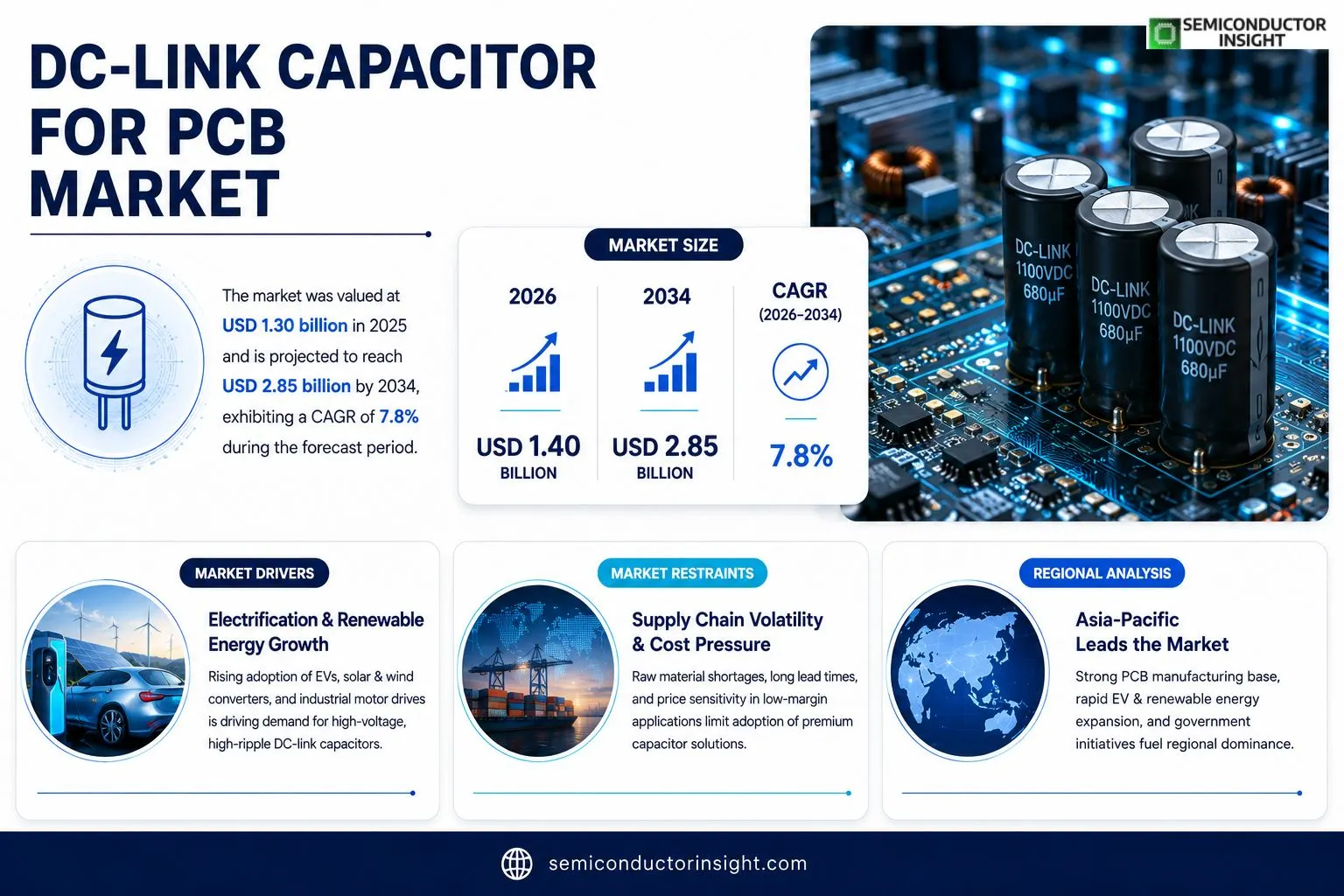
DC‑Link Capacitor for PCB market was valued at USD 1.30 billion in 2025 and rose to USD 2.85 billion by 2034, reflecting an annual compound growth rate of 7.8 % over the period.
DC‑Link capacitors mounted on printed circuit boards serve as essential energy‑storage elements in three‑phase inverter modules used for electric‑vehicle motor drives, photovoltaic and wind‑energy converters, industrial motor drives, on‑board chargers, as well as power supplies feeding medical and industrial equipment.The expansion of this segment aligns with the broader printed‑circuit‑board industry, whose total output value reached USD 81 billion in 2022 according to semiconductor research data. Adoption of AI‑enabled devices, rollout of 5G infrastructure, and acceleration of new‑energy vehicle production create sustained demand for high‑performance capacitors. Moreover, manufacturers are focusing on higher rated voltages,500 Vdc through 1100 Vdc,to meet efficiency targets in renewable‑energy systems while maintaining reliability standards required by critical applications such as uninterruptible power supplies.
MARKET DRIVERS
Electrification of Industrial Equipment
The shift toward energy‑efficient motor drives in factories has increased demand for high‑performance DC‑Link capacitors that can handle higher voltages while maintaining compact footprints on printed circuit boards. Manufacturers are substituting legacy electrolytic designs with film‑based solutions, because the latter offer lower ESR and longer life cycles, directly influencing the cost of ownership.
Growth of Renewable Energy Converters
Solar‑inverter and wind‑turbine power converters rely on robust DC‑Link stages to stabilize fluctuating input currents. As utility‑scale projects expand, system integrators prioritize capacitors that combine high ripple current capability with thermal resilience, prompting a measurable uptick in procurement volumes.
➤ “Component reliability now drives system architecture decisions more than ever before.”
Automotive power‑train designers are also integrating DC‑Link capacitors into hybrid and electric vehicle converters. The need to meet stringent weight and space constraints forces suppliers to innovate thin‑film constructions, thereby creating a new revenue stream within the DC‑Link Capacitor for PCB Market.
MARKET CHALLENGES
Supply‑Chain Volatility
Recent raw‑material shortages for high‑purity polymer films have produced lead times that exceed six months for certain voltage classes. End users facing production bottlene‑cks are forced to maintain higher safety stocks, which inflates working capital and erodes margin potential.
Other Challenges
Regulatory Compliance
Stringent RoHS and REACH restrictions limit the use of certain dielectric additives, compelling manufacturers to reformulate chemistries. The transition period introduces additional testing cycles, slowing time‑to‑market for new product families.
MARKET RESTRAINTS
Cost Sensitivity in Low‑Margin Segments
OEMs operating in consumer‑grade power supplies often allocate less than 2 % of total bill‑of‑materials to DC‑Link capacitors. When price pressure intensifies, they may revert to lower‑spec components, curbing the overall spend on premium film solutions.Furthermore, the incremental cost of advanced ceramic additives, while improving performance, remains a barrier for volume manufacturers seeking to keep unit prices under tight thresholds.
MARKET OPPORTUNITIES
High‑Power Density Applications
Emerging sectors such as data‑center power distribution units and aerospace power electronics demand capacitors that deliver higher energy density without sacrificing reliability. Companies that can certify ultra‑thin, high‑voltage films stand to capture a disproportionate share of future spend.Strategic partnerships between capacitor manufacturers and PCB designers are also opening channels for co‑development of embedded‑cap solutions, which could reduce assembly steps and improve thermal management across the DC‑Link Capacitor for PCB Market.
DC-Link Capacitor for PCB Market Trends
Electric‑Vehicle Power‑train Demand
The surge in electric‑vehicle adoption is reshaping component sourcing strategies, and DC‑Link Capacitor for PCB units are becoming a critical bottleneck in inverter design. Automakers are tightening specifications for voltage stability and thermal performance, prompting suppliers to prioritize higher‑rated voltage families (500 Vdc‑1100 Vdc). This shift forces manufacturers to balance cost pressure against the need for tighter tolerances, influencing bill‑of‑materials allocations across the supply chain. Companies that can offer consistent quality at scale are gaining a decisive edge in contracts with OEMs seeking to accelerate model rollouts.
Other Trends
Renewable Energy Inverter Expansion
Photovoltaic and wind‑farm converters are scaling from megawatt‑class installations to distributed micro‑grid solutions. The modular nature of DC‑Link Capacitor for PCB assemblies enables designers to adapt to fluctuating grid conditions while maintaining efficiency targets above 95 %. As grid codes tighten, the emphasis on low‑loss dielectric materials is translating into a wave of product redesigns, nudging suppliers toward new chemistries and tighter form‑factor standards. The resulting product refresh cycles create recurring revenue opportunities for firms with agile R&D pipelines.
Regional Shifts in PCB Production
Asia remains the dominant hub for PCB fabrication, yet recent investment in advanced‑node facilities across South‑East Asia and India is redistributing capacity. Chinese manufacturers, while still holding the largest share, are encountering rising labor costs and stricter environmental regulations, prompting a subtle off‑shoring to neighboring economies. This geographic diversification is influencing lead‑time expectations for DC‑Link Capacitor for PCB shipments, compelling distributors to develop multi‑source strategies. For end‑users, the emerging regional mix offers both pricing leverage and risk mitigation against supply disruptions.
COMPETITIVE LANDSCAPE
Key Industry Players
DC‑Link Capacitor for PCB Market – Competitive Overview
TDK Corporation dominates the DC‑Link capacitor segment for printed‑circuit‑board applications, leveraging a broad product range that spans 500 V dc to 1100 V dc ratings. Its extensive wafer‑level integration capabilities, combined with strategic acquisitions of niche Asian firms, have enabled TDK to secure long‑term supply contracts with major EV inverter manufacturers and renewable‑energy inverter producers. The company’s focus on high‑reliability silicone‑based ceramics aligns with the stringent quality standards of automotive‑grade power modules, reinforcing its position as a preferred supplier for OEMs seeking robust, temperature‑stable components. Concomitantly, the overall market structure remains moderately consolidated, with three to five entities accounting for roughly half of total sales, while the remainder is fragmented across specialized manufacturers that target bespoke voltage or form‑factor requirements.Beyond the tier‑one leaders, several niche firms have carved out defensible positions by tailoring their portfolios to specific application niches or regional demand patterns. Xiamen Faratronic and Xiamen Hongfa Electroacoustic, for instance, excel in cost‑competitive aluminum electrolytic designs that serve mass‑market industrial motor drives in Southeast Asia. AVX and Vishay supply high‑frequency, low‑ESR ceramic variants that are favored in medical‑equipment power supplies, where electromagnetic interference tolerances are tight. Yageo (KEMET) and Panasonic diversify their offerings across both ceramic and film technologies, allowing them to address the divergent needs of 5G infrastructure power modules and UPS systems. Smaller players such as Qixing Capacitor, Yangzhou Kaipu Electronics, Shengye Electrical, and Zhongxing Electronic maintain regional relevance through rapid prototype cycles and localized support, positioning themselves as agile alternatives to the larger, ly dispersed competitors.
List of Key DC‑Link Capacitor for PCB Companies Profiled
- TDK Corporation
- Xiamen Faratronic
- Xiamen Hongfa Electroacoustic
- Qixing Capacitor
- Yangzhou Kaipu Electronics
- Shengye Electrical
- Zhongxing Electronic
- AVX
- Yageo (KEMET)
- Vishay
- Panasonic
- Murata Manufacturing
- Samsung Electro‑Mechanics
- Taiyo Yuden
- NEC Tokin
Segment Analysis:
| Segment Category | Sub-Segments | Key Insights |
| By Type |
|
500Vdc remains the dominant voltage class because it aligns well with the power requirements of many inverter topologies and offers a balanced trade‑off between size and performance.
|
| By Application |
|
Photovoltaic is emerging as the most compelling application channel, driven by the rapid rollout of solar farms and rooftop installations.
|
| By End User |
|
Electric Vehicles drive a sophisticated demand profile for DC‑Link capacitors, as power‑train architectures evolve toward higher power densities.
|
| By Reliability Class |
|
High Reliability is gaining traction where failure‑critical applications demand stringent quality controls.
|
| By Emerging Trend |
|
Miniaturization is reshaping design philosophies, as boards become denser and performance expectations rise.
|
Regional Analysis: DC-Link Capacitor for PCB Market
Asia‑Pacific
Tier‑1 capacitor producers are merging with substrate manufacturers to lock in material access and reduce lead times. The resulting vertical integration streamlines board‑level design, curbing the risk of component shortages that previously hampered high‑mix production lines.
OEMs are embedding more stringent thermal‑cycling tests into their qualification processes. This shift pressures capacitor makers to enhance film stability and improve dielectric loss characteristics, directly influencing product roadmaps.
Energy‑efficiency directives across China, Japan and South Korea mandate lower standby losses for power converters. Compliance drives adoption of advanced DC‑link capacitor chemistries that balance size reduction with higher voltage withstand.
Universities in the region are feeding a pipeline of specialists in high‑frequency power electronics, accelerating the diffusion of novel film‑forming processes that improve ripple current capability on PCBs.
North America
North America remains a technology incubator, where premium‑grade DC‑Link Capacitor for PCB solutions serve aerospace, data‑center, and defense applications. The market’s trajectory is anchored in the demand for high‑efficiency converters that meet strict emissions standards, prompting end‑users to prioritize low‑ESR, high‑temperature components. Although volume is modest compared to Asia‑Pacific, the region’s willingness to pay for reliability creates a niche for specialty manufacturers that partner with silicon‑carbide inverter developers. Recent collaborations between U.S. semiconductor firms and capacitor specialists underscore a strategic shift toward co‑development of boards that can survive harsh thermal cycling, a prerequisite for next‑generation electric‑grid storage systems.
Europe
European automotive and industrial sectors drive a distinct set of expectations for the DC‑Link Capacitor for PCB Market. Stringent EU directives on energy consumption and a strong push toward electrified transport compel manufacturers to select capacitors that deliver consistent performance under tight space constraints. German and French engineering houses are favoring suppliers that can guarantee long‑term reliability, which has sparked a modest uptick in localized production of film‑based capacitors. In parallel, the rise of green‑hydrogen projects across Scandinavia adds a new demand vector, as power‑electronic modules for electrolyzers rely on robust DC‑link solutions to manage fluctuating loads.
South America
South America’s market is shaped by expanding renewable‑energy installations, particularly in Brazil and Chile, where grid‑scale inverter farms rely on compact power‑conversion boards. The region’s cost‑sensitivity means that manufacturers gravitate toward mid‑range capacitor offerings that balance price with acceptable ripple current performance. Local distributors are increasingly acting as technical advisors, helping utilities select capacitors that can tolerate the high ambient temperatures typical of the continent’s tropical zones. While overall demand remains nascent, ongoing infrastructure projects signal a gradual shift toward more sophisticated DC‑link components.
Middle East & Africa
In the Middle East & Africa, the DC‑Link Capacitor for PCB Market is propelled by large‑scale solar‑power deployments and the nascent adoption of electrified public‑transport fleets in United Arab Emirates and South Africa. Extreme ambient temperatures challenge capacitor reliability, prompting system integrators to specify polymer‑film variants with enhanced thermal endurance. The region’s procurement cycles are increasingly aligned with standards, as multinational EPC firms bring best‑practice specifications to local projects. Although the market size is still limited, the combination of government incentives for renewable energy and a growing appetite for electric mobility positions the area for steady, technology‑driven growth over the next decade.
Report Scope
This market research report provides a comprehensive analysis of the DC-Link Capacitor for PCB Market , covering the forecast period 2026–2034. It offers detailed insights into market dynamics, technological advancements, competitive landscape, and key trends shaping the industry.
Key focus areas of the report include:
- Market Overview: The report begins with an overview outlining its current market scenario, key growth indicators, and industry transformation drivers. It discusses macroeconomic factors, demand–supply balance, regulatory landscape, and the strategic role of semiconductors in powering advancements across industries such as automotive, telecommunications, consumer electronics, and industrial automation.
- Market Size & Forecast: Historical data and future projections for revenue, unit shipments, and market value across major regions and segments.
- Segmentation Analysis: Detailed breakdown by product type, technology, application, and end-user industry to identify high-growth segments and investment opportunities.
- Regional Insights: Insights into market performance across North America, Europe, Asia-Pacific, Latin America, and the Middle East & Africa, including country-level analysis where relevant.
- Competitive Landscape: Profiles of leading market participants, including their product offerings, R&D focus, manufacturing capacity, pricing strategies, and recent developments such as mergers, acquisitions, and partnerships.
- Technology Trends & Innovation: Assessment of emerging technologies, integration of AI/IoT, semiconductor design trends, fabrication techniques, and evolving industry standards.
- Market Drivers & Restraints: Evaluation of factors driving market growth along with challenges, supply chain constraints, regulatory issues, and market-entry barriers.
- Stakeholder Insights: Insights for component suppliers, OEMs, system integrators, investors, and policymakers regarding the evolving ecosystem and strategic opportunities.
Primary and secondary research methods are employed, including interviews with industry experts, data from verified sources, and real-time market intelligence to ensure the accuracy and reliability of the insights presented.
FREQUENTLY ASKED QUESTIONS:
What is the current market size of DC-Link Capacitor for PCB Market?
-> DC-Link Capacitor for PCB Market was valued USD 1.30 billion in 2025 and rose to USD 2.85 billion by 2034, reflecting an annual compound growth rate of 7.8 % over the period
Which key companies operate in DC-Link Capacitor for PCB Market?
-> Key players include TDK Corporation, Xiamen Faratronic, Xiamen Hongfa Electroacoustic, Qixing Capacitor, Yangzhou Kaipu Electronics, Shengye Electrical, Zhongxing Electronic, AVX, Yageo (KEMET), Vishay, Panasonic.
What are the key growth drivers?
-> Key growth drivers include rapid proliferation of electronic devices, increasing adoption of green energy sources, growth of electric vehicles, renewable energy conversion, and industrial automation.
Which region dominates the market?
-> Asia holds the largest share, driven by extensive PCB manufacturing capacity in China, Taiwan, Japan, and South Korea.
What are the emerging trends?
-> Emerging trends include development of more efficient and reliable DC‑Link capacitor designs, integration with smart energy systems, and focus on environmentally friendly circuit solutions.
Get Sample Report PDF for Exclusive Insights
Report Sample Includes
- Table of Contents
- List of Tables & Figures
- Charts, Research Methodology, and more...
 Download Sample Report PDF