Wire Wound Chip Reactors Market Insights
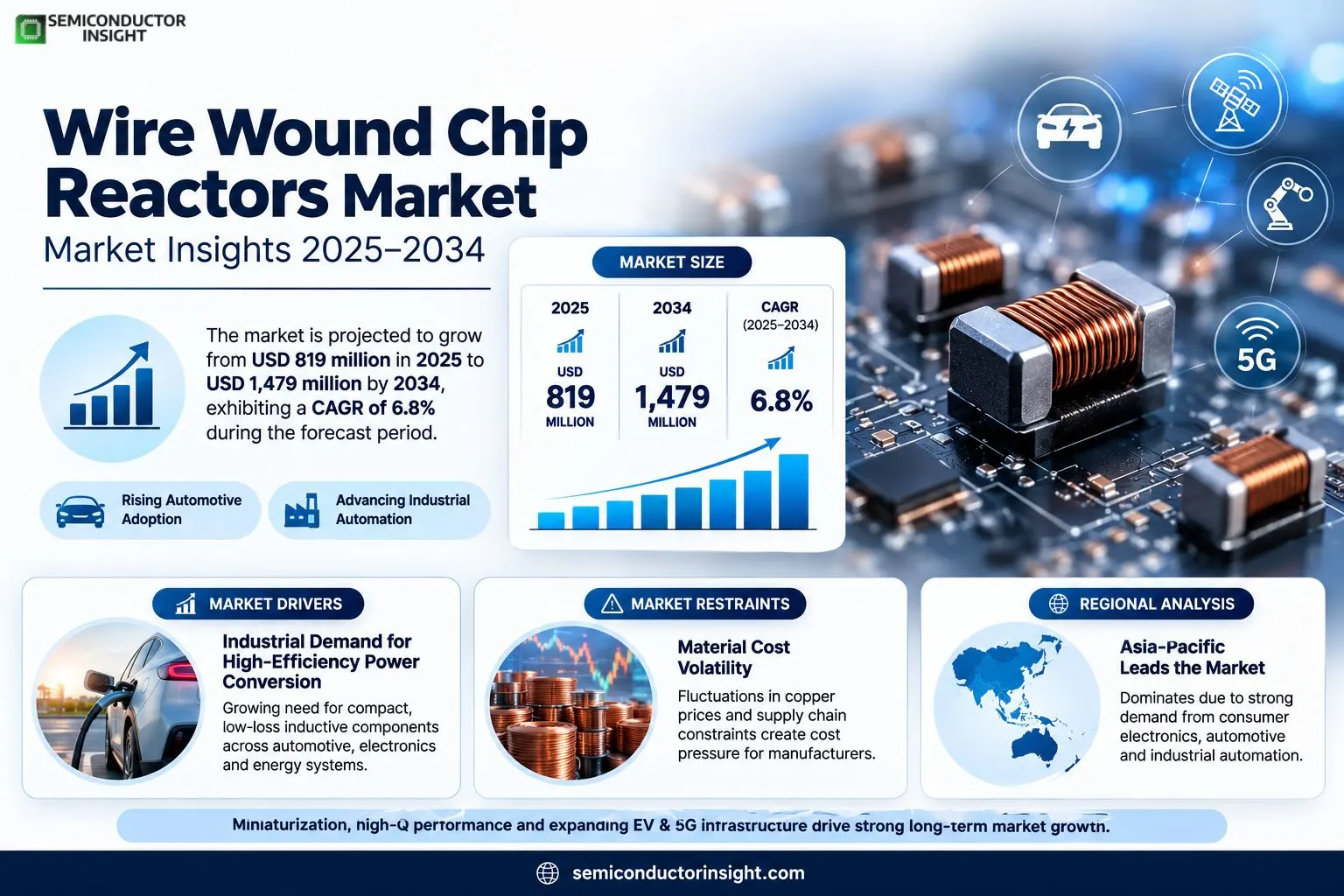
Wire Wound Chip Reactors market size was valued at USD 819 million in 2025. The market is projected to grow from USD 819 million in 2025 to USD 1479 million by 2034, exhibiting a CAGR of 6.8% during the forecast period.
Wire wound chip reactors are inductors where copper windings are wrapped around a magnetic core forming an inductive coil. They provide a wide inductance range (mH‑H), high accuracy, low loss (high Q), sizable current capability and simple manufacturing; nevertheless, further miniaturisation remains limited.The expansion is driven by growing deployment of these reactors in electronic equipment for electromagnetic‑interference suppression, increasing adoption in automotive and aerospace subsystems, and rising demand for ferrite chokes within automation machinery. Prominent suppliers such as TDK, Murata, Taiyo Yuden, Sunlord and Vishay are extending product lines while investing in advanced ferrite technologies.
MARKET DRIVERS
Industrial Demand for High‑Efficiency Power Conversion
Wire Wound Chip Reactors Market is being propelled by manufacturers that require compact, low‑loss inductive components for high‑frequency converters. As equipment sizes shrink, the need for reactors that deliver superior thermal performance without sacrificing footprint becomes a decisive factor for system designers.
Regulatory Incentives for Energy‑Saving Technologies
Governments across North America and Europe have introduced efficiency standards that push OEMs toward solutions with reduced copper losses. Wire‑wound chip reactors, with their precise magnetic path control, align well with those standards, encouraging broader adoption across automotive and renewable‑energy sectors.
➤ Design engineers cite the predictable impedance profile of wire‑wound reactors as a key factor in meeting tight electromagnetic compatibility (EMC) specifications.
These drivers collectively tighten the value chain, prompting suppliers to invest in advanced winding technologies and tighter tolerances, which in turn accelerates market momentum.
MARKET CHALLENGES
Material Cost Volatility
Fluctuations in copper prices inject uncertainty into bill‑of‑materials calculations, forcing manufacturers to reassess pricing strategies. When raw‑material costs spike, the margin compression can delay new project approvals, especially for cost‑sensitive end‑markets such as consumer electronics.
Other Challenges
Supply Chain Bottlenecks
Limited capacity at specialty winding facilities creates lead‑time extensions. Clients seeking rapid prototyping often encounter delays, which can erode confidence in the supply network and prompt a search for alternative component families.
MARKET RESTRAINTS
Technological Substitution by Integrated Magnetics
Some manufacturers favor fully integrated magnetics modules that embed the reactor within a single package, citing lower assembly costs. While these solutions deliver comparable performance for certain frequency ranges, they limit design flexibility, yet the trend does siphon a portion of potential orders away from discrete wire‑wound products.
MARKET OPPORTUNITIES
Expansion into Emerging Automotive Powertrains
Electric‑vehicle architectures increasingly rely on high‑frequency DC‑DC converters, where compact, high‑efficiency reactors are indispensable. Companies that can certify their wire‑wound chip reactors for automotive reliability standards stand to capture a sizable share of this growing demand, especially as vehicle electrification rates accelerate worldwide.
Wire Wound Chip Reactors Market Trends
Rising Adoption in Automotive and Industrial Automation
Automakers are incorporating wire wound chip reactors to meet stricter electromagnetic‑interference (EMI) regulations while preserving power‑train efficiency. The reactors’ high inductance accuracy and low loss profile make them ideal for on‑board chargers, electric‑vehicle inverters, and advanced driver‑assistance sensors. In parallel, factories upgrading to Industry 4.0 standards are re‑engineering motor‑drive circuits, where the same devices serve as compact, high‑Q filters that stabilize current spikes from programmable logic controllers. The convergence of tighter emissions standards and the need for precise, low‑profile power conditioning is fueling a noticeable uptick in component orders across both sectors.
Other Trends
Shift Toward Ferrite Core Designs
Manufacturers are progressively favoring ferrite cores over traditional ceramic substrates to address the thermal constraints of high‑current applications. Ferrite’s superior permeability enables smaller coil dimensions while retaining the required inductance range, directly tackling the miniaturisation ceiling that has long limited chip‑reactor deployment in portable electronics. This material transition also aligns with the automotive push for lighter, more thermally stable components, prompting a wave of new product introductions that emphasize reduced core loss at elevated frequencies.
Emerging Demand in High‑Frequency RF Applications
Wireless infrastructure and satellite‑receiver manufacturers are turning to wire wound chip reactors for band‑pass and notch filtering in the 2‑6 GHz range. Their ability to deliver high Q‑factors at millimetre‑scale footprints addresses the aggressive size‑to‑performance ratios demanded by 5G base stations and modern satellite payloads. As antenna‑array architectures become denser, designers are relying on these reactors to isolate inter‑module coupling, thereby preserving signal integrity without inflating board real‑estate. The resulting procurement trend signals a broader shift where high‑frequency RF performance, rather than merely cost, dictates component selection within Wire Wound Chip Reactors Market.
COMPETITIVE LANDSCAPEKey Industry Players
Wire Wound Chip Reactors: Competitive Pressures and Market Structure
TDK dominates the arena, leveraging a vertically integrated supply chain that spans core material production to finished‑product assembly. Its extensive catalogue of ceramic and ferrite chip reactors serves automotive infotainment, industrial automation, and consumer electronics, allowing the firm to set benchmark pricing and dictate technology roadmaps. Murata and Taiyo Yuden follow closely, each investing heavily in high‑Q ferrite formulations that meet the stringent electromagnetic compatibility (EMC) requirements of next‑generation vehicular networks. Collectively, these three entities capture roughly four‑tenths of worldwide shipments, creating a market where scale and access to proprietary magnetic powders become decisive factors for new entrants. The concentration of R&D resources in these incumbents also accelerates the introduction of miniaturized designs, albeit within the physical limits imposed by winding techniques.Beyond the tier‑one giants, a constellation of specialist manufacturers enriches the competitive fabric. Sunlord and Yageo concentrate on cost‑effective solutions for mass‑market RF modules, while Chilisin and Microgate differentiate through aerospace‑grade certification and ultra‑low loss configurations. Samsung Electro‑Mechanics exploits its semiconductor legacy to embed chip reactors directly within power‑management ICs, targeting compact smartphones and wearables. Bourns maintains a strong foothold in high‑current automotive power‑train applications, whereas Fenghua Advanced emerges as a Chinese challenger with aggressive pricing. Würth Elektronik supplies European OEMs that prioritize reliability in industrial controllers, and Vishay expands its portfolio into multilayer inductors that bridge power and signal domains. Tecstar, Laird, and Max Echo focus on defense and high‑frequency sectors, where ruggedness and stringent performance specifications drive demand.
List of Key Wire Wound Chip Reactors Companies Profiled
- TDK
- Murata
- Taiyo Yuden
- Sunlord
- Yageo
- Chilisin
- Microgate
- Samsung Electro‑Mechanics
- Bourns
- Fenghua Advanced
- Würth Elektronik GmbH
- Vishay
- Tecstar
- Laird
- Max Echo
Segment Analysis:
| Segment Category | Sub-Segments | Key Insights |
| By Type |
|
Wire Wound Ferrite Chip Reactors
|
| By Application |
|
RF Technique
|
| By End User |
|
Consumer Electronics
|
| By Technology |
|
Surface Mount (SMD)
|
| By Industry |
|
Telecommunications
|
Regional Analysis: Wire Wold Chip Reactors Market
Asia‑Pacific
Major equipment makers have erected new fabrication lines near Shenzhen and Seoul, shortening lead times for custom coils. Capacity upgrades focus on alloy‑specific winding techniques that improve thermal inertia, allowing customers to run reactions at higher loads without compromising safety. The localized capacity helps meet the surge in demand from downstream chemical plants seeking rapid turn‑around of reactor units.
While traditional petrochemical processing remains dominant, a noticeable shift toward high‑purity pharma intermediates and advanced battery electrolyte synthesis is reshaping product specifications. Engineers are tailoring wire gauge and insulation layers to meet tighter purity thresholds, which expands the addressable market beyond conventional sectors.
Regional safety directives increasingly reference IEC 61511 for functional safety of process equipment. Compliance pressures manufacturers to embed diagnostic features within the winding assemblies, fostering a wave of smart‑reactor modules that can self‑report thermal excursions, thereby differentiating suppliers that invest early in compliant designs.
Venture funds with a clean‑tech focus are allocating capital to startups that integrate wire‑wound reactors into modular process platforms. This financing trend not only accelerates product innovation but also creates strategic partnerships with established OEMs seeking entry into niche application areas like green hydrogen production.
North America
North America retains a solid foothold in Wire Wound Chip Reactors Market, largely sustained by sophisticated downstream users in the United States and Canada. The region’s emphasis on high‑value specialty chemicals and aerospace‑grade material processing encourages adoption of reactors that promise tighter temperature control. However, the market faces a paradox: stringent environmental regulations push for greener processes, yet legacy infrastructure limits rapid retrofitting. Companies are therefore investing in modular upgrades that allow incremental integration of wire‑wound units without extensive plant shutdowns. This incremental approach sustains demand while aligning with corporate sustainability roadmaps, positioning the market for steady, if measured, growth.
Europe
European manufacturers benefit from a mature regulatory framework that emphasizes energy efficiency and occupational safety. Wire Wound Chip Reactors Market here is characterised by a preference for high‑precision engineering, with German and French firms leading in custom coil designs that minimise thermal lag. Despite a comparatively slower expansion rate than Asia‑Pacific, Europe’s focus on circular‑economy initiatives drives interest in reactors that enable closed‑loop processes, reducing waste heat. This strategic alignment with environmental policy creates niche opportunities for suppliers that can certify compliance with EU directives, fostering a competitive but stable market environment.
South America
In South America, the market is shaped by a burgeoning petrochemical sector in Brazil and Argentina, where cost‑effective temperature management solutions are prized. Wire Wound Chip Reactors are favored for their durability in harsh operating conditions, a valuable trait given the region’s variable power quality. Market participants are concentrating on building local assembly capabilities to curb import dependence, a move that also supports technology transfer and up‑skilling of the workforce. Although the overall scale remains modest, the emphasis on self‑sufficiency is likely to stimulate gradual adoption across the continent’s process‑intensive industries.
Middle East & Africa
The Middle East & Africa region presents a mixed picture: oil‑rich economies in the Gulf are investing heavily in downstream value addition, while African markets are still in the early adoption phase. Wire Wound Chip Reactors appeal to Gulf refineries seeking to optimise catalyst lifespans under extreme thermal loads. In contrast, African nations with nascent industrial parks view these reactors as a pathway to modernise basic chemical production without extensive capital outlays. Partnerships between multinational OEMs and regional engineering firms are emerging as a catalyst for technology diffusion, gradually expanding the market footprint across the region.
Report Scope
This market research report provides a comprehensive analysis of the Wire Wound Chip Reactors Market , covering the forecast period 2026–2034. It offers detailed insights into market dynamics, technological advancements, competitive landscape, and key trends shaping the industry.
Key focus areas of the report include:
- Market Overview: The report begins with an overview outlining its current market scenario, key growth indicators, and industry transformation drivers. It discusses macroeconomic factors, demand–supply balance, regulatory landscape, and the strategic role of semiconductors in powering advancements across industries such as automotive, telecommunications, consumer electronics, and industrial automation.
- Market Size & Forecast: Historical data and future projections for revenue, unit shipments, and market value across major regions and segments.
- Segmentation Analysis: Detailed breakdown by product type, technology, application, and end-user industry to identify high-growth segments and investment opportunities.
- Regional Insights: Insights into market performance across North America, Europe, Asia-Pacific, Latin America, and the Middle East & Africa, including country-level analysis where relevant.
- Competitive Landscape: Profiles of leading market participants, including their product offerings, R&D focus, manufacturing capacity, pricing strategies, and recent developments such as mergers, acquisitions, and partnerships.
- Technology Trends & Innovation: Assessment of emerging technologies, integration of AI/IoT, semiconductor design trends, fabrication techniques, and evolving industry standards.
- Market Drivers & Restraints: Evaluation of factors driving market growth along with challenges, supply chain constraints, regulatory issues, and market-entry barriers.
- Stakeholder Insights: Insights for component suppliers, OEMs, system integrators, investors, and policymakers regarding the evolving ecosystem and strategic opportunities.
Primary and secondary research methods are employed, including interviews with industry experts, data from verified sources, and real-time market intelligence to ensure the accuracy and reliability of the insights presented.
FREQUENTLY ASKED QUESTIONS:
What is the current market size of Wire Wound Chip Reactors Market?
-> Wire Wound Chip Reactors market was valued at USD 766 million in 2024 and is expected to reach USD 1211 million by 2031, at a CAGR of 6.9% during the forecast period.
Which key companies operate in Wire Wound Chip Reactors Market?
-> Key players include TDK, Murata, TAIYO YUDEN, Sunlord, Yageo, Chilisin, Microgate, Samsung, Bourns, Fenghua Advanced, Würth Elektronik GmbH, Vishay, Tecstar, Laird, Max Echo.
What are the key growth drivers?
-> Key growth drivers include increasing adoption of wire wound chip reactors in electronic equipment to reduce electromagnetic interference, expanding use in military and aerospace systems, growing demand from automotive and transportation sectors, and rising integration of ferrite chokes in automation and factory applications.
Which region dominates the market?
-> Asia-Pacific is the leading region, driven by strong demand in consumer electronics, automotive manufacturing, and industrial automation, while Europe and North America also show significant growth.
What are the emerging trends?
-> Emerging trends include greater integration of wire wound chip reactors in electric vehicle power modules, miniaturization efforts despite size constraints, and the development of high‑Q ferrite materials to enhance performance in high‑frequency applications.
Get Sample Report PDF for Exclusive Insights
Report Sample Includes
- Table of Contents
- List of Tables & Figures
- Charts, Research Methodology, and more...
 Download Sample Report PDF