Smart Lighting LED Driver IC Market Insights
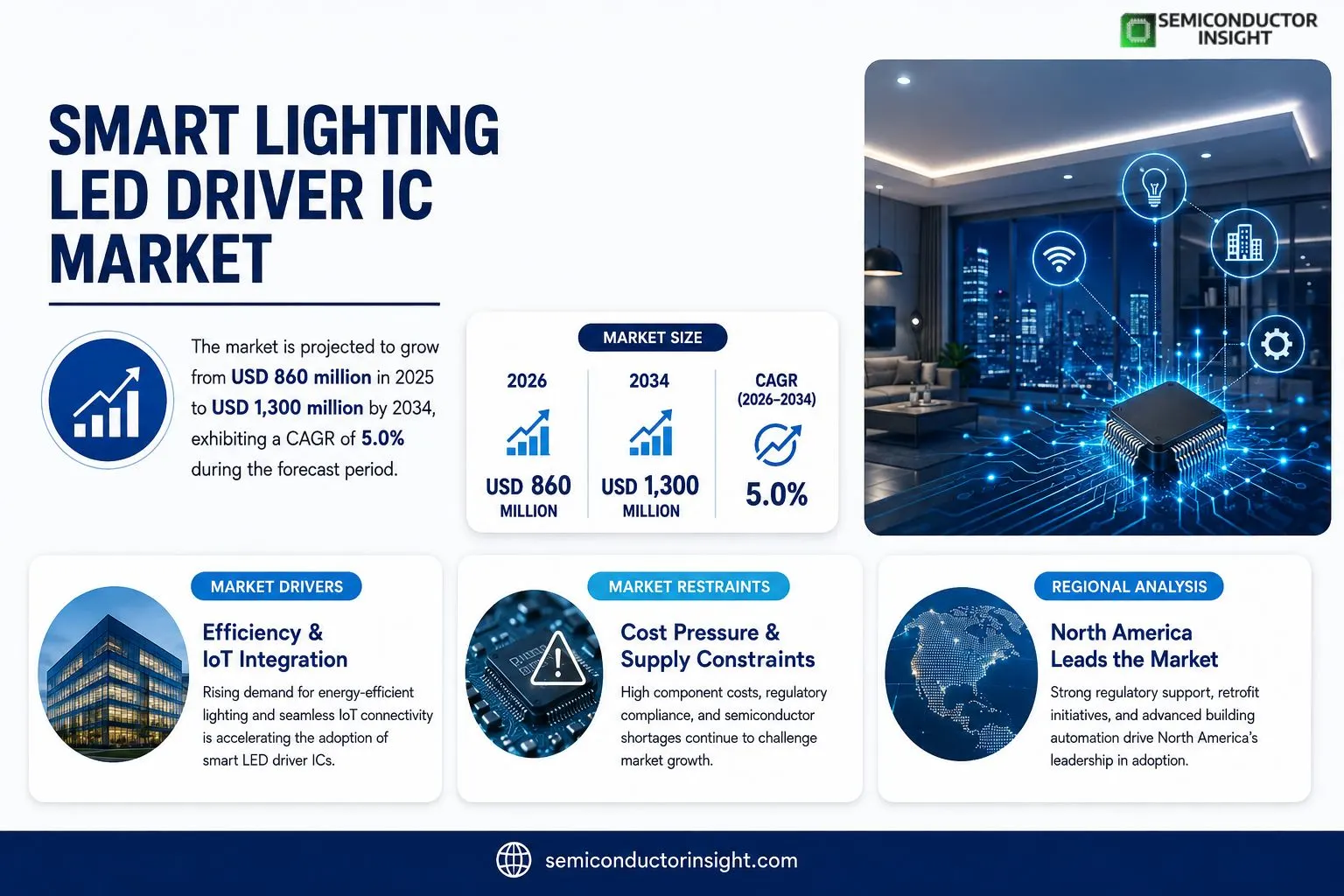
Smart Lighting LED Driver IC market size was valued at USD 800 million in 2024. It will increase to USD 860 million in 2025 and reach USD 1,300 million by 2034, reflecting an annual growth rate of about 5 % over the forecast horizon.
Smart lighting LED driver IC is an integrated circuit that delivers precise brightness control and backlighting colour management. Typically embedded within an LED driver circuit, it enables fine‑tuned luminance regulation while extending the operational life of LEDs through stable current delivery.
MARKET DRIVERS
Efficiency Improvements
The adoption of higher‑efficiency driver architectures is reducing overall system power draw by up to 15 %. This reduction translates into lower operating expenses for commercial facilities, prompting architects to specify advanced driver ICs during the design phase. Smart Lighting LED Driver IC Market players are capitalising on this trend by offering dimming solutions that maintain colour fidelity while cutting energy use.
Integration with IoT Platforms
Manufacturers that embed networking protocols directly into the silicon are creating a seamless bridge between lighting hardware and building‑management software. This convergence enables real‑time occupancy sensing, daylight harvesting, and predictive maintenance, all of which are reshaping spend‑allocation decisions in large‑scale projects. Companies that provide open‑API driver modules are gaining a competitive edge.
➤ “The next wave of growth will belong to suppliers who embed analytics at the chip level, not just at the controller.”
From a financial perspective, the incremental margin associated with these value‑added features is averaging 7 % above baseline driver products, encouraging OEMs to upgrade their core component lists. As a result, the sector is witnessing a steady shift toward integrated, software‑ready driver ICs.
MARKET CHALLENGES
Regulatory Hurdles
Stringent electromagnetic‑compatibility standards across Europe and North America are forcing manufacturers to redesign layouts and add shielding, which inflates bill‑of‑materials costs. Compliance testing cycles now extend beyond twelve months for many new parts, delaying time‑to‑market and squeezing cash flow for smaller design houses.
Other Challenges
Supply‑chain Bottlenecks
The semiconductor shortage that began in 2020 continues to affect critical components such as MOSFETs and inductors. Lead times for these items have stretched to eight weeks, compelling system integrators to maintain higher safety stocks and eroding the price advantage of volume purchases.
MARKET RESTRAINTS
Cost Sensitivity
Although energy‑saving benefits are clear, end‑users remain highly price‑aware, especially in retrofit projects where budget caps are strict. The premium attached to advanced driver ICsoften 20‑30 % above conventional partscreates a barrier for adoption in cost‑constrained segments such as education and public housing.
MARKET OPPORTUNITIES
Emerging Applications
Beyond commercial lighting, automotive interior illumination, horticultural grow‑lights, and wearable health devices are beginning to integrate intelligent driver ICs. Each of these niches demands compact form factors, precise current regulation, and remote programmabilityattributes that align directly with the strengths of next‑generation driver silicon. Early entry into these arenas could unlock revenue streams that dwarf traditional building‑automation markets.
Smart Lighting LED Driver IC Market Trends
Advancement of Adaptive Brightness Control
The integration of closed‑loop sensing within driver ICs is reshaping how luminaires respond to occupancy and daylight. By continuously measuring ambient levels, these chips modulate output with fine granularity, extending LED lifespans while trimming energy bills. Manufacturers that embed photodiodes and micro‑controllers on a single die are gaining a competitive edge because installers can achieve compliance with increasingly strict building codes without aftermarket retrofits. This shift is prompting OEMs to reassess bill‑of‑materials, allocating more budget to mixed‑signal architectures that support both dimming and color temperature tuning.
Other Trends
Rise of AC Driver Segments
Commercial facilities are favoring AC‑compatible driver ICs to simplify wiring and reduce transformer count. The convenience of a single‑stage conversion aligns with the push for modular lighting fixtures that can be dropped into existing junction boxes. Suppliers reporting higher order volumes note that the AC segment’s design flexibility shortens time‑to‑market, allowing projects to meet tight construction schedules. As a side effect, the demand for high‑voltage tolerant pass‑banks and robust isolation structures is rising, nudging silicon‑on‑silicon solutions into the spotlight.
Geographic Divergence in Adoption
North America continues to prioritize smart retrofit programs, driven by municipal incentives that reward energy‑saving upgrades in legacy properties. Meanwhile, Asian manufacturers are channeling R&D into ultra‑compact driver ICs suited for high‑density residential units, where space constraints dominate design choices. Europe’s emphasis on circular‑economy standards is accelerating the adoption of driver chips that facilitate easy disassembly and component reclamation. These regional nuances create pockets of opportunity for vendors that can tailor firmware and support services to local regulatory frameworks, thereby strengthening market positioning without relying on uniform strategies.
COMPETITIVE LANDSCAPE
Key Industry Players
Smart Lighting LED Driver IC Market – Competitive Overview
The segment is anchored by a handful of multinational semiconductor firms whose design portfolios combine high‑efficiency power management with integrated dimming protocols. Infineon Technologies AG leads the field, leveraging its CoolMOS and XMC families to secure large contracts with OEMs in automotive lighting and commercial building automation. Texas Instruments follows closely, differentiating through its Simple Switcher and LED driver families that integrate adaptive control algorithms, a capability increasingly demanded by smart‑city projects. Both companies have deep R&D pipelines and maintain a sales footprint, enabling them to set reference architectures that smaller rivals must accommodate. Their scale also allows aggressive pricing, pressuring margins across the supply chain while encouraging collaborative standard‑setting within industry consortia.Beyond the dominant duopoly, a diverse set of specialized players adds depth to the ecosystem. STMicroelectronics and NXP focus on mixed‑signal solutions that pair LED control with wireless connectivity, positioning them well for IoT‑enabled lighting fixtures. Analog Devices and Maxim Integrated offer precision current‑regulation blocks that appeal to high‑end architectural lighting where color fidelity is critical. Regional innovators such as ROHM, Cypress Semiconductor, and Richtek Technology provide cost‑effective parts that satisfy volume manufacturers in China and Southeast Asia. Meanwhile firms like Meanwell, Power Integrations, and Diodes Incorporated concentrate on compact, off‑the‑shelf driver modules, supporting rapid‑time‑to‑market for lighting startups. This layered competitive structure creates a dynamic where technology leadership, geographic presence, and price positioning each drive distinct business opportunities.
List of Key Smart Lighting LED Driver IC Companies Profiled
- Infineon Technologies AG
- Texas Instruments Inc.
- STMicroelectronics
- NXP Semiconductors N.V.
- Analog Devices, Inc.
- Maxim Integrated (now part of Analog Devices)
- ROHM Semiconductor
- Cypress Semiconductor
- Richtek Technology Corp.
- Allegro MicroSystems
- Mean Well Enterprise Co., Ltd.
- Power Integrations, Inc.
- Diodes Incorporated
- Microchip Technology Inc.
- Intersil (Renesas Electronics)
Segment Analysis:
| Segment Category | Sub-Segments | Key Insights |
| By Type |
|
Leading Segment emphasizes flexibility in power sourcing and ease of integration.
|
| By Application |
|
Leading Segment drives innovation through user‑centric lighting experiences.
|
| By End User |
|
Leading Segment reflects the growing emphasis on user experience and operational efficiency.
|
| By Power Mode |
|
Leading Segment is shaped by the desire for precise illumination control and energy optimisation.
|
| By Integration Level |
|
Leading Segment drives the convergence of lighting and IoT functionality.
|
Regional Analysis: Smart Lighting LED Driver IC Market
North America
Stringent energy‑efficiency standards across the United States and Canada compel architects to specify driver ICs that meet low‑power thresholds, while provincial incentive programs reward installations that demonstrate measurable reductions in electricity consumption.
Proximity to major semiconductor fabs and a well‑developed logistics network enable rapid replenishment of driver IC inventories, limiting the impact of component shortages on project timelines.
Legacy chip makers capitalize on brand trust, whereas emerging firms differentiate through modular driver architectures that support a broader array of communication protocols and sensor integrations.
Facility managers value the granular analytics offered by smart drivers, which translate into actionable insights for reducing operating costs and enhancing occupant comfort.
Europe
European nations benefit from a harmonized set of eco‑design directives that prioritize low‑energy lighting solutions. The region’s fragmented market, spanning Western, Northern, and Southern countries, encourages manufacturers to develop driver ICs capable of handling diverse voltage standards and control schemes. Green building certifications such as BREEAM and LEED accelerate demand for integrated drivers that can communicate with building‑management platforms. Collaborative research initiatives funded by the EU further stimulate innovation, resulting in driver designs that incorporate advanced thermal management and high‑efficiency topologies. As utilities impose dynamic tariff structures, utilities and large‑scale property owners increasingly look for driver ICs that can support demand‑response programs, reinforcing the market’s strategic relevance.
Asia‑Pacific
Rapid urbanization and expansive smart‑city projects across China, India, and Southeast Asia generate a fertile environment for Smart Lighting LED Driver IC Market. Local manufacturers leverage cost‑effective fabrication facilities to produce driver ICs that meet emerging standards for interoperability and low‑maintenance operation. Governments promote incentives for retrofitting existing infrastructure, prompting retro‑fit specialists to adopt driver solutions that simplify integration with legacy luminaire stock. Meanwhile, the region’s burgeoning renewable‑energy sector creates a cross‑over demand for driver ICs that can seamlessly operate alongside solar‑powered lighting arrays, enhancing system resiliency and reducing grid dependence.
South America
In Brazil, Argentina, and Chile, public‑sector initiatives aimed at reducing municipal energy expenditures drive interest in intelligent lighting controls. The market is characterized by a preference for driver ICs that offer ruggedness against high humidity and temperature fluctuations common in many South‑American climates. Local distributors increasingly stock modular driver families that can be customized for mixed‑voltage environments, allowing installers to address both commercial and residential projects with a single product line. As regional trade agreements lower import barriers, multinational firms are accessing new customer bases, blending best practices with locally tuned driver designs.
Middle East & Africa
The Middle East’s focus on flagship smart‑city developments, coupled with Africa’s push for off‑grid lighting solutions, creates divergent but complementary opportunities for driver IC providers. In the Gulf, high‑lux indoor and outdoor lighting installations demand driver ICs that can operate efficiently under extreme temperature conditions while integrating with centralized control hubs. African markets, where grid reliability remains a concern, favor driver ICs that incorporate battery‑management features and can sustain operation during intermittent power supply. Partnerships between regional utilities and international semiconductor firms are fostering technology transfer, accelerating the adoption of driver architectures that balance performance with cost‑effectiveness.
Report Scope
This market research report provides a comprehensive analysis of the Smart Lighting LED Driver IC Market , covering the forecast period 2026–2034. It offers detailed insights into market dynamics, technological advancements, competitive landscape, and key trends shaping the industry.
Key focus areas of the report include:
- Market Overview: The report begins with an overview outlining its current market scenario, key growth indicators, and industry transformation drivers. It discusses macroeconomic factors, demand–supply balance, regulatory landscape, and the strategic role of semiconductors in powering advancements across industries such as automotive, telecommunications, consumer electronics, and industrial automation.
- Market Size & Forecast: Historical data and future projections for revenue, unit shipments, and market value across major regions and segments.
- Segmentation Analysis: Detailed breakdown by product type, technology, application, and end-user industry to identify high-growth segments and investment opportunities.
- Regional Insights: Insights into market performance across North America, Europe, Asia-Pacific, Latin America, and the Middle East & Africa, including country-level analysis where relevant.
- Competitive Landscape: Profiles of leading market participants, including their product offerings, R&D focus, manufacturing capacity, pricing strategies, and recent developments such as mergers, acquisitions, and partnerships.
- Technology Trends & Innovation: Assessment of emerging technologies, integration of AI/IoT, semiconductor design trends, fabrication techniques, and evolving industry standards.
- Market Drivers & Restraints: Evaluation of factors driving market growth along with challenges, supply chain constraints, regulatory issues, and market-entry barriers.
- Stakeholder Insights: Insights for component suppliers, OEMs, system integrators, investors, and policymakers regarding the evolving ecosystem and strategic opportunities.
Primary and secondary research methods are employed, including interviews with industry experts, data from verified sources, and real-time market intelligence to ensure the accuracy and reliability of the insights presented.
FREQUENTLY ASKED QUESTIONS:
What is the current market size of Smart Lighting LED Driver IC Market?
-> Smart Lighting LED Driver IC Market was valued at USD 800 million in 2024. It will increase to USD 860 million in 2025 and reach USD 1,300 million by 2034, reflecting an annual growth rate of about 5 % over the forecast horizon
Which key companies operate in Smart Lighting LED Driver IC Market?
-> Key players include Infineon, NXP, Panasonic, Texas Instruments, Maxim, Ams, STMicroelectronics, Analog Devices, Onsemi, Cypress Semiconductor, among others.
What are the key growth drivers?
-> Key growth drivers include increasing adoption of smart lighting solutions, stringent energy‑efficiency regulations, and the integration of LED driver ICs with IoT platforms.
Which region dominates the market?
-> Asia‑Pacific, led by China, holds the largest market share, while the United States remains a significant contributor in North America.
What are the emerging trends?
-> Emerging trends include AI‑enabled adaptive lighting, advanced dimming techniques, and multi‑color backlighting control.
Get Sample Report PDF for Exclusive Insights
Report Sample Includes
- Table of Contents
- List of Tables & Figures
- Charts, Research Methodology, and more...
 Download Sample Report PDF