Single-Mode OPS Lasers Market Insights
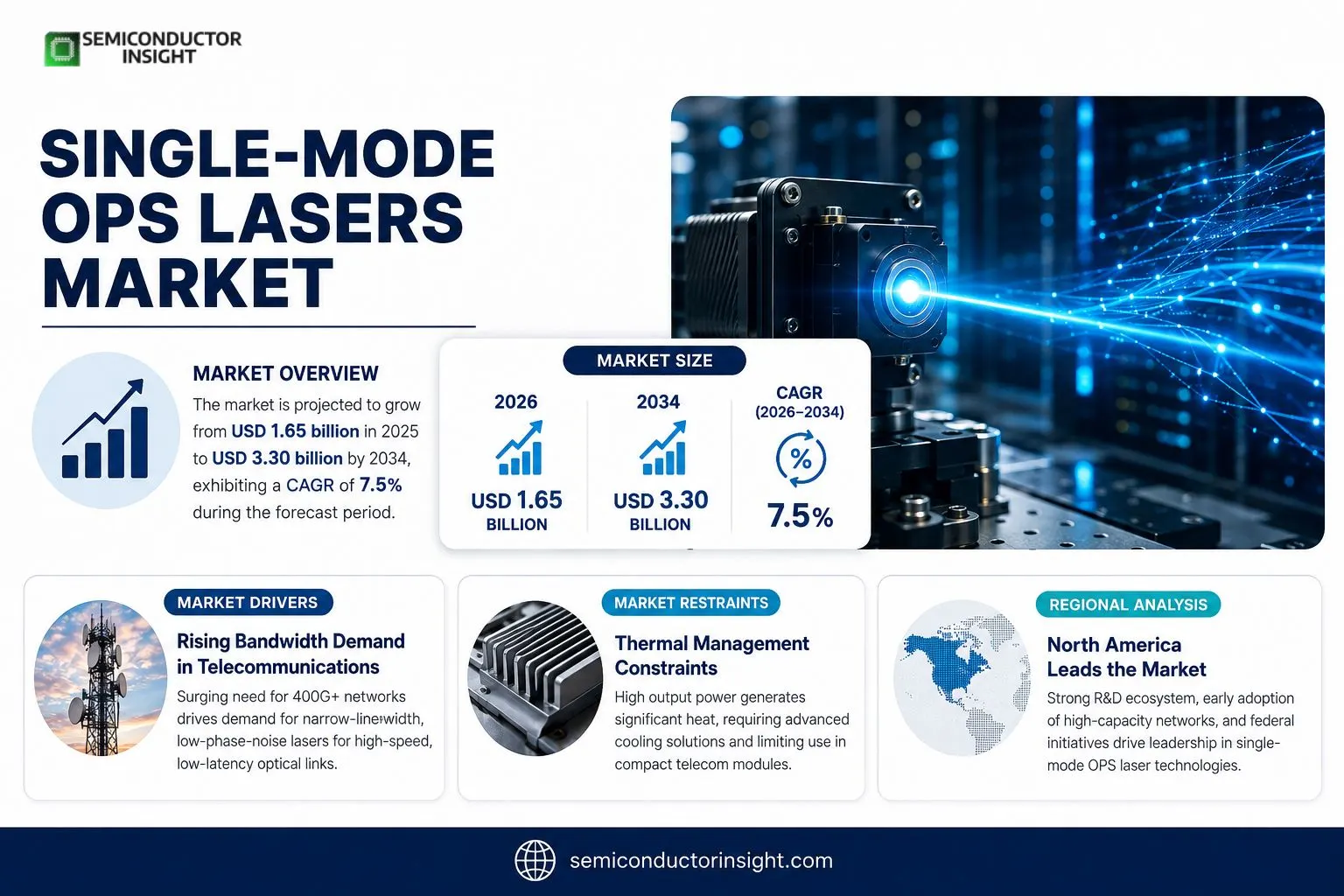
Single-Mode OPS Lasers market size was valued at USD 1.498 billion in 2024. Forecasts indicate the market will rise to USD 1.65 billion in 2025 and reach USD 3.30 billion by 2034, reflecting an implied compound annual growth rate of roughly 7½ percent over the period.
This upward trajectory aligns with expanding data‑center capacity, where higher optical‑interconnect speeds create demand for VCSEL‑based pump sources; additional support stems from U.S. manufacturing initiatives that allocate substantial R&D funds toward photonic components.The single‑mode OPS laser delivers a high‑stability light output optimized for pumping tasks. Its comparatively thin gain medium produces a beam with superior quality and a Gaussian energy profile, concentrating energy density at the centre while maintaining near‑diffraction‑limited divergence when driven by low‑brightness diode‑array pumps.
MARKET DRIVERS
Rising Bandwidth Demand in Telecommunications
Single-Mode OPS Lasers Market benefits from carriers upgrading to 400 Gbps and beyond. Operators are forced to replace legacy sources with lasers that deliver narrow spectral width and low phase noise, characteristics that single‑mode OPS lasers provide without excessive amplification stages. This shift reduces link latency and improves signal integrity across long-haul fiber routes.
Stringent Precision Requirements in Semiconductor Lithography
Advanced node fabs rely on lasers whose linewidth can be held below 10 kHz over extended exposure periods. The ability of single‑mode OPS lasers to maintain coherence under high‑power operation translates into tighter critical dimension control, directly influencing yield rates. As manufacturers push toward sub‑5 nm patterns, the demand for such stability becomes a decisive factor.
➤ Adoption of single‑mode OPS lasers can raise system throughput by as much as 30% while trimming power consumption.
Beyond telecom and lithography, the convergence of autonomous‑vehicle lidar and high‑resolution metrology creates a feedback loop that amplifies investment in narrow‑band sources, positioning Single-Mode OPS Lasers Market for sustained momentum.
MARKET CHALLENGES
Cost Sensitivity in Mid‑range Applications
While high‑end users are prepared to absorb premium pricing, smaller system integrators often view single‑mode OPS lasers as a cost outlier. The total cost of ownershipincluding ancillary cooling and control electronicscan deter adoption in budget‑constrained projects, limiting market penetration outside flagship deployments.
Other Challenges
Supply Chain Volatility
Fluctuations in rare‑earth alloy availability and the limited number of qualified wafer fabs create bottlenecks. When lead times extend beyond six months, OEMs are forced to lock in price escalations, further straining budgetary flexibility.
MARKET RESTRAINTS
Thermal Management Constraints
Single‑mode OPS lasers generate substantial heat at the output power levels required for long‑distance transmission. Integrating efficient heat‑sink designs without compromising footprint remains a technical hurdle, particularly in compact telecom modules where space is at a premium.Compounding the issue, many existing chassis lack the thermal headroom to accommodate the higher dissipation rates, prompting redesign cycles that add to development timelines and expense.
MARKET OPPORTUNITIES
Integration with Photonic Integrated Circuits
The movement toward silicon‑photonic platforms opens a pathway for embedding single‑mode OPS sources directly onto PICs. Such integration promises reduced package size, lower interconnect loss, and streamlined manufacturing, all of which resonate with OEMs seeking to differentiate next‑generation transceivers.Additionally, burgeoning interest in quantum‑sensing applicationswhere ultra‑stable lasers are a prerequisitecreates a niche where Single-Mode OPS Lasers Market can command premium pricing while expanding its addressable customer base.
Single-Mode OPS Lasers Market Trends
Data Center Interconnects Accelerate Adoption
Surging construction of hyperscale data facilities has placed unprecedented pressure on optical link performance. Operators require sources that can sustain gigabit‑per‑second signaling while preserving low noise footprints. The narrow‑core architecture of single‑mode devices, combined with Gaussian energy distribution, makes them ideal for VCSEL‑based transceivers in rack‑level interconnects. As cloud providers upgrade to 400 GbE and beyond, the demand for high‑speed, low‑divergence emitters is translating into volume orders for manufacturers that can guarantee both wavelength stability and power efficiency. This shift reshapes supply chain priorities, prompting vendors to expand capacity in wavelength‑specific product lines and to streamline testing protocols that align with data‑center reliability standards.
Other Trends
Manufacturing Policy and Automation Push
The 2021 Made‑in‑America agenda introduced a multi‑billion‑dollar research envelope aimed at bolstering domestic photonics production. By earmarking funds for advanced automation, the policy incentivizes facilities to adopt robotic wafer handling and AI‑driven process control. Companies that retrofit their fabs with these capabilities report shorter cycle times and tighter tolerances on beam uniformity, directly benefiting the output quality of single‑mode sources. Moreover, the policy’s emphasis on reshoring reduces exposure to geopolitical supply disruptions, granting U.S. manufacturers a competitive edge in serving North American telecommunications contracts that specify locally sourced components.
LiDAR Integration in Autonomous Vehicles
Automakers are converging on solid‑state LiDAR architectures that replace mechanical scanning mirrors with VCSEL arrays. A 2022 collaboration between a leading VCSEL supplier and a LiDAR specialist produced a hybrid module that meets automotive grade reliability while keeping per‑unit costs within mass‑market thresholds. The scalability of array‑based emitters enables higher point‑cloud densities, improving object detection at longer ranges. For the Single‑Mode OPS Lasers Market, this partnership signals a new revenue stream: automotive OEMs are now issuing long‑term purchase agreements that demand consistent wavelength output and temperature‑insensitive performance, two attributes inherent to single‑mode designs. Suppliers that can integrate these lasers into compact, ruggedized packages are poised to capture a growing slice of the vehicular perception ecosystem.
COMPETITIVE LANDSCAPE
Key Industry Players
Single-Mode OPS Lasers: Competitive Dynamics and Strategic Positioning
II‑VI remains the market’s anchor, leveraging a vertically integrated supply chain that couples advanced wafer‑scale epitaxy with proprietary packaging expertise. Its breadth of single‑mode OPS offeringsspanning the 976 nm to 1480 nm bandsenables the company to service high‑volume data‑center interconnects while retaining the precision needed for laboratory and medical applications. Lumentum, with its deep heritage in telecom photonics, captures a sizable share of the communication segment by bundling OPS modules with driver electronics, thereby shortening customers’ time‑to‑market. Both firms pursue aggressive price‑performance trade‑offs, a strategy that pressures smaller rivals to specialize or form alliances.Beyond the two titans, a cadre of niche innovators distinguishes itself through wavelength‑specific or application‑focused solutions. Furukawa Electric and Polytec GmbH concentrate on the 980 nm regime, targeting metal‑processing tools that demand high beam quality. 3SP Technologies and DoGain Laser Technology have built modest but growing footprints in the lidar and autonomous‑vehicle ecosystem, capitalising on the Gaussian energy distribution of OPS sources. Lumics, Oxxius, and Thorlabs supply laboratory‑grade lasers that command premium margins because of their ultra‑low noise characteristics. InnoLas, Vexlum, NKT Photonics, and Coherent round out the landscape, each carving out a segmentwhether it be medical imaging, high‑power communication, or custom‑engineered modules for OEMsby pairing proprietary designs with flexible manufacturing footprints.
List of Key Single-Mode OPS Lasers Companies Profiled
- II‑VI Incorporated
- Lumentum Holdings Inc.
- Furukawa Electric Co., Ltd.
- Polytec GmbH
- 3SP Technologies
- DoGain Laser Technology
- Lumics
- Oxxius
- Thorlabs Inc.
- InnoLas
- Vexlum
- NKT Photonics
- Coherent Inc.
Segment Analysis:
| Segment Category | Sub-Segments | Key Insights |
| By Type |
|
High‑Stability Core Segment
|
| By Application |
|
Versatile Application Segment
|
| By End User |
|
Strategic End‑User Segment
|
| By Wavelength |
|
Wavelength‑Driven Differentiation
|
| By Technology Adoption |
|
Adoption‑Stage Insights
|
Regional Analysis: Single-Mode OPS Lasers Market
North America
Leading universities and federal labs cooperate with laser manufacturers on wafer‑scale integration, shortening development cycles and reducing cost per watt for single‑mode OPS devices.
A diversified component base, from crystal growers in the Midwest to packaging specialists on the West Coast, cushions the market against geopolitical shocks and material shortages.
Tier‑1 telecom carriers prioritize low‑phase‑noise lasers to sustain coherent detection schemes, driving early‑stage volume purchases that set benchmarks for the rest of the world.
Federal funding programs targeting next‑generation networking infrastructure directly fund pilot deployments of single‑mode OPS lasers, accelerating commercial rollout timelines.
Europe
European markets exhibit a balanced mix of legacy fiber networks and pioneering research initiatives, particularly in Germany, France, and the Nordic countries. Policy frameworks that emphasize sustainability have prompted operators to replace older, less efficient sources with high‑efficiency single‑mode solutions, treating the upgrade as both a performance and an environmental measure. Collaborative projects funded by the EU, such as Horizon‑Europe, create cross‑border consortia that share design expertise and testing facilities, fostering a regional standardization advantage. While the overall volume lags behind North America, European buyers tend to demand tighter specifications on wavelength stability, nudging suppliers toward premium product lines and higher margin opportunities.
Asia-Pacific
The Asia‑Pacific region, anchored by China, Japan, South Korea, and India, presents the most heterogeneous demand landscape for Single-Mode OPS Lasers. Rapid urbanization and aggressive rollout of 5G and private‑network solutions generate pockets of high growth, especially in megacities where data‑center density drives back‑haul upgrades. However, cost sensitivity remains a decisive factor; local manufacturers often prioritize price‑performance trade‑offs, leading to a proliferation of hybrid designs that blend single‑mode performance with lower‑cost packaging. Governmental push for domestic semiconductor capabilities adds a layer of strategic investment, yet the fragmented supply chain can create uneven quality standards across the sub‑region.
South America
South American adoption of single‑mode optical sources is still nascent, constrained by limited fiber‑to‑the‑home penetration and modest capital‑expenditure cycles. Brazil and Chile lead the region in telecom modernization, where operators view laser upgrades as a prerequisite for expanding broadband reach into underserved territories. Financial constraints encourage leasing models and partnerships with OEMs, allowing service providers to access cutting‑edge hardware without upfront outlays. The market’s slower pace gives regional distributors ample time to cultivate technical expertise, which could translate into a more educated end‑user base as network upgrades accelerate.
Middle East & Africa
In the Middle East and Africa, Single-Mode OPS Lasers Market is driven largely by sovereign wealth fund investments in digital infrastructure and the strategic ambition to position regional hubs as data‑center corridors. The United Arab Emirates and Saudi Arabia spearhead large‑scale fiber projects that require reliable, low‑noise lasers for long‑haul routes across desert environments. African nations, while facing infrastructure deficits, are beginning to attract multinational telecom operators who view laser‑based solutions as essential for leapfrogging legacy copper networks. The combination of high‑visibility government initiatives and early‑stage commercial interest creates a fertile, albeit volatile, environment for specialized laser suppliers.
Report Scope
This market research report provides a comprehensive analysis of the Single-Mode OPS Lasers Market , covering the forecast period 2026–2034. It offers detailed insights into market dynamics, technological advancements, competitive landscape, and key trends shaping the industry.
Key focus areas of the report include:
- Market Overview: The report begins with an overview outlining its current market scenario, key growth indicators, and industry transformation drivers. It discusses macroeconomic factors, demand–supply balance, regulatory landscape, and the strategic role of semiconductors in powering advancements across industries such as automotive, telecommunications, consumer electronics, and industrial automation.
- Market Size & Forecast: Historical data and future projections for revenue, unit shipments, and market value across major regions and segments.
- Segmentation Analysis: Detailed breakdown by product type, technology, application, and end-user industry to identify high-growth segments and investment opportunities.
- Regional Insights: Insights into market performance across North America, Europe, Asia-Pacific, Latin America, and the Middle East & Africa, including country-level analysis where relevant.
- Competitive Landscape: Profiles of leading market participants, including their product offerings, R&D focus, manufacturing capacity, pricing strategies, and recent developments such as mergers, acquisitions, and partnerships.
- Technology Trends & Innovation: Assessment of emerging technologies, integration of AI/IoT, semiconductor design trends, fabrication techniques, and evolving industry standards.
- Market Drivers & Restraints: Evaluation of factors driving market growth along with challenges, supply chain constraints, regulatory issues, and market-entry barriers.
- Stakeholder Insights: Insights for component suppliers, OEMs, system integrators, investors, and policymakers regarding the evolving ecosystem and strategic opportunities.
Primary and secondary research methods are employed, including interviews with industry experts, data from verified sources, and real-time market intelligence to ensure the accuracy and reliability of the insights presented.
FREQUENTLY ASKED QUESTIONS:
What is the current market size of Single-Mode OPS Lasers Market?
-> Single-Mode OPS Lasers Market was valued at USD 1,498 million in 2024 and is expected to reach USD 3,299 million by 2031 with a CAGR of 12.2% during the forecast period.
Which key companies operate in Single-Mode OPS Lasers Market?
-> Key players include II-VI, Furukawa Electric, Polytec GmbH, Lumentum, 3SP Technologies, DoGain Laser Technology, Lumics, Oxxius, Thorlabs, InnoLas, and Vexlum, among others.
What are the key growth drivers?
-> Key growth drivers include the rapid expansion of data centers demanding high‑speed optical interconnects, increasing adoption of VCSEL for high‑speed transmission, automation and LiDAR integration in manufacturing and automotive sectors, and supportive government initiatives such as the Made in America program.
Which region dominates the market?
-> Asia holds the largest market share, driven by extensive semiconductor manufacturing, data‑center growth, and emerging LiDAR applications, while North America remains a close secondary market.
What are the emerging trends?
-> Emerging trends include advancements in VCSEL‑based data‑center optical interconnects, solid‑state LiDAR solutions for autonomous vehicles, strategic partnerships for cost‑effective ADAS systems, and increased automation in manufacturing leveraging high‑stability single‑mode OPS lasers.

Get Sample Report PDF for Exclusive Insights
Report Sample Includes
- Table of Contents
- List of Tables & Figures
- Charts, Research Methodology, and more...
 Download Sample Report PDF