Guitar Electronic Amplifiers Market Insights
Guitar Electronic Amplifiers market was valued at USD 123 million in 2024 and will reach USD 156 million by 2034, achieving a CAGR of about 3.6% during the forecast period.
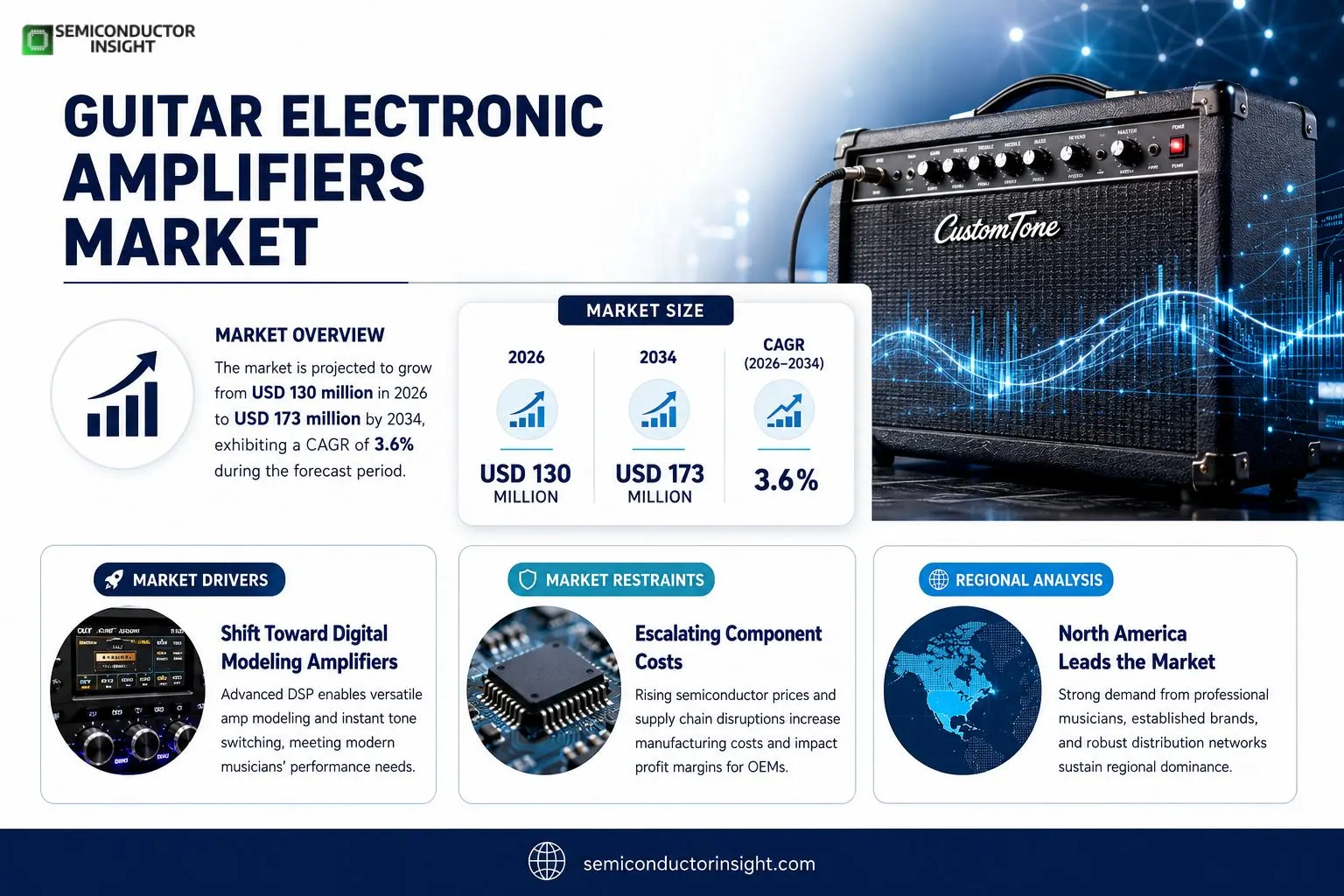
A guitar electronic amplifier (or amp) is an electronic device that amplifies the electrical signal from a pickup on an electric, bass or acoustic guitar so it can drive one or more loudspeakers typically housed in a wooden cabinet; amplifiers may be standalone heads requiring separate speaker cabinets or “combo” units that integrate both amplifier circuitry and speakers.The Guitar Electronic Amplifiers market size was valued at USD 127 million in 2025; it will rise from USD 130 million in 2026 to USD 173 million by 2034, exhibiting a CAGR of roughly 3‑5% over the projection period.
MARKET DRIVERS
Shift Toward Digital Modeling Amplifiers
The rise of digital signal‑processing chips has lowered the barrier for manufacturers to embed hundreds of classic amp voicings into a single chassis. Musicians value the ability to swap tones instantly without the logistical overhead of multiple physical units, a convenience that aligns with the gig‑centric lifestyle of modern performers. This technical shift also shortens product development cycles, allowing brands to respond quickly to emerging tonal trends.
Growth of Live‑Streaming Performances
Since the proliferation of high‑definition streaming platforms, artists are delivering concerts from home studios and intimate venues. The need for compact, low‑noise amplifiers that integrate seamlessly with digital audio workstations has surged. Brands that offer USB‑compatible heads and amps with built‑in DSP gain a competitive edge, as they enable creators to maintain professional sound quality while reducing on‑stage complexity.
➤ “The convergence of portable amplification and online performance channels is redefining how guitarists think about tone delivery.”
Retail data shows a steady uptick in sales of hybrid models that blend analogue warmth with programmable presets. By catering to both purists and tech‑savvy players, manufacturers can capture a broader demographic, driving revenue beyond the traditional boutique market.
MARKET CHALLENGES
Escalating Component Costs
The semiconductor shortage that began in the early 2020s has persisted, inflating the price of digital‐processing chips and power‑management modules integral to modern amplifiers. Smaller OEMs find it difficult to absorb these costs, which squeezes margins and can lead to price‑sensitive buyers opting for legacy analogue units.
Other Challenges
Supply Chain Disruptions
Logistical bottlenecks at key ports, combined with fluctuating freight rates, have extended lead times for chassis and speaker components. Manufacturers that lack diversified sourcing strategies risk inventory shortages during peak touring seasons, potentially eroding brand loyalty.
MARKET RESTRAINTS
Regulatory Constraints on Power Consumption
Environmental legislation in the European Union and several North American states imposes strict limits on standby power draw for electronic equipment. Amplifier designs that exceed these thresholds must undergo costly redesigns or face market exclusion, slowing the rollout of innovative high‑output models.Manufacturers that have already integrated energy‑efficient transformers and smart‑shutdown circuitry report lower compliance costs, highlighting the strategic advantage of early adoption of green engineering practices.For boutique firms lacking large R&D budgets, meeting these standards often translates into delayed product launches, which can cede market share to larger competitors that can amortize compliance expenses across broader portfolios.
MARKET OPPORTUNITIES
Emerging Demand in Asia‑Pacific
Rapid urbanization and a growing middle class in countries such as India, Indonesia, and the Philippines have fostered a vibrant community of amateur guitarists. Local distributors are seeking affordable, feature‑rich amplifiers that can serve both rehearsal spaces and small‑venue gigs, opening a sizable gap for value‑oriented product lines.Collaborations with regional influencers and music academies present a channel for brand building that resonates with culturally specific tonal preferences. Companies that tailor preset libraries to regional music styles can differentiate themselves and capture loyalty early in the market lifecycle.Additionally, the rise of e‑commerce platforms in the region reduces reliance on traditional brick‑and‑mortar retail, allowing manufacturers to test niche concepts with limited inventory risk.
Guitar Electronic Amplifiers Market Trends
Adoption of Class D Amplifier Technology
Guitar Electronic Amplifiers Market is witnessing a clear migration from traditional Class AB circuits toward Class D designs. Manufacturers cite the ability of Class D modules to deliver comparable sonic fidelity while cutting power consumption by up to 40 percent. This efficiency gain aligns with stricter energy‑use regulations in key territories and lowers total cost of ownership for venue operators. For distributors, the shift translates into shorter shipping cycles because lighter chassis reduce freight expenses. End‑users, especially touring musicians, favor the reduced heat output, which permits tighter backstage packing. Collectively, these dynamics reshuffle competitive positioning, prompting legacy players to broaden their Class D portfolios and niche firms to specialize in high‑resolution digital modeling.
Other Trends
Growth of Portable Practice Amplifiers
Compact, battery‑operated units have become a staple in Guitar Electronic Amplifiers Market’s consumer segment. The proliferation of gig‑economy performers and the resurgence of home‑studio practice have amplified demand for 10‑watt, 6‑inch speaker combos that deliver full‑range tone without the bulk of stage rigs. Retail data indicate a year‑over‑year increase of roughly eight percent in unit sales for this class, outpacing larger‑format categories. Producers are responding by integrating digital effects and Bluetooth connectivity, thereby blending convenience with studio‑grade sound shaping. This trend pressures large‑format manufacturers to offer entry‑level lines that retain brand cache while meeting price‑sensitive buyer expectations.
Automotive and IoT Integration Expands Demand
Automakers are embedding Class D amplifiers within infotainment systems, a development that broadens the addressable audience for Guitar Electronic Amplifiers Market beyond traditional musicians. The convergence of IoT sensors and vehicle audio platforms creates a niche where amplifiers must accommodate both high‑fidelity music playback and low‑latency instrument input. As in‑vehicle entertainment adoption climbs, OEMs seek partners capable of delivering compact, low‑heat solutions that integrate seamlessly with CAN‑bus architectures. This cross‑industry link opens avenues for joint‑development agreements, and firms that can certify automotive‑grade durability are likely to capture a disproportionate share of future revenue streams.
COMPETITIVE LANDSCAPE
Key Industry Players
Guitar Amplifier Market: Competitive Overview 2024‑2034
Fender and Marshall continue to dominate the guitar amplifier arena, leveraging extensive distribution networks and deep brand heritage that resonate with both professional musicians and hobbyists. Their portfolios span entry‑level “practice” combos, high‑output tube rigs, and increasingly sophisticated modelling units, allowing them to capture a wide price spectrum. The duopoly’s scale affords preferential access to component suppliers, which translates into cost efficiencies and rapid product refresh cycles. Consequently, market share remains heavily weighted toward these two, shaping pricing benchmarks and driving product innovation timelines across the segment.Beyond the flagship brands, a cluster of specialized manufacturers intensifies competition through niche focus and technical differentiation. Blackstar and Hughes & Kettner have carved reputations for boutique tone‑shaping circuitry, attracting tone‑conscious players seeking signature voicings. Orange and Vox exploit distinct aesthetic cues and a legacy of rock‑era amplification to maintain loyal followings. Peavey, Roland, Laney, Yamaha, and PRS diversify the field with solutions that blend affordability, digital integration, and hybrid architectures. Emerging players such as Dr. Z, Mesa/Boogie, Fishman, and Music Tribe broaden the competitive set by targeting boutique markets, high‑end professional rigs, and integrated speaker‑cabinet solutions, respectively. Their agility in adopting Class‑D efficiency gains and IoT‑enabled connectivity adds layers of complexity to the competitive matrix, prompting incumbents to accelerate feature development.
List of Key Guitar Amplifiers Companies Profiled
- Fender
- Marshall Amplification
- Blackstar Amplification
- Hughes & Kettner
- Orange Music Electronic Company
- Vox (Korg)
- Peavey Electronics
- Roland Corporation
- Laney Amplification
- Yamaha Corporation
- PRS Guitars
- Dr. Z Amplification
- Mesa/Boogie
- Fishman
- Music Tribe
Segment Analysis:
| Segment Category | Sub-Segments | Key Insights |
| By Type |
|
Tube Amps remain the aspirational choice for professional musicians seeking harmonic richness and organic response.
|
| By Application |
|
Commercial applications drive premium feature development, focusing on reliability and tonal versatility.
|
| By End User |
|
Professional Musicians prioritize performance‑grade tone shaping and durability.
|
| By Technology |
|
Class D Amplifiers are reshaping efficiency expectations while preserving tonal character.
|
| By Form Factor |
|
Combo Amplifiers dominate the mainstream market due to their all‑in‑one convenience.
|
Regional Analysis: Guitar Electronic Amplifiers Market
North America
Musicians are gravitating toward amplifiers that offer seamless integration with mobile apps, allowing real‑time tone sculpting and preset sharing. This trend fuels demand for products that balance analog warmth with digital convenience, reshaping retailer floor plans to showcase interactive demo stations.
Component shortages have prompted manufacturers to diversify silicon sources and shorten lead times through regional assembly hubs. These adjustments reduce dependency on distant factories and improve responsiveness to sudden market spikes.
Tightening emissions standards for electronic devices have led firms to adopt greener PCB finishes and low‑power op‑amps, a move that also aligns with the growing eco‑consciousness among professional players.
The next wave of amplifiers is expected to blend AI‑driven tone prediction with modular hardware, enabling users to reconfigure signal paths without soldering, a capability that could redefine product lifecycles.
Europe
European markets exhibit a nuanced appetite for high‑fidelity amplifiers, particularly in the UK, Germany, and Scandinavia. Local musicians value craftsmanship and are willing to pay a premium for boutique brands that emphasize hand‑wired circuitry. At the same time, the rise of festival circuits across the continent is encouraging manufacturers to develop rugged, battery‑operated heads that can withstand outdoor conditions. Environmental regulations are stricter than in many other regions, prompting a gradual shift toward recyclable chassis and low‑noise power supplies. Retailers respond by curating a mix of heritage models and emerging European makers, creating a competitive landscape where brand story and technical merit intersect.
Asia‑Pacific
The Asia‑Pacific region is the fastest‑growing cluster of guitarists, with emerging economies in India, Indonesia, and Vietnam fueling demand for affordable entry‑level amplifiers. While price sensitivity dominates, a parallel market of enthusiasts in Japan and South Korea drives interest in boutique, high‑gain units. Manufacturers are localising production to benefit from lower labour costs, yet they must navigate heterogeneous quality expectations across countries. Digital ecosystems, especially mobile‑first platforms, are shaping how consumers discover and purchase amplifiers, leading brands to invest in localized app experiences and regional influencer partnerships.
South America
In South America, Brazil and Argentina anchor a vibrant live‑music scene that sustains a healthy demand for versatile amplification solutions. Economic volatility forces buyers to prioritise durability and serviceability, prompting a preference for modular designs that can be repaired locally. Import tariffs on high‑end equipment have spurred a modest but growing cohort of regional assemblers who source key components from North America and re‑brand them for the local market. This hybrid approach sustains market activity despite fiscal headwinds.
Middle East & Africa
The Middle East & Africa segment reflects a patchwork of market dynamics, with affluent Gulf states importing premium amplifiers for professional venues, while Sub‑Saharan nations rely on cost‑effective models for burgeoning grassroots music scenes. Limited distribution infrastructure often leads to longer product cycles, encouraging brands to launch region‑specific limited runs that cater to local aesthetic preferences. Furthermore, rising internet penetration is enabling online marketplaces to bridge the gap between manufacturers and end‑users, gradually reducing reliance on traditional import channels.
Report Scope
This market research report provides a comprehensive analysis of the Guitar Electronic Amplifiers Market , covering the forecast period 2026–2034. It offers detailed insights into market dynamics, technological advancements, competitive landscape, and key trends shaping the industry.
Key focus areas of the report include:
- Market Overview: The report begins with an overview outlining its current market scenario, key growth indicators, and industry transformation drivers. It discusses macroeconomic factors, demand–supply balance, regulatory landscape, and the strategic role of semiconductors in powering advancements across industries such as automotive, telecommunications, consumer electronics, and industrial automation.
- Market Size & Forecast: Historical data and future projections for revenue, unit shipments, and market value across major regions and segments.
- Segmentation Analysis: Detailed breakdown by product type, technology, application, and end-user industry to identify high-growth segments and investment opportunities.
- Regional Insights: Insights into market performance across North America, Europe, Asia-Pacific, Latin America, and the Middle East & Africa, including country-level analysis where relevant.
- Competitive Landscape: Profiles of leading market participants, including their product offerings, R&D focus, manufacturing capacity, pricing strategies, and recent developments such as mergers, acquisitions, and partnerships.
- Technology Trends & Innovation: Assessment of emerging technologies, integration of AI/IoT, semiconductor design trends, fabrication techniques, and evolving industry standards.
- Market Drivers & Restraints: Evaluation of factors driving market growth along with challenges, supply chain constraints, regulatory issues, and market-entry barriers.
- Stakeholder Insights: Insights for component suppliers, OEMs, system integrators, investors, and policymakers regarding the evolving ecosystem and strategic opportunities.
Primary and secondary research methods are employed, including interviews with industry experts, data from verified sources, and real-time market intelligence to ensure the accuracy and reliability of the insights presented.
FREQUENTLY ASKED QUESTIONS:
What is the current market size of Guitar Electronic Amplifiers Market?
-> Guitar Electronic Amplifiers Market was valued at USD 127 million in 2025 and is expected to reach USD 173 million by 2034.
Which key companies operate in Guitar Electronic Amplifiers Market?
-> Key players include Fender, Marshall Amplification, Blackstar Amplification, Hughes & Kettner, Orange Music Electronic Company, Vox Amps (Korg), Peavey Electronics, Roland Corporation, Laney Amplification, Yamaha, PRS Guitars, Dr. Z Amplification, Mesa/Boogie, Fishman, Music Tribe.
What are the key growth drivers?
-> Key growth drivers include increasing adoption of Class D technology, rising demand for energy‑efficient audio solutions, growth of in‑vehicle infotainment systems, and expanding IoT integration in musical equipment.
Which region dominates the market?
-> North America remains the dominant region, supported by a high concentration of major manufacturers and strong professional‑musician demand.
What are the emerging trends?
-> Emerging trends include advanced Class D amplifiers, IoT‑enabled smart amplifiers, and sustainable, low‑power designs targeting both professional and home‑studio segments.
Get Sample Report PDF for Exclusive Insights
Report Sample Includes
- Table of Contents
- List of Tables & Figures
- Charts, Research Methodology, and more...
 Download Sample Report PDF