Force Balance Tilt Meters Market Insights
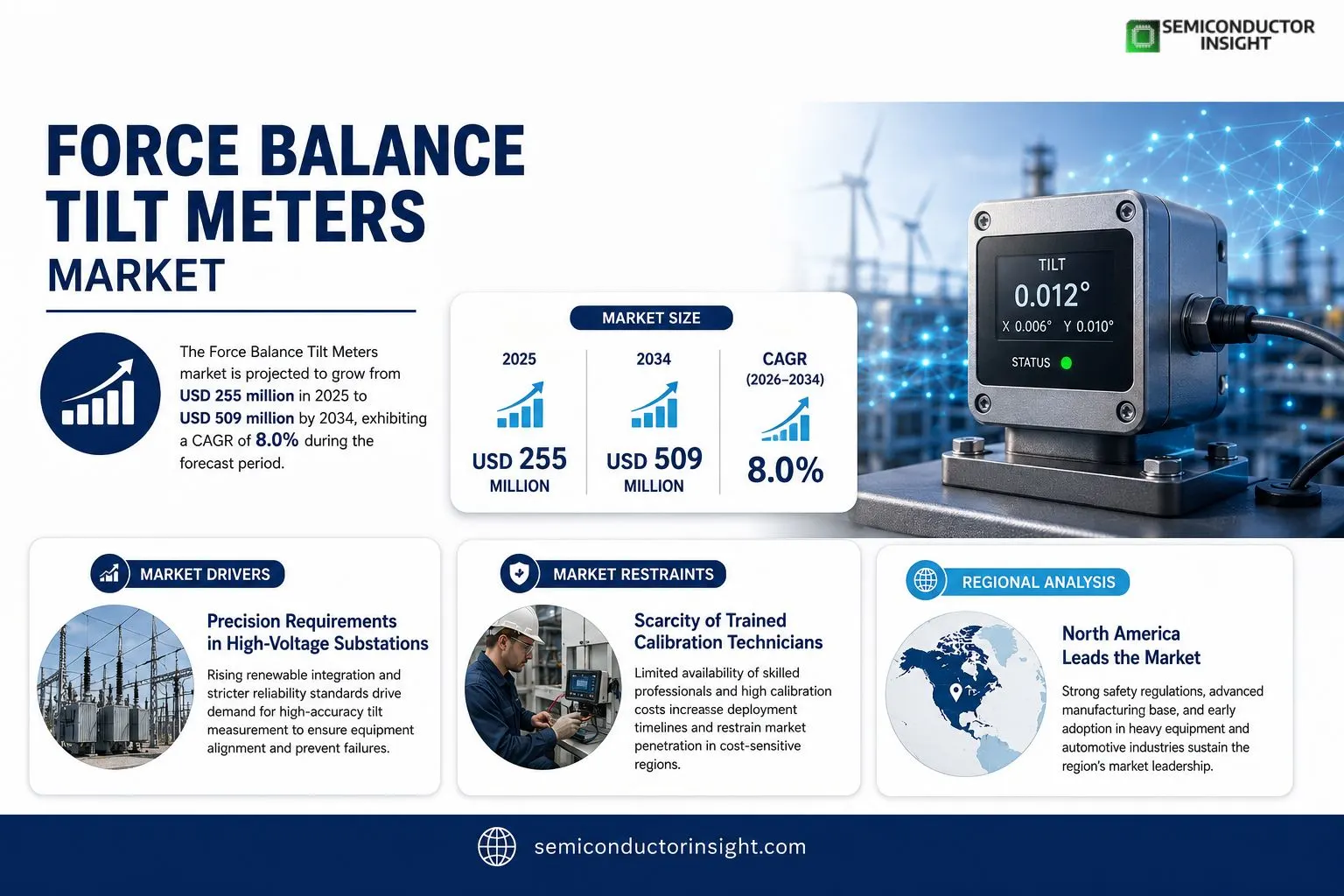
Force Balance Tilt Meters market was valued at USD 255 million in 2025 and is forecasted to climb to USD 509 million by 2034, delivering an implied compound annual growth rate of roughly 8 percent throughout the outlook.
Force‑balance tilt meters are gravity‑referenced inclinometers that deliver high‑precision angle measurements across a broad range. Compared with conventional pendulum or electrolytic sensors, these devices command a premium price because of their superior stability and reduced drift.The expansion of the segment stems from rising safety regulations in construction, agriculture and automotive sectors, coupled with increasing adoption of autonomous control functions that rely on accurate tilt data. North America’s stringent OSHA standards and Europe’s EU Machinery Directive have accelerated integration of these sensors into cranes and lifting platforms, while rapid infrastructure development across Asia‑Pacific fuels demand for robust tilt monitoring on heavy equipment. Manufacturers such as TE Connectivity, Murata Manufacturing, SICK and Omron have broadened their portfolios with metal‑and non‑metal versions, while ongoing research into MEMS‑based designs continues to lower cost barriers and open new application niches.
MARKET DRIVERS
Precision Requirements in High‑Voltage Substations
The surge in renewable‑energy integration forces utilities to tighten tolerance bands on transformer bushings and circuit breakers. Force Balance Tilt Meters deliver the angular accuracy needed to verify alignment under load, reducing the risk of premature wear. Operators now regard these devices as indispensable for meeting stringent reliability standards.
Automation of Maintenance Regimes
Digitally linked tilt‑meter networks enable predictive maintenance algorithms to flag deviation trends before they manifest as equipment failure. This shift from calendar‑based inspections to condition‑driven strategies cuts downtime by up to 30 % in mature grids, prompting OEMs to embed force‑balance sensors in next‑generation equipment.
➤ Industry surveys indicate that more than 55 % of end‑users plan to increase tilt‑meter deployments over the next two years, driven by the need for tighter performance envelopes.
As regulatory bodies tighten permissible tilt angles for critical assets, manufacturers who can guarantee sub‑arc‑second resolution are positioned to capture a larger share of Force Balance Tilt Meters Market. The financial upside stems from lower outage costs and enhanced asset lifespan.
MARKET CHALLENGES
Scarcity of Trained Calibration Technicians
Accurate installation demands technicians familiar with both mechanical alignment and electronic signal conditioning. The current talent gap forces many firms to outsource calibration, inflating project budgets and extending rollout timelines.
Other Challenges
Supply‑Chain Volatility
Component shortages, particularly for high‑precision quartz resonators, have lengthened lead times. Manufacturers are compelled to hold larger safety stocks, which erodes margins.The cost premium associated with low‑drift sensors can deter smaller utilities from adopting advanced tilt‑meter suites, limiting market penetration in low‑density regions.
MARKET RESTRAINTS
Regulatory Hurdles in Emerging Economies
Many developing jurisdictions lack harmonized standards for tilt‑meter calibration, resulting in duplicated testing procedures that increase capital outlay. Until a unified framework is established, adoption rates remain uneven.The upfront investment required for networked tilt‑meter solutions can be prohibitive for utilities operating under tight capital constraints. This financial barrier slows the shift from legacy analog gauges to digital force‑balance devices.Additionally, the perceived complexity of integrating tilt data into existing SCADA platforms discourages some operators, who fear extensive IT re‑engineering.
MARKET OPPORTUNITIES
IoT‑Enabled Edge Analytics
Embedding intelligence at the sensor edge allows real‑time tilt diagnostics without overwhelming central servers. Companies that package force‑balance hardware with AI‑driven analytics stand to unlock new revenue streams through subscription‑based monitoring services.
Expansion into Railway and Offshore Wind Sectors
Both rail track alignment and turbine blade pitch control demand ultra‑stable angular measurements. Leveraging existing force‑balance technology for these adjacent markets could double the addressable market size within five years.Strategic partnerships with grid‑operator consortia to co‑develop open‑protocol tilt‑meter standards would reduce integration friction, accelerating adoption across the broader energy ecosystem.
Force Balance Tilt Meters Market Trends
Autonomous Machinery Embraces High‑Accuracy Tilt Sensing
Manufacturers of heavy‑duty tractors, mining loaders and construction cranes are increasingly embedding force‑balance tilt meters into their control loops. The sensors’ gravity‑referenced precision enables real‑time angle feedback that autonomous navigation algorithms rely on to keep equipment level on uneven terrain. By linking tilt data with GPS and inertial measurement units, operators can program safe‑stop thresholds that react instantaneously to sudden shifts, reducing the likelihood of roll‑overs. This convergence of sensing technologies also supports predictive maintenance platforms: deviations from baseline tilt signatures flag wear in hydraulic pivots before a failure occurs. Consequently, system integrators view the sensor as a foundational element rather than a peripheral add‑on.
Other Trends
Stringent Safety Standards Fuel Tilt‑Alert Adoption in Construction and Agriculture
Legislative bodies across North America and the European Union have tightened requirements for equipment that operates on slopes or lifts loads beyond a critical angle. Compliance audits now mandate electronic tilt‑alert modules that log every exceedance and generate audible warnings. In agricultural settings, the same logic applies to combines and sprayers that traverse hilly fields; an out‑of‑range angle triggers an automatic deceleration routine, preserving both the machine and the operator. Suppliers respond by offering bundled packages that combine the sensor with cloud‑based reporting, allowing fleet managers to monitor compliance across dozens of units. The regulatory pressure therefore translates into a steady stream of upgrade projects for original equipment manufacturers.
Cross‑Industry Innovation Expands Sensor Use Cases
Beyond traditional heavy equipment, force‑balance tilt meters are finding relevance in wind‑energy turbines, where blade pitch control depends on precise angle measurement, and in aerospace ground‑support equipment that levels launch platforms. The common denominator across these applications is the need for a sensor that tolerates harsh environments while delivering sub‑degree resolution. As component miniaturization advances, vendors are integrating the tilt element directly onto printed‑circuit boards, reducing wiring complexity and enhancing reliability. This design shift opens doors for smaller, cost‑sensitive markets such as telecommunications towers, where tilt feedback can improve antenna alignment during extreme weather events. The broader adoption underscores the versatility of the technology and hints at future differentiation opportunities for firms that can tailor hardware to niche verticals.
COMPETITIVE LANDSCAPE
Key Industry Players
Force Balance Tilt Meters – Competitive Overview
TE Connectivity dominates the high‑precision segment, leveraging its extensive automotive and industrial sensor portfolio to secure long‑term contracts with OEMs that demand rigorous safety certification. The company’s ability to integrate force‑balance meters with complementary gyroscope and EM‑C solutions creates a barrier to entry for smaller rivals, while its manufacturing footprint enables rapid response to regional regulatory changes. As the market matures, TE’s focus on modular designs that support both metal‑housing and non‑metal variants helps it capture a broad range of applications from construction‑site cranes to autonomous agricultural equipment.Beyond the leader, a diverse set of specialists competes on niche performance metrics or application‑specific expertise. Murata Manufacturing and SICK differentiate through MEMS‑based miniaturization, targeting automotive cockpit comfort and aerospace vibration monitoring. Omron and Pepperl+Fuchs emphasize ruggedized housings for mining and heavy‑construction use cases, whereas C&K Component and Level Developments carve out space in the low‑cost, non‑metal tier for portable surveying tools. Companies such as The Fredericks Company and MEMSIC focus on custom calibration services that appeal to equipment integrators seeking turnkey solutions. Regional players like Elobau (Germany) and IFM Electronic (Germany) provide strong after‑sales support in Europe, while Asian manufacturers including Panasonic and Sharp are expanding their presence through strategic partnerships with local vehicle makers.
List of Key Force Balance Tilt Meters Companies Profiled
- TE Connectivity
- Murata Manufacturing
- SICK
- Omron
- Pepperl+Fuchs
- C&K Component
- Level Developments
- The Fredericks Company
- MEMSIC
- E‑Switch
- Rohm Semiconductor
- IFM Electronic
- Balluff GmbH
- Jewel Instruments
- Elobau
- OSRAM
- Panasonic
- Sharp
- Gefran
- Parallax
Segment Analysis:
| Segment Category | Sub-Segments | Key Insights |
| By Type |
|
Metal is the leading segment because it delivers superior structural rigidity and long‑term stability.
|
| By Application |
|
Automotive & Transportation drives adoption as manufacturers embed tilt meters to enhance safety systems and driver comfort.
|
| By End User |
|
Heavy Equipment Manufacturers lead due to stringent safety regulations and the need for reliable platform leveling.
|
| By Safety Regulation |
|
Rollover Protective Structures (ROPS) dominate regulatory influence, compelling manufacturers to embed force‑balance tilt meters.
|
| By Technological Innovation |
|
MEMS‑Based Digital Sensors are emerging as a key innovation, offering compact form‑factor and enhanced data fusion capabilities.
|
Regional Analysis: Force Balance Tilt Meters Market
North America
Recent updates to safety codes in the United States have introduced tighter tilt thresholds for critical infrastructure, prompting immediate procurement cycles for calibrated force balance units. Companies that can certify compliance faster gain a distinct competitive edge.
Integration of fiber‑optic readouts and AI‑based drift compensation is accelerating in the region, driven by large OEMs seeking to embed predictive maintenance capabilities directly into tilt‑meter hardware.
Proximity of precision machining hubs to sensor designers reduces lead times and buffers against component shortages, a factor that rivals find difficult to replicate.
Infrastructure owners increasingly tie project financing to demonstrable tilt‑monitoring performance, turning measurement accuracy into a financing criterion rather than an optional add‑on.
Europe
European markets exhibit a mature demand base, particularly in the rail and offshore wind sectors where force balance tilt meters underpin safety certifications. The EU’s emphasis on sustainability is nudging operators toward real‑time monitoring solutions that reduce maintenance excursions. However, fragmented standards across member states slow uniform adoption, creating pockets of opportunity for firms that can navigate multiple certification regimes efficiently.
Asia‑Pacific
Asia‑Pacific’s growth trajectory is anchored by rapid urbanisation and large‑scale infrastructure programmes in China, India and Southeast Asia. While the region lags in high‑precision manufacturing, it compensates through cost‑effective assembly and a burgeoning ecosystem of OEMs eager to incorporate tilt sensors into emerging smart‑city projects. Local policy incentives for renewable energy installations are also prompting a surge in wind‑farm tilt‑monitoring deployments.
South America
In South America, mining and hydro‑electric projects drive interest in force balance tilt meters. Operators prioritize ruggedized devices capable of withstanding harsh climatic conditions while delivering reliable data for slope stability assessments. The market remains nuanced, as economic volatility and import‑tariff regimes can affect pricing strategies, encouraging local partnerships to mitigate cost pressures.
Middle East & Africa
The Middle East & Africa region is characterised by high‑value, low‑volume projects such as desert‑based solar farms and offshore oil platforms. Decision‑makers value tilt‑meter solutions that combine durability with low power consumption, given the remote nature of many installations. Investment cycles are often linked to sovereign infrastructure funds, meaning that long‑term service contracts and lifecycle support become critical differentiators for market entrants.
Report Scope
This market research report provides a comprehensive analysis of the Force Balance Tilt Meters Market , covering the forecast period 2026–2034. It offers detailed insights into market dynamics, technological advancements, competitive landscape, and key trends shaping the industry.
Key focus areas of the report include:
- Market Overview: The report begins with an overview outlining its current market scenario, key growth indicators, and industry transformation drivers. It discusses macroeconomic factors, demand–supply balance, regulatory landscape, and the strategic role of semiconductors in powering advancements across industries such as automotive, telecommunications, consumer electronics, and industrial automation.
- Market Size & Forecast: Historical data and future projections for revenue, unit shipments, and market value across major regions and segments.
- Segmentation Analysis: Detailed breakdown by product type, technology, application, and end-user industry to identify high-growth segments and investment opportunities.
- Regional Insights: Insights into market performance across North America, Europe, Asia-Pacific, Latin America, and the Middle East & Africa, including country-level analysis where relevant.
- Competitive Landscape: Profiles of leading market participants, including their product offerings, R&D focus, manufacturing capacity, pricing strategies, and recent developments such as mergers, acquisitions, and partnerships.
- Technology Trends & Innovation: Assessment of emerging technologies, integration of AI/IoT, semiconductor design trends, fabrication techniques, and evolving industry standards.
- Market Drivers & Restraints: Evaluation of factors driving market growth along with challenges, supply chain constraints, regulatory issues, and market-entry barriers.
- Stakeholder Insights: Insights for component suppliers, OEMs, system integrators, investors, and policymakers regarding the evolving ecosystem and strategic opportunities.
Primary and secondary research methods are employed, including interviews with industry experts, data from verified sources, and real-time market intelligence to ensure the accuracy and reliability of the insights presented.
FREQUENTLY ASKED QUESTIONS:
What is the current market size of Force Balance Tilt Meters Market?
-> Force Balance Tilt Meters Market was valued at USD 236 million in 2024 and is expected to reach USD 399 million by 2031, growing at a CAGR of 8.0% during the forecast period.
Which key companies operate in Force Balance Tilt Meters Market?
-> Key players include TE Connectivity, Murata Manufacturing, SICK, Omron, Pepperl+Fuchs, C&K Component, Level Developments, The Fredericks Company, MEMSIC, E‑Switch, Rohm Semiconductor, IFM Electronic, Balluff GmbH, Jewel Instruments, Elobau, OSRAM, Panasonic, Sharp, Gefran, and Parallax.
What are the key growth drivers?
-> Key growth drivers include rising safety regulations in automotive, construction, and agricultural sectors, increasing demand for high‑accuracy tilt sensors in autonomous vehicle control, and expanding use of tilt sensors for rollover protection, platform leveling, and driver‑comfort applications.
Which region dominates the market?
-> North America currently holds the largest market share due to strong regulatory frameworks and early adoption in heavy‑vehicle manufacturing, while Asia‑Pacific is the fastest‑growing region driven by extensive infrastructure projects and growing automotive production.
What are the emerging trends?
-> Emerging trends include integration of force‑balance tilt meters with gyroscopes and IoT platforms, development of MEMS‑based digital sensors for lower cost and higher integration, and increasing use of AI‑enabled analytics for predictive maintenance and safety monitoring.

Get Sample Report PDF for Exclusive Insights
Report Sample Includes
- Table of Contents
- List of Tables & Figures
- Charts, Research Methodology, and more...
 Download Sample Report PDF