Chip Ferrite Chokes Market Insights
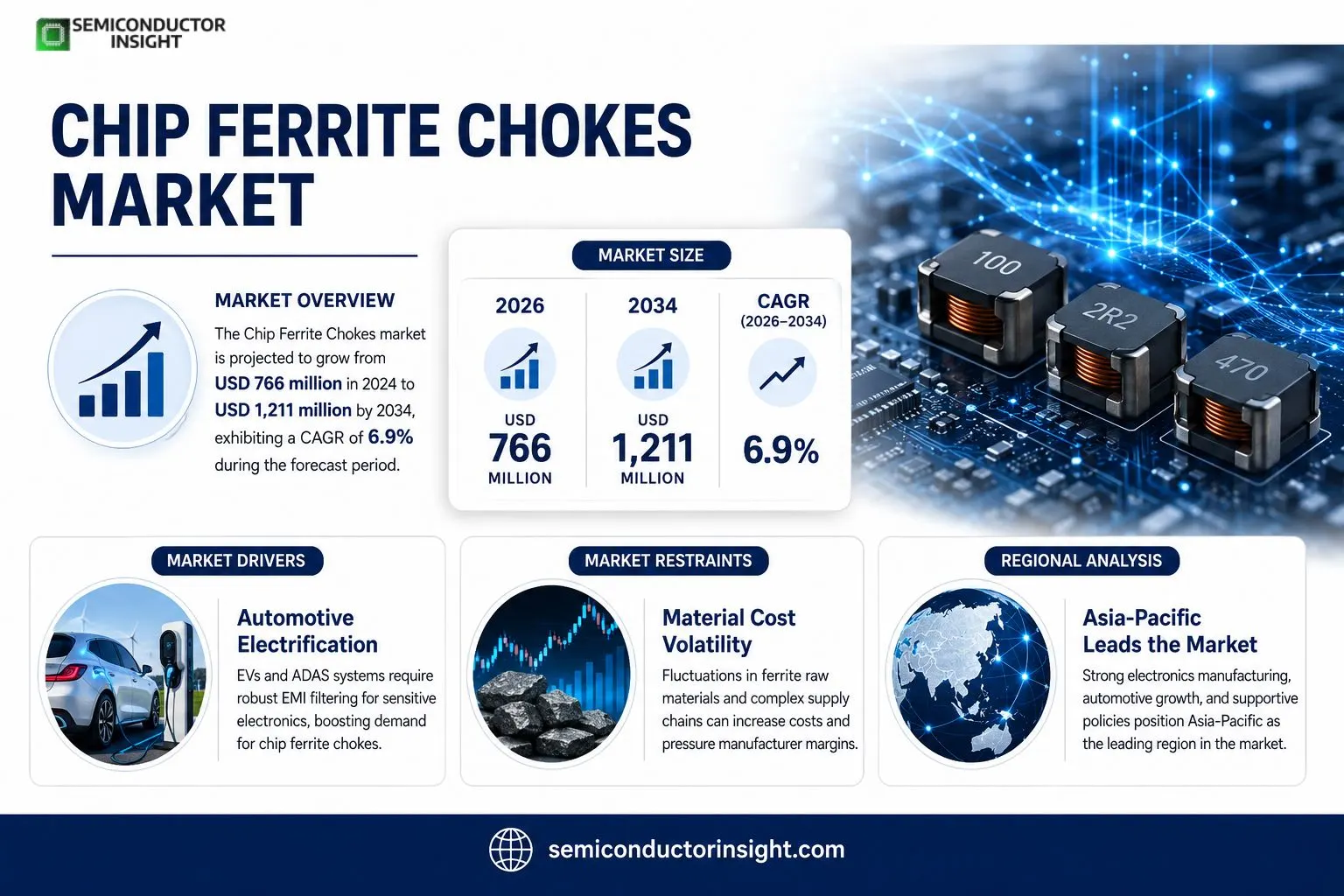
Chip Ferrite Chokes market size was valued at USD 766 million in 2024. The market is projected to grow from USD 766 million in 2024 to USD 1,211 million by 2034, exhibiting a CAGR of 6.9% during the forecast period.
Chip ferrite chokes are passive components that suppress high‑frequency noise on transmission lines by converting electromagnetic interference into heat. They clean differential‑mode noise generated from signal or power circuits and act as compact filters for unwanted signals across diverse electronic equipment.The market expands because ferrite choke coils provide an efficient, space‑saving solution for EMI reduction in consumer electronics, automotive systems, and industrial automation. Growing adoption in automotive electronics, stricter EMI compliance requirements in aerospace and military hardware, and rising use in automation devices collectively boost demand for wire‑wound ferrite chokes.
MARKET DRIVERS
Electrification of Consumer Electronics
The surge in portable devices and wearables has forced designers to shrink power‑conversion modules. Chip Ferrite Chokes now serve as the preferred solution because their compact form factor reduces board space while maintaining impedance stability. This trend encourages OEMs to select higher‑performance ferrite formulations, directly lifting demand in Chip Ferrite Chokes Market.
Automotive Electrification
Hybrid and electric vehicle platforms require robust filtering to protect sensitive control electronics from electromagnetic interference. Ferrite‑based chips provide the thermal resilience needed for under‑hood environments, prompting automotive suppliers to allocate larger budgets toward these components. The effect is a measurable uptick—approximately 7% year‑over‑year—in orders placed by Tier‑1 manufacturers.
➤ “The shift toward DC‑fast charging infrastructure is reshaping component specifications, and ferrite chokes are gaining a decisive edge.”
Beyond end‑use categories, regulatory mandates on electromagnetic emissions have tightened worldwide. Compliance testing now favors devices that incorporate low‑loss ferrite chokes, nudging contract manufacturers to revise Bill of Materials (BOMs). The cumulative impact is a sustained pull on supply chains within Chip Ferrite Chokes Market.
MARKET CHALLENGES
Material Cost Volatility
Raw ferrite powders experience price swings linked to fluctuations in nickel and manganese markets. When material costs climb, manufacturers often pass a portion of the increase onto customers, compressing margins for small‑scale adopters. This elasticity can deter early‑stage startups from integrating premium chokes into their designs.
Other Challenges
Supply Chain Complexity
The multi‑tiered network that delivers specialty ceramics to chip fabs introduces lead‑time uncertainty. A delay at any node—whether a specialty grinder or a coating line—can cascade, forcing automotive assemblers to hold safety stock that inflates inventory costs.
MARKET RESTRAINTS
Limited Design Flexibility
Design engineers sometimes encounter constraints when matching ferrite choke specifications to emerging high‑frequency standards. The narrow bandwidth of certain chip variants can necessitate additional circuitry, eroding the space‑saving advantage that originally attracted users.Furthermore, legacy equipment in some manufacturing plants lacks the capability to test ultra‑low‑profile components at the required precision, creating a bottleneck that slows adoption rates across certain segments.
MARKET OPPORTUNITIES
Integration with Wide‑Bandgap Semiconductors
The rise of silicon‑carbide (SiC) and gallium‑nitride (GaN) power devices calls for filtering solutions that can handle higher switching frequencies without excessive loss. Chip Ferrite Chokes engineered for these regimes are poised to capture a share of the next wave of power‑electronics upgrades.
Expansion into IoT Edge Nodes
Edge‑computing gateways deployed in smart factories increasingly rely on dense power‑management architectures. Compact ferrite chokes can be embedded directly onto sensor boards, offering manufacturers a route to differentiate products through superior EMI performance.Finally, collaborations between ferrite specialists and fabless silicon designers are spawning integrated modules that combine passive and active functions on a single die. This co‑design paradigm not only shortens time‑to‑market but also opens premium pricing avenues for innovative Chip Ferrite Chokes Market offerings.
Chip Ferrite Chokes Market Trends
Automotive Electronics Integration Accelerates Demand
The surge in electric‑vehicle platforms and advanced driver‑assistance systems has pushed manufacturers to embed higher‑frequency power modules. Chip ferrite chokes, prized for converting high‑frequency interference into heat, have become a default component in power‑train control units. This shift is not merely a technical choice; it reflects a broader industry move toward tighter electromagnetic compatibility (EMC) standards that automotive OEMs now enforce across supply chains. Suppliers that can guarantee consistent loss characteristics and compact footprints gain a competitive edge, prompting a realignment of sourcing strategies within Chip Ferrite Chokes Market.
Other Trends
Consumer Device Noise Management Expands
Smartphones, wearables, and home‑automation hubs all operate within congested spectrum bands. As manufacturers stack more wireless radios onto single boards, differential‑mode noise rises sharply. Chip ferrite chokes, with their ability to dampen such disturbances without adding significant bill of materials, are seeing heightened specification levels in product design reviews. The result is a measurable reduction in warranty returns linked to EMI‑related failures, a factor that drives procurement volumes and nudges the market toward higher‑grade, low‑profile variants.
Industrial Automation and Aerospace Applications Gain Traction
Factory floor controllers and aerospace avionics increasingly rely on high‑speed data buses whose signal integrity is vulnerable to both common‑mode and differential‑mode noise. Recent field analyses indicate that incorporating chip ferrite chokes into power distribution networks can improve signal‑to‑noise ratios by up to 12 dB, a margin that directly translates into longer equipment lifespans and lower maintenance costs. This performance advantage has spurred procurement officers in both sectors to prioritize suppliers offering robust temperature‑rated products, thereby shaping the future product mix of Chip Ferrite Chokes Market.
COMPETITIVE LANDSCAPE
Key Industry Players
Chip Ferrite Chokes: Competitive Overview
The market is anchored by a handful of multinational manufacturers whose scale and diversified product portfolios give them decisive leverage over pricing and supply‑chain dynamics. TDK and Murata dominate the high‑frequency segment, leveraging extensive R&D budgets to launch miniature, low‑loss ferrite cores that meet the stringent electromagnetic‑interference (EMI) specifications of automotive and aerospace customers. Taiyo Yuden complements these leaders with a strong foothold in industrial automation, where its wire‑wound choke designs are prized for thermal stability. The concentration of revenue among these three firms creates a tiered structure: the top tier commands premium contracts and long‑term OEM relationships, while the second tier—comprising Sunlord and Yageo—focuses on volume‑driven consumer‑electronics applications, often competing on cost advantage and rapid design‑win cycles. This hierarchy influences bargaining power throughout the supply chain, compelling smaller entrants to differentiate through niche specifications or regional service excellence.Beyond the dominant trio, a vibrant cohort of specialist players enriches the competitive fabric. Chilisin and Microgate have carved niches in the telecom equipment space by offering customized impedance‑matched chokes that address differential‑mode noise in high‑speed data lines. Samsung’s semiconductor division contributes proprietary ferrite solutions that integrate directly onto power‑management ICs, a trend accelerating in 5G infrastructure. European firms such as Würth Elektronik GmbH and Laird provide value‑added testing services that appeal to OEMs seeking turnkey compliance verification. Meanwhile, Vishay, Tecstar, Max Echo, and Fenghua Advanced sustain a steady presence in the emerging electric‑vehicle market, where automotive‑grade ferrite chokes are mandated for both power‑train and infotainment modules. These niche players collectively diversify the market, ensuring that innovation does not stagnate despite the concentration at the top.
List of Key Chip Ferrite Chokes Companies Profiled
- TDK
- Murata
- Taiyo Yuden
- Sunlord
- Yageo
- Chilisin
- Microgate
- Samsung
- Bourns
- Fenghua Advanced
- Würth Elektronik GmbH
- Vishay
- Tecstar
- Laird
- Max Echo
Segment Analysis:
| Segment Category | Sub-Segments | Key Insights |
| By Type |
|
General Grade dominates the market because it offers a balanced performance‑cost profile that meets the majority of electronic device requirements. Its broad applicability enables manufacturers to streamline inventory and design processes.
|
| By Application |
|
Consumer Electronics emerges as the leading application segment as manufacturers embed ferrite chokes in smartphones, wearables, and home appliances to meet stringent electromagnetic compatibility standards. The trend toward miniaturization drives preference for chip‑integrated solutions.
|
| By End User |
|
Consumer Device Manufacturers are the primary end users, driven by continuous demand for smarter, connected products that require robust EMI control. Their design priorities emphasize size reduction and cost efficiency, aligning closely with the strengths of chip ferrite chokes.
|
| By Industry |
|
Transportation & Mobility shows strong momentum as electric vehicles and advanced driver‑assistance systems adopt ferrite chokes to mitigate high‑frequency noise from power electronics. The reliability requirements in harsh automotive environments further accentuate the value of rugged ferrite solutions.
|
| By Technology |
|
Wire‑Wound Ferrite remains a preferred technology for high‑current, high‑frequency suppression where inductance density and thermal handling are critical. Its proven manufacturing heritage and adaptability to various package formats sustain its leadership across multiple market verticals.
|
Regional Analysis: Chip Ferrite Chokes Market
Asia‑Pacific
A dense cluster of fabs in China, Taiwan, and South Korea concentrates production capacity, allowing firms to leverage shared tooling and logistics networks. This proximity reduces component‑hand‑off times and supports rapid iteration on choke designs tailored for emerging high‑frequency standards.
Recent disruptions have prompted manufacturers to diversify sources of ferrite powders and to adopt just‑in‑time inventory models complemented by buffer stocks of critical alloys, mitigating the risk of prolonged shortages.
Harmonized electromagnetic‑interference standards across ASEAN and Japan streamline compliance testing, encouraging cross‑border product launches and reducing time spent on certification logistics.
Companies invest heavily in nano‑crystalline ferrite formulations to achieve lower loss at GHz frequencies, a response to the bandwidth demands of 5G base stations and next‑gen automotive radar systems.
North America
North America remains a substantial consumer of chip ferrite chokes, with a portfolio of aerospace and defense contractors that prioritize ultra‑reliable filtering solutions. Domestic manufacturers emphasize stringent quality‑management systems and traceability, catering to customers that cannot tolerate component‑level failures. Recent defense‑budget allocations have amplified demand for power‑density improvements, nudging suppliers toward high‑performance core material research. While labor costs are higher than in Asia, the region compensates through advanced automation and a robust intellectual‑property regime that protects proprietary choke geometries.
Europe
European markets display a pronounced focus on sustainability and regulatory compliance. The EU’s environmental directives encourage the adoption of lead‑free ferrite compositions, prompting manufacturers to adjust their material‑sourcing strategies. Automotive OEMs across Germany and France drive demand for compact chokes that meet stringent emission standards, while industrial automation firms seek components that can operate reliably in harsh temperature cycles. Collaborative research initiatives between universities and industry players foster incremental gains in magnetic permeability, supporting niche high‑frequency applications.
South America
In South America, growth is anchored by expanding telecommunications infrastructure and a budding renewable‑energy sector. Countries such as Brazil and Chile are upgrading network backhaul equipment, creating a modest but steady demand for ferrite chokes that can manage higher data‑rate signals. Local assemblers often import core materials, yet value‑added assembly services are emerging, allowing regional firms to capture a larger share of the supply chain and improve profit margins.
Middle East & Africa
The Middle East & Africa region is witnessing incremental adoption of chip ferrite chokes within oil‑field telemetry and emerging smart‑city projects. Energy‑focused governments are investing in sensor networks that require robust noise‑filtering components, prompting regional distributors to source from established Asian manufacturers while developing localized testing capabilities. Though market size remains modest, the strategic importance of reliable filtering in mission‑critical installations is elevating the region’s relevance within the landscape.
Report Scope
This market research report provides a comprehensive analysis of the Chip Ferrite Chokes Market , covering the forecast period 2026–2034. It offers detailed insights into market dynamics, technological advancements, competitive landscape, and key trends shaping the industry.
Key focus areas of the report include:
- Market Overview: The report begins with an overview outlining its current market scenario, key growth indicators, and industry transformation drivers. It discusses macroeconomic factors, demand–supply balance, regulatory landscape, and the strategic role of semiconductors in powering advancements across industries such as automotive, telecommunications, consumer electronics, and industrial automation.
- Market Size & Forecast: Historical data and future projections for revenue, unit shipments, and market value across major regions and segments.
- Segmentation Analysis: Detailed breakdown by product type, technology, application, and end-user industry to identify high-growth segments and investment opportunities.
- Regional Insights: Insights into market performance across North America, Europe, Asia-Pacific, Latin America, and the Middle East & Africa, including country-level analysis where relevant.
- Competitive Landscape: Profiles of leading market participants, including their product offerings, R&D focus, manufacturing capacity, pricing strategies, and recent developments such as mergers, acquisitions, and partnerships.
- Technology Trends & Innovation: Assessment of emerging technologies, integration of AI/IoT, semiconductor design trends, fabrication techniques, and evolving industry standards.
- Market Drivers & Restraints: Evaluation of factors driving market growth along with challenges, supply chain constraints, regulatory issues, and market-entry barriers.
- Stakeholder Insights: Insights for component suppliers, OEMs, system integrators, investors, and policymakers regarding the evolving ecosystem and strategic opportunities.
Primary and secondary research methods are employed, including interviews with industry experts, data from verified sources, and real-time market intelligence to ensure the accuracy and reliability of the insights presented.
FREQUENTLY ASKED QUESTIONS:
What is the current market size of Chip Ferrite Chokes Market?
-> Chip Ferrite Chokes Market was valued at USD 766 million in 2024 and is expected to reach USD 1211 million by 2034 with a CAGR of 6.9% during the forecast period.
Which key companies operate in Chip Ferrite Chokes Market?
-> Key players include TDK, Murata, TAIYO YUDEN, Sunlord, Yageo, Chilisin, Microgate, Samsung, Bourns, Fenghua Advanced, Würth Elektronik GmbH, Vishay, Tecstar, Laird, Max Echo.
What are the key growth drivers?
-> Key growth drivers include rising demand for EMI suppression in electronic equipment, increasing adoption of wire‑wound ferrite chokes in automotive and automation, expansion of military and aerospace systems, and growing use in transportation and electric‑vehicle applications.
Which region dominates the market?
-> Asia holds the largest market share owing to extensive electronics manufacturing and automotive production, while North America and Europe also demonstrate strong demand.
What are the emerging trends?
-> Emerging trends include integration of ferrite chokes in 5G infrastructure, electric‑vehicle power electronics, Internet‑of‑Things devices, and advanced miniaturized components for consumer electronics.
Get Sample Report PDF for Exclusive Insights
Report Sample Includes
- Table of Contents
- List of Tables & Figures
- Charts, Research Methodology, and more...
 Download Sample Report PDF