Audio Frequency Electrolytic Capacitors Market Insights
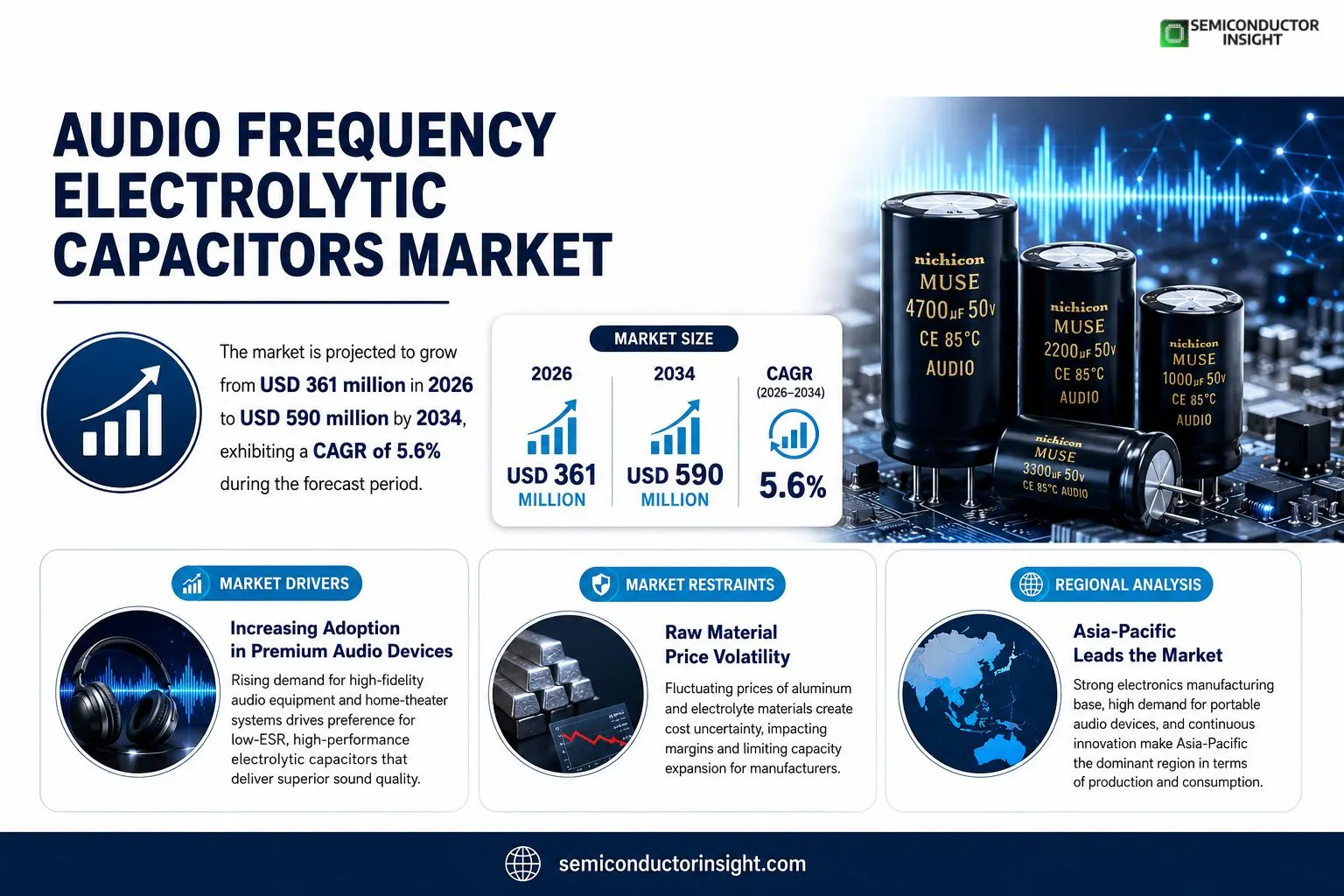
Audio Frequency Electrolytic Capacitors market was valued at USD 361 million in 2025 and is projected to grow to USD 590 million by 2034, exhibiting a CAGR of 5.6 % during the forecast period.
Audio frequency electrolytic capacitors feature a second anode foil that renders them resistant to AC voltage, making them ideal for music‑signal applications; rough electrolytic variants employ specially etched foils whose surfaces are enlarged to increase capacitance.The market is experiencing growth due to rising demand for high‑fidelity audio equipment, expanding portable‑audio segments, and continuous product innovation by leading manufacturers such as Nichicon, Panasonic and KEMET; however, price pressure stemming from raw‑material cost volatility poses a notable challenge.
MARKET DRIVERS
Increasing Adoption in Premium Audio Devices
Audio Frequency Electrolytic Capacitors Market is being steered by manufacturers of high‑fidelity headphones and home‑theater systems that demand tighter tolerance and lower distortion. As consumers gravitate toward immersive sound experiences, engineers prioritize electrolytic solutions that can handle low‑frequency ripple while preserving acoustic neutrality. This preference translates into higher unit shipments for capacitors that meet stringent audio‑performance specifications.
Regulatory Push for Energy Efficiency
Legislation targeting power‑consumption standards for consumer electronics has forced OEMs to revisit component selection. Modern audio amplifiers now incorporate standby‑mode circuitry, and electrolytic capacitors with low‑ESR values become essential to meet those efficiency benchmarks without sacrificing audio quality. Companies that can certify compliance gain a competitive edge, prompting a shift in design philosophy across Audio Frequency Electrolytic Capacitors Market.
➤ Design engineers report that a 15 % reduction in ESR can extend amplifier lifespan by roughly two years, directly influencing component procurement strategies.
Because the market is anchored to both performance expectations and regulatory compliance, suppliers that invest in refined electrolyte formulas and tighter tolerances see amplified demand, while downstream audio brands benefit from more reliable product roll‑outs.
MARKET CHALLENGES
Manufacturing Complexity
Producing electrolytic capacitors for the audio band requires precise control of electrolyte viscosity and foil thickness. Small deviations can introduce audible hiss or frequency response irregularities, forcing manufacturers to maintain rigorous quality‑control loops. This complexity raises production costs and narrows the margin cushion for volume‑driven manufacturers.
Other Challenges
Cost Sensitivity
End‑users increasingly balance sound fidelity against price, especially in mid‑range consumer segments. While premium brands can absorb higher component costs, mainstream manufacturers must negotiate tighter pricing, which can limit the adoption of advanced capacitor chemistries.
MARKET RESTRAINTS
Raw Material Price Volatility
The cost of aluminum and electrolyte compounds fluctuates with global commodity cycles, injecting uncertainty into Audio Frequency Electrolytic Capacitors Market. When raw‑material prices surge, manufacturers may defer capacity expansions or pass costs to OEMs, which can dampen demand for higher‑specification audio components.
MARKET OPPORTUNITIES
Emergence of Miniaturized Wireless Speakers
Portable Bluetooth speakers and compact soundbars are integrating sophisticated audio processing chains that still rely on stable low‑frequency filtering. The drive toward ever‑smaller form factors creates a niche for high‑density electrolytic capacitors that can fit within limited board real‑estate while delivering the low‑distortion performance required by audiophiles. Companies that can engineer thinner profiles without compromising ESR stand to capture a growing slice of Audio Frequency Electrolytic Capacitors Market.
Audio Frequency Electrolytic Capacitors Market Trends
Rising Demand in Portable Audio Devices
Audio Frequency Electrolytic Capacitors Market recorded approximately $342 million in 2024 and is slated to climb to roughly $497 million by 2031. The upward trajectory stems from the proliferation of wireless earbuds, Bluetooth speakers, and compact soundbars, all of which require capacitors that can handle alternating‑current signals without distortion. The second‑anode foil design, coupled with rough‑etched surfaces, gives these electrolytic units superior AC voltage tolerance, making them the preferred choice for high‑fidelity music reproduction in space‑constrained products. Manufacturers are therefore allocating resources to expand capacity lines that meet tighter tolerance specifications, which in turn nudges the market toward higher unit volumes while preserving price stability.
Other Trends
Shift Toward Polystyrene Dielectric
While traditional polypropylene formulations dominate older designs, a noticeable migration toward polystyrene‑based electrolytic capacitors is taking place. Polystyrene offers lower dielectric loss and improved temperature stability, attributes that align with the audio industry’s push for longer playback life and reduced noise floor. This material shift is reflected in the emerging segment forecasts, which anticipate a modest yet consistent rise in polystyrene market share through the next decade. Suppliers that successfully integrate polystyrene processes can command premium pricing and differentiate themselves in a market where acoustic clarity is a decisive purchase factor.
Competitive Landscape Consolidation
The competitive arena is increasingly defined by a handful of global players—Nichicon, Panasonic, KEMET (YAGEO), ELNA, and Nippon Chemi‑Con—who together capture the majority of revenue in 2025. Their dominance is reinforced by strategic acquisitions of niche manufacturers and investments in advanced etching technologies that enhance foil roughness. Smaller firms are either aligning with these leaders through supply agreements or exiting segments where scale economies outweigh innovation potential. For downstream OEMs, this consolidation translates into more predictable supply chains but also tighter bargaining power, prompting many to develop parallel sourcing strategies to mitigate dependency on any single supplier.
COMPETITIVE LANDSCAPE
Key Industry Players
Audio Frequency Electrolytic Capacitors – Competitive Overview
The market is anchored by a handful of firms that combine scale with deep engineering expertise. Nichicon retains the largest share owing to its extensive portfolio covering high‑voltage and low‑ESR designs, which are prized in professional audio amplifiers. Panasonic leverages its global manufacturing network to supply consistent‑quality components to OEMs across automotive and consumer segments, while KEMET, now part of YAGEO, differentiates through aggressive pricing and a broad thin‑film product line that caters to portable audio devices. ELNA’s focus on ultra‑stable dielectric formulations has secured it preferred‑vendor status among high‑end audiophile brands, and Toshin Kogyo’s in‑house foil‑roughening process gives it a technical edge in low‑distortion applications. Collectively, these leaders shape pricing benchmarks, drive standards adoption, and dictate the pace of incremental innovation in capacitance tolerance and temperature stability.Beyond the core quartet, a diverse set of specialists adds depth to the competitive picture. Amtrans and JB Capacitor concentrate on niche segments such as vintage‑equipment restoration, where legacy specifications matter more than cost. Mundorf and Audio Note have cultivated premium‑brand reputations by emphasizing sonic characteristics that appeal to boutique manufacturers. ClarityCap (Charcroft Electronics) and Dayton Audio target the DIY and mid‑range market with value‑oriented product families that still meet stringent acoustic criteria. Intertechnik, Miflex, and Jiangsu Fala Electronics operate primarily in regional supply chains, providing localized support that larger players cannot match. CapXon, Kuan Kun Electronic, Nantong Jianghai and Man Yue Technology round out the field, each offering either cost‑competitive mass‑production or tailored solutions for emerging markets in Asia and South America. Their agility in product customization and responsiveness to regional regulatory shifts creates opportunities for partnership or acquisition by the larger incumbents.
List of Key Audio Frequency Electrolytic Capacitors Companies Profiled
- Nichicon
- Panasonic
- KEMET (YAGEO)
- ELNA
- Toshin Kogyo
- Nippon Chemi-Con
- Amtrans
- JB Capacitor
- Mundorf
- SamYoung Electronics
- Audio Note
- ClarityCap (Charcroft Electronics)
- Dayton Audio
- Intertechnik
- Miflex
- Jiangsu Fala Electronics
- CapXon
- Kuan Kun Electronic
- Nantong Jianghai
- Man Yue Technology
Segment Analysis:
| Segment Category | Sub-Segments | Key Insights |
| By Type |
|
Rough Electrolytic
|
| By Application |
|
Portable Audio
|
| By End User |
|
Professional Audio Equipment
|
| By Performance |
|
Low ESR
|
| By Market Trend |
|
Miniaturization
|
Regional Analysis: Audio Frequency Electrolytic Capacitors Market
Asia-Pacific
Asia‑Pacific’s circuit‑board fabs and component assemblers are densely clustered, allowing capacitor makers to integrate production steps and shorten lead times. Proximity to end‑users reduces freight costs and facilitates rapid feedback loops for product tweaks, which is especially valuable in the fast‑moving audio segment.
Recent disruptions have prompted firms to diversify sourcing across Vietnam, Malaysia, and Taiwan. The resulting network elasticity not only mitigates material shortages but also creates bargaining power that can be leveraged to secure better pricing for raw electrolytes.
Voice‑activated assistants and wireless earbuds are gaining traction, and their architects demand capacitors that sustain high ripple currents while maintaining a low profile. Suppliers that anticipate these performance envelopes are positioning themselves as preferred partners for the next wave of audio‑centric devices.
Regional standards increasingly address RoHS compliance and end‑of‑life recyclability. Companies that embed compliance into design early avoid costly redesign cycles and can market their capacitors as environmentally responsible, a selling point for premium brands.
North America
In North America, Audio Frequency Electrolytic Capacitors Market is shaped by a mature consumer‑electronics ecosystem and a strong emphasis on product durability. OEMs here prioritize long‑term reliability, especially for automotive infotainment and high‑end home‑theater systems, leading manufacturers to invest in advanced sealing technologies. The region’s emphasis on intellectual‑property protection encourages collaborations between capacitor suppliers and design houses, fostering bespoke solutions that address niche performance criteria. However, cost pressures from offshore competitors force North American firms to balance premium pricing with the need for competitive cost structures, prompting a strategic focus on value‑added services such as customized failure analysis and rapid prototyping.
Europe
European demand for audio‑frequency electrolytic capacitors is driven by a blend of legacy audio equipment and a surge in portable premium devices. Manufacturers in Germany and the United Kingdom leverage a heritage of precision engineering to develop capacitors with tight tolerance ranges, catering to audiophile markets that prize sound fidelity. Sustainability mandates across the EU compel suppliers to adopt greener electrolytes and enhance recyclability, reinforcing a market segment willing to pay a premium for environmentally conscious components. The regulatory environment also accelerates the adoption of safety standards, which can lengthen product development cycles but ultimately yields higher confidence among end‑users.
South America
South America’s market dynamics revolve around expanding consumer purchasing power and a growing appetite for mobile entertainment. While overall volumes remain modest compared to Asia‑Pacific, local distributors are increasingly seeking capacitors that can tolerate the region’s climatic extremes, such as high humidity and temperature swings. This requirement nudges manufacturers to adjust moisture‑resistant formulations, creating a differentiated offering that can command a price premium. Investment in local assembly plants is also gaining momentum, as it reduces import duties and shortens the supply chain, giving regional players a competitive edge in price-sensitive segments.
Middle East & Africa
The Middle East & Africa region presents a heterogeneous landscape where high‑end automotive audio systems coexist with burgeoning mobile device markets. In the Gulf states, luxury automotive brands demand capacitors that sustain rigorous performance under intense heat, prompting suppliers to develop high‑temperature electrolytes and robust packaging. Meanwhile, sub‑Saharan markets are experiencing rapid mobile penetration, creating opportunities for capacitors that support compact, energy‑efficient designs. Infrastructure projects focused on smart‑city initiatives are also introducing demand for connected audio solutions, incentivising vendors to align product roadmaps with emerging connectivity standards while navigating a patchwork of regulatory regimes.
Report Scope
This market research report provides a comprehensive analysis of the Audio Frequency Electrolytic Capacitors Market , covering the forecast period 2026–2034. It offers detailed insights into market dynamics, technological advancements, competitive landscape, and key trends shaping the industry.
Key focus areas of the report include:
- Market Overview: The report begins with an overview outlining its current market scenario, key growth indicators, and industry transformation drivers. It discusses macroeconomic factors, demand–supply balance, regulatory landscape, and the strategic role of semiconductors in powering advancements across industries such as automotive, telecommunications, consumer electronics, and industrial automation.
- Market Size & Forecast: Historical data and future projections for revenue, unit shipments, and market value across major regions and segments.
- Segmentation Analysis: Detailed breakdown by product type, technology, application, and end-user industry to identify high-growth segments and investment opportunities.
- Regional Insights: Insights into market performance across North America, Europe, Asia-Pacific, Latin America, and the Middle East & Africa, including country-level analysis where relevant.
- Competitive Landscape: Profiles of leading market participants, including their product offerings, R&D focus, manufacturing capacity, pricing strategies, and recent developments such as mergers, acquisitions, and partnerships.
- Technology Trends & Innovation: Assessment of emerging technologies, integration of AI/IoT, semiconductor design trends, fabrication techniques, and evolving industry standards.
- Market Drivers & Restraints: Evaluation of factors driving market growth along with challenges, supply chain constraints, regulatory issues, and market-entry barriers.
- Stakeholder Insights: Insights for component suppliers, OEMs, system integrators, investors, and policymakers regarding the evolving ecosystem and strategic opportunities.
Primary and secondary research methods are employed, including interviews with industry experts, data from verified sources, and real-time market intelligence to ensure the accuracy and reliability of the insights presented.
FREQUENTLY ASKED QUESTIONS:
What is the current market size of Audio Frequency Electrolytic Capacitors Market?
-> Audio Frequency Electrolytic Capacitors Market was valued at USD 342 million in 2024 and is expected to reach USD 497 million by 2031, growing at a CAGR of 5.6% during the forecast period.
Which key companies operate in Audio Frequency Electrolytic Capacitors Market?
-> Key players include Nichicon, Panasonic, KEMET (YAGEO), ELNA, Toshin Kogyo, Nippon Chemi-Con, Amtrans, JB Capacitor, Mundorf, SamYoung Electronics, Audio Note, ClarityCap (Charcroft Electronics), Dayton Audio, Intertechnik, Miflex, Jiangsu Fala Electronics, CapXon, Kuan Kun Electronic, Nantong Jianghai, Man Yue Technology.
What are the key growth drivers?
-> Key growth drivers include increased demand for high‑fidelity audio in consumer electronics, automotive and professional audio applications, as well as technological advancements such as rough electrolytic capacitor designs that improve performance and reliability.
Which region dominates the market?
-> Asia, particularly China, together with North America (United States), are the dominant regions driving market growth, reflecting strong adoption in electronics manufacturing and automotive audio sectors.
What are the emerging trends?
-> Emerging trends include development of rough electrolytic capacitor technologies, integration of secondary anode foil designs for improved AC voltage resistance, and miniaturization to meet compact device requirements.
Get Sample Report PDF for Exclusive Insights
Report Sample Includes
- Table of Contents
- List of Tables & Figures
- Charts, Research Methodology, and more...
 Download Sample Report PDF