Electrodynamic Speaker Drivers Market Insights
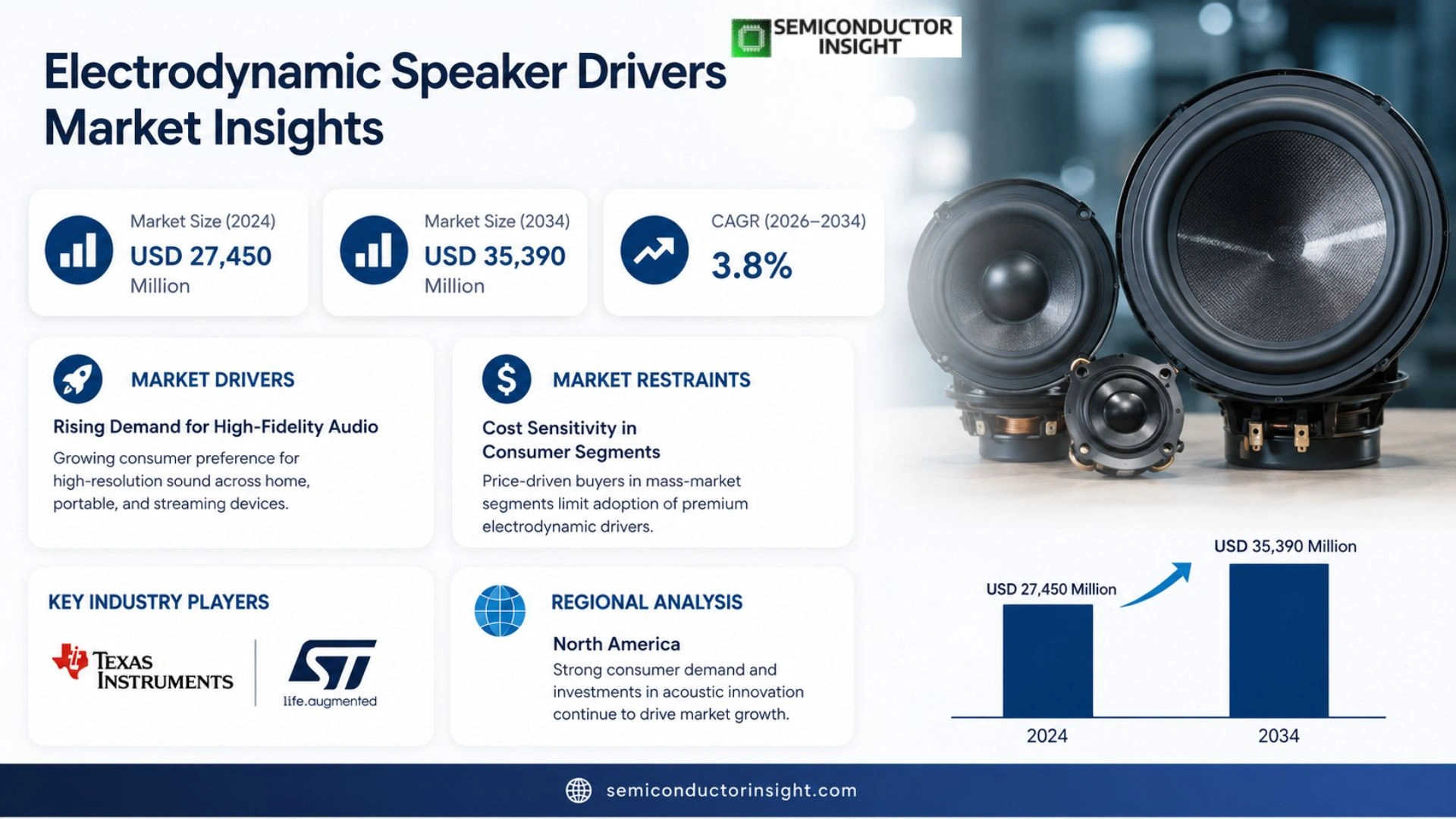
Global Electrodynamic Speaker Drivers market size was valued at USD 27,450 million in 2024 and will climb to USD 35,390 million by 2034, indicating a CAGR of 3.8% during the forecast period.
Electrodynamic speaker drivers are individual transducers that convert an electrical audio signal into sound waves. They are typically used in specialized units that reproduce only part of the audible spectrum,tweeters handle high frequencies, mid‑range drivers cover middle tones, woofers address low frequencies and sub‑woofers deliver deep bass. When several drivers are combined within one enclosure they provide high‑fidelity reproduction across the full frequency range.
The upward trend originates from growing consumer demand for televisions, smartphones and smart watches that require premium audio performance, alongside expanding streaming services that raise expectations for higher‑quality sound. Rising disposable incomes and rapid urbanisation further boost purchases of sophisticated speaker systems. Technological advances such as wireless earbuds and notch‑less smartphones pressure manufacturers to adopt more efficient electrodynamic drivers. Additionally, the rollout of 5G networks enables seamless high‑definition media consumption, reinforcing the need for superior acoustic solutions in both mobile devices and hospitality environments.
MARKET DRIVERS
Rising Demand for High‑Fidelity Audio
Electrodynamic Speaker Drivers Market is buoyed by consumers who increasingly value immersive sound experiences across home‑theater, portable, and streaming devices. As streaming services expand their high‑resolution catalogs, manufacturers are compelled to differentiate‑proof their product lines with drivers that deliver tighter bass response and lower distortion. This shift nudges OEMs to prioritize premium electrodynamic designs over cost‑driven alternatives.
Advances in Magnetic Materials
Recent breakthroughs in neodymium‑based magnets have reshaped the cost‑performance equation for speaker assemblies. Higher magnetic flux density enables smaller diaphragms to achieve the same output pressure, opening doors for compact devices without compromising on power handling. Companies that embed these materials into their driver stacks report a measurable lift in unit‑level revenue because end‑users associate sleek form factors with superior acoustics.
➤ Industry insiders note that the convergence of material science and digital signal processing is turning electrodynamic drivers into a platform for differentiated audio branding.
Beyond product‑level incentives, the ecosystem surrounding acoustic calibration software is maturing, allowing manufacturers to sell driver modules as part of integrated solutions rather than isolated components. This service‑oriented approach creates recurring revenue streams and reinforces the strategic importance of the electrodynamic segment within broader audio portfolios.
MARKET CHALLENGES
Manufacturing Complexity
Precision winding of voice‑coil wire and tight tolerances on cone geometry demand sophisticated production lines that are capital‑intensive. Small‑to‑mid‑size players often lack the economies of scale required to amortize these investments, rendering them vulnerable to price pressure from larger rivals that have already automated key steps.
Other Challenges
Supply Chain Volatility
Fluctuations in rare‑earth metal prices and geopolitical constraints on extraction sites introduce uncertainty into cost forecasts. Companies that fail to secure long‑term contracts or develop alternative magnet technologies risk margin erosion during periods of price spikes.
The regulatory environment for electronic waste also adds a compliance layer; stricter disposal standards in major markets compel manufacturers to redesign end‑of‑life processes, further stretching operational budgets.
MARKET RESTRAINTS
Cost Sensitivity in Consumer Segments
While audiophiles are willing to pay a premium for electrodynamic excellence, mass‑market buyers remain price‑driven. Entry‑level smart speakers and budget headphones often substitute planar‑magnetic or electrostatic alternatives to keep unit costs below critical thresholds. This pricing gap limits the overall penetration rate of high‑end electrodynamic drivers.
Furthermore, the rise of integrated audio chips that embed amplification and digital processing reduces the perceived need for separate driver modules, especially in low‑cost devices. As a result, manufacturers must justify the added expense through demonstrable performance gaps, which is not always straightforward.
Finally, regional economic slowdowns dampen discretionary spending on premium audio equipment, curbing the willingness of retailers to stock higher‑margin electrodynamic options during inventory reviews.
MARKET OPPORTUNITIES
Emerging Automotive Audio Systems
Automakers are embedding sophisticated sound bars and surround‑sound arrays into vehicle cabins to create a concert‑hall feel for passengers. Electrodynamic drivers, with their proven efficiency and ability to operate across a wide frequency band, are positioned as the preferred choice for these high‑visibility projects. Partnerships with OEMs unlock a channel that values durability and consistent performance over pure cost considerations.
In parallel, electric vehicle platforms present a unique acoustic challenge: the near‑silent drivetrain amplifies road and wind noise, prompting manufacturers to invest in driver designs that can generate richer sound fields without excessive power draw. This technical requirement aligns well with the high SPL capabilities of modern electrodynamic units.
Beyond automotive, the growth of immersive virtual‑reality headsets creates demand for miniature yet powerful drivers. Companies that can miniaturize electrodynamic technology while preserving low distortion levels stand to capture a niche yet rapidly expanding segment of the market.
Electrodynamic Speaker Drivers Market Trends
Consumer Electronics Integration
Manufacturers are embedding electrodynamic speaker drivers into an ever‑wider range of consumer devices. Smartphone OEMs now specify drivers that can reproduce both mid‑range music and high‑frequency effects, allowing a single handset to serve as a credible audio source for streaming platforms. Television sets, particularly premium models, incorporate multiple driver configurations to deliver theater‑like sound without the need for external speakers. This convergence of audio hardware and visual hardware reflects a market shift where end users treat sound quality as an equal pillar of the overall media experience. Price elasticity remains moderate; while premium segments command higher margins, mid‑range devices rely on volume sales to offset narrower spreads. This dynamic pushes OEMs to negotiate aggressively with driver suppliers, fostering a competitive bidding environment that accelerates innovation cycles.
Other Trends
Miniaturization and Power Efficiency
Advances in micro‑electromechanical processing have enabled drivers that occupy less than half the footprint of previous generations while consuming markedly lower power. The reduction in size permits integration into wearables such as smart watches, where space constraints previously limited audio output to basic buzzers. Efficiency gains also translate to longer battery life, a decisive factor for mobile users who stream high‑definition content throughout the day.
Automotive Integration
Vehicle manufacturers are incorporating electrodynamic drivers into cockpit sound systems and driver‑alert alerts. The transition to electric powertrains reduces ambient engine noise, creating a demand for richer in‑cab audio to maintain perceived vehicle quality. Suppliers that can deliver compact, vibration‑resistant drivers gain contracts with OEMs seeking to differentiate their models through premium sound experiences.
Smart Home and Hospitality
Hotels and serviced apartments are deploying networked smart speakers to streamline guest interactions, from check‑in notifications to room‑service requests. The integration of electrodynamic drivers ensures that voice‑assistant responses are clear even in acoustically challenging lobby spaces. Vendors that bundle drivers with built‑in DSP capabilities gain traction as property managers seek turnkey solutions that reduce installation complexity.
5G Rollout and Streaming Quality
The deployment of 5G networks has lifted bandwidth bottlenecks, making loss‑less audio streams a realistic expectation for many consumers. As streaming services expand their high‑resolution catalogues, demand for speakers that can faithfully render nuanced sound signatures rises. OEMs respond by selecting electrodynamic drivers capable of handling wider dynamic ranges, thereby positioning their products as premium audio solutions in a competitive market. Supply‑chain volatility for rare‑earth magnets and high‑precision coils introduces cost pressure, prompting manufacturers to explore alternative materials such as neodymium‑free composites. Firms that secure stable component sourcing and invest in automation are better positioned to meet the escalating order volumes forecast by major audio‑equipment brands.
COMPETITIVE LANDSCAPE
Key Industry Players
Electrodynamic Speaker Drivers Market – Competitive Overview
Texas Instruments and STMicroelectronics dominate the upper tier of the electrodynamic speaker driver arena, leveraging extensive analog‑circuit expertise and deep relationships with OEMs in the consumer electronics chain. Their portfolios span high‑efficiency woofers, mids, and ultra‑compact tweeters tailored for flagship smartphones and premium smart‑speakers. Scale economies allow these firms to sustain aggressive pricing while funding silicon‑level innovations such as integrated acoustic‑feedback loops that improve linearity. The resulting market structure features a concentrated core of multinational semiconductor giants, whose product roadmaps often dictate the performance envelope that downstream manufacturers must accommodate. This concentration also creates a predictable supply chain for high‑volume brands, but it leaves room for disruptive entrants that can address niche acoustic specifications or emerging form factors.
Beyond the tier‑one group, a cohort of specialized suppliers,including Dongwoon Anatech, ZINITIX, Rohm Semiconductor, ON Semiconductor, Fitipower, Giantec Semiconductor, Weltrend, Physik Instrumente, Sensata Technologies, Allegro Microsystems, Farnell, Knowles Corporation, and TDK Corporation,provides differentiated driver technologies. Many focus on micro‑electromechanical (MEMS) VCM designs that meet the miniaturization pressures of wearables and ultra‑thin tablets, while others supply premium ceramic or magnetic‑suspension woofers for automotive infotainment systems. Their agility stems from targeted R&D investments and strategic partnerships with device makers seeking unique acoustic signatures. Consequently, these players can capture market share in segments where performance nuance outweighs pure cost considerations, fostering a competitive environment that encourages continual refinement of driver efficiency, distortion control, and integration simplicity.
List of Key Electrodynamic Speaker Drivers Companies Profiled
- Dongwoon Anatech
- ZINITIX
- Rohm Semiconductor
- ON Semiconductor
- Fitipower
- Giantec Semiconductor
- Weltrend
- STMicroelectronics
- Texas Instruments
- Physik Instrumente
- Sensata Technologies
- Allegro Microsystems
- Farnell
- Knowles Corporation
- TDK Corporation
Segment Analysis:
| Segment Category | Sub-Segments | Key Insights |
| By Type |
|
Open Loop VCM Driver • Favoured for its straightforward architecture that reduces production complexity. • Delivers reliable low‑frequency output, making it a go‑to choice for entry‑level audio modules. • Supports modular designs where cost efficiency and ease of integration are paramount. |
| By Application |
|
Mobile Phone • Drives demand for compact, high‑definition audio performance in hand‑held devices. • Encourages innovation around space‑saving driver designs that still deliver rich soundscapes. • Aligns with consumer expectations for immersive media experiences on portable platforms. |
| By End User |
|
Consumer Electronics • Continues to push manufacturers toward higher fidelity and louder sound in compact form factors. • Fuels development of drivers that balance efficiency with premium acoustic quality for everyday devices. • Supports ecosystem growth where audio performance is a key differentiator in product selection. |
| By Frequency Range |
|
Mid‑range • Serves as the core driver for balanced audio reproduction across most consumer devices. • Offers a sweet spot between low‑end power and high‑frequency clarity, making it indispensable for versatile speaker systems. • Guides product designers to prioritize driver materials that sustain consistent performance over varied content. |
| By Integration Mode |
|
Integrated Module • Enables compact system‑in‑package solutions that reduce assembly steps. • Appeals to OEMs focused on delivering thin, lightweight devices without compromising acoustic quality. • Drives collaborative engineering between driver manufacturers and device architects to harmonize electrical and mechanical design aspects. |
Regional Analysis: Electrodynamic Speaker Drivers Market
Companies are trialing graphene‑reinforced diaphragms and bio‑based polymers, aiming to reduce mass while preserving stiffness. The material shift promises tighter transient response and positions manufacturers to meet eco‑label requirements that are gaining traction among premium audio brands.
Advanced CNC machining and additive layering enable higher volume output without sacrificing tolerances. This production flexibility supports both large‑scale OEM orders and limited‑edition projects, blurring the line between mass market and boutique supply chains.
The rise of spatial audio and object‑based sound formats forces designers to prioritize uniform dispersion. Drivers that can maintain coherent wavefronts across a broader frequency range are becoming a decisive differentiator for home‑entertainment manufacturers.
Emerging directives on hazardous substances compel suppliers to replace lead‑based magnets and certain adhesives. Early compliance not only averts supply disruptions but also enhances brand perception among environmentally conscious consumers.
Europe
European firms leverage a dense network of acoustical research institutions, fostering a climate where theoretical advances quickly translate into market‑ready driver designs. The region’s emphasis on high‑resolution sound reproduction, especially within the luxury home‑audio sector, drives demand for drivers that can sustain low distortion at elevated SPL levels. Additionally, stricter electromagnetic emission standards push manufacturers toward refined magnetic circuit topologies, encouraging a wave of compact, high‑efficiency models. Companies that integrate these technical imperatives with the continent’s strong emphasis on design aesthetics often secure contracts with premium OEMs seeking differentiated sound experiences.
Asia‑Pacific
In Asia‑Pacific, the market momentum stems from a blend of rapid urbanization and a burgeoning middle class eager for premium audio experiences. While China and India dominate volume production, Japan and South Korea continue to push the envelope in driver precision, especially for automotive and portable devices. Supply‑chain agility, facilitated by extensive contract manufacturing hubs, allows regional players to iterate designs at pace, meeting the diverse specifications of consumer electronics giants. This capacity to balance scale with specialization is reshaping competitive dynamics across Electrodynamic Speaker Drivers Market in the region.
South America
South America’s growth narrative is anchored in a rising appetite for home‑entertainment upgrades across Brazil and Argentina. Local distributors increasingly favor drivers that combine robust performance with cost‑effective manufacturing, prompting importers to source from nearby low‑cost facilities. At the same time, a nascent interest in live‑event sound reinforcement is encouraging regional manufacturers to develop drivers optimized for durability and wide‑band response, opening niche opportunities for specialised component suppliers.
Middle East & Africa
The Middle East & Africa exhibit a heterogeneous landscape where luxury hospitality venues in the Gulf and emerging consumer markets in sub‑Saharan Africa drive distinct demand patterns. In the Gulf, high‑end hotel chains integrate bespoke audio solutions that rely on ultra‑low‑distortion drivers, motivating suppliers to offer customized magnet assemblies and premium finishings. Conversely, African markets prioritize affordability and ruggedness, steering manufacturers toward simplified driver constructions that can withstand variable power conditions while delivering acceptable acoustic performance.
Report Scope
This market research report provides a comprehensive analysis of the Electrodynamic Speaker Drivers Market , covering the forecast period 2026–2034. It offers detailed insights into market dynamics, technological advancements, competitive landscape, and key trends shaping the industry.
Key focus areas of the report include:
- Market Overview: The report begins with an overview outlining its current market scenario, key growth indicators, and industry transformation drivers. It discusses macroeconomic factors, demand–supply balance, regulatory landscape, and the strategic role of semiconductors in powering advancements across industries such as automotive, telecommunications, consumer electronics, and industrial automation.
- Market Size & Forecast: Historical data and future projections for revenue, unit shipments, and market value across major regions and segments.
- Segmentation Analysis: Detailed breakdown by product type, technology, application, and end-user industry to identify high-growth segments and investment opportunities.
- Regional Insights: Insights into market performance across North America, Europe, Asia-Pacific, Latin America, and the Middle East & Africa, including country-level analysis where relevant.
- Competitive Landscape: Profiles of leading market participants, including their product offerings, R&D focus, manufacturing capacity, pricing strategies, and recent developments such as mergers, acquisitions, and partnerships.
- Technology Trends & Innovation: Assessment of emerging technologies, integration of AI/IoT, semiconductor design trends, fabrication techniques, and evolving industry standards.
- Market Drivers & Restraints: Evaluation of factors driving market growth along with challenges, supply chain constraints, regulatory issues, and market-entry barriers.
- Stakeholder Insights: Insights for component suppliers, OEMs, system integrators, investors, and policymakers regarding the evolving ecosystem and strategic opportunities.
Primary and secondary research methods are employed, including interviews with industry experts, data from verified sources, and real-time market intelligence to ensure the accuracy and reliability of the insights presented.
FREQUENTLY ASKED QUESTIONS:
What is the current market size of Electrodynamic Speaker Drivers Market?
-> Electrodynamic Speaker Drivers market will climb to USD 35,390 million by 2034, indicating a CAGR of 3.8% during the forecast period.
Which key companies operate in Electrodynamic Speaker Drivers Market?
-> Key players include Dongwoon Anatech, ZINITIX, Rohm Semiconductor, On Semiconductor, Fitipower, Giantec Semiconductor, Weltrend, ST Microelectronics, Texas Instruments, Physik Instrumente, Sensata Technologies, Allegro Microsystems, and Farnell.
What are the key growth drivers?
-> Key growth drivers include rising demand for consumer electronics such as TVs, smartphones and smart watches, growth of online audio‑video streaming, increasing disposable income and living standards, rapid urbanization, strong mobile‑phone penetration, high‑speed inexpensive internet, launch of AirPods and notch‑less smartphones, new product introductions by major brands, commercialization of 5G networks, and expanding use of smart speakers in travel and hospitality.
Which region dominates the market?
-> Asia dominates the market, driven by large consumer‑electronics manufacturing bases and high demand in countries such as China, Japan, South Korea, India and Southeast Asia.
What are the emerging trends?
-> Emerging trends include integration of 5G connectivity, AI‑enabled smart speaker functionality, development of advanced driver types like super‑tweeters and rotary woofers, and a focus on energy‑efficient, high‑fidelity audio solutions.
Get Sample Report PDF for Exclusive Insights
Report Sample Includes
- Table of Contents
- List of Tables & Figures
- Charts, Research Methodology, and more...
 Download Sample Report PDF