Vertical External Cavity Surface Emitting Laser (VECSEL) Market Insights
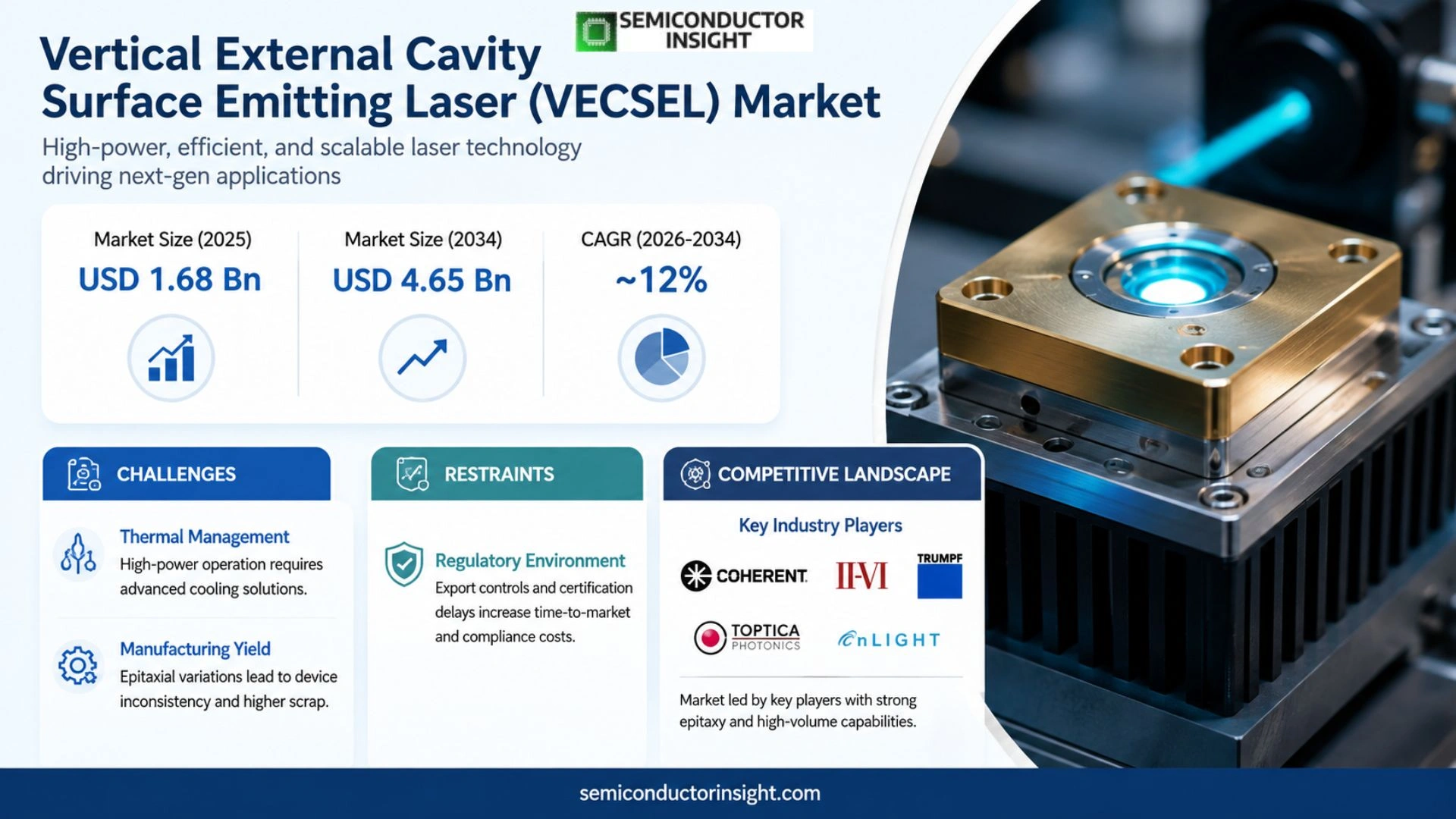
Vertical External Cavity Surface Emitting Laser (VECSEL) market size was valued at USD 1.68 billion in 2025. The market is projected to grow from USD 1.68 billion in 2026 to USD 4.65 billion by 2034, exhibiting a CAGR of approximately 12 % during the forecast period.
A vertical‑external‑cavity surface‑emitting laser (VECSEL) is a compact semiconductor laser that shares architecture with VCSELs but delivers higher output power and broader wavelength flexibility. VECSELs are chiefly used as near‑infrared sources for laser cooling, spectroscopy, and emerging telecommunications applications, while also supporting high‑speed data‑center interconnects and LiDAR‑based sensing solutions.
MARKET DRIVERS
Rising Demand for High‑Performance Light Sources
Vertical External Cavity Surface Emitting Laser (VECSEL) Market is benefitting from a surge in applications that require high optical power combined with narrow linewidth. Data‑center interconnects, LIDAR for autonomous vehicles, and precision manufacturing all depend on stable, tunable beams, pushing manufacturers to expand capacity. Companies that can deliver scalable modules are seeing order books grow faster than the overall semiconductor photonics segment.
Advancements in Semiconductor Materials
Recent breakthroughs in GaAs‑based quantum‑well structures and the introduction of InP‑type substrates have lifted ceiling efficiencies above 30 %. These material gains translate into lower operating currents and reduced cooling requirements, making VECSELs economically attractive for OEMs seeking to replace bulkier laser diodes. The performance edge is prompting R&D budgets to earmark a larger share for VECSEL‑centric projects.
➤ Industry analysts note that the convergence of material science and system‑level integration is the single most influential factor shaping the competitive landscape today.
As system architects prioritize compactness without compromising output power, the VECSEL platform is emerging as the preferred choice for next‑generation optical modules. This shift is reshaping supply chains, with component suppliers adapting to higher‑volume, lower‑cost production runs.
MARKET CHALLENGES
Thermal Management Constraints
Despite efficiency gains, dissipating heat from high‑power VECSEL arrays remains a bottleneck. Designers must balance cavity length, pump intensity, and heat‑sink geometry, often resorting to complex micro‑fluidic cooling solutions that add cost and integration difficulty. Failure to resolve these thermal issues can erode the reliability advantage VECSELs hold over conventional laser diodes.
Other Challenges
Manufacturing Yield
Achieving consistent wafer‑scale uniformity is challenging because VECSEL performance is highly sensitive to epitaxial layer thickness. Variations translate into split‑frequency devices, driving up scrap rates and limiting the ability to meet large‑volume forecasts.
MARKET RESTRAINTS
Stringent Regulatory Environment
Export controls on high‑power photonic components, particularly in regions targeting defense‑related LIDAR systems, impose licensing hurdles that delay market entry. Companies must navigate a patchwork of certification regimes, inflating time‑to‑market and diverting engineering resources from product development to compliance activities.
MARKET OPPORTUNITIES
Emerging Applications in Augmented Reality
AR headsets demand compact, eye‑safe lasers with rapid wavelength agility for dynamic projection. VECSELs can deliver the required brightness while maintaining a low footprint, positioning them as a cornerstone technology for next‑gen immersive devices. Early partnerships between VECSEL manufacturers and headset makers are already yielding pilot programs that could expand into multi‑billion‑dollar revenue streams within the next five years.
Vertical External Cavity Surface Emitting Laser (VECSEL) Market Trends
Rising Demand for High‑Speed Optical Interconnects
The surge in data‑center deployments has intensified the need for optical links capable of supporting terabit‑per‑second traffic. Engineers are increasingly selecting VECSEL devices because their narrow linewidth and high modulation bandwidth align with the performance envelope required for dense wavelength‑division multiplexing (DWDM) modules. This technical fit, combined with the relative ease of integrating VECSELs into silicon photonics platforms, is prompting equipment manufacturers to redesign transceiver architectures around the technology. As a result, component suppliers are allocating more wafer capacity to near‑infrared VECSEL lines, a move that reshapes the supply chain and nudges pricing toward a more competitive tier.
Other Trends
LiDAR Integration in Autonomous Vehicles
Automakers and Tier‑1 suppliers are accelerating the rollout of solid‑state LiDAR solutions, and VECSEL‑based emitter arrays have become a preferred choice due to their high optical power per unit area and reliable eye‑safe wavelengths. The 2022 partnership between a leading VCSEL array producer and a global LiDAR specialist exemplifies how joint development programs are shortening time‑to‑market for driver‑assistance systems. By leveraging the scalability of VECSEL chips, system designers can achieve wider field‑of‑view coverage while keeping module cost within automotive target ranges, thereby strengthening the overall business case for sensor‑centric vehicle architectures.
Policy‑Driven Funding and Manufacturing Capacity
Recent federal initiatives aimed at revitalizing domestic semiconductor manufacturing have earmarked substantial resources for advanced optoelectronic devices. The infusion of capital is being directed toward automated fab lines that can produce high‑volume VECSEL wafers with tighter process control. Companies that secure these incentives are positioned to expand output without sacrificing yield, which in turn creates a feedback loop: greater availability reduces lead times for end‑users in telecommunications, medical imaging, and industrial processing, prompting those sectors to increase their order books. This policy environment therefore acts as a catalyst, encouraging both incumbents and new entrants to deepen their R&D investments in VECSEL architectures.
COMPETITIVE LANDSCAPE
Key Industry Players
Competitive Outlook for the Global VECSEL Market
The VECSEL arena is dominated by a handful of large‑scale suppliers that have leveraged both wafer‑scale epitaxy expertise and high‑volume packaging capabilities. II‑VI Incorporated, for example, has built a portfolio that spans high‑power near‑infrared devices for data‑center interconnects and precision spectroscopy modules for laboratory use. Its ability to integrate custom Bragg mirrors with thin‑film gain structures gives it a pricing advantage that forces smaller firms into niche segments. Lumentum Holdings, bolstered by strategic acquisitions in the photonics space, now offers modular VECSEL arrays that feed directly into automotive LiDAR prototypes. The concentration of revenue among these two firms creates a de‑facto tiered market: the top tier supplies turnkey solutions to Tier‑1 OEMs, while the rest compete on application‑specific performance or regional service depth.
Beyond the tier‑one leaders, a diverse set of companies sustains innovation across wavelength bands and end‑use cases. Furukawa Electric and Polytec GmbH focus on the 980 nm band, catering to medical imaging and industrial cutting tools where beam quality is paramount. 3SP Technologies and DoGain Laser Technology have carved out positions in ultrafast pulse generation for spectroscopy, emphasizing low‑noise operation. Lumics and Oxxius develop compact, fiber‑coupled VECSEL sources that address portable sensing and consumer electronics. Thorlabs leverages its broad distribution network to deliver experimental kits that accelerate university‑scale research. InnoLas and Vexlum target the emerging 1480 nm space, aligning with next‑generation telecommunications roll‑outs. Collaborative efforts,such as Lumentum’s partnership with HESAI on hybrid solid‑state LiDAR,illustrate how niche players amplify their market relevance by aligning with system integrators and automotive OEMs.
List of Key VECSEL Companies Profiled
- II‑VI Incorporated
- Lumentum Holdings Inc.
- Furukawa Electric Co., Ltd.
- Thorlabs Inc.
- Polytec GmbH
- 3SP Technologies
- DoGain Laser Technology
- Lumics GmbH
- Oxxius SA
- InnoLas GmbH
- Vexlum AG
- NeoPhotonics Corporation
Segment Analysis:
| Segment Category | Sub-Segments | Key Insights |
| By Type |
|
Near‑infrared variants dominate design efforts, offering:
|
| By Application |
|
Laboratory & research segment thrives because:
|
| By End User |
|
Automotive & LiDAR gains momentum through:
|
| By Material System |
|
GaAs‑based VECSELs remain preferred because:
|
| By Technology Advancement |
|
Integrated photonic VECSELs are shaping future roadmaps through:
|
Regional Analysis: Vertical External Cavity Surface Emitting Laser (VECSEL) Market
Manufacturers of precision metal‑cutting and additive‑manufacturing equipment are integrating VECSEL modules to achieve tighter tolerances and higher throughput. The ability to deliver narrow‑band, high‑power output reduces thermal distortion during laser‑based processing, which translates into superior surface finish and lower post‑process rework. This functional edge has spurred several mid‑size firms to replace legacy sources with VECSEL solutions, reshaping the competitive landscape of industrial laser suppliers.
In ophthalmic surgery and diagnostics, VECSELs provide the wavelength agility required for emerging procedures such as corneal cross‑linking and retinal imaging. Clinicians value the consistent beam quality that minimizes collateral tissue exposure, while device manufacturers appreciate the reduced component count enabled by monolithic VECSEL designs. These efficiencies are prompting a shift toward next‑generation therapeutic platforms that position VECSEL technology as a catalyst for procedural differentiation.
Military research agencies are exploring VECSELs for lidar‑based target acquisition and directed‑energy prototypes. The high peak power and spectral purity of VECSELs meet stringent detection and range‑finding specifications, while the scalable cavity architecture supports rapid customization for divergent mission sets. Early field trials have demonstrated measurable performance gains over conventional solid‑state lasers, hinting at a strategic pivot toward photonic solutions in future defense procurements.
Federal research grants continue to funnel resources into photonic experimentation, with a noticeable tilt toward VECSEL architectures that promise higher wall‑plug efficiency. Collaborative labs in Silicon Valley and the Boston corridor are publishing breakthroughs in epitaxial growth that lower manufacturing defects, thereby extending device lifetimes. These academic‑industry synergies are generating a pipeline of differentiated VECSEL products that will likely dictate the next wave of market growth.
Europe
European manufacturers are leveraging VECSEL technology to meet stringent EU regulations on energy consumption and emission control. The automotive sector, in particular, views VECSELs as an enabler for next‑generation headlamp systems that combine adaptive illumination with low‑power operation. Moreover, the region’s strong emphasis on standardization has accelerated the certification process for VECSEL‑based medical devices, granting firms quicker market entry. Collaborative frameworks between German engineering firms and French research institutes are also yielding bespoke VECSEL designs tailored for high‑precision metrology, reinforcing Europe’s position as a hub for specialized photonic solutions.
Asia‑Pacific
Asia‑Pacific’s rapidly expanding consumer electronics market is prompting OEMs to explore VECSELs for high‑resolution projection and augmented‑reality displays. The ability to tune emission wavelengths without extensive hardware changes aligns well with the region’s fast product‑cycle dynamics. In addition, burgeoning semiconductor fabs in Taiwan and South Korea are experimenting with VECSELs for wafer‑level testing, attracted by the lasers’ superior coherence and power stability. Government incentives targeting advanced manufacturing further encourage local suppliers to invest in VECSEL production capabilities, creating a fertile environment for both domestic and foreign entrants.
South America
South American research institutions are beginning to adopt VECSEL platforms for material‑science investigations, particularly in the fields of photovoltaics and polymer synthesis. While the market remains nascent, early collaboration between Brazilian universities and multinational laser firms is fostering knowledge transfer that could unlock new application niches. Logistic improvements in regional supply chains are gradually reducing lead times for VECSEL components, making the technology more accessible to mid‑size manufacturers seeking to differentiate their product lines with advanced photonic features.
Middle East & Africa
In the Middle East, defense modernization programs are creating a modest but growing demand for high‑performance VECSELs in surveillance and directed‑energy prototypes. Meanwhile, African nations are investing in telemedicine infrastructure where VECSEL‑based diagnostic tools can offer higher reliability in remote settings. Partnerships between Gulf‑state research centers and global laser suppliers are facilitating technology transfer, while emerging local talent pools are beginning to contribute to VECSEL system integration, hinting at a longer‑term diversification of the regional market.
Report Scope
This market research report provides a comprehensive analysis of the Vertical External Cavity Surface Emitting Laser (VECSEL) Market , covering the forecast period 2026–2034. It offers detailed insights into market dynamics, technological advancements, competitive landscape, and key trends shaping the industry.
Key focus areas of the report include:
- Market Overview: The report begins with an overview outlining its current market scenario, key growth indicators, and industry transformation drivers. It discusses macroeconomic factors, demand–supply balance, regulatory landscape, and the strategic role of semiconductors in powering advancements across industries such as automotive, telecommunications, consumer electronics, and industrial automation.
- Market Size & Forecast: Historical data and future projections for revenue, unit shipments, and market value across major regions and segments.
- Segmentation Analysis: Detailed breakdown by product type, technology, application, and end-user industry to identify high-growth segments and investment opportunities.
- Regional Insights: Insights into market performance across North America, Europe, Asia-Pacific, Latin America, and the Middle East & Africa, including country-level analysis where relevant.
- Competitive Landscape: Profiles of leading market participants, including their product offerings, R&D focus, manufacturing capacity, pricing strategies, and recent developments such as mergers, acquisitions, and partnerships.
- Technology Trends & Innovation: Assessment of emerging technologies, integration of AI/IoT, semiconductor design trends, fabrication techniques, and evolving industry standards.
- Market Drivers & Restraints: Evaluation of factors driving market growth along with challenges, supply chain constraints, regulatory issues, and market-entry barriers.
- Stakeholder Insights: Insights for component suppliers, OEMs, system integrators, investors, and policymakers regarding the evolving ecosystem and strategic opportunities.
Primary and secondary research methods are employed, including interviews with industry experts, data from verified sources, and real-time market intelligence to ensure the accuracy and reliability of the insights presented.
FREQUENTLY ASKED QUESTIONS:
What is the current market size of Vertical External Cavity Surface Emitting Laser (VECSEL) Market?
-> Vertical External Cavity Surface Emitting Laser (VECSEL) market is projected to grow from USD 1.68 billion in 2026 to USD 4.65 billion by 2034, exhibiting a CAGR of approximately 12 %
Which key companies operate in Vertical External Cavity Surface Emitting Laser (VECSEL) Market?
-> Key players include II-VI, Furukawa Electric, Polytec GmbH, Lumentum, 3SP Technologies, DoGain Laser Technology, Lumics, Oxxius, Thorlabs, InnoLas, and Vexlum.
What are the key growth drivers?
-> Key growth drivers include the rapid expansion of data centers demanding high‑speed optical interconnects, increased adoption of automation and LiDAR technologies in manufacturing and automotive sectors, and supportive government initiatives such as the Made in America program that boost R&D investment.
Which region dominates the market?
-> North America leads in market share, driven by strong research funding, strategic partnerships (e.g., Lumentum‑HESAI LiDAR collaboration), and early adoption of high‑speed data‑center infrastructure.
What are the emerging trends?
-> Emerging trends include integration of VCSEL‑based arrays into solid‑state LiDAR for ADAS, development of high‑power VECSELs for telecommunications, and increased focus on cost‑effective, automotive‑grade reliability in laser components.
Get Sample Report PDF for Exclusive Insights
Report Sample Includes
- Table of Contents
- List of Tables & Figures
- Charts, Research Methodology, and more...
 Download Sample Report PDF