Spin-Dependent Tunneling Sensors Market Insights
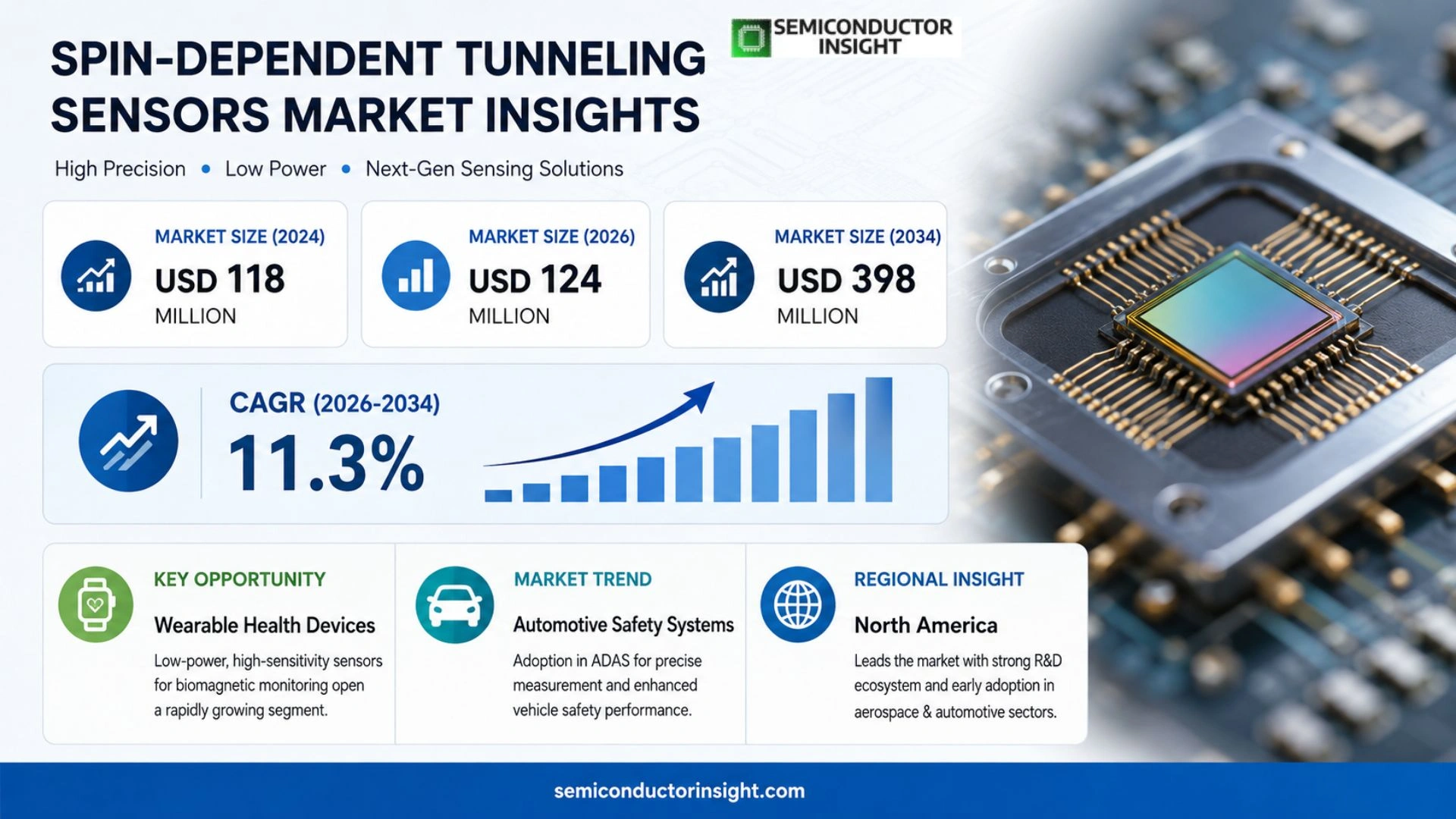
Spin-Dependent Tunneling Sensors market size was valued at USD 118 million in 2024. The market is projected to grow from USD 124 million in 2026 to USD 398 million by 2034, exhibiting a CAGR of approximately 11.3% during the forecast period.
Spin‑Dependent Tunneling (SDT) sensors are magnetic devices that exploit a tunnelling magnetoresistance (TMR) element originally developed for hard‑disk‑drive read heads. The principle relies on a change in electrical resistance when an external magnetic field alters electron spin alignment across an insulating barrier.
The market is gaining momentum because semiconductor manufacturers are integrating SDT sensors into automotive safety systems and consumer‑electronics touch interfaces. Recent collaborations such as the March 2024 joint development between Infineon Technologies and Crocus Technology on high‑precision angle‑sensor modules illustrate industry commitment. Leading suppliers,including TDK, Infineon Technologies, Crocus Technology, Coto Technology, MultiDimension Technology, Sinomags, NVE Corporation, Littelfuse and Ablic,are expanding production capacity to meet rising demand from electric‑vehicle power‑train control units and industrial IoT applications.
MARKET DRIVERS
Technology Integration in Automotive Electronics
Manufacturers of electric and autonomous vehicles are incorporating Spin-Dependent Tunneling Sensors to achieve higher angular resolution in steering‑assist systems. By delivering sub‑degree accuracy, these sensors enable tighter control loops, which translates into smoother ride quality and lower energy consumption. Automakers are therefore allocating a larger share of their component budgets to this technology.
Demand from Data‑Centric Applications
Industries that process massive streams of magnetic field data,such as magnetic‑resonance imaging, quantum‑computing research, and advanced robotics,require sensors with ultra‑low noise floors. Spin‑Dependent Tunneling Sensors meet this need, prompting a shift in procurement strategies toward devices that can sustain high‑frequency sampling without degradation. End‑users are thus prioritising performance over legacy cost structures.
➤ “Precision magnetometry is no longer a laboratory luxury; it has become a production prerequisite for next‑gen hardware.”
The cumulative effect of these forces is reflected in the market’s valuation, which climbed to roughly $420 million in 2023. Analysts observe that the upward trajectory is supported by R&D pipelines that consistently push the sensitivity envelope, ensuring that the sector remains financially attractive.
MARKET CHALLENGES
Manufacturing Yield Constraints
Fabrication of spin‑filter layers demands atomic‑scale uniformity, a requirement that pushes lithography tools to their limits. Even marginal variations can cause a noticeable drop in tunnel magnetoresistance, forcing producers to discard an appreciable portion of each wafer. Yield pressures therefore inflate unit costs and dampen price‑competitiveness.
Other Challenges
Supply‑Chain Volatility
The rare‑earth elements essential for certain ferromagnetic alloys face unpredictable export policies, creating short‑term shortages. Companies that lack diversified sourcing strategies encounter production bottlenecks, which can delay product roll‑outs and erode customer confidence.
MARKET RESTRAINTS
High Capital Expenditure for Tooling
Establishing a line capable of meeting the nanometer‑scale tolerances required for these sensors involves multi‑million‑dollar investments in deposition chambers, in‑situ metrology, and clean‑room infrastructure. Smaller players, in particular, find it difficult to justify the upfront spend, which creates a concentration of capability among a limited set of suppliers.
MARKET OPPORTUNITIES
Expansion into Wearable Health Devices
Emerging wearables that monitor biomagnetic signals,such as neural activity and cardiac magnetic fields,require sensors that can operate at low power while preserving sensitivity. Spin‑Dependent Tunneling Sensors, with their minimal standby consumption, fit this niche perfectly. Companies that adapt their product lines for medical‑grade compliance stand to capture a rapidly maturing segment, potentially adding $80 million to the market pool by 2029.
Spin-Dependent Tunneling Sensors Market Trends
Automotive Safety Systems Accelerate Sensor Adoption
Vehicle manufacturers are embedding spin‑dependent tunneling sensors into advanced driver‑assistance systems to improve angular precision and reduce latency in steering feedback. The underlying tunnel‑magnetoresistance element translates minute magnetic field variations into high‑resolution electrical signals, a capability that aligns with the tightening safety regulations across major markets. As manufacturers shift from legacy Hall‑effect devices toward higher‑fidelity solutions, supply chains are adapting to meet the stricter electromagnetic compatibility standards demanded by electric‑powertrain platforms. This transition not only elevates functional safety but also creates a cost‑performance premium for suppliers who can guarantee stable output across a wide temperature envelope.
Other Trends
Angle Sensors Segment Evolution
Angle‑orientation modules are benefitting from the intrinsic linearity of spin‑dependent tunneling technology, which reduces the need for extensive calibration routines. OEMs in robotics and precision manufacturing are favoring these modules because they deliver sub‑degree accuracy without sacrificing bandwidth. The segment’s growth is further reinforced by the rollout of collaborative robots that require real‑time joint‑position data; the sensors’ low power draw dovetails with the energy‑efficiency targets of next‑generation production lines.
Competitive Consolidation Highlights Market Maturity
Over the past two years, the leading cohort of manufacturers,including TDK, Infineon Technologies, and Crocus Technology,has intensified merger activity to fortify intellectual‑property portfolios around tunneling‑magnetoresistance materials. This consolidation yields tighter control over wafer‑scale fabrication processes, which translates into more consistent device yields and lower per‑unit costs. Companies that have secured end‑to‑end production capability are positioned to negotiate longer‑term supply agreements with automotive and industrial customers, thereby locking in revenue streams while limiting exposure to volatile raw‑material markets.
COMPETITIVE LANDSCAPE
Key Industry Players
Competitive Overview of Spin-Dependent Tunneling Sensors Market
TDK dominates the spin‑dependent tunneling sensor segment, leveraging its deep heritage in magnetic‑core technologies and an extensive portfolio of TMR‑based modules. The company’s ability to integrate sensor designs with advanced packaging has entrenched it as the primary supplier for automotive and industrial OEMs that demand high‑precision angle detection. TDK’s scale enables aggressive pricing while sustaining R&D pipelines that focus on miniaturisation and power‑efficiency, pressures that shape the market’s hierarchical structure where a handful of global giants capture the bulk of revenue.
Beyond the tier‑one leaders, a cluster of specialised firms fuels innovation across niche applications. Crocus Technology and Coto Technology exploit proprietary ferromagnetic tunnel junction processes to serve emerging sectors such as wearable robotics and high‑resolution motion capture. Infineon Technologies and NVE Corporation concentrate on automotive safety systems, translating stringent functional‑safety standards into robust sensor kits. Meanwhile, companies like MultiDimension Technology, Sinomags, Littelfuse, Ablic, STMicroelectronics, NXP Semiconductors, Renesas, Texas Instruments, Samsung Electronics, and Robert Bosch diversify the ecosystem by targeting specific verticals,from consumer electronics to industrial automation,thereby preventing market concentration and encouraging competitive differentiation.
List of Key Spin-Dependent Tunneling Sensors Companies Profiled
- TDK
- Infineon Technologies
- Crocus Technology
- Coto Technology
- MultiDimension Technology
- Sinomags
- NVE Corporation
- Littelfuse
- Ablic
- STMicroelectronics
- NXP Semiconductors
- Renesas Electronics
- Texas Instruments
- Samsung Electronics
- Robert Bosch GmbH
Segment Analysis:
| Segment Category | Sub-Segments | Key Insights |
| By Type |
|
Angle Sensors
|
| By Application |
|
Automotive
|
| By End User |
|
Vehicle Manufacturers
|
| By Technology |
|
TMR‑based
|
| By Functional Requirement |
|
High Sensitivity
|
Regional Analysis: Spin-Dependent Tunneling Sensors Market
OEMs in the region prioritize integration of spin‑dependent tunneling sensors with CMOS platforms, accelerating hybrid‑chip solutions that deliver higher signal‑to‑noise ratios without inflating power budgets.
Defense contractors and autonomous‑vehicle developers represent the most demanding end‑users, seeking magnetic field precision that supports navigation and threat‑detection subsystems.
Federal safety standards for automotive electronics have begun to reference magnetic‑sensor reliability, nudging manufacturers toward compliant spin‑dependent tunneling designs.
Venture funds with a cleantech focus allocate capital to startups that can demonstrate sensor performance gains relevant to renewable‑energy grid monitoring.
Europe
European market participants leverage a dense network of research institutions,particularly in Germany and the Netherlands,to explore spin‑dependent tunneling sensors for precision manufacturing and rail‑system monitoring. The EU’s emphasis on sustainability drives interest in sensors that can optimise magnetic‑brake systems for high‑speed trains, while strict electromagnetic‑compatibility directives push suppliers toward solutions that minimise interference. Cross‑border collaborations funded through Horizon Europe create a pipeline of joint‑development projects, yet fragmented funding structures sometimes slow commercialization compared with North America.
Asia‑Pacific
Asia‑Pacific’s rapid industrialisation fuels demand for compact magnetic sensors in consumer electronics and emerging 5G infrastructure. China’s state‑backed semiconductor initiatives have accelerated prototype production, though technology transfer constraints limit full‑scale deployment. Japan and South Korea, with their legacy in magnetic‑storage technologies, are repurposing expertise toward spin‑dependent tunneling formats, targeting automotive electronics that require high‑temperature stability. The region’s cost advantage attracts multinational fabs, but intellectual‑property enforcement remains a strategic concern for Western entrants.
South America
In South America, Brazil’s aerospace sector and Argentina’s renewable‑energy projects are the primary catalysts for sensor interest. Limited local fabrication capacity means most components are imported, creating an opportunity for niche distributors who can bundle value‑added services such as calibration and field‑testing. Regulatory frameworks are evolving, with new standards for magnetic‑field monitoring in hydro‑electric facilities prompting modest but measurable demand growth.
Middle East & Africa
The Middle East & Africa region exhibits a nascent yet promising landscape. Oil‑and‑gas operators in the Gulf are experimenting with spin‑dependent tunneling sensors for pipeline integrity monitoring, capitalising on their low‑power footprint in remote installations. Meanwhile, Africa’s expanding telecom networks are evaluating magnetic sensors for antenna‑alignment systems. Investment is predominantly project‑specific, and the absence of a coordinated regional R&D agenda keeps market development scattered, but early‑adopter incentives from sovereign wealth funds could catalyse a more coherent growth path.
Report Scope
This market research report provides a comprehensive analysis of the Spin-Dependent Tunneling Sensors Market , covering the forecast period 2026–2034. It offers detailed insights into market dynamics, technological advancements, competitive landscape, and key trends shaping the industry.
Key focus areas of the report include:
- Market Overview: The report begins with an overview outlining its current market scenario, key growth indicators, and industry transformation drivers. It discusses macroeconomic factors, demand–supply balance, regulatory landscape, and the strategic role of semiconductors in powering advancements across industries such as automotive, telecommunications, consumer electronics, and industrial automation.
- Market Size & Forecast: Historical data and future projections for revenue, unit shipments, and market value across major regions and segments.
- Segmentation Analysis: Detailed breakdown by product type, technology, application, and end-user industry to identify high-growth segments and investment opportunities.
- Regional Insights: Insights into market performance across North America, Europe, Asia-Pacific, Latin America, and the Middle East & Africa, including country-level analysis where relevant.
- Competitive Landscape: Profiles of leading market participants, including their product offerings, R&D focus, manufacturing capacity, pricing strategies, and recent developments such as mergers, acquisitions, and partnerships.
- Technology Trends & Innovation: Assessment of emerging technologies, integration of AI/IoT, semiconductor design trends, fabrication techniques, and evolving industry standards.
- Market Drivers & Restraints: Evaluation of factors driving market growth along with challenges, supply chain constraints, regulatory issues, and market-entry barriers.
- Stakeholder Insights: Insights for component suppliers, OEMs, system integrators, investors, and policymakers regarding the evolving ecosystem and strategic opportunities.
Primary and secondary research methods are employed, including interviews with industry experts, data from verified sources, and real-time market intelligence to ensure the accuracy and reliability of the insights presented.
FREQUENTLY ASKED QUESTIONS:
What is the current market size of Spin-Dependent Tunneling Sensors Market?
-> Spin-Dependent Tunneling Sensors market is projected to grow from USD 124 million in 2026 to USD 398 million by 2034, exhibiting a CAGR of approximately 11.3%
Which key companies operate in Spin-Dependent Tunneling Sensors Market?
-> Key players include TDK, Infineon Technologies, Crocus Technology, Coto Technology, MultiDimension Technology, Sinomags, NVE Corporation, LITTELFUSE, Ablic, among others.
What are the key growth drivers?
-> Key growth drivers include the increasing adoption of Tunneling Magnetoresistance (TMR) elements in high‑sensitivity magnetic sensors, rising demand for advanced HDD head technology, and expanding applications in automotive and consumer‑electronics sectors.
Which region dominates the market?
-> Asia, led by China, shows the strongest growth potential, while North America (particularly the United States) remains a significant market contributor.
What are the emerging trends?
-> Emerging trends include the development of ultra‑miniature Angle Sensors, integration of Spin‑Dependent Tunneling Sensors into IoT devices, and the pursuit of higher‑frequency operation for automotive safety systems.

Get Sample Report PDF for Exclusive Insights
Report Sample Includes
- Table of Contents
- List of Tables & Figures
- Charts, Research Methodology, and more...
 Download Sample Report PDF