Wire Wound Chip Chokes Market Insights
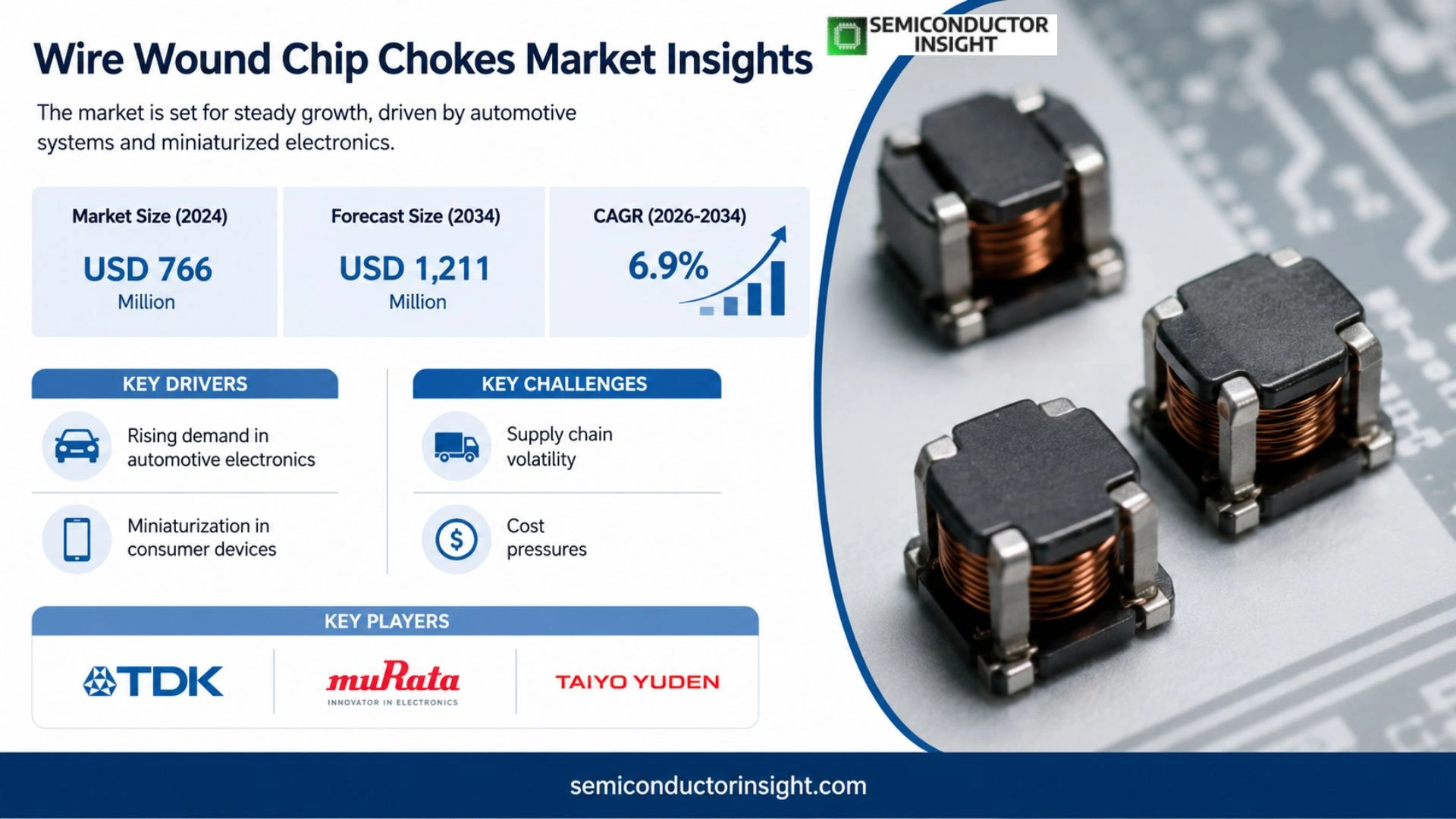
Wire Wound Chip Chokes market was valued at USD 766 million in 2024 and is projected to reach USD 1,211 million by 2034, exhibiting a CAGR of 6.9% during the forecast period.
Wire wound chip chokes are inductors where copper wires are wound on a magnetic core forming an inductive coil. They provide a broad inductance spectrum (mH‑H), high inductance accuracy, low loss (high Q), substantial current handling capability and benefit from simple low‑cost manufacturing; however, further miniaturisation remains constrained.
The market expansion is driven by growing adoption of ferrite choke coils for electromagnetic interference suppression across electronic equipment, increasing integration of wire wound ferrite chokes in automotive and industrial automation systems, and rising demand from military‑aerospace subsystems and consumer appliances.
MARKET RESTRAINTS
Regulatory Compliance Complexity
The proliferation of regional safety and electromagnetic‑compatibility standards forces manufacturers to certify each product variant across multiple jurisdictions. This multi‑track validation routine adds lead time and raises engineering overhead, particularly for firms lacking a global compliance infrastructure.
In addition, emerging restrictions on certain alloy compositions limit the pool of permissible raw materials. Suppliers must adapt production lines quickly, which can hinder the ability to scale new designs in a timely manner.
MARKET OPPORTUNITIES
Emergence of 5G Infrastructure
Deployment of 5G small cells and massive‑MIMO antenna arrays elevates the need for high‑frequency filtering at millimeter‑wave bands. Wire‑wound chip chokes, with their intrinsic low loss at elevated frequencies, are gaining attention as critical components in RF front‑end modules.
Moreover, telecom operators are investing heavily in edge‑computing platforms where power‑efficiency is paramount. Integrating compact chokes helps reduce overall system power draw, aligning with operator goals of lower operating expenditures.
Vendors that can certify choke performance at >6 GHz and offer volume‑ready footprints will likely secure early contracts in Wire Wound Chip Chokes Market, establishing a foothold in a segment that is still in its formative stage.
Wire Wound Chip Chokes Market Trends
Increasing Adoption of Ferrite Chokes in Automotive and Industrial Systems
The automotive sector’s shift toward electrified powertrains has intensified the need for compact, high‑current filtering components. Ferrite‑based wire wound chokes, valued for their low loss and high Q, are now standard in electric‑vehicle inverters and on‑board charging modules. Parallel growth in factory automation,where motor‑driven robots generate substantial electromagnetic interference,has reinforced the same demand. As a result, Wire Wound Chip Chokes Market expanded from roughly $766 million in 2024 to an estimated $1,211 million by 2031, reflecting a 6.9 % CAGR. This price and volume trajectory underscores a strategic advantage for suppliers that can scale ferrite‑core production while maintaining tight inductance tolerances.
Other Trends
Miniaturization Constraints and Material Choices
Design engineers continue to wrestle with the physical limits of winding processes. While ceramic cores enable higher temperature operation, their lower permeability forces larger coil dimensions to achieve the same inductance range as ferrite alternatives. The trade‑off has prompted a niche of hybrid designs that combine a thin ferrite slab with precision‑wound copper to meet stringent board‑space requirements in portable medical devices. Companies that invest in automated winding equipment and advanced magnetic composites are positioning themselves to mitigate the size‑vs‑performance dilemma that still hampers broader market penetration.
Expansion of RF, Antenna and Satellite Receiver Applications
Beyond power‑line filtering, wire wound chokes are gaining traction in high‑frequency domains such as RF front‑ends, antenna‑amplifier chains, and satellite‑receiver tuners. The rollout of 5G infrastructure and the proliferation of IoT gateways demand components that combine high inductance accuracy with minimal parasitic capacitance. Manufacturers that tailor ferrite formulations for frequencies above 1 GHz are seeing incremental order flow from telecom equipment makers. This shift diversifies Wire Wound Chip Chokes Market, reducing reliance on traditional automotive and industrial segments and opening revenue channels tied to next‑generation wireless deployments.
COMPETITIVE LANDSCAPE
Key Industry Players
Wire Wound Chip Chokes: Competitive Positioning and Strategic Outlook
The upper tier of the wire wound chip choke market is tightly packed with three multinational manufacturers that together account for roughly half of global revenue. TDK leverages its extensive ferrite core expertise and scale‑driven production network to supply automotive and industrial customers across Europe and North America. Murata, with a strong focus on high‑frequency RF modules, captures a sizable share of the communications segment, especially in smartphones and base‑station equipment. Taiyo Yuden complements the duo by specializing in miniature ferrite designs for portable electronics, an area where cost sensitivity and Q‑factor performance are decisive. These incumbents benefit from vertically integrated supply chains, long‑standing OEM relationships, and R&D programs that target incremental improvements in loss and current handling.
Beyond the top tier, a constellation of regionally focused firms sustains competitive pressure through niche product portfolios or price‑lead strategies. Sunlord and Yageo, both headquartered in China, have expanded their line‑up to include high‑current chip chokes for power‑train applications, leveraging local manufacturing capacity to offer attractive unit costs. Chilisin and Microgate concentrate on aerospace‑grade components, meeting stringent certification requirements that few larger players prioritize. Samsung Electro‑Mechanics and Bourns maintain a diversified passive component business, allowing cross‑selling of chip chokes within broader product families. European specialist Würth Elektronik and US‑based Vishay provide custom magnetic core geometries that address specific automotive safety standards. Tecstar, Laird, and Max Echo round out the field with targeted solutions for medical devices, IoT sensors, and consumer wearables, respectively, underscoring the market’s fragmentation at the middle and lower tiers.
List of Key Wire Wound Chip Chokes Companies Profiled
- TDK Corporation
- Murata Manufacturing Co., Ltd.
- TAIYO YUDEN Co., Ltd.
- Sunlord Electronics
- Yageo Corporation
- Chilisin Electronics
- Microgate (Taiwan) Ltd.
- Samsung Electro‑Mechanics
- Bourns, Inc.
- Fenghua Advanced Technology Co., Ltd.
- Würth Elektronik GmbH
- Vishay Intertechnology, Inc.
- Tecstar Electronics Ltd.
- Laird Technologies plc
- Max Echo Electronics Ltd.
Segment Analysis:
| Segment Category | Sub-Segments | Key Insights |
| By Type |
|
Wire Wound Ferrite Chip Chokes are widely preferred because:
|
| By Application |
|
RF Technique drives market interest due to:
|
| By End User |
|
Consumer Electronics dominate because:
|
| By Material |
|
Ferrite Core is favored for:
|
| By Performance Attribute |
|
High Q Factor stands out because:
|
Regional Analysis: Wire Wound Chip Chokes Market
North America
The transition to electrified drivetrains has amplified the need for robust choke components that can withstand high surge currents during regenerative braking. Vehicle manufacturers are specifying tighter tolerance levels, prompting suppliers to enhance winding precision and core material selection.
Portable devices demand compact inductors that deliver consistent performance across temperature swings. Design engineers are leaning toward wire‑wound configurations to achieve superior Q‑factors, especially in fast‑charging adapters and wireless power modules.
Factories adopting advanced motor‑control solutions require chokes capable of handling intermittent high‑load conditions. The sector’s emphasis on predictive maintenance encourages manufacturers to provide components with extended lifespan certifications.
New safety directives in the United States mandate tighter electromagnetic‑interference limits, compelling suppliers to re‑engineer choke geometries to achieve lower emission profiles without sacrificing inductance.
Europe
European manufacturers are integrating Wire Wound Chip Chokes into renewable‑energy converters, a move that aligns with the bloc’s carbon‑reduction agenda. The region’s emphasis on sustainability drives the adoption of components that enable higher efficiency in wind‑turbine inverters and solar‑panel micro‑converters. Meanwhile, the automotive sector’s commitment to stricter CO₂ standards forces chassis designers to select inductors capable of operating under high‑frequency switching conditions common in hybrid powertrains. German and French engineering firms are collaborating with choke producers to develop standards‑compliant footprints, ensuring compatibility with the expanding pool of European‑certified power‑management ICs. This collaborative climate, combined with a strong intellectual‑property ecosystem, fosters incremental innovation that resonates across multiple end‑markets.
Asia‑Pacific
The Asia‑Pacific region witnesses a surge in demand for Wire Wound Chip Chokes as manufacturers in China, South Korea and Taiwan scale production of 5G infrastructure and high‑performance computing platforms. The density of fab facilities in Taiwan, in particular, creates a localized demand for chokes optimized for power‑delivery modules in server farms. Concurrently, India’s burgeoning automotive export pipeline introduces a need for components that satisfy both domestic regulations and overseas certification requirements. Suppliers are responding by establishing dedicated design‑support centers within the region, offering rapid prototyping services that shorten development cycles for original equipment manufacturers seeking to differentiate product line‑ups.
South America
In South America, Brazil’s expanding renewable‑energy projects,especially in hydro‑electric installations,are prompting system integrators to adopt wire‑wound solutions that can manage fluctuating load profiles with minimal loss. The local market’s preference for cost‑effective yet reliable components has spurred a niche of manufacturers focusing on standardized choke sizes that simplify inventory management across diverse utility operators. Additionally, the rise of mobile‑network roll‑outs across the continent fuels demand for compact inductors embedded in base‑station power supplies, encouraging regional distributors to source components with proven thermal stability.
Middle East & Africa
The Middle East & Africa region is experiencing a modest yet strategic uptake of Wire Wound Chip Chokes driven by large‑scale data‑center projects in the United Arab Emirates and expanding oil‑field automation in Saudi Arabia. Operators in these sectors prioritize components that can endure harsh temperature extremes while maintaining inductance accuracy, prompting suppliers to offer enhanced packaging solutions. Moreover, the proliferation of solar‑energy farms across North Africa generates a need for chokes that support high‑efficiency DC‑to‑DC converters, reinforcing the market’s focus on durability and performance under sustained irradiance conditions.
Report Scope
This market research report provides a comprehensive analysis of the Wire Wound Chip Chokes Market , covering the forecast period 2026–2034. It offers detailed insights into market dynamics, technological advancements, competitive landscape, and key trends shaping the industry.
Key focus areas of the report include:
- Market Overview: The report begins with an overview outlining its current market scenario, key growth indicators, and industry transformation drivers. It discusses macroeconomic factors, demand–supply balance, regulatory landscape, and the strategic role of semiconductors in powering advancements across industries such as automotive, telecommunications, consumer electronics, and industrial automation.
- Market Size & Forecast: Historical data and future projections for revenue, unit shipments, and market value across major regions and segments.
- Segmentation Analysis: Detailed breakdown by product type, technology, application, and end-user industry to identify high-growth segments and investment opportunities.
- Regional Insights: Insights into market performance across North America, Europe, Asia-Pacific, Latin America, and the Middle East & Africa, including country-level analysis where relevant.
- Competitive Landscape: Profiles of leading market participants, including their product offerings, R&D focus, manufacturing capacity, pricing strategies, and recent developments such as mergers, acquisitions, and partnerships.
- Technology Trends & Innovation: Assessment of emerging technologies, integration of AI/IoT, semiconductor design trends, fabrication techniques, and evolving industry standards.
- Market Drivers & Restraints: Evaluation of factors driving market growth along with challenges, supply chain constraints, regulatory issues, and market-entry barriers.
- Stakeholder Insights: Insights for component suppliers, OEMs, system integrators, investors, and policymakers regarding the evolving ecosystem and strategic opportunities.
Primary and secondary research methods are employed, including interviews with industry experts, data from verified sources, and real-time market intelligence to ensure the accuracy and reliability of the insights presented.
FREQUENTLY ASKED QUESTIONS:
What is the current market size of Wire Wound Chip Chokes Market?
-> Wire Wound Chip Chokes Market was valued at USD 766 million in 2024 and is expected to reach USD 1211 million by 2031 with a CAGR of 6.9% during the forecast period.
Which key companies operate in Wire Wound Chip Chokes Market?
-> Key players include TDK, Murata, TAIYO YUDEN, Sunlord, Yageo, Chilisin, Microgate, Samsung, Bourns, Fenghua Advanced, Würth Elektronik GmbH, Vishay, Tecstar, Laird, Max Echo.
What are the key growth drivers?
-> Key growth drivers include increasing adoption of ferrite choke coils to reduce electromagnetic interference, rising demand in automotive and transportation sectors, expanding use in military and aerospace systems, and growth in automation and industrial equipment.
Which region dominates the market?
-> Asia is the leading region, driven by an extensive manufacturing base and growing demand in electronics, while Europe and North America also show significant adoption.
What are the emerging trends?
-> Emerging trends include integration of wire wound ferrite chokes in electric vehicles, increased focus on miniaturization for portable electronics, and development of high‑Q, low‑loss chokes for advanced communication systems.
Get Sample Report PDF for Exclusive Insights
Report Sample Includes
- Table of Contents
- List of Tables & Figures
- Charts, Research Methodology, and more...
 Download Sample Report PDF