Passive Wire Wound Chip Inductors Market Insights
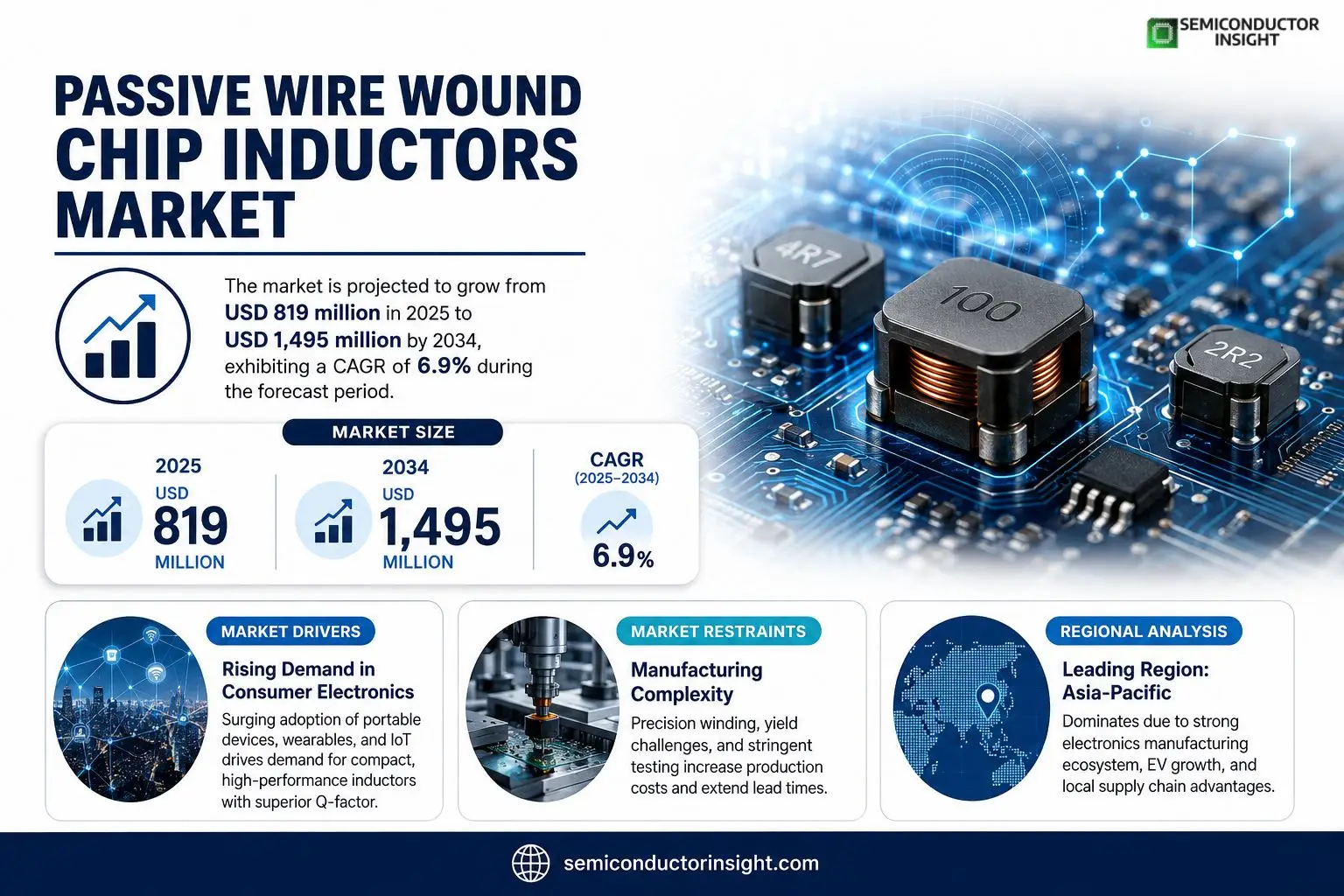
Passive Wire Wound Chip Inductors market size was valued at USD 819 million in 2025. The market is projected to grow from USD 819 million in 2025 to USD 1495 million by 2034, exhibiting a CAGR of approximately 6.9% during the forecast period.
Passive wire wound chip inductors are components where copper or alloy wire is tightly wound around a magnetic coretypically ferrite or ceramicto create a compact inductive element. They provide a wide inductance spectrum (millihenries to henries), high Q‑factor, and strong current capability while keeping losses low; nevertheless, their physical construction constrains further miniaturisation relative to planar alternatives.
MARKET DRIVERS
Electrification of Consumer Electronics
The surge in portable devices, wearables, and IoT sensors pushes designers toward compact passive solutions. Passive Wire Wound Chip Inductors offer superior Q‑factor and current handling, attributes that enable thinner form factors without sacrificing performance. Manufacturers therefore prioritize these components to meet aggressive size‑to‑function ratios demanded by flagship products.
Shift Toward High‑Frequency Power Conversion
Modern power‑management architectures increasingly operate above 1 MHz to improve efficiency and reduce thermal footprints. Wire‑wound chip inductors retain inductance stability at such frequencies, making them attractive for synchronous buck converters and resonant link topologies. This technical advantage translates into a measurable uptick in procurement volumes across automotive and industrial sectors.
➤ “Design teams cite reliability under thermal cycling as the decisive factor when selecting inductors for next‑gen EV chargers.”
As supply chains mature, a broader pool of specialty alloys becomes available, lowering cost barriers that previously confined wire‑wound designs to premium segments. The resulting price elasticity encourages mid‑range OEMs to adopt the technology, further expanding Passive Wire Wound Chip Inductors Market.
MARKET CHALLENGES
Miniaturization Limits in Ultra‑Low‑Profile Designs
While wire‑wound structures excel in performance, their physical winding geometry imposes a lower bound on achievable thickness. Devices that demand sub‑0.3 mm profiles often turn to planar or multilayer alternatives, creating a niche where traditional wire‑wound inductors cannot compete.
Other Challenges
Material Cost Volatility
Fluctuations in copper and specialty alloy prices cascade into BOM calculations, prompting some buyers to postpone large‑scale orders until price trends stabilize.Furthermore, stringent EMI regulations in emerging markets compel manufacturers to adopt shielding techniques that add to component footprint, counteracting the very advantage of compactness that these inductors provide.
MARKET RESTRAINTS
Manufacturing Complexity and Yield Constraints
Producing wire‑wound chip inductors at high volume requires precise tension control and automated winding equipment. Even minor deviations can lead to inductance drift, forcing producers to scrap batches and inflate unit costs. This operational bottleneck deters smaller fabs from entering the space.Additionally, the requirement for thorough post‑process testingespecially for high‑frequency applicationsextends lead times, which can clash with the rapid product‑launch cycles typical of consumer electronics firms.Finally, legacy design libraries in many engineering teams still favor planar inductors, meaning that the adoption curve for wire‑wound variants is partially impeded by entrenched design habits.
MARKET OPPORTUNITIES
Emergence of Advanced Automotive Power Systems
Electrified vehicle architectures increasingly rely on high‑current DC‑DC converters that operate in the 500 kHz to 2 MHz band. Wire‑wound chip inductors, with their robust thermal handling, align well with these specifications, presenting a clear pathway for OEMs to upgrade powertrain efficiency.Parallel to automotive trends, the rollout of 5G infrastructure introduces dense power‑distribution modules where inductance stability under load is critical. Suppliers that can certify wire‑wound inductors for telecom‑grade reliability stand to capture a growing slice of network‑equipment spend.Lastly, ongoing research into novel alloy compositessuch as nanocrystalline corespromises to further enhance inductance density while curbing core losses. Early adopters of these materials could differentiate their product portfolios and command premium pricing within Passive Wire Wound Chip Inductors Market.
Passive Wire Wound Chip Inductors Market Trends
Rising Demand for EMI Mitigation in Automotive and Industrial Automation
Passive Wire Wound Chip Inductors Market is experiencing a measurable uplift as manufacturers of electric‑drive vehicles and factory‑floor controllers prioritize electromagnetic interference (EMI) suppression. The 2024 market valuation of $766 million already reflects heightened adoption of wire‑wound reactors in power‑train modules, where their high Q factor and current handling capability reduce noise without inflating bill‑of‑materials cost. Parallelly, automation equipment integrates these components to meet stricter EMC standards imposed by new safety directives. The confluence of tighter regulatory envelopes and the proliferation of compact power converters creates a feedback loop that encourages suppliers to expand capacity. Consequently, the market is slated to climb to approximately $1.21 billion by 2031, a trajectory anchored in the practicality of the technology rather than speculative hype.
Other Trends
Segment Diversification by Core Material
Within the broader market, the split between ceramic‑core and ferrite‑core inductors has become a strategic lever for OEMs seeking performance‑cost balance. Ceramic variants, prized for their thermal stability, dominate applications such as RF front‑ends and antenna amplifiers where precise inductance values are mandatory. ferrite-core on the other hand, deliver superior magnetic permeability, making them the preferred choice for high‑current power lines in automotive chargers and rail‑grade converters. This material‑driven segmentation grants designers the flexibility to tailor component selection to specific loss budgets and size constraints, thereby widening the addressable market pool and encouraging manufacturers to diversify product portfolios.
Geographic Momentum in Asia‑Pacific
Regional analysis reveals that Asia‑Pacific accounts for the lion’s share of incremental demand, fueled by aggressive rollout of electric mobility and smart‑grid infrastructure across China, Japan, and South Korea. Local policy incentives that lower the total cost of ownership for EVs translate directly into larger bill‑of‑materials contracts for inductors. Moreover, a surge in contract manufacturing hubs has accelerated the supply chain, shortening lead times for component delivery. Competitive pressures have prompted several key playerssuch as KYOCERA AVX and Murata Manufacturingto inaugurate new fab lines within the region, a move that both secures market share and reduces exposure to tariff fluctuations. These dynamics suggest that firms which embed regional agility into their strategic planning are likely to capture outsized returns as Passive Wire Wound Chip Inductors Market continues its evolution.
COMPETITIVE LANDSCAPE
Key Industry Players
Competitive Positioning and Market Share Dynamics
The passive wire wound chip inductor arena is dominated by a handful of large‑scale manufacturers that command the bulk of volume. KYOCERA AVX leverages its deep expertise in ferrite material engineering to secure premium contracts in aerospace and high‑frequency telecom equipment, translating into a sizeable revenue share. Vishay Intertechnology and Murata Manufacturing complement this hierarchy by offering extensive product portfolios that span both ceramic and ferrite cores, enabling them to serve diverse automotive and industrial automation segments. These incumbents benefit from vertically integrated supply chains and expansive distribution networks, which create high barriers to entry for newcomers seeking comparable scale.Beyond the top tier, a cluster of specialized firms injects competitive vigor through niche innovations and regional focus. Sumida and Coilmaster Electronics excel in delivering ultra‑low‑profile inductors for consumer electronics, while Bourns and KEMET target power‑management applications with high‑current designs. European players such as ZONKAS ELECTRONIC and Core Master Enterprise differentiate themselves by customizing magnetic configurations for defense contracts, whereas Asian manufacturers including Shenzhen Sunlord Electronics and Fenghua (HK) Electronics capitalize on cost‑effective production to capture volume‑driven markets in IoT devices. This layered structure ensures that the market remains responsive to both high‑value and price‑sensitive demand pockets.
List of Key Passive Wire Wound Chip Inductors Companies Profiled
- KYOCERA AVX
- Vishay Intertechnology
- Murata Manufacturing
- Sumida
- Coilmaster Electronics
- Bourns
- Johanson Technology
- ATEC Group
- ZenithTek
- TRIO
Segment Analysis:
| Segment Category | Sub-Segments | Key Insights |
| By Type |
|
Wire Wound Ferrite Chip Inductors
|
| By Application |
|
RF Technique
|
| By End User |
|
Consumer Electronics
|
| By Frequency Range |
|
Mid Frequency (MHz)
|
| By Core Material |
|
Ferrite Core
|
Regional Analysis: Passive Wire Wound Chip Inductors Market
Asia‑Pacific
Proximity to raw‑material suppliers and high‑volume PCB assemblers slashes transit intervals, allowing producers to adopt just‑in‑time inventory methods. This reduces working capital exposure while preserving the ability to meet volatile demand spikes from smart‑device launches.
Innovation parks in China, Taiwan, and South Korea host cross‑disciplinary teams that iteratively refine winding techniques, boosting inductance density without compromising Q‑factor. This collaborative atmosphere accelerates the transition from prototype to volume production.
Harmonised environmental directives across the region streamline compliance, allowing manufacturers to adopt common manufacturing standards and avoid costly re‑certifications in each market.
Direct interfaces with key automotive OEMs and consumer‑electronics giants enable rapid feedback loops, ensuring that new inductor specifications are validated against real‑world performance criteria early in the development cycle.
North America
North America remains a mature arena where Passive Wire Wound Chip Inductors Market is shaped by stringent performance specifications demanded by defense and aerospace programs. Suppliers that can demonstrate superior temperature stability and low‑profile form factors secure premium contracts. Meanwhile, the Silicon Valley ecosystem drives a parallel demand for high‑frequency inductors that support emerging 5G and edge‑computing platforms. The combination of high R&D spend and a regulatory environment that emphasises reliability forces manufacturers to invest heavily in process control, thereby elevating overall product quality across the region.
Europe
European manufacturers benefit from a long‑standing emphasis on precision engineering and sustainability. Passive Wire Wound Chip Inductors Market here is influenced by automotive manufacturers’ shift toward electrified powertrains, prompting a need for inductors that can handle higher currents while maintaining compact footprints. Concurrently, the region’s rigorous environmental standards encourage the adoption of lead‑free winding processes, nudging suppliers toward greener production pathways. Strategic partnerships between component providers and vehicle‑system integrators are becoming a hallmark of the European landscape.
South America
In South America, market activity is driven by growing demand for renewable‑energy installations and the accompanying power‑management electronics. While the overall scale remains modest, local assemblers are beginning to source passive components domestically to avoid import delays and tariffs. This trend nurtures a nascent ecosystem of specialized winding facilities that aim to tailor inductors for solar‑inverter applications, positioning the region as a potential niche supplier for emerging green‑tech projects.
Middle East & Africa
The Middle East & Africa segment reflects a gradual diversification beyond oil‑centric economies. Infrastructure projects that incorporate smart‑grid technologies create a steady appetite for reliable passive components. Local governments are incentivising technology parks, which attract multinational firms looking to establish regional production nodes. For Passive Wire Wound Chip Inductors Market, this translates into opportunities to embed advanced winding capabilities within emerging supply chains, thereby reducing dependence on distant exporters and fostering a more resilient regional market structure.
Report Scope
This market research report provides a comprehensive analysis of the Passive Wire Wound Chip Inductors Market , covering the forecast period 2026–2034. It offers detailed insights into market dynamics, technological advancements, competitive landscape, and key trends shaping the industry.
Key focus areas of the report include:
- Market Overview: The report begins with an overview outlining its current market scenario, key growth indicators, and industry transformation drivers. It discusses macroeconomic factors, demand–supply balance, regulatory landscape, and the strategic role of semiconductors in powering advancements across industries such as automotive, telecommunications, consumer electronics, and industrial automation.
- Market Size & Forecast: Historical data and future projections for revenue, unit shipments, and market value across major regions and segments.
- Segmentation Analysis: Detailed breakdown by product type, technology, application, and end-user industry to identify high-growth segments and investment opportunities.
- Regional Insights: Insights into market performance across North America, Europe, Asia-Pacific, Latin America, and the Middle East & Africa, including country-level analysis where relevant.
- Competitive Landscape: Profiles of leading market participants, including their product offerings, R&D focus, manufacturing capacity, pricing strategies, and recent developments such as mergers, acquisitions, and partnerships.
- Technology Trends & Innovation: Assessment of emerging technologies, integration of AI/IoT, semiconductor design trends, fabrication techniques, and evolving industry standards.
- Market Drivers & Restraints: Evaluation of factors driving market growth along with challenges, supply chain constraints, regulatory issues, and market-entry barriers.
- Stakeholder Insights: Insights for component suppliers, OEMs, system integrators, investors, and policymakers regarding the evolving ecosystem and strategic opportunities.
Primary and secondary research methods are employed, including interviews with industry experts, data from verified sources, and real-time market intelligence to ensure the accuracy and reliability of the insights presented.
FREQUENTLY ASKED QUESTIONS:
What is the current market size of Passive Wire Wound Chip Inductors Market?
-> Passive Wire Wound Chip Inductors Market was valued at USD 766 million in 2024 and is expected to reach USD 1211 million by 2031, growing at a CAGR of 6.9% during the forecast period.
Which key companies operate in Passive Wire Wound Chip Inductors Market?
-> Key players include KYOCERA AVX, Coilmaster Electronics, Vishay Intertechnology, Viking Tech, Eaton, KEMET, Murata Manufacturing, Sumida, Bourns, Johanson Technology, Zxcompo, Erocore, Core Master Enterprise, ZONKAS ELECTRONIC, JANTEK Electronics, ATEC Group, ZenithTek, TRIO, Gowanda Electronics, Renco Electronics, Fenghua (HK) Electronics, Taiwan YoChang Electronic, Shenzhen Sunlord Electronics.
What are the key growth drivers?
-> Key growth drivers include increasing adoption of wire‑wound chip reactors in electronic equipment for EMI reduction, expanding use in military and aerospace systems, rising demand in automotive and transportation sectors, and growing deployment of ferrite chokes in automation and industrial applications.
Which region dominates the market?
-> Asia holds the largest market share, driven by extensive electronics manufacturing, automotive production, and rapid adoption of advanced filtering solutions across China, Japan, South Korea and Southeast Asia.
What are the emerging trends?
-> Emerging trends include integration of wire‑wound chip inductors in 5G and IoT devices, increased focus on miniaturization despite inherent size limits, and greater utilization of these components in electric‑vehicle power‑train and autonomous‑vehicle systems.
Get Sample Report PDF for Exclusive Insights
Report Sample Includes
- Table of Contents
- List of Tables & Figures
- Charts, Research Methodology, and more...
 Download Sample Report PDF