Common Mode Choke Inductors Market Insights
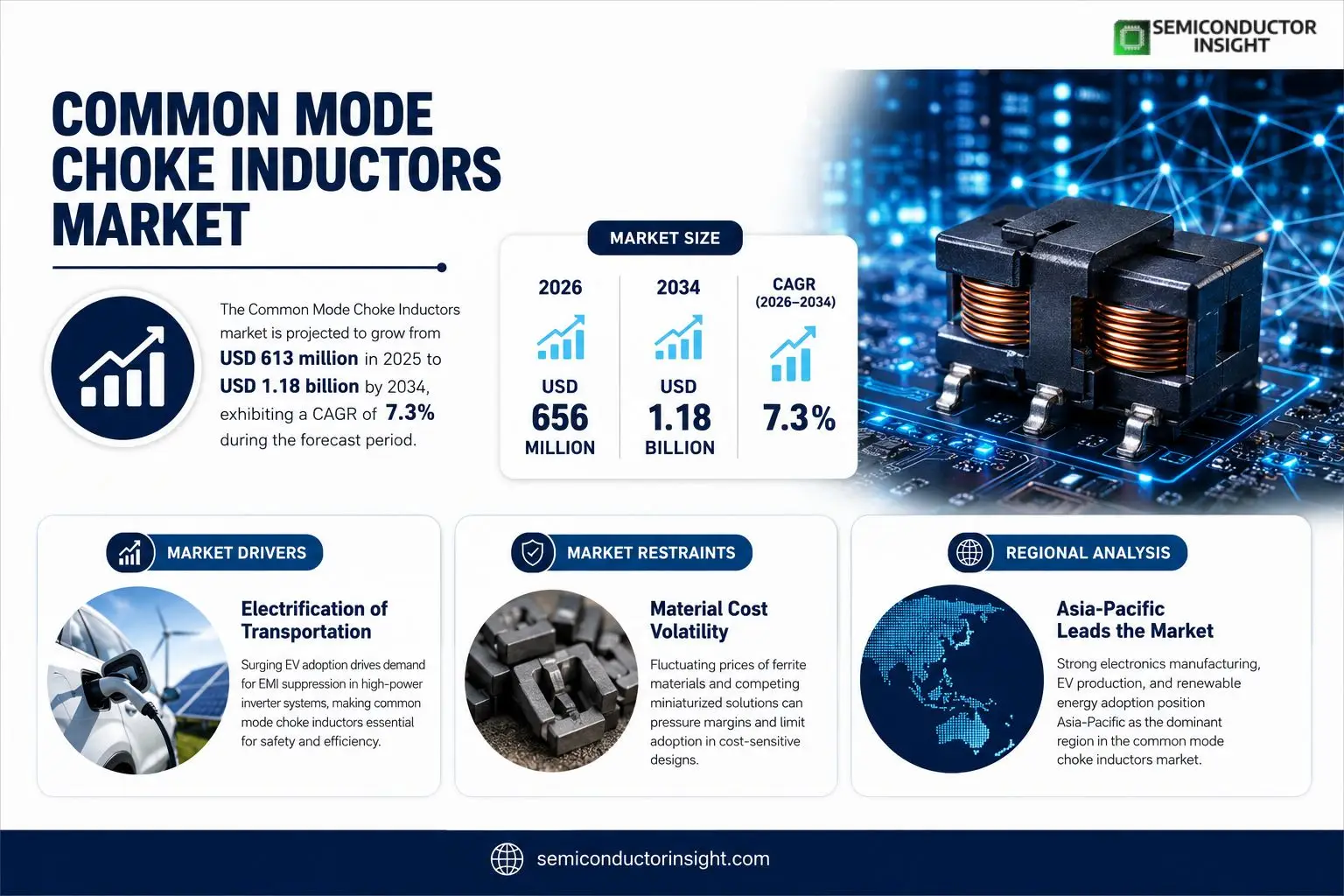
Common Mode Choke Inductors market size was valued at USD 613 million in 2025 and is expected to increase to USD 1.18 billion by 2034, reflecting an implied compound annual growth rate of roughly 7.3% over the forecast horizon.
Common mode choke inductors consist of two or more insulated‑wire windings mounted on a single magnetic core; each winding is placed in series with a separate conductor so that their magnetic fields combine, presenting high impedance to unwanted noise signals. The device blocks high‑frequency alternating current while allowing low‑frequency direct current to pass, making it essential for suppressing electromagnetic interference (EMI) and radio‑frequency interference (RFI) in power‑supply circuits.The upward trend stems from expanding use of mobile devices, laptops and IoT gadgets that require stringent noise reduction, as well as growing adoption of electric‑vehicle power systems and renewable‑energy converters where EMI control is critical. Moreover, tighter environmental regulations encourage cleaner energy solutions such as solar inverters
MARKET DRIVERS
Electrification of Transportation
The surge in electric‑vehicle production forces designers to address electromagnetic interference (EMI) at ever‑higher power levels. Common Mode Choke Inductors provide the most reliable path for dissipation, enabling inverter modules to meet stringent safety standards while preserving efficiency.
Data‑Center Power Architecture
Modern hyperscale facilities rely on high‑density converters that operate across wide frequency bands. The need to suppress common‑mode noise without adding bulk has turned choke inductors into a preferred component, especially as operators push for lower total‑ownership‑cost ratios.
➤ “Effective common‑mode noise mitigation is now a design prerequisite, not an after‑thought.”
Regulatory agencies worldwide have tightened limits on radiated emissions. Compliance drives OEMs to select components with proven attenuation characteristics, further cementing the role of these inductors in next‑generation power designs.
MARKET CHALLENGES
Material Cost Volatility
Ferrite alloys with optimal permeability are subject to fluctuating raw‑material prices, a factor that inflates bill‑of‑materials for high‑volume projects. Manufacturers that cannot secure long‑term supply contracts may see margin compression.
Other Challenges
Design Complexity
\Achieving low impedance across a broad frequency spectrum demands precise winding techniques and tighter tolerances, raising engineering effort and validation cycles.
MARKET RESTRAINTS
Thermal and Form‑Factor Limits
Applications such as aerospace or wearables impose strict temperature envelopes and space constraints. Conventional choke geometries often struggle to deliver required performance without exceeding thermal budgets.Competing technologiesintegrated planar filters and surface‑mount capacitive solutionscan achieve comparable attenuation with a smaller footprint, pressuring designers to justify the added volume of traditional inductors.Fragmented supplier landscape leads to inconsistent quality standards, which can deter large OEMs from adopting new sources, thereby limiting market expansion.
MARKET OPPORTUNITIES
5G Infrastructure Rollout
Base‑station power modules for 5G networks demand choke inductors that operate efficiently at higher frequencies while maintaining low profile. Companies that develop ultra‑compact, high‑Q designs stand to capture a sizable share of this emerging segment.The rise of silicon‑carbide (SiC) and gallium‑nitride (GaN) power devices opens a niche for inductors engineered to handle faster switching speeds and reduced parasitics, attributes essential for maintaining system stability.Customization platforms that allow on‑demand specification of inductance, current rating, and footprint can attract low‑volume, high‑margin customers in the IoT and medical device sectors, where product differentiation hinges on precise EMI control.
Common Mode Choke Inductors Market Trends
Escalating Need for EMI Suppression in Consumer Electronics
The proliferation of smartphones, tablets, wearables and IoT gateways has turned electromagnetic compatibility from a peripheral concern into a core design driver. As manufacturers embed higher‑speed interfaces and denser power‑management chips, the spectral density of unwanted signals rises sharply. Engineers therefore turn to common mode choke inductors to isolate noisy conductors while preserving DC continuity. This shift is not merely regulatory; it translates directly into longer battery life, lower return‑rate incidents and stronger brand reputation for reliability. The ripple effect is visible across component‑selection tools, where BOM planners now allocate dedicated space for compact, high‑impedance chokes in early design stages.
Other Trends
Automotive Electrification
Electrified power‑trains, advanced driver‑assist systems and in‑vehicle infotainment demand robust protection against high‑frequency interference generated by DC‑DC converters and synchronous motors. Common mode choke inductors, especially those built with low‑loss ferrite cores, are being integrated directly onto power‑train modules to curb conducted emissions that could otherwise jeopardise safety‑critical communication links. This trend compels suppliers to certify components against automotive reliability standards, opening a premium segment that rewards higher margins for proven performance.
Industrial Automation & Renewable Energy
Factories adopting Industry 4.0 architectures rely on modular drives, PLCs and high‑speed data buses, all of which are vulnerable to common‑mode noise originating from switch‑mode power supplies. Simultaneously, solar inverters and wind‑turbine converters operate at ever‑higher switching frequencies to improve efficiency. In both arenas, common mode choke inductors act as gatekeepers, preventing electromagnetic interference from propagating back into the grid or control network. The practical outcome is a measurable reduction in unscheduled downtime and a smoother integration of distributed generation assets into legacy grids.
Supply‑Chain Resilience and Material Innovation
Recent disruptions in raw‑material logistics have pushed manufacturers to diversify core compositions, moving from traditional iron‑powder to nanocrystalline and amorphous alloys. These newer cores offer tighter permeability tolerances and smaller footprints, which align with the market’s drive toward miniaturization. At the same time, vendors are establishing multi‑regional stocking strategies to mitigate lead‑time volatility, ensuring that production lines for high‑volume consumer and automotive customers remain uninterrupted. For buyers, the implication is a need to reassess qualification cycles, balancing the benefits of cutting‑edge magnetic materials against the risks of supply‑chain instability.
COMPETITIVE LANDSCAPE
Key Industry Players
Competitive Overview of the Common Mode Choke Inductors Market
The market is anchored by a handful of large multinational firms that command the majority of revenue through extensive product portfolios and deep supply‑chain integration. Murata Manufacturing stands out as the de‑facto leader, leveraging its broad magnetic material library and high‑volume foundry capacity to supply automotive OEMs, consumer‑electronics brands, and industrial equipment makers. TDK complements Murata’s reach with a strong focus on surface‑mount device (SMD) formats, capitalising on its expertise in aluminium‑based ferrites to meet the miniaturisation trend in portable electronics. YAGEO (via its Chilisin acquisition) has expanded its footprint in the North‑American and European markets, offering a differentiated line of high‑current through‑hole chokes that cater to power‑conversion applications. The concentration of these three players creates a tiered competitive structure: tier‑one firms dominate volume contracts, while specialized mid‑tier manufacturers secure niche segments through application‑specific designs and rapid development cycles.Beyond the tier‑one cohort, a diversified set of niche innovators injects agility into the market. Companies such as TAIYO YUDEN and Cyntec focus on advanced nanocrystalline core technologies that promise lower loss at higher frequencies, targeting emerging 5G infrastructure and aerospace systems. Sunlord Electronics and Vishay differentiate themselves with a wide array of custom winding options, often partnering directly with OEM design teams to co‑develop solutions for electric‑vehicle power trains. Smaller yet technically sophisticated outfitsincluding Sumida, Coilcraft, and Bournsexcel in ultra‑compact form factors that satisfy space‑constrained IoT devices. This layered ecosystem ensures that while the market is led by a few capital‑heavy entities, innovation and customer‑centric flexibility remain dispersed across a broader base of manufacturers.
List of Key Common Mode Choke Inductors Companies Profiled
- Murata Manufacturing
- TDK Corporation
- YAGEO (Chilisin)
- TAIYO YUDEN
- Cyntec
- Sunlord Electronics
- Vishay Intertechnology
- Sumida
- Coilcraft
- Bourns
- Eaton
- Schaffner
- Laird Performance Materials
- Hitachi Metals
- AVX Corporation
Segment Analysis:
| Segment Category | Sub-Segments | Key Insights |
| By Type |
|
SMD Type
|
| By Application |
|
Consumer Electronics
|
| By End User |
|
OEMs
|
| By Technology |
|
Ferrite Core
|
| By Market Trend |
|
Miniaturization
|
Regional Analysis: Common Mode Choke Inductors Market
Asia-Pacific
Manufacturers are diversifying raw‑material sources for ferrite powders and copper wire to mitigate geopolitical disruptions. Localized sourcing in Southeast Asia reduces lead times, allowing designers to prototype choke configurations faster than peers reliant on distant suppliers. This agility translates into more responsive product cycles for the Common Mode Choke Inductors Market.
As electric‑vehicle platforms proliferate across the region, power‑train engineers demand inductors that can cope with higher voltage domains while maintaining low profile footprints. This shift drives niche material development and bespoke winding architectures, influencing the overall market trajectory.
Grid‑scale inverter manufacturers in India and China are embedding more sophisticated common‑mode suppression to meet stricter grid codes. The resulting need for higher‑current choke designs nudges the market toward larger form factors and advanced thermal management solutions.
Collaborative platforms that link PCB designers with choke fabricators are gaining traction, shortening the iteration loop. This co‑development model enhances component suitability for emerging standards, reinforcing the region’s competitive edge in the Common Mode Choke Inductors Market.
North America
The North American segment remains a strong adopter of premium choke solutions, driven primarily by defense procurement and advanced data‑center deployments. Customers prioritize reliability and compliance with stringent electromagnetic standards, prompting suppliers to focus on high‑performance ferrite compositions and rigorous testing regimes. While cost sensitivity is less pronounced than in Asia‑Pacific, manufacturers still face pressure to justify premium pricing through measurable gains in efficiency and lifecycle support. Industry alliances between silicon designers and component makers are sharpening the value proposition of custom inductors, ensuring the region sustains its relevance despite modest volume growth.
Europe
European manufacturers are channeling effort toward sustainability, aligning choke development with the EU’s broader circular‑economy agenda. This translates into a preference for recyclable core materials and designs that facilitate easy disassembly. The automotive sector, especially with the rise of autonomous driving prototypes, is demanding inductors that can operate reliably under extreme temperature swings. Concurrently, the telecommunications rollout of 5G infrastructure is compelling network equipment vendors to adopt choke configurations that mitigate cross‑talk without inflating cabinet space. These nuanced demands keep Europe at the forefront of technical refinement in the market.
South America
In South America, the market is shaped by incremental adoption in renewable‑energy projects and expanding urban electrification programs. Local OEMs often lack the scale to justify large‑volume orders, leading them to source from regional distributors that aggregate demand across multiple countries. As a result, product offerings tend to be standardized rather than highly customized, yet there is a growing appetite for solutions that can tolerate the region’s diverse climate conditions. The gradual alignment with international standards is encouraging domestic players to upgrade manufacturing capabilities, positioning the continent for modest but steady participation in the market.
Middle East & Africa
The Middle East & Africa region is witnessing early‑stage rollout of smart‑grid initiatives and data‑center expansions, particularly in the Gulf Cooperation Council states. Energy‑intensive applications, such as desalination and oil‑field automation, are prompting engineers to seek choke designs that can endure high‑current transients while maintaining a compact footprint. However, market penetration is tempered by limited local production capacity, making imports the norm. Strategic partnerships with Asian manufacturers are emerging as a pathway to secure supply, allowing the region to bridge the technology gap without heavy capital outlays.
Report Scope
This market research report provides a comprehensive analysis of the Common Mode Choke Inductors Market , covering the forecast period 2026–2034. It offers detailed insights into market dynamics, technological advancements, competitive landscape, and key trends shaping the industry.
Key focus areas of the report include:
- Market Overview: The report begins with an overview outlining its current market scenario, key growth indicators, and industry transformation drivers. It discusses macroeconomic factors, demand–supply balance, regulatory landscape, and the strategic role of semiconductors in powering advancements across industries such as automotive, telecommunications, consumer electronics, and industrial automation.
- Market Size & Forecast: Historical data and future projections for revenue, unit shipments, and market value across major regions and segments.
- Segmentation Analysis: Detailed breakdown by product type, technology, application, and end-user industry to identify high-growth segments and investment opportunities.
- Regional Insights: Insights into market performance across North America, Europe, Asia-Pacific, Latin America, and the Middle East & Africa, including country-level analysis where relevant.
- Competitive Landscape: Profiles of leading market participants, including their product offerings, R&D focus, manufacturing capacity, pricing strategies, and recent developments such as mergers, acquisitions, and partnerships.
- Technology Trends & Innovation: Assessment of emerging technologies, integration of AI/IoT, semiconductor design trends, fabrication techniques, and evolving industry standards.
- Market Drivers & Restraints: Evaluation of factors driving market growth along with challenges, supply chain constraints, regulatory issues, and market-entry barriers.
- Stakeholder Insights: Insights for component suppliers, OEMs, system integrators, investors, and policymakers regarding the evolving ecosystem and strategic opportunities.
Primary and secondary research methods are employed, including interviews with industry experts, data from verified sources, and real-time market intelligence to ensure the accuracy and reliability of the insights presented.
FREQUENTLY ASKED QUESTIONS:
What is the current market size of Common Mode Choke Inductors Market?
-> Common Mode Choke Inductors Market was valued at USD 571 million in 2024 and is expected to reach USD 928 million by 2031, at a CAGR of 7.4% during the forecast period.
Which key companies operate in Common Mode Choke Inductors Market?
-> Key players include Murata, YAGEO (Chilisin), TDK, TAIYO YUDEN, Cyntec, Sunlord Electronics, Vishay, TAI-TECH Advanced Electronic, Sumida, Eaton, Schaffner, Laird Performance Materials, TABUCHI ELECTRIC, TAMURA CORPORATION, Hitachi Metals, Coilcraft, Nippon Chemi-Con Corporation, Bourns, AVX Corporation.
What are the key growth drivers?
-> Key growth drivers include rising demand for noise reduction in electronic equipment, rapid adoption of consumer electronics (mobile phones, tablets, laptops, IoT devices), increasing integration of common mode chokes in automotive and transportation systems, expansion of clean‑energy solutions such as solar and wind, and advancements in industrial automation and control systems.
Which region dominates the market?
-> Asia-Pacific dominates the market, driven by strong electronics manufacturing, automotive production, and growing adoption of renewable energy technologies.
What are the emerging trends?
-> Emerging trends include development of more compact and efficient magnetic cores, integration of advanced materials to improve EMI suppression, and increased focus on miniaturization for high‑density electronic applications.
Get Sample Report PDF for Exclusive Insights
Report Sample Includes
- Table of Contents
- List of Tables & Figures
- Charts, Research Methodology, and more...
 Download Sample Report PDF