Common Mode Choke Filters Market Insights
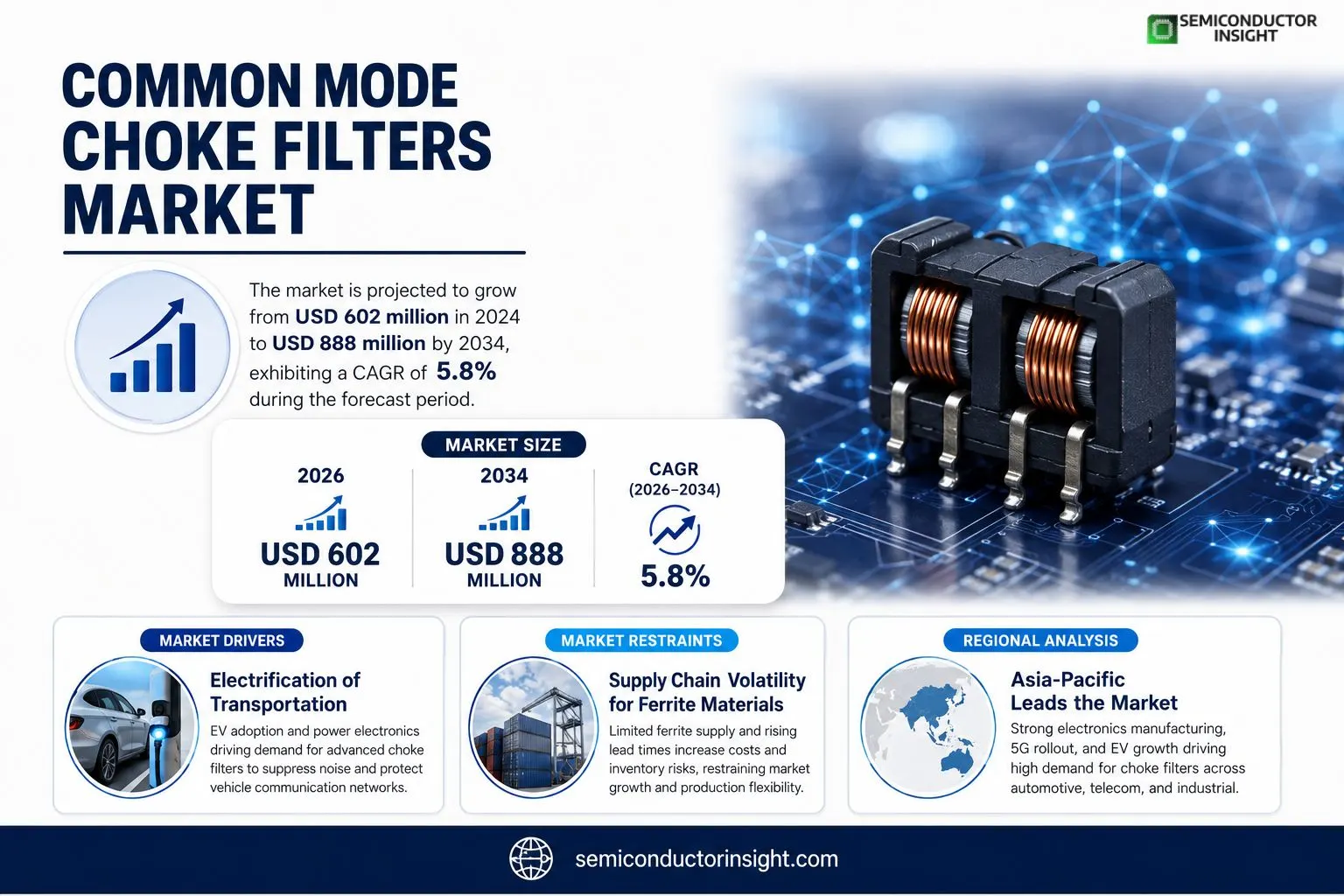
Common Mode Choke Filters market size was valued at USD 602 million in 2024. The market will move from USD 602 million in 2024 to USD 888 million by 2034, reflecting a compound annual growth rate of 5.8 % over the forecast horizon.
Common mode choke filters are built from two or more insulated‑wire windings mounted on a single magnetic core. Each winding is placed in series with one conductor, causing their magnetic fields to combine and present high impedance toward unwanted noise signals.The devices are integral for improving electromagnetic compatibility in automotive CAN networks, where they suppress high‑frequency interference generated by electronic control units and boost transceiver immunity on the bus. Telecom infrastructure also relies heavily on these chokes as mobile data traffic surges and network speeds climb, prompting manufacturers such as Murata, TDK, Vishay and YAGEO (Chilisin) to expand production capacities.
MARKET DRIVERS
Electrification of Transportation
The rapid rollout of electric vehicles forces power‑train designers to tame conducted emissions that can interfere with on‑board communication networks. Common Mode Choke Filters Market participants are capitalising on this pressure by integrating higher‑performance choke modules directly into inverter assemblies, thereby reducing the need for separate filtering stages.
Stringent EMI Compliance Standards
Regulatory bodies across Europe, North America and Asia have tightened limits for electromagnetic interference in industrial automation. Manufacturers now view advanced choke designs as a cost‑effective pathway to meet those standards without redesigning entire product lines, nudging demand upward.
➤ Design teams that embed common‑mode chokes early in the schematic gain a measurable lead in time‑to‑market, because downstream redesign cycles are avoided.
Beyond automotive and industrial sectors, the surge in renewable‑energy convertersparticularly grid‑connected inverterscreates a steady demand for compact, high‑current choke solutions that preserve signal integrity while handling harsh environmental conditions.
MARKET CHALLENGES
Cost Sensitivity in Consumer Electronics
Low‑margin consumer devices such as smartphones and wearables operate on tight bill‑of‑materials constraints. Although engineers recognise the value of common‑mode chokes for reducing electromagnetic disturbances, price pressure often forces them to select legacy components over newer, higher‑performance alternatives.
Other Challenges
Design Complexity
Integrating choke filters into increasingly dense printed‑circuit‑board footprints demands intricate layout techniques. Missteps can lead to excess heat buildup or unintended coupling, making the design phase riskier and lengthening development timelines.
MARKET RESTRAINTS
Supply Chain Volatility for Ferrite Materials
Ferrite powders, the core ingredient of most common‑mode chokes, are sourced from a limited pool of manufacturers. Recent geopolitical tensions and raw‑material shortages have compressed inventories, driving up lead times and forcing buyers to place larger, forward‑looking orders that strain cash flow.
MARKET OPPORTUNITIES
Emerging 5G Infrastructure Deployments
The rollout of 5G base stations introduces dense antenna arrays that operate across a wide frequency spectrum. To prevent cross‑talk and ensure compliance with ultra‑low‑interference thresholds, network equipment vendors are seeking specialised choke filters capable of handling higher power densities without compromising bandwidth.Simultaneously, data‑center operators are upgrading power‑distribution units to support higher compute loads. This creates a niche for choke products that combine high saturation current with a compact form factor, opening a profitable segment for suppliers that can innovate in material science and thermal management.
Common Mode Choke Filters Market Trends
Automotive CAN Networks Intensify Filter Adoption
The rise of automotive Ethernet and CAN bus architectures has placed electromagnetic compatibility at the forefront of vehicle design. By integrating common mode choke coils directly into the communication backbone, manufacturers can suppress high‑frequency disturbances generated by power‑train controllers and infotainment units. This approach reduces error rates on the bus, enabling more reliable diagnostics and over‑the‑air updates. Because vehicle platforms now accommodate multiple domain controllers, the cumulative noise envelope grows, making choke‑based filtering a practical solution for preserving signal integrity across increasingly complex networks. Moreover, the cost per unit has fallen as automated winding techniques mature, allowing volume manufacturers to embed chokes without inflating bill‑of‑materials. Suppliers that can offer compact, surface‑mount packages align with OEM preferences for space‑constrained engine compartments, steering procurement strategies toward automotive‑grade certifications.
Other Trends
Telecommunications Expansion Fuels Filter Demand
The telecom sector’s shift toward 5G and edge‑computing nodes has escalated the density of high‑speed transceivers in base stations. Each transceiver operates at gigahertz frequencies, where stray emissions can couple into adjacent lines and degrade link performance. Deploying common mode choke filters within the RF front‑end mitigates such cross‑talk, preserving carrier integrity and reducing the need for costly redesigns. As operators roll out massive antenna arrays, the cumulative demand for compact choke solutions spikes. Manufacturers that adapt their product lines to support both through‑hole and SMD formats gain a competitive edge, because network equipment vendors value flexibility in board layout. The result is a steady uptick in order volumes from telecom OEMs seeking to future‑proof their installations.
Regulatory Influence on Common Mode Choke Filters Market
Regulatory agencies worldwide have tightened limits on conducted and radiated emissions for both consumer and industrial equipment. Compliance testing now incorporates stricter thresholds for common‑mode noise, compelling OEMs to incorporate filtering early in the design cycle. This shift has elevated the strategic importance of choke suppliers that can guarantee performance across temperature extremes and under automotive‑grade vibration profiles. Companies that invest in multi‑core magnetic materials and automated test rigs can deliver parts that meet the dual demand for lower emissions and higher reliability, reducing warranty claims. As the rulebook evolves, the market rewards vendors who align product development with compliance roadmaps, translating technical capability into measurable sales momentum.
COMPETITIVE LANDSCAPE
Key Industry Players
Competitive dynamics shaping the Common Mode Choke Filters Market
Murata stands out as the dominant force, leveraging a vertically integrated supply chain that spans magnetic material sourcing to final module assembly. Its extensive portfolio of high‑frequency choke designs addresses automotive CAN‑bus compliance, telecom back‑haul requirements, and consumer‑electronics EMC standards. By continuously refining core geometry and employing proprietary insulation techniques, Murata sustains superior impedance characteristics while keeping unit cost competitive. This technological edge, combined with a sales network, forces smaller manufacturers to specialize or form alliances, reinforcing a tiered market structure where a few large firms capture the bulk of volume and the rest occupy niche segments.Beyond Murata, a constellation of agile players contributes depth to the ecosystem. Companies such as TDK and YAGEO (Chilisin) focus on SMD‑type chokes for compact mobile devices, whereas TAI‑TECH Advanced Electronic and Sunlord Electronics dominate the through‑hole segment serving industrial power supplies. Regional specialistsincluding Sumida in Japan, Bourns in the United States, and Coilcraft in Europedifferentiate through custom winding configurations and rapid prototyping capabilities. This diversified landscape fuels innovation, as each firm seeks to address specific EMI challenges across automotive, telecom, and industrial verticals, creating opportunities for targeted collaborations and technology licensing.
List of Key Common Mode Choke Filters Companies Profiled
- Murata
- TDK
- YAGEO (Chilisin)
- TAIYO YUDEN
- Cyntec
- Sunlord Electronics
- Vishay
- TAI‑TECH Advanced Electronic
- Sumida
- Eaton
- Schaffner
- Laird Performance Materials
- TABUCHI ELECTRIC
- Hitachi Metals
- Coilcraft
- Nippon Chemi‑Con Corporation
- Bourns
- AVX Corporation
Segment Analysis:
| Segment Category | Sub-Segments | Key Insights |
| By Type |
|
Through Hole Type
|
| By Application |
|
Automotive
|
| By End User |
|
Telecom Service Providers
|
| By Performance Band |
|
Wide‑Band
|
| By Design Approach |
|
Integrated Choke Modules
|
Regional Analysis: Common Mode Choke Filters Market
North America
The shift toward electrified powertrains amplifies the demand for choke filters that can survive high‑frequency switching while occupying minimal board space. OEMs prioritize components that survive harsh thermal cycles, as this directly impacts vehicle warranty costs and overall reliability perception.
Factories upgrading to Industry 4.0 rely on dense sensor networks and variable‑frequency drives, both of which emit substantial common‑mode noise. Engineers therefore select choke filters that maintain signal integrity across long cable runs, ensuring uninterrupted data flow in critical control loops.
Solar inverters and wind‑turbine converters now incorporate high‑speed switching to maximize efficiency. Choke filters that tolerate wide voltage swings without saturating become essential to meet grid‑interconnection standards and protect downstream electronics.
Rapid miniaturization of chargers, adapters, and IoT devices forces designers to embed choke solutions that suppress noise without compromising form factor, a trade‑off that directly influences time‑to‑market.
Europe
European manufacturers confront a regulatory environment where EMC directives are strictly enforced, particularly within the automotive and medical device sectors. The ongoing rollout of EURO 6 emission standards necessitates tighter control of ancillary electronics, prompting suppliers to innovate choke designs that reconcile high‑efficiency power conversion with low‑noise performance. In addition, Germany’s push toward high‑voltage electric‑vehicle platforms creates a demand for choke filters that can operate reliably at elevated bus voltages. Companies that can harmonize component specifications across disparate national standards gain a competitive edge, enabling smoother cross‑border supply chains.
Asia‑Pacific
Asia‑Pacific’s growth story is anchored in its expansive manufacturing base and the rapid adoption of electric mobility in China, India, and Southeast Asia. While cost considerations remain paramount, buyers increasingly value reliability as product warranties tighten. The region’s focus on smart‑grid infrastructure also fuels demand for choke filters capable of handling fluctuating power inputs without inducing harmonic distortion. Local manufacturers that invest in advanced magnetic core technologies can differentiate themselves from low‑cost competitors, positioning their offerings for higher‑margin contracts in automotive and renewable‑energy projects.
South America
In South America, market momentum is tied to infrastructure upgrades and a nascent electric‑vehicle ecosystem. Governments are incentivizing cleaner transportation, which translates to a modest but growing need for high‑performance choke filters in both passenger and commercial fleets. Additionally, the expansion of mining equipment automation introduces stricter EMC requirements, compelling equipment makers to source filters that can survive rugged operating conditions while maintaining signal fidelity.
Middle East & Africa
The Middle East’s oil‑centric economy is diversifying toward renewable‑energy installations and data‑center expansions, both of which rely on robust power‑conversion hardware. Choke filters that can endure extreme ambient temperatures while delivering consistent noise suppression become valuable assets. In Africa, emerging telecom networks and off‑grid solar solutions create pockets of demand where reliability outweighs price, encouraging suppliers to offer customized solutions tailored to harsh environmental constraints.
Report Scope
This market research report provides a comprehensive analysis of the Common Mode Choke Filters Market , covering the forecast period 2026–2034. It offers detailed insights into market dynamics, technological advancements, competitive landscape, and key trends shaping the industry.
Key focus areas of the report include:
- ✅ Market Overview: The report begins with an overview outlining its current market scenario, key growth indicators, and industry transformation drivers. It discusses macroeconomic factors, demand–supply balance, regulatory landscape, and the strategic role of semiconductors in powering advancements across industries such as automotive, telecommunications, consumer electronics, and industrial automation.
- ✅ Market Size & Forecast: Historical data and future projections for revenue, unit shipments, and market value across major regions and segments.
- ✅ Segmentation Analysis: Detailed breakdown by product type, technology, application, and end-user industry to identify high-growth segments and investment opportunities.
- ✅ Regional Insights: Insights into market performance across North America, Europe, Asia-Pacific, Latin America, and the Middle East & Africa, including country-level analysis where relevant.
- ✅ Competitive Landscape: Profiles of leading market participants, including their product offerings, R&D focus, manufacturing capacity, pricing strategies, and recent developments such as mergers, acquisitions, and partnerships.
- ✅ Technology Trends & Innovation: Assessment of emerging technologies, integration of AI/IoT, semiconductor design trends, fabrication techniques, and evolving industry standards.
- ✅ Market Drivers & Restraints: Evaluation of factors driving market growth along with challenges, supply chain constraints, regulatory issues, and market-entry barriers.
- ✅ Stakeholder Insights: Insights for component suppliers, OEMs, system integrators, investors, and policymakers regarding the evolving ecosystem and strategic opportunities.
Primary and secondary research methods are employed, including interviews with industry experts, data from verified sources, and real-time market intelligence to ensure the accuracy and reliability of the insights presented.
FREQUENTLY ASKED QUESTIONS:
What is the current market size of Common Mode Choke Filters Market?
-> Common Mode Choke Filters Market was valued at USD 602 million in 2024 and is expected to reach USD 888 million by 2034, growing at a CAGR of 5.8% during the forecast period.
Which key companies operate in Common Mode Choke Filters Market?
-> Key players include Murata, YAGEO (Chilisin), TDK, TAIYO YUDEN, Cyntec, Sunlord Electronics, Vishay, TAI-TECH Advanced Electronic, Sumida, Eaton, Schaffner, Laird Performance Materials, TABUCHI ELECTRIC, TAMURA CORPORATION, Hitachi Metals, Coilcraft, Nippon Chemi-Con Corporation, Bourns, AVX Corporation.
What are the key growth drivers?
-> Key growth drivers include the expansion of common mode choke coils in automotive CAN networks, rising electromagnetic interference mitigation needs, rapid growth of the telecommunications sector, and increased demand for high‑speed data services driving broader adoption of choke filters.
Which region dominates the market?
-> Asia-Pacific is anticipated to be a leading growth region, driven by strong telecom infrastructure investments and automotive electronics development, while North America and Europe also hold significant market shares.
What are the emerging trends?
-> Emerging trends include integration of common mode choke filters in advanced automotive CAN bus systems, heightened use in 5G and broadband telecommunications equipment, and development of high‑frequency, low‑loss choke designs for next‑generation electronic devices.
Get Sample Report PDF for Exclusive Insights
Report Sample Includes
- Table of Contents
- List of Tables & Figures
- Charts, Research Methodology, and more...
 Download Sample Report PDF