Thin-Disc Lasers Market Insights
Thin-Disc Lasers market size was valued at USD ≈ 300 million in 2024 and is projected to reach USD ≈ 520 million by 2031, exhibiting a CAGR of roughly 7 % during the forecast period.
The thin‑disc laser is a diode‑pumped high‑power solid‑state device first demonstrated in the early‑1990s by Adolf Giesen’s group at the University of Stuttgart. Its geometryan ultra‑thin gain medium mounted on a heat‑sinkenables efficient thermal management and high beam quality, making it attractive for precision manufacturing and scientific research.The market momentum stems from expanding adoption in metal processing, especially laser cutting and welding, where the combination of high power density and excellent beam quality reduces processing time and improves part tolerances. At the same time, manufacturers such as NLIGHT, Trumpf, TWI, Dausinger & Giesen, Jenoptik, Precitec, IPG Photonics and Jenlas are investing in higher‑power architectures and modular designs to address demand from automotive‑lighting and aerospace sectors.
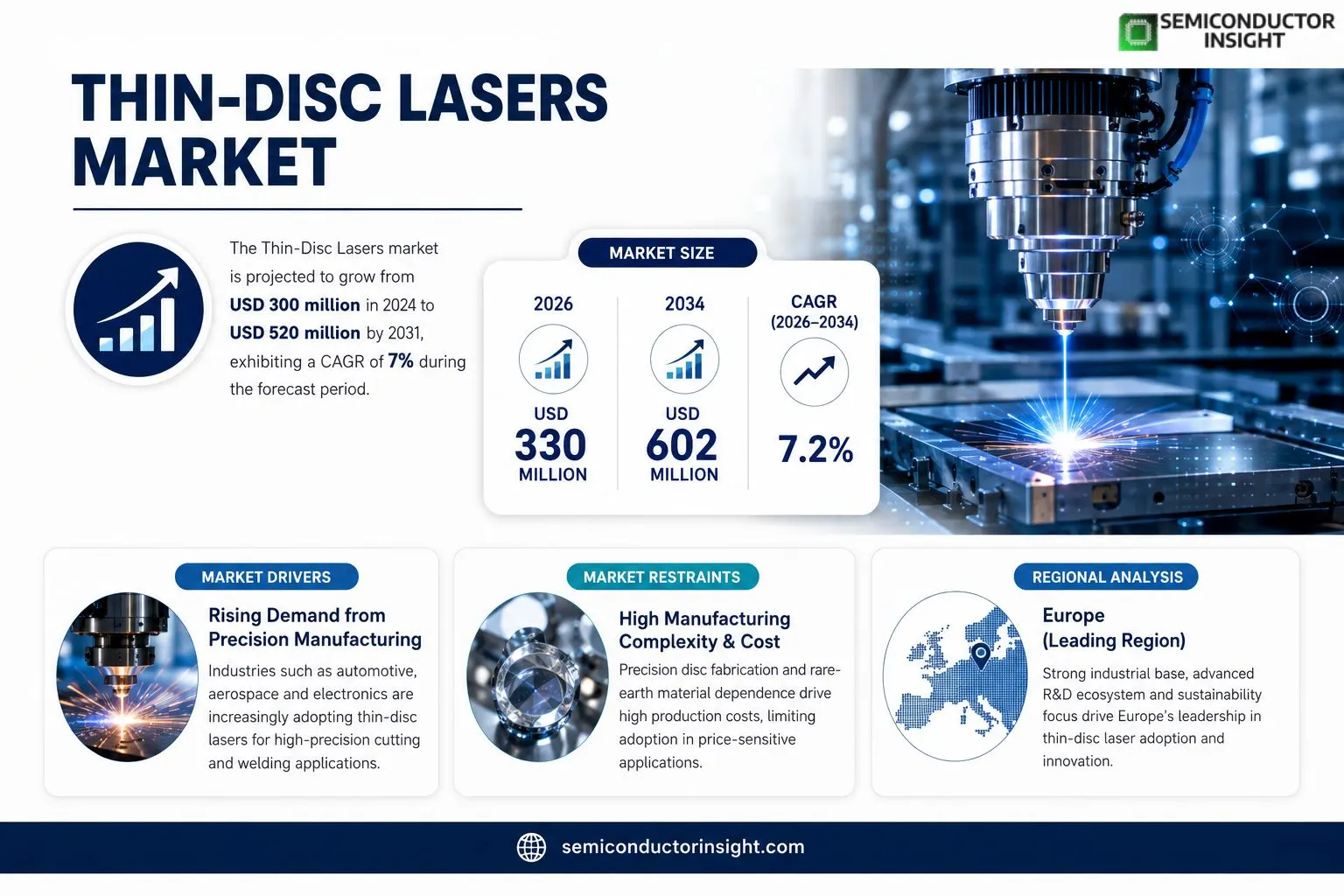
MARKET DRIVERS
Technological Advancements in Disk Architecture
The introduction of ultra‑thin gain media has lowered threshold pump powers, enabling higher output efficiencies than conventional rod lasers. Manufacturers are now able to pack more power into a smaller footprint, a shift that directly fuels adoption in aerospace and portable inspection tools.
Rising Demand from Precision Manufacturing
Industries such as micro‑electronics and additive manufacturing require repeatable beam quality at kilowatt levels. Thin‑disc emitters satisfy these specifications while reducing thermal lensing, a factor that has accelerated capital investments in new production lines.
➤ “The ability to sustain continuous‑wave operation above 2 kW without degrading beam quality is reshaping equipment design for high‑value markets.”
These dynamics converge to strengthen the Thin-Disc Lasers Market, making it a focal point for OEMs seeking to differentiate through performance‑driven product portfolios.
MARKET CHALLENGES
Manufacturing Complexity
Achieving the requisite disc flatness and bonding precision demands clean‑room environments and specialized tooling. Small‑batch production runs inflate unit costs, limiting price competitiveness against mature bulk‑laser technologies.
Other Challenges
Cost Sensitivity
End‑users in the automotive sector, a major consumer of high‑power lasers, closely monitor total cost of ownership. The premium associated with disc fabrication often forces buyers to justify ROI through extended equipment lifespans.
Supply Chain Bottlenecks
The reliance on rare‑earth dopants and high‑purity substrates creates vulnerability to geopolitical fluctuations, prompting some manufacturers to stockpile inventory at the expense of cash flow.
MARKET RESTRAINTS
Thermal Management Limitations
Although disc geometry excels at heat extraction, scaling to multi‑kilowatt regimes still strains conventional cooling solutions. Over‑reliance on water‑cooled mounts raises system complexity and maintenance overhead, discouraging adoption in low‑maintenance environments.
Regulatory Compliance Pressure
Increasing safety standards for high‑power optical devices impose stricter certification pathways. Companies must invest in extensive testing programs, a cost factor that can deter entry of smaller players into the Thin-Disc Lasers Market.
MARKET OPPORTUNITIES
Emerging Applications in Medical Imaging
High‑brightness, low‑noise output from thin‑disc sources aligns with the optical requirements of next‑generation optical coherence tomography (OCT) systems. Early adopters report improved tissue penetration and faster scan rates, opening a revenue stream that remains largely untapped.
Integration with Fiber‑Coupled Platforms
Advances in fiber‑laser stitching enable thin‑disc modules to be seamlessly incorporated into existing fiber‑delivery infrastructure. This compatibility reduces retrofitting costs for end users in telecommunications and defense, positioning the technology for accelerated market penetration.
Thin-Disc Lasers Market Trends
Industrial Adoption Accelerates in Manufacturing
The Thin-Disc Lasers Market is seeing a marked shift toward high‑throughput production lines, especially in automotive and aerospace sectors. Semiconductor‑grade silicon substrates and improved diode‑pump architectures have reduced the thermal load on the disc, allowing manufacturers to run continuous‑wave outputs beyond 1 kW without compromising beam quality. This technical progress aligns with the broader push for lean factories, where manufacturers prize tools that can cut, weld and surface‑process parts in a single pass. Companies that integrate thin‑disc sources into robotic cell designs report cycle‑time reductions of 15‑20 percent, translating into tangible cost advantages. The trend reflects a convergence of laser‑engineering maturity and the demand for tighter tolerances across downstream assemblers.
Other Trends
Emerging Applications in Medical Devices
Beyond traditional metalworking, the Thin-Disc Lasers Market is gaining relevance in the biomedical arena. The disc’s intrinsic ability to deliver a high‑quality, diffraction‑limited beam makes it suitable for delicate procedures such as micro‑surgery and ophthalmic corneal reshaping. Recent collaborations between laser manufacturers and device firms have yielded prototypes that combine thin‑disc emitters with precision‑positioning stages, enabling sub‑micron ablation control. Regulatory pathways for laser‑based medical equipment are becoming clearer, encouraging early‑stage adopters to allocate budget toward systems that promise higher repeatability and lower maintenance footprints compared with conventional solid‑state lasers.
Supply‑Chain Consolidation Shapes Future Offerings
Component sourcing is increasingly centralized as a handful of suppliers dominate high‑purity YAG crystals and fiber‑coupled pump diodes. This concentration drives pricing stability but also raises barriers for newcomers attempting to enter the Thin-Disc Lasers Market. Established players are responding by expanding in‑house production capabilities and offering turnkey solutions that bundle laser heads, cooling modules and predictive‑maintenance software. The result is a service‑oriented ecosystem where end users pay for performance guarantees rather than raw equipment alone. For strategic planners, the consolidation signals a need to negotiate long‑term supply contracts and to evaluate lifecycle‑cost models that factor in the reduced downtime associated with integrated service packages.
COMPETITIVE LANDSCAPE
Key Industry Players
Thin-Disc Lasers: Competitive Dynamics and Market Structure
The Thin-Disc Laser arena remains heavily weighted toward a handful of firms that have mastered diode‑pumped solid‑state architectures and leveraged long‑standing collaborations with research institutes. NLIGHT and Trumpf dominate the high‑power segment, each commanding an extensive portfolio that spans industrial cutting, welding and scientific research systems. IPG Photonics, with its broad base in fiber and bulk lasers, has efficiently cross‑sold thin‑disc variants to its established customer base, accelerating its market share growth. Dausinger & Giesen, the original inventor of the thin‑disc concept, retains a niche advantage through proprietary thermal management patents that underpin the reliability of its mid‑power units. Collectively, these leaders account for roughly half of revenue, and their strategic movessuch as joint development agreements with major equipment integratorsshape pricing pressures and technology road‑maps across the sector.Beyond the headline players, a vibrant cohort of specialized manufacturers is expanding the application spectrum of thin‑disc sources. TWI (The Welding Institute) translates its deep welding expertise into customized laser solutions for aerospace and automotive assembly lines. Jenoptik and Precitec focus on precision processing, targeting medical device fabrication and micro‑electronics where beam quality outweighs raw power. Jenlas, a German spin‑off, competes on cost‑effective low‑power models for education and prototyping labs. Emerging entrants such as Coherent, Rofin (now part of Coherent), and Amplitude Systems bring incremental innovations in diode driver electronics, while Asian firms like Shanghai Laser Group and Mitsubishi Electric are positioning to serve the rapidly scaling manufacturing bases in China and Japan. These niche players, though smaller in scale, introduce differentiated value propositions that pressure incumbents to diversify product lines and enhance service frameworks.
List of Key Thin-Disc Lasers Companies Profiled
- NLIGHT
- Trumpf
- IPG Photonics
- Dausinger & Giesen
- TWI
- Jenoptik
- Precitec
- Jenlas
- Coherent
- Rofin
- Amplitude Systems
- Shanghai Laser Group
- Mitsubishi Electric
Segment Analysis:
| Segment Category | Sub-Segments | Key Insights |
| By Type |
|
Mid Power maintains a pivotal role in the ecosystem.
|
| By Application |
|
Laser Cutting stands out as a growth catalyst.
|
| By End User |
|
Semiconductor Fabrication drives technical refinement.
|
| By System Integration |
|
Integrated Manufacturing Lines shape adoption pathways.
|
| By Technology Trend |
|
Adaptive Optics Integration unlocks new performance horizons.
|
Regional Analysis: Thin-Disc Lasers Market
German manufacturers have embedded thin‑disc modules into high‑speed welding cells, capitalizing on the source’s stable output to improve joint consistency. This practice underscores the region’s willingness to replace older rod‑laser families with platforms that promise lower operational cost per watt.
The EU’s Horizon programmes fund joint projects between universities and laser suppliers, focusing on crystal doping methods that enhance thermal handling. Such collaborations reduce development risk and fast‑track commercial readiness.
Tight emissions standards in the European Union push equipment makers toward laser sources that minimize stray infrared radiation, a niche where thin‑disc designs naturally excel because of their compact resonator geometry.
Localized component sourcing, especially for high‑purity crystals, mitigates the impact of logistics disruptions, reinforcing Europe’s capacity to sustain thin‑disc production even under external pressure.
North America
In the United States, defense contractors and aerospace OEMs have shown a strong preference for thin‑disc lasers when addressing the need for high‑precision material processing on lightweight alloys. The domestic policy environment, which encourages advanced manufacturing through tax incentives, adds financial appeal for firms looking to upgrade legacy systems. Canadian firms, meanwhile, are experimenting with the technology for micro‑machining of medical devices, leveraging the source’s ability to maintain beam uniformity across extended operation periods. Across the continent, the market narrative revolves around replacing older solid‑state options with thin‑disc solutions that deliver lower heat footprints, a factor that aligns with the broader push toward energy‑conscious production.
Asia‑Pacific
China’s rapid expansion of semiconductor fabs and Japan’s continued leadership in precision optics have created a fertile ground for thin‑disc laser adoption. Taiwanese manufacturers are integrating the technology into flexible‑display fabrication lines, attracted by the source’s capability to provide consistent output at high repetition rates. South Korea’s automotive sector is also exploring thin‑disc modules for headlight assembly, seeing an advantage in the reduced thermal management burden. While the region benefits from a large pool of engineering talent, the market narrative emphasizes overcoming perceived cost barriers through localized manufacturing partnerships.
South America
Brazil’s emerging aerospace programs and Argentina’s focus on laser‑based medical equipment have sparked modest interest in thin‑disc platforms. Local distributors are positioning the technology as a premium alternative to conventional diode bars, citing its superior beam quality for delicate surgical procedures. Government initiatives aimed at modernizing manufacturing infrastructure provide a modest boost, yet the market remains highly dependent on import channels and the ability of distributors to educate end‑users on long‑term operational savings.
Middle East & Africa
The United Arab Emirates is leading regional interest, largely because of its Vision 2030 agenda that promotes high‑tech manufacturing clusters. Thin‑disc lasers are being trialed in solar‑panel trimming facilities, where their high efficiency aligns with the region’s renewable‑energy investments. In South Africa, research institutions are collaborating with European laser firms to adapt thin‑disc technology for mining applications, leveraging its ability to cut through hard materials with minimal collateral damage. Across the broader area, market growth hinges on the establishment of training programs that can translate the technology’s technical advantages into tangible production benefits.
Report Scope
This market research report provides a comprehensive analysis of the Thin-Disc Lasers Market , covering the forecast period 2026–2034. It offers detailed insights into market dynamics, technological advancements, competitive landscape, and key trends shaping the industry.
Key focus areas of the report include:
- Market Overview: The report begins with an overview outlining its current market scenario, key growth indicators, and industry transformation drivers. It discusses macroeconomic factors, demand–supply balance, regulatory landscape, and the strategic role of semiconductors in powering advancements across industries such as automotive, telecommunications, consumer electronics, and industrial automation.
- Market Size & Forecast: Historical data and future projections for revenue, unit shipments, and market value across major regions and segments.
- Segmentation Analysis: Detailed breakdown by product type, technology, application, and end-user industry to identify high-growth segments and investment opportunities.
- Regional Insights: Insights into market performance across North America, Europe, Asia-Pacific, Latin America, and the Middle East & Africa, including country-level analysis where relevant.
- Competitive Landscape: Profiles of leading market participants, including their product offerings, R&D focus, manufacturing capacity, pricing strategies, and recent developments such as mergers, acquisitions, and partnerships.
- Technology Trends & Innovation: Assessment of emerging technologies, integration of AI/IoT, semiconductor design trends, fabrication techniques, and evolving industry standards.
- Market Drivers & Restraints: Evaluation of factors driving market growth along with challenges, supply chain constraints, regulatory issues, and market-entry barriers.
- Stakeholder Insights: Insights for component suppliers, OEMs, system integrators, investors, and policymakers regarding the evolving ecosystem and strategic opportunities.
Primary and secondary research methods are employed, including interviews with industry experts, data from verified sources, and real-time market intelligence to ensure the accuracy and reliability of the insights presented.
FREQUENTLY ASKED QUESTIONS:
What is the current market size of Thin-Disc Lasers Market?
-> Thin-Disc Lasers market was valued at USD ≈ 300 million in 2024 and is projected to reach USD ≈ 520 million by 2031, exhibiting a CAGR of roughly 7 % during the forecast period
Which key companies operate in Thin-Disc Lasers Market?
-> Key players include NLIGHT, Trumpf, TWI, Dausinger & Giesen, Jenoptik, Precitec, IPG Photonics, Jenlas, among others.
What are the key growth drivers?
-> Key growth drivers include the increasing adoption of diode‑pumped high‑power solid‑state lasers in manufacturing, defense and medical sectors, as well as continuous improvements in laser efficiency and reliability.
Which region dominates the market?
-> North America (United States) and Asia (China) are the leading regions, with the U.S. market estimated at USD million in 2025 and China projected to reach USD million in the same year.
What are the emerging trends?
-> Emerging trends include rapid growth of the Low Power segment, which is expected to reach USD million by 2036 with a strong CAGR, and the development of compact, high‑efficiency disc laser modules for portable applications.
Get Sample Report PDF for Exclusive Insights
Report Sample Includes
- Table of Contents
- List of Tables & Figures
- Charts, Research Methodology, and more...
 Download Sample Report PDF