Multi-Mode OPS Lasers Market Insights
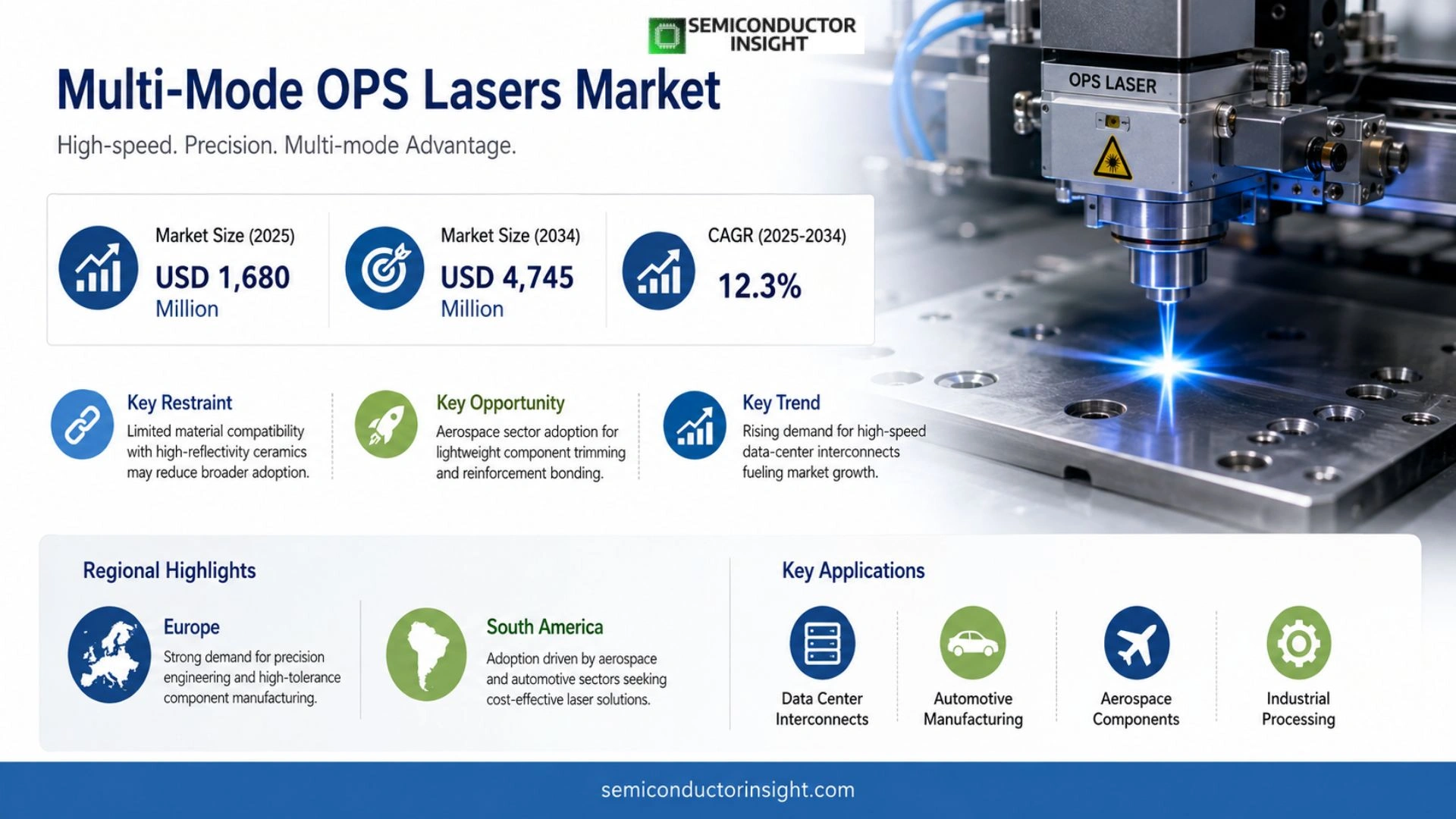
Multi-Mode OPS Lasers market size was valued at USD 1,680 million in 2025 and is projected to reach USD 4,745 million by 2034, exhibiting a CAGR of 12.3% during the forecast period.
Multimode pump laser is a high‑stability laser designed for high‑power pumping applications. The fiber core of a multimode laser is thicker than that of a single‑mode laser, resulting in lower beam quality but a more uniform energy distribution across the spot.
The surge in data‑center deployments has heightened demand for ultra‑fast optical interconnects, while automation programmes such as the Made in America initiative are accelerating adoption of LiDAR‑based sensing systems that rely on these lasers.
MARKET DRIVERS
Advanced Manufacturing Adoption
Multi-Mode OPS Lasers Market gains traction as manufacturers replace legacy tooling with laser systems that combine high‑speed scanning and flexible power modulation. This dual capability shortens cycle times on complex geometries, allowing factories to meet tighter delivery windows without compromising surface finish. As the cost of mechanical wear parts rises, firms recognize that optical solutions deliver a lower total cost of ownership.
Regulatory Incentives for Energy Efficiency
Legislation in Europe and North America now rewards processes that reduce energy per unit of output. Multi‑mode OPS lasers, by virtue of their ability to switch between low‑power alignment and high‑power machining modes, align well with these performance metrics. Companies that integrate such lasers can claim reduced carbon footprints, a factor that increasingly influences procurement decisions.
➤ Operators reporting a 12‑15% drop in per‑part energy consumption after migrating to multi‑mode OPS platforms
For original equipment manufacturers, the ability to offer a single laser that serves both prototyping and full‑scale production creates a compelling value proposition. This flexibility encourages OEMs to embed the technology deeper into their product lines, accelerating market penetration.
MARKET CHALLENGES
High Capital Expenditure
Purchasing a multi‑mode OPS laser typically requires an upfront outlay that exceeds the budget thresholds of many small‑to‑mid‑size enterprises. Although the long‑term amortization appears attractive, the initial cash demand can delay adoption, especially in capital‑constrained sectors such as medical device fabrication.
Other Challenges
Maintenance Complexity
The coexistence of multiple operating modes introduces additional optical alignment steps and firmware calibration cycles. Clients without dedicated laser technicians often face extended downtime, which erodes the anticipated productivity gains.
MARKET RESTRAINTS
Limited Material Compatibility
While multi‑mode OPS lasers excel on metals and certain polymers, their interaction with high‑reflectivity ceramics remains less predictable. This limitation reduces the technology’s appeal for niche markets that rely on advanced composites, curbing overall market breadth.
MARKET OPPORTUNITIES
Emerging Applications in Aerospace
The aerospace sector is experimenting with multi‑mode OPS lasers for lightweight structural component trimming and localized reinforcement bonding. These applications demand precise energy delivery combined with rapid re‑configuration,attributes that align tightly with the technology’s core strengths. Early adopters are reporting shorter lead times for prototype validation, suggesting a pathway for broader industry uptake.
Multi-Mode OPS Lasers Market Trends
Rising Demand for High‑Speed Data‑Center Interconnects
The surge in data‑center construction worldwide has translated into a pressing need for optical sources capable of sustaining multi‑gigabit per second links. Multi‑Mode OPS Lasers, with their broader core and comparatively uniform energy distribution, are being chosen for short‑reach modules where cost and power efficiency outweigh the premium beam quality of single‑mode devices. Operators value the ability to deploy dense wavelength‑division multiplexing (DWDM) over multimode fibers to shorten link distances while retaining acceptable signal integrity. This preference is driving vendors to expand product lines that integrate directly with VCSEL‑based transceivers, thereby shortening bill‑of‑materials and simplifying thermal management. As a result, the Multi‑Mode OPS Lasers Market is seeing a noticeable shift toward solutions that balance modest power density with the scalability demanded by hyperscale cloud providers.
Other Trends
Policy‑Driven Manufacturing Incentives
Government initiatives that channel billions into advanced photonics research are reshaping the supply chain. The U.S. Made in America program, backed by a $300 billion R&D allocation, has encouraged domestic firms to localize wafer‑fab capacity and automate assembly lines for laser modules. This environment reduces lead times for critical components and lowers exposure to geopolitical supply disruptions. Companies that have leveraged the funding are able to offer tighter tolerances at competitive pricing, which in turn strengthens their position in both the North American and European segments of the Multi‑Mode OPS Lasers Market.
Expansion into Automotive LiDAR and Sensing
Automotive manufacturers are increasingly adopting solid‑state LiDAR to meet regulatory safety requirements while keeping unit costs below mass‑market thresholds. The inherent high‑power output of Multi‑Mode OPS Lasers makes them attractive for VCSEL arrays that illuminate long‑range scanning patterns. Recent collaborations,such as a 2022 partnership between a leading VCSEL supplier and a 3D‑LiDAR specialist,highlight the strategic importance of integrating multimode pump lasers into cost‑effective ADAS platforms. This convergence creates a new revenue stream for laser producers, prompting them to prioritize reliability testing and automotive‑grade qualification in their product roadmaps. Consequently, the market is witnessing a diversification of application portfolios, moving beyond traditional metal‑processing and medical niches into automotive sensing.
COMPETITIVE LANDSCAPE
Key Industry Players
Competitive dynamics shaping Multi-Mode OPS Lasers sector
The market is anchored by a handful of vertically integrated firms that control both laser‑diode manufacturing and high‑power pump assemblies. II‑VI Technologies, leveraging its broad portfolio in advanced photonics, commands the largest share of multi‑mode OPS output, thanks to deep R&D capabilities and a global sales network that serves data‑center OEMs and industrial laser integrators. Its strategic focus on scaling fiber‑core diameters while maintaining thermal stability has forced smaller entrants to differentiate through niche wavelength bands or specialty applications such as LiDAR. This concentration at the top of the value chain creates a competitive environment where price pressure is mitigated by the ability to bundle complementary optics and system‑level services.
Beyond the dominant player, a constellation of specialists is expanding the market’s breadth. Furukawa Electric and Polytec GmbH supply high‑precision pump modules that cater to medical‑device manufacturers demanding tighter beam uniformity. Lumentum and 3SP Technologies have accelerated product roadmaps that target the communication segment, introducing multi‑mode arrays optimized for short‑reach optical interconnects. Companies such as DoGain Laser Technology, Lumics, Oxxius, Thorlabs, InnoLas, Vexlum, and nLIGHT occupy distinct niches,ranging from compact laboratory sources to rugged units for metal‑processing equipment. Their agility in customizing wavelength selections (e.g., 9xx nm or 10xx nm) and form‑factor designs fuels adoption in emerging applications like high‑speed data‑center links and autonomous‑vehicle LiDAR, compelling the incumbents to refine their offerings and preserve market relevance.
List of Key Multi-Mode OPS Lasers Companies Profiled
- II‑VI Technologies
- Furukawa Electric
- Polytec GmbH
- Lumentum
- 3SP Technologies
- DoGain Laser Technology
- Lumics
- Oxxius
- Thorlabs
- InnoLas
- Vexlum
- nLIGHT
Segment Analysis:
| Segment Category | Sub-Segments | Key Insights |
| By Type |
|
High‑Power Multi‑Mode OPS Lasers
|
| By Application |
|
Industrial & Communication Integration
|
| By End User |
|
Data‑Center & Automotive Drivers
|
| By Wavelength |
|
Wavelength‑Specific Opportunities
|
| By Performance Characteristic |
|
Performance‑Driven Adoption
|
Regional Analysis: Multi-Mode OPS Lasers Market
The continent benefits from a vertically integrated supply base, where semiconductor fabs, precision optics firms, and specialty alloy providers operate within close geographic proximity. This reduces lead times for critical components and enables rapid iteration of system designs, a competitive edge that smaller regions struggle to match.
Federal agencies maintain a clear framework for laser safety and export controls, offering predictability for manufacturers targeting both domestic and overseas contracts. Recent revisions emphasize performance validation rather than prescriptive design, giving innovators leeway to experiment with unconventional mode‑mixing strategies.
Aerospace assemblers have integrated Multi-Mode OPS Lasers into composite‑layup processes, citing improved bonding consistency. In parallel, semiconductor fabs are piloting the technology for wafer cleaning, where its broader spot size mitigates damage while preserving throughput.
Leading vendors leverage extensive patent portfolios that combine wave‑guide engineering with adaptive pulse control. New entrants focus on niche applications such as medical device manufacturing, where customization of mode patterns can create differentiated product lines.
Europe
European markets exhibit a strong emphasis on precision engineering, where the Multi-Mode OPS Laser is valued for its ability to fine‑tune energy distribution for high‑tolerance components. Collaborative research programs funded by the EU foster cross‑border projects that blend optics expertise with materials science, generating application blueprints for automotive lightweighting and renewable‑energy hardware. Although the supply chain is less consolidated than in North America, strong regulatory alignment across member states streamlines certification processes, encouraging manufacturers to adopt the technology for series production. The region’s focus on sustainability drives interest in laser‑based recycling methods, where multi‑mode operation offers the flexibility needed to process heterogeneous material streams without extensive equipment changes.
Asia‑Pacific
In Asia‑Pacific, rapid industrialization and a burgeoning electronics sector create a fertile environment for Multi-Mode OPS Lasers, especially in countries launching large‑scale smart‑factory initiatives. Domestic manufacturers are increasingly capable of fabricating high‑quality gain media, narrowing the reliance on imported components. Government incentives target advanced manufacturing, prompting firms to trial multi‑mode configurations that can switch between high‑speed marking and delicate surface treatment on a single platform. The region’s diverse customer base,ranging from consumer‑electronics assemblers to semiconductor packaging plants,pushes vendors to develop modular solutions that can be customized for varying throughput requirements. While intellectual‑property protection remains a concern, collaborative licensing models are emerging to balance innovation with market access.
South America
South American adoption of Multi-Mode OPS Lasers is driven primarily by the aerospace and automotive sectors, which seek cost‑effective alternatives to traditional fiber lasers. Local engineering firms are experimenting with hybrid systems that combine OPS technology with existing CNC infrastructure, aiming to extend tool life and reduce downtime. Governmental industrial policies emphasize technology transfer, encouraging partnerships between multinational equipment suppliers and regional universities. Although the market size remains modest, early‑stage pilots demonstrate that the flexibility of multi‑mode operation can address a wide spectrum of material thicknesses, making the technology attractive for small‑batch specialty production. Supply‑chain constraints, such as limited domestic component manufacturers, are gradually being mitigated through regional trade agreements that lower tariff barriers.
Middle East & Africa
The Middle East & Africa region shows a growing curiosity about Multi-Mode OPS Lasers, largely within oil‑field services and defense refurbishment programs. Operators value the technology’s ability to process thick‑walled alloys used in drilling equipment without sacrificing surface quality. Regional research hubs are beginning to explore laser‑based additive manufacturing, where the multi‑mode capability can modulate heat input to manage residual stresses. While the ecosystem is still nascent, strategic investments from sovereign wealth funds are funding demonstration projects that could accelerate local expertise. Partnerships with established Asian and European suppliers are essential for technology transfer, positioning the region to leapfrog stages of conventional laser adoption.
Report Scope
This market research report provides a comprehensive analysis of the Multi-Mode OPS Lasers Market , covering the forecast period 2026–2034. It offers detailed insights into market dynamics, technological advancements, competitive landscape, and key trends shaping the industry.
Key focus areas of the report include:
- Market Overview: The report begins with an overview outlining its current market scenario, key growth indicators, and industry transformation drivers. It discusses macroeconomic factors, demand–supply balance, regulatory landscape, and the strategic role of semiconductors in powering advancements across industries such as automotive, telecommunications, consumer electronics, and industrial automation.
- Market Size & Forecast: Historical data and future projections for revenue, unit shipments, and market value across major regions and segments.
- Segmentation Analysis: Detailed breakdown by product type, technology, application, and end-user industry to identify high-growth segments and investment opportunities.
- Regional Insights: Insights into market performance across North America, Europe, Asia-Pacific, Latin America, and the Middle East & Africa, including country-level analysis where relevant.
- Competitive Landscape: Profiles of leading market participants, including their product offerings, R&D focus, manufacturing capacity, pricing strategies, and recent developments such as mergers, acquisitions, and partnerships.
- Technology Trends & Innovation: Assessment of emerging technologies, integration of AI/IoT, semiconductor design trends, fabrication techniques, and evolving industry standards.
- Market Drivers & Restraints: Evaluation of factors driving market growth along with challenges, supply chain constraints, regulatory issues, and market-entry barriers.
- Stakeholder Insights: Insights for component suppliers, OEMs, system integrators, investors, and policymakers regarding the evolving ecosystem and strategic opportunities.
Primary and secondary research methods are employed, including interviews with industry experts, data from verified sources, and real-time market intelligence to ensure the accuracy and reliability of the insights presented.
FREQUENTLY ASKED QUESTIONS:
What is the current market size of Multi-Mode OPS Lasers Market?
-> Multi-Mode OPS Lasers market is projected to reach USD 4,745 million by 2034, exhibiting a CAGR of 12.3% during the forecast period.
Which key companies operate in Multi-Mode OPS Lasers Market?
-> Key players include II-VI, Furukawa Electric, Polytec GmbH, Lumentum, 3SP Technologies, DoGain Laser Technology, Lumics, Oxxius, Thorlabs, InnoLas, Vexlum.
What are the key growth drivers?
-> Key growth drivers include the rapid expansion of data centers demanding high‑speed optical interconnects, increasing adoption of VCSEL technology for fast data transmission, automation and LiDAR applications in manufacturing and automotive sectors, and supportive government initiatives promoting advanced manufacturing.
Which region dominates the market?
-> North America leads the market, driven by strong data‑center investments, early adoption of VCSEL‑based solutions, and robust R&D activities, while Europe and Asia‑Pacific show significant growth potential.
What are the emerging trends?
-> Emerging trends include integration of VCSEL arrays in next‑generation LiDAR systems for autonomous vehicles, increased use of multimode pump lasers in high‑power industrial processing, and the development of energy‑efficient optical components for data‑center networking.

Get Sample Report PDF for Exclusive Insights
Report Sample Includes
- Table of Contents
- List of Tables & Figures
- Charts, Research Methodology, and more...
 Download Sample Report PDF