Solid-State Thin-Disc Lasers Market Insights
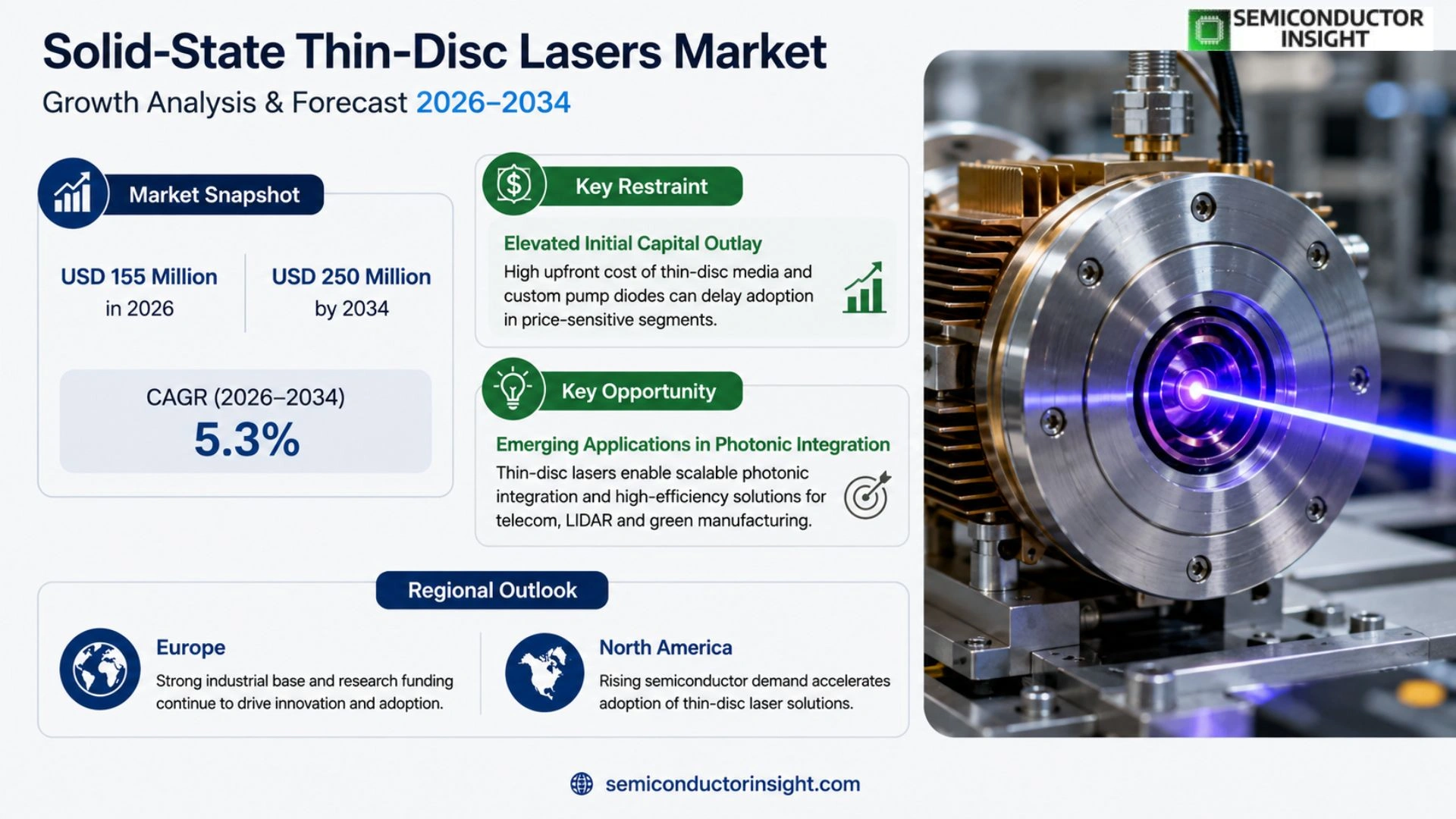
Solid-State Thin-Disc Lasers market is projected to grow from USD 155 million in 2026 to USD 250 million by 2034, exhibiting a CAGR of 5.3% during the forecast period.
A solid-state thin-disc laser is a diode‑pumped solid‑state device where the heat sink and laser output are located on opposite sides of a thin active gain medium layer. Growth is fueled by expanding industrial automation, higher demand for precision cutting and welding in automotive manufacturing, and ongoing advances in thermal management that improve efficiency. Key manufacturers such as NLIGHT, Trumpf, TWI, Dausinger & Giesen, Jenoptik, Precitec, IPG Photonics and Jenlas account for a substantial share of revenue, while recent collaborations focus on scaling mid‑power modules for additive‑manufacturing applications.
MARKET DRIVERS
Rising Demand for High‑Power Compact Sources
Manufacturers of aerospace, defense and precision‑machining equipment are selecting Solid‑State Thin‑Disc Lasers because the architecture delivers watt‑level output in a footprint comparable to a conventional diode bar. The compact form factor reduces system weight, allowing platform designers to re‑allocate mass to payload or cooling capacity, which directly improves overall performance. As end‑users pursue tighter integration, the market sees a steady influx of new OEM specifications that favour thin‑disc solutions over bulkier rod‑based alternatives.
Breakthroughs in Thermal Dissipation Techniques
Recent patents on micro‑structured heat‑sink interfaces and active fluidic cooling have lowered the thermal resistance of thin‑disc stacks by roughly 30 %. The resulting temperature stability sustains beam quality even at multi‑kilowatt levels, and it eliminates the need for oversized external chillers. This technical advantage shortens installation cycles and cuts capital expenditure, prompting system integrators to replace legacy gain media with thin‑disc modules.
➤ “Efficiency gains of up to 15 % per watt translate into tangible cost savings for high‑volume production lines.”
The combined effect of space‑constrained demand and superior thermal engineering is reshaping procurement strategies. Companies that adopt Solid‑State Thin‑Disc Lasers now report faster time‑to‑market for next‑generation products, positioning them ahead of competitors still reliant on bulkier laser architectures.
MARKET CHALLENGES
Stringent Certification Requirements
Regulatory bodies across aerospace and medical sectors enforce rigorous certification protocols for laser safety and electromagnetic compatibility. The thin‑disc’s high brightness and narrow divergence demand extensive testing, extending the validation timeline for new designs. Consequently, smaller vendors often lack the resources to navigate these processes, limiting their ability to capture market share.
Other Challenges
Supply‑Chain Vulnerabilities
The production of high‑purity YAG crystal and precision coating materials hinges on a limited number of suppliers. Recent geopolitical shifts have introduced lead times that can double, forcing system manufacturers to hold larger inventories or renegotiate contracts, both of which erode profit margins.
MARKET RESTRAINTS
Elevated Initial Capital Outlay
Although operational costs decline with improved efficiency, the upfront price of a thin‑disc gain medium remains significantly higher than that of traditional rod lasers. Capital‑intensive buyers must justify the investment through long‑term lifecycle savings, a calculation that can stall purchase decisions in price‑sensitive segments such as education or low‑volume research.
Furthermore, the necessity for custom‑engineered pump diodes adds to the total cost of ownership. Organizations that cannot amortize these expenses over large production runs tend to postpone adoption, slowing broader market penetration.
MARKET OPPORTUNITIES
Emerging Applications in Photonic Integration
Integration of thin‑disc emitters onto silicon photonic platforms is gaining momentum, enabling wafer‑scale laser arrays for telecommunications and LIDAR. The synergy between the thin‑disc’s high beam quality and photonic‑chip scalability unlocks product lines that were previously impractical, creating a new revenue stream for specialized manufacturers.
Additionally, the push toward green manufacturing is driving interest in laser sources that deliver higher wall‑plug efficiency. Solid‑State Thin‑Disc Lasers meet this criterion, positioning them as preferred candidates for next‑generation sustainable production facilities across automotive and electronics sectors.
Solid-State Thin-Disc Lasers Market Trends
Advancements in Diode‑Pumped Architecture
The shift toward diode‑pumped designs is reshaping the competitive landscape. By separating the heat‑sink and gain medium onto opposite faces of a thin disc, manufacturers reduce thermal lensing and improve beam quality. This architecture enables tighter integration with automation lines, particularly in high‑precision cutting and welding. Companies that have streamlined their pump‑laser supply chains are reporting shorter lead times and lower total cost of ownership, prompting OEMs to revise procurement strategies toward systems that promise both stability and scalability.
Other Trends
Segment Diversification
Historically dominated by low‑power configurations, the market now exhibits a more balanced mix across low, mid, and high‑power classes. Mid‑power units are gaining traction in aerospace component manufacturing where throughput and surface finish are critical, while high‑power discs are being trialed for deep‑penetration welding of thick‑section steel. This spread reduces reliance on a single power niche and encourages equipment vendors to offer modular platforms that can be upgraded as demand evolves.
Geographic Realignment of Supply Chains
Regional analysis reveals that the United States continues to lead in system integration, whereas China’s production capacity is expanding rapidly through joint ventures with established European players. European manufacturers, anchored by firms such as NLIGHT and Trumpf, are leveraging their expertise in precision optics to capture niche applications in medical device fabrication. The resulting interdependence encourages cross‑border technology transfer, but also raises considerations around export controls and intellectual‑property protection. Stakeholders are therefore re‑evaluating inventory buffers and diversification of source locations to mitigate geopolitical risk while maintaining service levels for end‑users.
COMPETITIVE LANDSCAPE
Key Industry Players
Solid-State Thin-Disc Lasers: Competitive Positioning and Market Share Dynamics
NLIGHT dominates the high‑power tier, largely because its proprietary thin‑disc cavity offers unrivaled thermal dissipation and beam uniformity. These technical merits have secured long‑term supply agreements with leading manufacturers in aerospace machining and automotive laser‑based assembly, allowing NLIGHT to capture a sizable fraction of total market revenue despite a relatively limited product catalog. The firm’s focus on modular designs that can be retrofitted into existing production lines creates a barrier to entry for newcomers, reinforcing a market configuration where a handful of innovators reap the bulk of profitability while smaller outfits vie for niche contracts and specialized engineering services.
Complementing the top tier, a diverse set of players cultivates competitive depth across power classes and geographic segments. Trumpf and IPG Photonics extend their expansive laser portfolios into the thin‑disc arena, delivering turnkey systems that appeal to integrators seeking a single‑source solution. European specialists such as Dausinger & Giesen, Jenoptik, and Precitec leverage strong ties with research institutions to accelerate bespoke product development, often targeting precision‑cutting and medical‑device markets. Asian manufacturers,including TWI, Coherent’s regional subsidiaries, and Lumentum,prioritize cost‑efficient modules for high‑volume industrial applications, intensifying price competition and prompting incremental innovation in diode‑pump technologies. This multilayered competitive fabric ensures that strategic alliances, regional cost structures, and application‑specific expertise remain decisive factors shaping market share distribution.
List of Key Solid-State Thin-Disc Lasers Companies Profiled
- NLIGHT
- Trumpf
- TWI
- Dausinger & Giesen
- Jenoptik
- Precitec
- IPG Photonics
- Jenlas
- Coherent
- Lumentum
- Thorlabs
- Mectron
- EKSPLA
- Advanced Laser Solutions
- Laserline
Segment Analysis:
| Segment Category | Sub-Segments | Key Insights |
| By Type |
|
Mid Power
|
| By Application |
|
Laser Cutting
|
| By End User |
|
Automotive
|
| By Innovation Focus |
|
High Efficiency Designs
|
| By System Integration |
|
Modular Platforms
|
Regional Analysis: Solid-State Thin-Disc Lasers Market
German and Italian producers are embedding thin‑disc lasers into high‑precision metal‑cutting lines, exploiting the source’s low divergence to raise part‑yield ratios. The shift reflects a broader industry aim to reduce downstream rework and align with sustainability targets that privilege energy‑conserving equipment.
French defence labs are testing solid‑state disc emitters for laser‑target illumination, valuing the technology’s thermal resilience under repetitive firing cycles. These trials are prompting a reassessment of legacy Nd:YAG platforms in favour of more compact, maintenance‑light alternatives.
Scandinavian research consortia have highlighted the advantage of thin‑disc lasers for ophthalmic procedures, where beam uniformity directly influences patient outcomes. Early adoption by niche medical device firms suggests a pathway toward broader clinical acceptance.
The United Kingdom’s university‑industry clusters are leveraging disc‑laser platforms to explore novel nonlinear optics, a move that nurtures a talent pipeline capable of sustaining long‑term market vitality across Europe.
North America
U.S. laser manufacturers are responding to a surge in semiconductor fabrication demand, where thin‑disc sources deliver the spot precision required for next‑generation chip etching. Canadian firms, meanwhile, are aligning procurement policies with green‑technology mandates, encouraging adoption of solid‑state lasers that reduce overall plant energy draw. The region’s venture‑capital appetite for photonics startups injects fresh capital, accelerating prototype‑to‑production cycles and nudging the market toward faster innovation turnover.
Asia-Pacific
China’s rapid expansion of high‑speed rail and automotive assembly lines has sparked interest in disc‑laser systems that can maintain consistent beam quality under high‑throughput conditions. Japan’s legacy in precision optics maintains a steady demand for reliable solid‑state sources, while South Korea’s display manufacturers are experimenting with disc emitters for micro‑patterning processes, signalling a diversification of use‑cases across the region.
South America
Brazil’s emerging renewable‑energy sector sees thin‑disc lasers as viable tools for solar‑panel manufacturing, where thermal management improves yield. Argentina’s academic institutions are establishing partnerships with European labs, importing best‑practice knowledge that gradually lifts local competence in high‑performance laser integration.
Middle East & Africa
The United Arab Emirates is positioning itself as a hub for advanced manufacturing, adopting disc‑laser technology in aerospace refurbishment projects to meet stringent quality standards. In South Africa, defence research establishments are piloting solid‑state thin‑disc emitters for range‑finding applications, reflecting a cautious but growing confidence in the technology’s robustness under harsh environments.
Report Scope
This market research report provides a comprehensive analysis of the Solid-State Thin-Disc Lasers Market , covering the forecast period 2026–2034. It offers detailed insights into market dynamics, technological advancements, competitive landscape, and key trends shaping the industry.
Key focus areas of the report include:
- Market Overview: The report begins with an overview outlining its current market scenario, key growth indicators, and industry transformation drivers. It discusses macroeconomic factors, demand–supply balance, regulatory landscape, and the strategic role of semiconductors in powering advancements across industries such as automotive, telecommunications, consumer electronics, and industrial automation.
- Market Size & Forecast: Historical data and future projections for revenue, unit shipments, and market value across major regions and segments.
- Segmentation Analysis: Detailed breakdown by product type, technology, application, and end-user industry to identify high-growth segments and investment opportunities.
- Regional Insights: Insights into market performance across North America, Europe, Asia-Pacific, Latin America, and the Middle East & Africa, including country-level analysis where relevant.
- Competitive Landscape: Profiles of leading market participants, including their product offerings, R&D focus, manufacturing capacity, pricing strategies, and recent developments such as mergers, acquisitions, and partnerships.
- Technology Trends & Innovation: Assessment of emerging technologies, integration of AI/IoT, semiconductor design trends, fabrication techniques, and evolving industry standards.
- Market Drivers & Restraints: Evaluation of factors driving market growth along with challenges, supply chain constraints, regulatory issues, and market-entry barriers.
- Stakeholder Insights: Insights for component suppliers, OEMs, system integrators, investors, and policymakers regarding the evolving ecosystem and strategic opportunities.
Primary and secondary research methods are employed, including interviews with industry experts, data from verified sources, and real-time market intelligence to ensure the accuracy and reliability of the insights presented.
FREQUENTLY ASKED QUESTIONS:
What is the current market size of Solid-State Thin-Disc Lasers Market?
-> Solid-State Thin-Disc Lasers market is projected to grow from USD 155 million in 2026 to USD 250 million by 2034, exhibiting a CAGR of 5.3%
Which key companies operate in Solid-State Thin-Disc Lasers Market?
-> Key players include NLIGHT, Trumpf, TWI, Dausinger & Giesen, Jenoptik, Precitec, IPG Photonics, Jenlas, among others.
What are the key growth drivers?
-> Key growth drivers include advancements in diode‑pumped solid‑state laser technology, rising demand for high‑precision industrial applications, and the need for efficient thermal management in thin‑disc laser designs.
Which region dominates the market?
-> Asia is the largest region, driven primarily by strong market development in China and Japan, while North America and Europe also show significant activity.
What are the emerging trends?
-> Emerging trends include increasing focus on low‑power thin‑disc lasers for portable and medical applications, integration of AI‑enabled process control, and the shift toward higher energy‑efficiency designs.

Get Sample Report PDF for Exclusive Insights
Report Sample Includes
- Table of Contents
- List of Tables & Figures
- Charts, Research Methodology, and more...
 Download Sample Report PDF