G-Force Accelerometers Market Insights
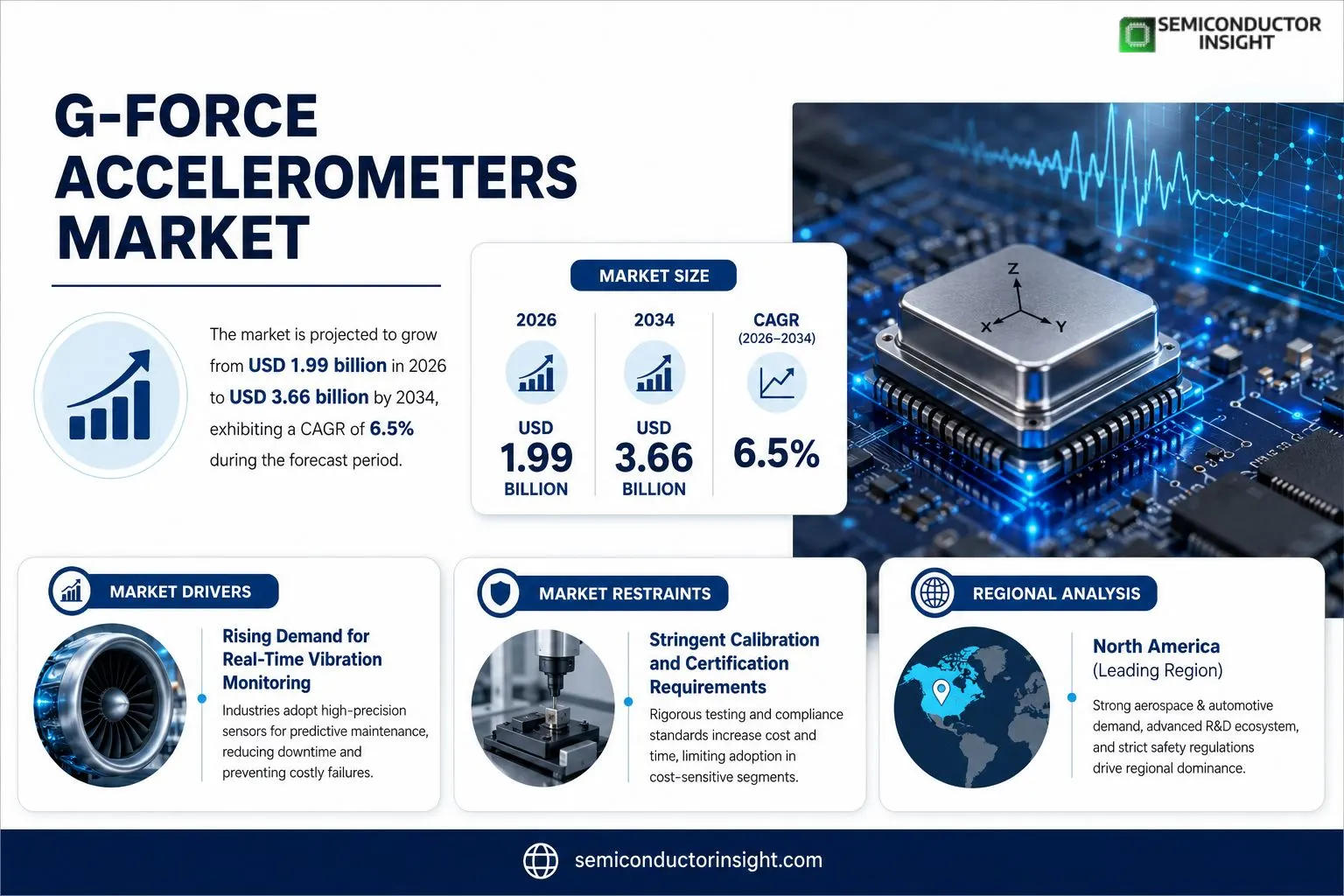
G‑Force Accelerometers market size was valued at USD 1.99 billion in 2026 and is projected to reach USD 3.66 billion by 2034, exhibiting a CAGR of approximately 6.5 % during the forecast period.
G‑Force accelerometers are electromechanical devices that measure acceleration forces across one or multiple axes; they are commonly employed to detect position, velocity, vibration and orientation in automotive safety systems, consumer electronics, aerospace platforms and industrial monitoring.The market is experiencing growth because automotive safety regulations are tightening worldwide while smartphone manufacturers integrate motion sensors for enhanced user experiences; furthermore, advances in MEMS processing reduce unit costs and improve performance, encouraging broader adoption across renewable‑energy turbine monitoring and unmanned aerial vehicle navigation.
MARKET DRIVERS
Rising Demand for Real‑Time Vibration Monitoring
Manufacturers across aerospace, automotive, and heavy‑machinery sectors are investing in sensors that can capture instantaneous G‑force spikes. This shift reflects a broader industry move toward predictive maintenance, where early detection of abnormal vibration reduces downtime and prevents costly equipment failures. The G‑Force Accelerometers Market benefits directly because suppliers that deliver high‑resolution, low‑latency devices gain a competitive edge.
Advancements in Miniaturization and Power Efficiency
CMOS‑based micro‑electromechanical systems (MEMS) have shrunk in size while consuming less power, enabling integration into portable and wearable platforms. These technical gains open new revenue streams in consumer electronics, sports analytics, and health monitoring. Companies that align product roadmaps with these engineering trends can capture market share that was previously unavailable to bulkier, power‑hungry units.
➤ “The convergence of lower power footprints and cloud‑connected analytics is redefining how end‑users extract value from acceleration data.”
A parallel driver is the increasing regulatory scrutiny on safety standards in transportation and industrial environments. Compliance mandates compel OEMs to embed precise acceleration sensors within critical systems, reinforcing demand for certified, high‑accuracy accelerometers.
MARKET CHALLENGES
High Initial Capital Outlay for Precision Sensors
Deploying state‑of‑the‑art accelerometers often requires substantial upfront investment in calibration equipment and specialized integration services. Smaller enterprises, especially those in emerging economies, may find the cost barrier prohibitive, limiting broader market penetration.
Other Challenges
Supply‑Chain Volatility
Fluctuations in semiconductor availability have tightened lead times for MEMS components. Manufacturers that lack diversified sourcing strategies risk delayed shipments, which can erode client confidence and compress profit margins.
MARKET RESTRAINTS
Stringent Calibration and Certification Requirements
Many end‑use sectorsaviation, defense, and automotive safetyrequire accelerometers to meet rigorous certification protocols such as ISO 17025 or MIL‑STD‑810. The extensive testing and documentation process adds time and expense, deterring some potential adopters.
MARKET OPPORTUNITIES
Emergence of Edge‑AI Enabled Sensing Platforms
Integrating lightweight AI inference engines at the sensor edge allows real‑time classification of motion patterns without relying on centralized cloud servers. This capability is particularly attractive for autonomous vehicles and remote industrial sites where bandwidth is limited. Companies that bundle AI‑ready firmware with their G‑Force Accelerometers Market offerings stand to unlock a new tier of premium pricing.
G-Force Accelerometers Market Trends
Increasing Integration of MEMS Sensors in Consumer Electronics
The proliferation of smartphones, wearables, and gaming peripherals has made miniature motion‑detecting components a prerequisite rather than an optional add‑on. MEMS‑based G‑Force accelerometers satisfy that requirement by delivering sub‑g precision while occupying a fraction of the board area of legacy piezoelectric designs. Manufacturers have responded by streamlining wafer‑level processes, which translates into lower unit costs and faster time‑to‑market. For suppliers, the shift creates a pricing pressure corridor that rewards volume‑driven production lines and penalises small‑batch custom parts. Consequently, firms that can lock in high‑volume contracts with original equipment manufacturers (OEMs) are poised to capture incremental margin even as the overall price per sensor declines.
Other Trends
Automotive Safety Systems
Advanced driver‑assistance systems (ADAS) and electronic stability control rely on accurate detection of longitudinal and lateral forces. The transition from discrete sensor modules to integrated MEMS arrays has shortened signal pathways, reducing latency in crash‑avoidance algorithms. In parallel, regulatory bodies in North America and Europe have tightened crash‑test standards, prompting automakers to embed multiple accelerometers across vehicle platforms. This regulatory push, combined with consumer demand for smoother ride quality, encourages tier‑one suppliers to broaden their G‑Force sensor portfolios, often by acquiring niche firms with specialty packaging capabilities.
Emerging Applications in Aerospace and Defense
Aircraft vibration monitoring and missile guidance have traditionally depended on rugged piezoelectric accelerometers. Recent material‑science breakthroughs, however, allow MEMS devices to survive extreme temperature swings and high‑g environments previously reserved for bulkier technologies. Defense contractors are beginning to specify mixed‑technology sensor suites that pair the robustness of piezoelectric units with the low‑power footprint of MEMS components. This hybrid approach enables more autonomous platforms, such as unmanned aerial vehicles, to execute complex maneuvers without over‑taxing onboard power budgets. Suppliers that can demonstrate compliance with mil‑spec certifications while offering scalable production volumes are likely to become preferred partners for next‑generation aerospace programs.
COMPETITIVE LANDSCAPE
Key Industry Players
G‑Force Accelerometers: Competitive Overview 2026‑2031
The G‑Force accelerometer market continues to be anchored by a handful of large, vertically integrated manufacturers. Bosch remains the most prominent supplier, leveraging its extensive automotive and industrial sensor portfolio to capture a sizeable share of the demand. Its ability to co‑develop accelerometer modules with OEMs shortens the product development cycle and creates pricing leverage that smaller rivals struggle to match. Analog Devices complements this landscape through a focus on high‑precision MEMS designs that serve aerospace and defense applications, where performance thresholds are stringent. Both firms benefit from deep R&D pipelines and distribution networks, which translate into consistent revenue streams across North America, Europe, and emerging Asian markets. The dominance of these incumbents shapes the competitive dynamics, forcing newer entrants to pursue differentiated technology or niche verticals to obtain market traction.Beyond the leading tier, a diverse set of specialists contests specific segments of the G‑Force accelerometer space. Murata and TDK excel in compact MEMS solutions tailored for consumer electronics, where volume pricing and miniaturization are decisive. Kionix, now part of ROHM, has carved a reputation for low‑power sensors suited to wearable and IoT devices, allowing it to secure design‑in agreements with several handset manufacturers. PCB Piezotronics, Meggitt Sensing Systems, and Dytran Instruments concentrate on piezoelectric and piezoresistive designs that meet rigorous vibration‑testing requirements in aerospace and industrial testing rigs. Companies such as MCube, KISTLER, and Safran Colibrys focus on high‑g impact sensors for automotive crash‑safety and ballistic testing, operating in a niche where certification and reliability outweigh cost considerations. Regional playersincluding RION in Japan and Miramems in Taiwanare expanding their MEMS capabilities, suggesting that geographic diversification may introduce additional competitive pressure in the next few years.
List of Key G-Force Accelerometers Companies Profiled
- Bosch
- NXP Semiconductors
- STMicroelectronics
- Murata Manufacturing
- PCB Piezotronics
- Analog Devices
- TDK
- Kionix (ROHM)
- Honeywell International
- TE Connectivity
- MCube
- KISTLER
- Meggitt Sensing Systems
- Safran Colibrys
- Dytran Instruments
- Bruel & Kjaer (Spectris)
Segment Analysis:
| Segment Category | Sub-Segments | Key Insights |
| By Type |
|
MEMS Accelerometers
|
| By Application |
|
Automobile
|
| By End User |
|
OEMs
|
| By Technology |
|
Wireless‑enabled
|
| By Market Trend |
|
Miniaturization
|
Regional Analysis: G-Force Accelerometers Market
North America
Defense contractors incorporate multi‑axis G‑Force accelerometers to verify missile trajectory and aircraft structural integrity, driving a niche yet high‑margin segment. The need for sensors that survive high‑g shocks pushes suppliers toward ruggedized designs, creating a cascade of specialty tooling and testing services.
Crash‑simulation labs rely on precise acceleration measurements to calibrate airbag deployment algorithms. As autonomous vehicle prototypes advance, the granularity of data required from accelerometers increases, prompting OEMs to source devices with higher bandwidth and lower latency.
Smartphone and wearable manufacturers must demonstrate compliance with drop‑test standards. G‑Force accelerometers integrated into test rigs supply the data needed for certification bodies, turning a compliance function into a steady source of sensor orders.
Proximity to leading research universities fuels collaborative projects on MEMS miniaturization. Start‑ups emerging from these hubs often secure venture capital, accelerating product cycles and introducing differentiated sensor architectures to the market.
Europe
European manufacturers benefit from a coordinated emphasis on industrial automation, where G‑Force accelerometers monitor robotic arm dynamics and railway system vibrations. Stringent EU safety directives amplify the requirement for validated measurement data, reinforcing procurement budgets for high‑performance sensors. Moreover, cross‑border research consortia enhance material science breakthroughs, enabling lighter yet more resilient sensor packages that appeal to automotive OEMs seeking to reduce vehicle weight without compromising safety standards.
Asia‑Pacific
The Asia‑Pacific arena sees rapid adoption of G‑Force accelerometers in emerging smart‑city initiatives, particularly for structural health monitoring of bridges and high‑rise constructions. Local governments incentivize sensor deployment to pre‑emptively detect seismic activity, creating a sizable public‑sector market. Simultaneously, consumer electronics firms in China and South Korea demand cost‑effective components, encouraging manufacturers to balance price with performance through advanced wafer‑level packaging techniques.
South America
In South America, the growth of mining operations drives demand for rugged accelerometers capable of withstanding harsh underground conditions. Companies undertaking infrastructure upgrades in Brazil and Chile require accurate vibration data to extend equipment lifespans, leading to incremental sales of durable sensor modules. Although overall market size remains modest, the region’s focus on resource extraction ensures a steady niche for specialized accelerometer solutions.
Middle East & Africa
The Middle East & Africa region is witnessing heightened investment in aerospace testing facilities, especially in United Arab Emirates, where private space endeavors necessitate precise G‑Force measurement. Parallelly, oil‑field service providers adopt accelerometers to monitor drilling‑head dynamics, reducing downtime through predictive maintenance. While distribution channels are still consolidating, the emerging demand profile signals a transition from ad‑hoc purchases to longer‑term supply contracts.
Report Scope
This market research report provides a comprehensive analysis of the G-Force Accelerometers Market , covering the forecast period 2026–2034. It offers detailed insights into market dynamics, technological advancements, competitive landscape, and key trends shaping the industry.
Key focus areas of the report include:
- Market Overview: The report begins with an overview outlining its current market scenario, key growth indicators, and industry transformation drivers. It discusses macroeconomic factors, demand–supply balance, regulatory landscape, and the strategic role of semiconductors in powering advancements across industries such as automotive, telecommunications, consumer electronics, and industrial automation.
- Market Size & Forecast: Historical data and future projections for revenue, unit shipments, and market value across major regions and segments.
- Segmentation Analysis: Detailed breakdown by product type, technology, application, and end-user industry to identify high-growth segments and investment opportunities.
- Regional Insights: Insights into market performance across North America, Europe, Asia-Pacific, Latin America, and the Middle East & Africa, including country-level analysis where relevant.
- Competitive Landscape: Profiles of leading market participants, including their product offerings, R&D focus, manufacturing capacity, pricing strategies, and recent developments such as mergers, acquisitions, and partnerships.
- Technology Trends & Innovation: Assessment of emerging technologies, integration of AI/IoT, semiconductor design trends, fabrication techniques, and evolving industry standards.
- Market Drivers & Restraints: Evaluation of factors driving market growth along with challenges, supply chain constraints, regulatory issues, and market-entry barriers.
- Stakeholder Insights: Insights for component suppliers, OEMs, system integrators, investors, and policymakers regarding the evolving ecosystem and strategic opportunities.
Primary and secondary research methods are employed, including interviews with industry experts, data from verified sources, and real-time market intelligence to ensure the accuracy and reliability of the insights presented.
FREQUENTLY ASKED QUESTIONS:
What is the current market size of G-Force Accelerometers Market?
-> G‑Force Accelerometers market size was valued at USD 1.99 billion in 2026 and is projected to reach USD 3.66 billion by 2034, exhibiting a CAGR of approximately 6.5 % during the forecast period
Which key companies operate in G-Force Accelerometers Market?
-> Key players include Bosch, NXP Semiconductors, STMicroelectronics, Murata, PCB Piezotronics, Analog Devices Inc., TDK, Kionix (ROHM), Honeywell International Inc., TE, among others.
What are the key growth drivers?
-> Key growth drivers include rising demand in automotive safety systems, expanding consumer electronics applications, increased adoption in aerospace and defense, and continuous advancements in MEMS technology.
Which region dominates the market?
-> Asia leads the market, driven primarily by strong growth in China, while North America and Europe remain significant contributors.
What are the emerging trends?
-> Emerging trends include integration of G‑Force accelerometers with IoT platforms, development of ultra‑low‑power MEMS devices, and the rise of AI‑enabled sensor analytics.
Which key companies operate in G-Force Accelerometers Market?
-> Key players include Bosch, NXP Semiconductors, STMicroelectronics, Murata, PCB Piezotronics, Analog Devices Inc., TDK, Kionix (ROHM), Honeywell International Inc., TE, among others.
What are the key growth drivers?
-> Key growth drivers include rising demand in automotive safety systems, expanding consumer electronics applications, increased adoption in aerospace and defense, and continuous advancements in MEMS technology.
Which region dominates the market?
-> Asia leads the market, driven primarily by strong growth in China, while North America and Europe remain significant contributors.
What are the emerging trends?
-> Emerging trends include integration of G‑Force accelerometers with IoT platforms, development of ultra‑low‑power MEMS devices, and the rise of AI‑enabled sensor analytics.
Get Sample Report PDF for Exclusive Insights
Report Sample Includes
- Table of Contents
- List of Tables & Figures
- Charts, Research Methodology, and more...
 Download Sample Report PDF