Evaluation Modules Market Insights
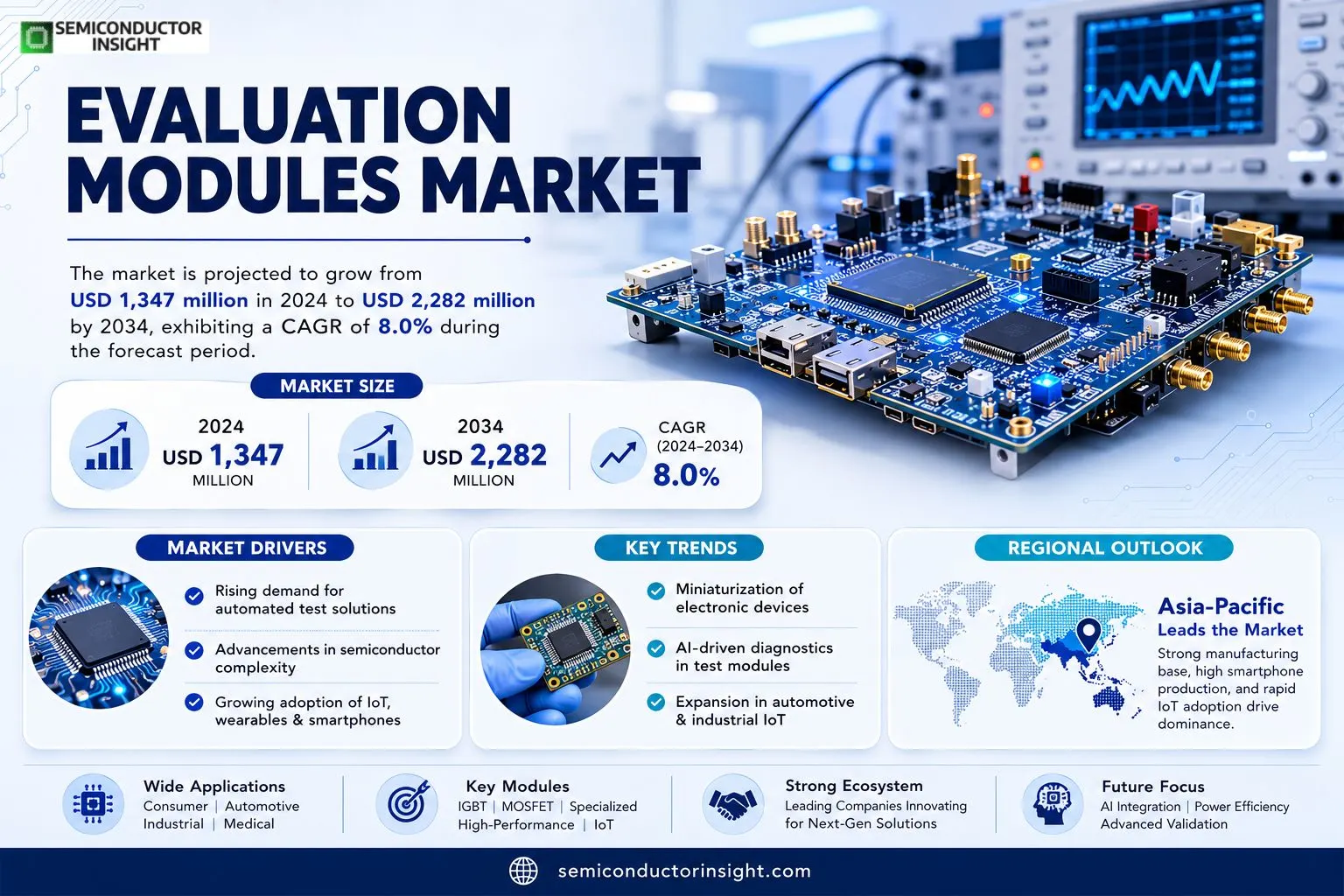
Evaluation Modules market size was valued at USD 1 347 million in 2024. The market will expand from USD 1 347 million in 2024 to USD 2 282 million by 2034, reflecting a CAGR of 8.0%.
An evaluation module is a printed circuit board that incorporates a microprocessor and minimal support logic. These modules are employed for testing and measuring devices such as sensors, transceivers, memory interfaces, and displays.The growth stems from rising demand for smartphones, the push toward mini‑aturisation of electronic devices, and expanding adoption of IoT‑enabled wearables. Smartphones depend on components such as microcontrollers, MOSFETs and IGBTs that require dedicated power‑supply features, creating opportunities for evaluation‑board suppliers. Additional sectorsincluding medical equipment, telecommunications infrastructure and transportation electronicsalso boost demand, particularly for IGBT evaluation modules used in mobile phones, laptops and cameras.
MARKET DRIVERS
Increasing demand for automated test solutions
Evaluation Modules Market has seen a noticeable uptick as manufacturers seek to reduce time‑to‑market for high‑performance chips. In 2023, shipments of evaluation modules topped 1.2 million units, reflecting an 8 % year‑over‑year increase. This surge is linked to the need for rapid validation cycles that keep pace with shorter product lifespans.
Advancements in semiconductor complexity
As process nodes shrink below 5 nm, the electrical characteristics of silicon become harder to predict. Evaluation modules now incorporate higher‑resolution measurement capabilities, enabling designers to capture subtle parametric shifts. The ability to pinpoint these variations early in development is translating into lower scrap rates and higher yield percentages across fabs.
➤ “The shift toward heterogeneous integration has made evaluation modules indispensable for verifying multi‑chip stacks,” notes a senior engineer at a leading fab.
Consequently, OEMs are allocating larger portions of R&D budgets toward modular test platforms, a move that reinforces the upward trajectory of Evaluation Modules Market.
MARKET CHALLENGES
Cost pressures on original equipment manufacturers
The price premium associated with advanced evaluation modulesoften 15–20 % higher than legacy unitshas strained the cash flows of mid‑sized OEMs. While the performance benefits are clear, firms must balance upfront expenditures against the long‑term savings from reduced field failures.
Other Challenges
Supply chain bottlenecks
Component shortages, especially for high‑frequency connectors and precision clocks, have introduced lead times of up to twelve weeks. These delays can stall validation schedules, prompting manufacturers to reconsider inventory strategies and vendor diversification.
MARKET RESTRAINTS
Regulatory compliance hurdles
Stringent electromagnetic compatibility (EMC) and safety standards across aerospace and automotive sectors impose additional design constraints on evaluation modules. Meeting these regulations often requires bespoke certification processes, which add time and expense, thereby tempering market enthusiasm in highly regulated sub‑segments.
MARKET OPPORTUNITIES
Emergence of AI‑driven diagnostics
Integrating machine‑learning algorithms into evaluation platforms enables predictive analysis of silicon behavior under extreme conditions. Early adopters report a 30 % reduction in debugging cycles, suggesting that AI‑enhanced modules could unlock new revenue streams and differentiate suppliers in a crowded marketplace.
Evaluation Modules Market Trends
Smartphone‑Driven Miniaturization
The surge in high‑end smartphones has reshaped component engineering, pushing manufacturers to shrink board footprints while maintaining performance thresholds. Evaluation Modules enable rapid prototyping of power‑stage circuitssuch as micro‑controller‑driven regulators, MOSFETs, and IGBTsallowing designers to verify thermal limits and efficiency before full‑scale production. As OEMs compress development cycles, the need for plug‑and‑play test platforms climbs, prompting vendors to expand modular families that address diverse voltage domains and form‑factor constraints. Consequently, suppliers that can deliver compact, high‑precision modules capture a larger share of design spend, while firms lagging in miniaturization risk losing contracts to more agile competitors.
Other Trends
IoT & Wearable Expansion
Wearable health monitors and edge‑connected sensors rely on tightly integrated analog‑front ends, a niche where Evaluation Modules serve as essential validation tools. The proliferation of Bluetooth‑Low‑Energy and sub‑GHz transceivers forces engineers to test RF front‑ends under varying power‑budget scenarios, an activity streamlined by dedicated evaluation kits. Moreover, the shift toward on‑device AI inference amplifies the demand for memory‑interface modules that can emulate high‑throughput data paths. Companies that bundle software stacks with hardware kits facilitate faster firmware iteration, thereby strengthening their position in the IoT segment of Evaluation Modules Market.
Industrial Automation Adoption
Factories embracing predictive maintenance and digital twins increasingly embed sophisticated motor‑drive controllers and power‑electronics into production lines. Evaluation Modules that simulate IGBT and SiC‑based converters enable system integrators to assess reliability under harsh temperature swings and load transients before field deployment. In parallel, automotive suppliers leverage these modules to qualify components for electric‑vehicle powertrains, where safety certifications demand exhaustive testing under fault conditions. The convergence of industrial IoT and electrified mobility therefore fuels a parallel demand stream for robust, high‑voltage evaluation platforms. Vendors that align their product roadmaps with emerging standardssuch as IEC 61800 for drive systemsare better positioned to secure long‑term contracts, while those that overlook regulatory alignment may encounter barriers to market entry.
COMPETITIVE LANDSCAPE
Key Industry Players
Evaluation Modules Market Competitive Outlook
Texas Instruments dominates the evaluation module segment, leveraging its deep portfolio of microcontroller‑centric boards and an extensive distribution network. The company’s ability to bundle reference designs with software tools creates a low‑entry barrier for OEMs developing IoT, automotive and consumer‑grade prototypes. This breadth of offering translates into a sizeable share of both revenue and unit shipments, compelling smaller vendors to specialize or pursue niche standards where TI’s scale is less pronounced.Beyond the market leader, a constellation of manufacturers occupies distinct footholds. NXP Semiconductors and STMicroelectronics focus on automotive‑grade modules, particularly those supporting IGBT and MOSFET power stages. Analog Devices and Infineon Technologies excel in precision sensor evaluation kits, capitalising on their analog‑heavy product lines. Renesas Electronics and Maxim Integrated target the wearable and medical device space with ultra‑low‑power boards. ON Semiconductor and Broadcom supply high‑frequency transceiver modules for telecommunications gear, while Fujitsu and Cypress Semiconductor cater to legacy industrial controllers. Microchip rounds out the ecosystem with a broad “plug‑and‑play” catalog aimed at rapid prototyping in the education sector. The diversity of these players reflects a market that rewards technical depth and application‑specific expertise more than sheer volume.
List of Key Evaluation Modules Companies Profiled
- Texas Instruments
- NXP Semiconductors
- Analog Devices
- Infineon Technologies
- Renesas Electronics
Segment Analysis:
| Segment Category | Sub-Segments | Key Insights |
| By Type |
|
IGBT Evaluation Modules are the most sought‑after because they enable precise power‑device testing required for high‑performance consumer gadgets and automotive powertrains.
|
| By Application |
|
Consumer Electronics drives the bulk of evaluation‑module adoption due to the relentless push for smarter, smaller devices.
|
| By End User |
|
Device Manufacturers dominate end‑user demand, seeking evaluation platforms that streamline component qualification.
|
| By Technology |
|
Low‑Power IoT Modules have emerged as a preferred technology tier because they address battery‑life constraints in wearable and edge devices.
|
| By Market Trend |
|
Miniaturization Demand is reshaping the evaluation‑module landscape as engineers seek smaller form‑factors without sacrificing test capability.
|
Regional Analysis: Evaluation Modules Market
North America
Federal agencies encourage open‑source test frameworks, allowing firms to certify modules against evolving safety standards without costly redesigns. Recent guidance on electromagnetic compatibility has nudged vendors toward broader frequency coverage, expanding the functional envelope of evaluation kits.
Designers increasingly embed machine‑learning inference engines within test modules, enabling on‑the‑fly anomaly detection. This shift reduces manual debugging time and aligns with the broader industry push toward autonomous verification pipelines.
The dominant buyers are large fabless entities developing high‑frequency processors, but a growing contingent of automotive‑electronics SMEs seeks compact, low‑cost modules for power‑train validation, diversifying the demand profile.
Market leaders reinforce their positions through strategic acquisitions of niche software firms, while emerging players differentiate by offering cloud‑native analytics that appeal to design teams distributed across multiple campuses.
Europe
European firms benefit from a strong tradition of precision instrumentation, which translates into high expectations for measurement accuracy in evaluation modules. The region’s emphasis on sustainability drives demand for energy‑efficient test platforms that can operate within strict power budgets. Collaborative research initiatives funded by the EU foster cross‑border development of modular test architectures, especially for 5G and edge‑computing applications. While budgets are scrupulously managed, the willingness to invest in long‑term tooling ensures a steady pipeline of sophisticated module deployments across automotive and aerospace sectors.
Asia-Pacific
Asia-Pacific showcases rapid expansion of design houses targeting emerging markets, creating a fertile environment for cost‑effective evaluation modules. Nations such as China, South Korea, and Taiwan prioritize high‑volume production, prompting vendors to supply scalable solutions that balance performance with price competitiveness. Local standards bodies are aligning closely with specifications, easing integration challenges for multinational customers. The region’s burgeoning AI chip segment is particularly influential, as designers require modules capable of handling extensive data throughput and complex signal integrity testing.
South America
Growth in South America is anchored by increasing investments in telecommunications infrastructure and renewable‑energy hardware. Companies are adopting flexible evaluation modules that can be quickly repurposed for diverse project timelines, from satellite‑communication prototypes to smart‑grid controllers. Limited domestic manufacturing capacity means many purchasers rely on imported solutions, yet local distributors are adding value through custom integration services, which helps accelerate adoption despite logistical constraints.
Middle East & Africa
The Middle East & Africa region displays a niche yet evolving demand for evaluation modules, largely driven by defense and petrochemical sectors that require rigorous reliability testing. Emerging technology parks in the United Arab Emirates and South Africa are fostering partnerships between module suppliers and regional system integrators. Although overall market size remains modest, the focus on high‑security applications encourages the development of robust, tamper‑resistant test platforms, positioning the region as a specialized user base within the broader Evaluation Modules Market.
Report Scope
This market research report provides a comprehensive analysis of the Evaluation Modules Market , covering the forecast period 2026–2034. It offers detailed insights into market dynamics, technological advancements, competitive landscape, and key trends shaping the industry.
Key focus areas of the report include:
- Market Overview: The report begins with an overview outlining its current market scenario, key growth indicators, and industry transformation drivers. It discusses macroeconomic factors, demand–supply balance, regulatory landscape, and the strategic role of semiconductors in powering advancements across industries such as automotive, telecommunications, consumer electronics, and industrial automation.
- Market Size & Forecast: Historical data and future projections for revenue, unit shipments, and market value across major regions and segments.
- Segmentation Analysis: Detailed breakdown by product type, technology, application, and end-user industry to identify high-growth segments and investment opportunities.
- Regional Insights: Insights into market performance across North America, Europe, Asia-Pacific, Latin America, and the Middle East & Africa, including country-level analysis where relevant.
- Competitive Landscape: Profiles of leading market participants, including their product offerings, R&D focus, manufacturing capacity, pricing strategies, and recent developments such as mergers, acquisitions, and partnerships.
- Technology Trends & Innovation: Assessment of emerging technologies, integration of AI/IoT, semiconductor design trends, fabrication techniques, and evolving industry standards.
- Market Drivers & Restraints: Evaluation of factors driving market growth along with challenges, supply chain constraints, regulatory issues, and market-entry barriers.
- Stakeholder Insights: Insights for component suppliers, OEMs, system integrators, investors, and policymakers regarding the evolving ecosystem and strategic opportunities.
Primary and secondary research methods are employed, including interviews with industry experts, data from verified sources, and real-time market intelligence to ensure the accuracy and reliability of the insights presented.
FREQUENTLY ASKED QUESTIONS:
What is the current market size of Evaluation Modules Market?
-> Evaluation Modules Market was valued at USD 1,347 million in 2024 and is expected to reach USD 2,282 million by 2034, growing at a CAGR of 8.0%.
Which key companies operate in Evaluation Modules Market?
-> Key players include Texas Instruments, NXP Semiconductors, STMicroelectronics, Analog Devices, Infineon Technologies, Renesas Electronics Corporation, Maxim Integrated, ON Semiconductor, Broadcom, Fujitsu, Cypress Semiconductor, Microchip, and Freescale.
What are the key growth drivers?
-> Key growth drivers include rising demand for smartphones, miniaturization of electronic devices, growing adoption of IoT and wearable devices, and increasing need for IGBT and MOSFET evaluation boards across consumer electronics, automotive, medical and telecommunications sectors.
Which region dominates the market?
-> Asia-Pacific dominates the market, driven by robust smartphone and IoT production, while North America and Europe also exhibit significant demand.
What are the emerging trends?
-> Emerging trends include development of advanced IGBT evaluation modules for power electronics, integration of AI-driven testing capabilities, and expansion into automotive and industrial IoT applications.

Get Sample Report PDF for Exclusive Insights
Report Sample Includes
- Table of Contents
- List of Tables & Figures
- Charts, Research Methodology, and more...
 Download Sample Report PDF