Single-Mode Semiconductor Disk Lasers Market Insights
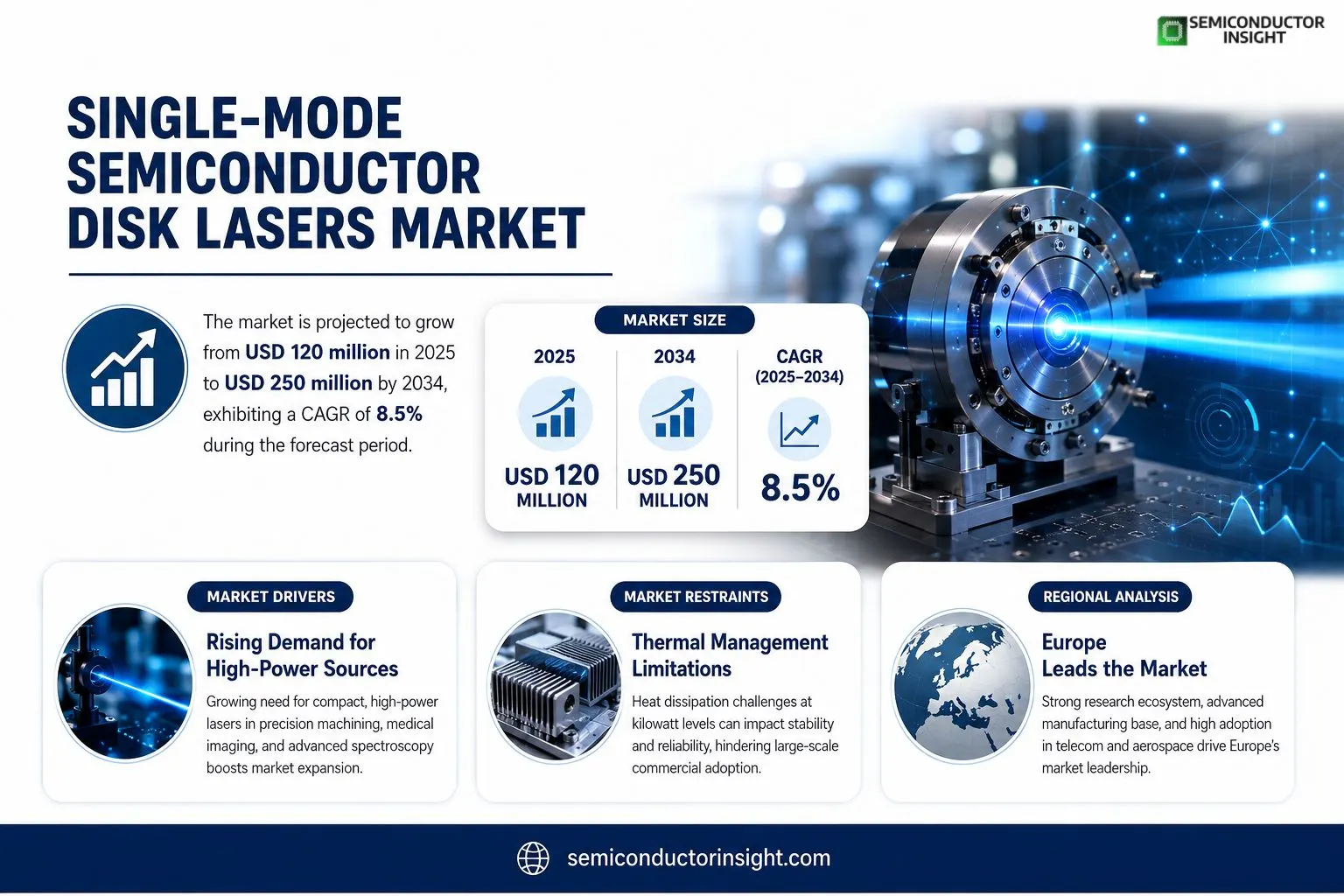
Single-Mode Semiconductor Disk Lasers market size was valued at USD 120 million in 2025. The market reached USD 250 million by 2034, reflecting an implied CAGR of approximately 8.5% over the nine‑year horizon.
Single‑Mode Semiconductor Disk Lasers merge semiconductor gain media with thin‑disk geometry, delivering high beam quality in the near‑infrared spectrum (≈970–1480 nm). Their compact footprint makes them attractive for laser cooling, precision spectroscopy, and emerging telecom links where narrow linewidths are essential.The sector gains momentum as demand for high‑precision metrology grows and telecom operators explore longer‑reach wavelengths. Recent activity includes II‑VI’s launch of a 980 nm high‑power module in March 2024 and Lumentum’s partnership with a leading photonics research institute to advance medical imaging applications. Key manufacturers such as Furukawa Electric, Thorlabs, and InnoLas continue expanding product portfolios while investing in next‑generation packaging technologies.
MARKET DRIVERS
Rising Demand for High‑Power Compact Sources
Single-Mode Semiconductor Disk Lasers Market is being pulled forward by manufacturers seeking watt‑level output in a footprint that fits next‑generation instruments. End‑users in precision machining and biomedical imaging prize the combination of narrow linewidth and low divergence, which cuts downstream optical complexity and reduces system cost. This shift explains why design teams are allocating larger portions of R&D budgets to disk‑laser modules rather than traditional fiber lasers.
Advancements in Thin‑Disk Technology
Recent breakthroughs in epitaxial growth and heat‑spreader bonding have lifted the power ceiling of single‑mode disks without sacrificing beam quality. Engineers now report stable operation at >2 kW while preserving a M² < 1.1, a performance metric that directly translates into higher productivity for customers. Companies that master this manufacturing step gain a defensible edge, prompting a wave of strategic partnerships across the supply chain.
➤ The integration of low‑noise designs is reshaping system architectures.
Consequently, system integrators are redesigning platforms to exploit the intrinsic stability of these lasers, positioning Single-Mode Semiconductor Disk Lasers Market as a catalyst for next‑level automation in aerospace testing and semiconductor lithography.
MARKET CHALLENGES
Manufacturing Complexity and Yield Management
Producing single‑mode disks demands sub‑micron uniformity across wafers, a prerequisite that pushes wafer‑scale defect rates into double‑digit percentages. The resulting yield pressure inflates unit costs, making price‑sensitive segments such as academic research slower to adopt the technology.
Other Challenges
Cost Sensitivity
The premium placed on ultra‑low divergence and narrow spectral width translates into a higher bill of materials. Buyers in emerging markets often trade off performance for affordability, limiting the addressable volume for high‑end offerings.
MARKET RESTRAINTS
Thermal Management Limitations
Even though thin‑disk geometry excels at spreading heat, the absolute thermal load at kilowatt levels strains conventional mount designs. Inadequate cooling can induce mode hopping, eroding the reliability that end‑users demand for long‑duration processes.Supply‑chain bottlenecks for high‑purity semiconductor substrates further narrow the production window, adding another layer of hesitation for firms evaluating large‑scale rollout.
MARKET OPPORTUNITIES
Emerging Applications in Quantum Computing
The strict phase‑noise requirements of quantum‑bit control systems align closely with the spectral purity of single‑mode disk lasers. Early adopters are piloting these sources for trapped‑ion and photonic qubit platforms, signaling a niche yet high‑value revenue stream for Single-Mode Semiconductor Disk Lasers Market.Geographic expansion, particularly in the Asia‑Pacific region, is another growth vector. Local governments are funding photonics clusters, and the resulting demand for compact, high‑power lasers creates a favorable launchpad for new entrants and established players alike.
Single-Mode Semiconductor Disk Lasers Market Trends
Increasing Adoption in Near‑Infrared Spectroscopy
Single-Mode Semiconductor Disk Lasers Market is seeing a noticeable shift toward high‑precision near‑infrared applications, especially in laboratory spectroscopy and laser cooling. Manufacturers are leveraging the intrinsic beam quality of disk geometries to deliver narrow linewidths that simplify calibration in analytical instruments. This technical advantage reduces system‑level complexity, allowing end‑users to replace bulkier solid‑state sources with more compact semiconductor modules. Consequently, equipment suppliers are redesigning product lines to integrate these lasers directly into portable analyzers, which opens new revenue streams for firms that can certify long‑term reliability under varied temperature cycles.
Other Trends
Expansion into Telecommunications Infrastructure
Although historically associated with scientific research, Single-Mode Semiconductor Disk Lasers Market is gaining traction in fiber‑optic communication networks that demand stable emission around 980 nm and 1480 nm. Telecom operators are attracted by the combination of high wall‑plug efficiency and reduced thermal load, which translates into lower operating expenditures for undersea repeaters and data‑center interconnects. Vendors that align their product roadmaps with emerging 400 G and beyond standards stand to capture a share of the infrastructure upgrade cycle, provided they address packaging challenges that arise from tighter bend radii in modern cabling.
Regional Diversification of Supply Chains
Geopolitical pressures are prompting OEMs to rethink the geographic distribution of their manufacturing footprint. In North America, collaborations between university research hubs and mid‑size laser firms are fostering a niche ecosystem focused on custom wavelengths for medical diagnostics. Europe, meanwhile, is channeling public‑funded programs into hybrid integration platforms that pair disk lasers with silicon photonics, aiming to shorten time‑to‑market for defense‑grade lidar systems. Asian players, particularly in Japan and South Korea, continue to exploit mature wafer‑fabrication capacity to drive down unit costs, making high‑volume applications such as metal processing more economically viable. This multi‑regional approach mitigates single‑source risk while allowing each market segment to benefit from locally optimized design expertise.
COMPETITIVE LANDSCAPEKey Industry Players
Competitive Dynamics in Single-Mode Semiconductor Disk Lasers Market
II‑VI (operating under the Coherent brand) anchors the market with a portfolio that spans high‑power thin‑disk modules, wavelength‑stable near‑infrared sources, and custom solutions for spectroscopy and laser cooling. Its extensive R&D network and vertically integrated supply chain allow rapid iteration of grating‑based output couplers, a capability that smaller rivals struggle to match. The company’s dominant share is reinforced by long‑term contracts with telecom equipment manufacturers and research institutions, creating a de‑facto tiered structure where a handful of OEMs dictate pricing and technical standards while a cohort of specialized firms occupy niche segments.Beyond the front‑runner, a constellation of focused players adds depth to the ecosystem. Furukawa Electric leverages its legacy in fiber‑optic components to deliver compact 976 nm disks for laboratory diagnostics. Polytec GmbH has carved out a reputation for ultra‑low noise designs that appeal to precision metrology labs. Lumentum, with its strong foothold in telecom, recently introduced a 980 nm line optimized for DWDM amplification. 3SP Technologies and DoGain Laser Technology concentrate on high‑efficiency pump architectures that reduce thermal load, while Lumics and Oxxius target the medical imaging niche with biocompatible housing. Thorlabs supplies turnkey kits that enable quick prototyping, InnoLas pursues integrated diode‑laser‑disk hybrids, Vexlum focuses on ruggedized industrial modules, and NKT Photonics supplies high‑power thin‑disk lasers for metal processing. Collectively, these firms sustain a vibrant competitive landscape where differentiation hinges on wavelength agility, thermal management, and application‑specific integration.
List of Key Single-Mode Semiconductor Disk Lasers Companies Profiled
- II‑VI (Coherent)
- Furukawa Electric
- Polytec GmbH
- Lumentum
- 3SP Technologies
- DoGain Laser Technology
- Lumics
- Oxxius
- Thorlabs
- InnoLas
- Vexlum
- NKT Photonics
Segment Analysis:
| Segment Category | Sub-Segments | Key Insights |
| By Type |
|
Near‑Infrared Wavelengths dominate design focus because they align with key photonic applications. ‑ Researchers prioritize stability and low noise for spectroscopy. ‑ Manufacturers emphasize integration ease with fiber‑optic platforms. ‑ Product road‑maps highlight modular upgrades across the 976‑980 nm band. |
| By Application |
|
Laser‑Assisted Manufacturing benefits from high beam quality and thermal management. ‑ Precision cutting in metal processing leverages the low divergence of disk lasers. ‑ In medical diagnostics, the stable narrow linewidth supports non‑invasive spectroscopy. ‑ Communication research explores bandwidth‑critical links using near‑IR emission. |
| By End User |
|
Industrial Users value the compact form factor and scalability of disk lasers. ‑ They integrate these sources into automated production lines for real‑time quality control. ‑ Telecommunications entities experiment with the technology for next‑generation fiber links, emphasizing reliability and low maintenance. |
| By Wavelength |
|
Near‑Infrared Dominance persists because it matches silicon photonics standards. ‑ Mid‑IR segments attract niche sensing markets focused on molecular fingerprinting. ‑ Visible offerings remain experimental, driven by emerging quantum‑optics research. |
| By Performance |
|
Low‑Noise Preference stems from the demand for precise spectroscopy and metrology. ‑ High‑power variants are pursued for material processing where throughput matters. ‑ Tunable designs attract research groups needing adaptable spectral coverage. |
Regional Analysis: Single-Mode Semiconductor Disk Lasers Market
Europe
The continent hosts a network of specialized fabs that integrate epitaxial growth with high‑precision dicing. Close ties between equipment suppliers and end‑users enable rapid iteration of cavity designs, while lean production lines keep lead times competitive. This manufacturing depth supports both volume and low‑volume, high‑specification orders.
Telecom back‑haul, precision metrology, and aerospace navigation dominate demand. Operators value the lasers’ spectral purity for coherent transmission, whereas research labs prize stability for frequency combs. The aerospace sector leverages the technology for lidar and free‑space optical links, creating a diversified customer base.
A tightly knit supply chain links silicon‑photonic component producers with optical‑coating specialists. Standardized testing protocols, driven by European standards bodies, reduce variability and foster trust among OEMs. Cross‑border logistics benefit from the EU’s integrated transport infrastructure, streamlining delivery to downstream integrators.
Certification pathways, such as the CE marking for laser safety, are clearly defined, allowing manufacturers to plan product launches with confidence. Environmental directives encourage the adoption of low‑power, high‑efficiency designs, nudging the market toward greener solutions without sacrificing performance.
North America
North America’s position in the Single‑Mode Semiconductor Disk Lasers market is shaped by a blend of venture‑backed startups and established defense contractors. The appetite for ultra‑low‑noise lasers in quantum computing research propels local demand, while large‑scale telecom operators invest in network upgrades that require high‑coherence sources. Collaborative hubs along the West Coast combine semiconductor process expertise with optical system integration, creating a pipeline that swiftly moves innovations from lab to field deployment. Regulatory bodies provide a flexible framework that accommodates rapid product iteration, further encouraging entrepreneurial activity in the sector.
Asia‑Pacific
In Asia‑Pacific, the market narrative revolves around aggressive capacity expansion and a burgeoning demand for advanced manufacturing equipment. Nations such as Japan and South Korea leverage long‑standing photonics expertise to attract component makers, while China’s strategic emphasis on high‑tech self‑sufficiency fuels local R&D investments. End‑users in the region include high‑speed data‑center operators and emerging satellite communications firms, both of which require compact, reliable laser sources. The diverse regulatory environment, though varied across countries, increasingly aligns with international safety standards, easing cross‑border technology transfer.
South America
South America remains a niche yet growing participant in the Single‑Mode Semiconductor Disk Lasers arena. Academic collaborations in Brazil and Argentina focus on adapting the technology for scientific instrumentation, particularly in spectroscopy and environmental monitoring. Although domestic manufacturing is limited, the region imports most high‑performance modules, creating a market that hinges on price‑performance trade‑offs. Emerging broadband initiatives in urban centers generate modest demand for fiber‑optic upgrades, offering a foothold for specialized laser suppliers willing to tailor solutions to local network constraints.
Middle East & Africa
The Middle East & Africa exhibit a fragmented market landscape, with interest concentrated around defense and space‑related projects. United Arab Emirates and Saudi Arabia invest heavily in satellite communication constellations, driving a need for compact, high‑stability laser emitters. Meanwhile, research institutions in South Africa explore applications in precision sensing and biomedical imaging. Import reliance is high, yet government‑led procurement programs aim to build regional assembly capabilities, hinting at a gradual shift toward localized value‑addition in the coming years.
Report Scope
This market research report provides a comprehensive analysis of the Single-Mode Semiconductor Disk Lasers Market , covering the forecast period 2026–2034. It offers detailed insights into market dynamics, technological advancements, competitive landscape, and key trends shaping the industry.
Key focus areas of the report include:
- Market Overview: The report begins with an overview outlining its current market scenario, key growth indicators, and industry transformation drivers. It discusses macroeconomic factors, demand–supply balance, regulatory landscape, and the strategic role of semiconductors in powering advancements across industries such as automotive, telecommunications, consumer electronics, and industrial automation.
- Market Size & Forecast: Historical data and future projections for revenue, unit shipments, and market value across major regions and segments.
- Segmentation Analysis: Detailed breakdown by product type, technology, application, and end-user industry to identify high-growth segments and investment opportunities.
- Regional Insights: Insights into market performance across North America, Europe, Asia-Pacific, Latin America, and the Middle East & Africa, including country-level analysis where relevant.
- Competitive Landscape: Profiles of leading market participants, including their product offerings, R&D focus, manufacturing capacity, pricing strategies, and recent developments such as mergers, acquisitions, and partnerships.
- Technology Trends & Innovation: Assessment of emerging technologies, integration of AI/IoT, semiconductor design trends, fabrication techniques, and evolving industry standards.
- Market Drivers & Restraints: Evaluation of factors driving market growth along with challenges, supply chain constraints, regulatory issues, and market-entry barriers.
- Stakeholder Insights: Insights for component suppliers, OEMs, system integrators, investors, and policymakers regarding the evolving ecosystem and strategic opportunities.
Primary and secondary research methods are employed, including interviews with industry experts, data from verified sources, and real-time market intelligence to ensure the accuracy and reliability of the insights presented.
FREQUENTLY ASKED QUESTIONS:
What is the current market size of Single-Mode Semiconductor Disk Lasers Market?
-> Single-Mode Semiconductor Disk Lasers Market was valued at USD 120 million in 2025. The market reached USD 250 million by 2034, reflecting an implied CAGR of approximately 8.5% over the nine‑year horizon
Which key companies operate in Single-Mode Semiconductor Disk Lasers Market?
-> Key players include II-VI, Furukawa Electric, Polytec GmbH, Lumentum, 3SP Technologies, DoGain Laser Technology, Lumics, Oxxius, Thorlabs, InnoLas, and Vexlum, among others.
What are the key growth drivers?
-> Key growth drivers include increasing demand for near‑infrared laser cooling, expanding spectroscopy applications, and broader adoption in telecommunications.
Which region dominates the market?
-> Asia is the fastest‑growing region, while Europe remains a significant market due to established industrial and research activities.
What are the emerging trends?
-> Emerging trends include integration of semiconductor disk lasers with IoT platforms, development of compact thin‑disk architectures, and exploration of new wavelength bands for advanced sensing.
Get Sample Report PDF for Exclusive Insights
Report Sample Includes
- Table of Contents
- List of Tables & Figures
- Charts, Research Methodology, and more...
 Download Sample Report PDF