Chip Ferrite Cores Market Insights
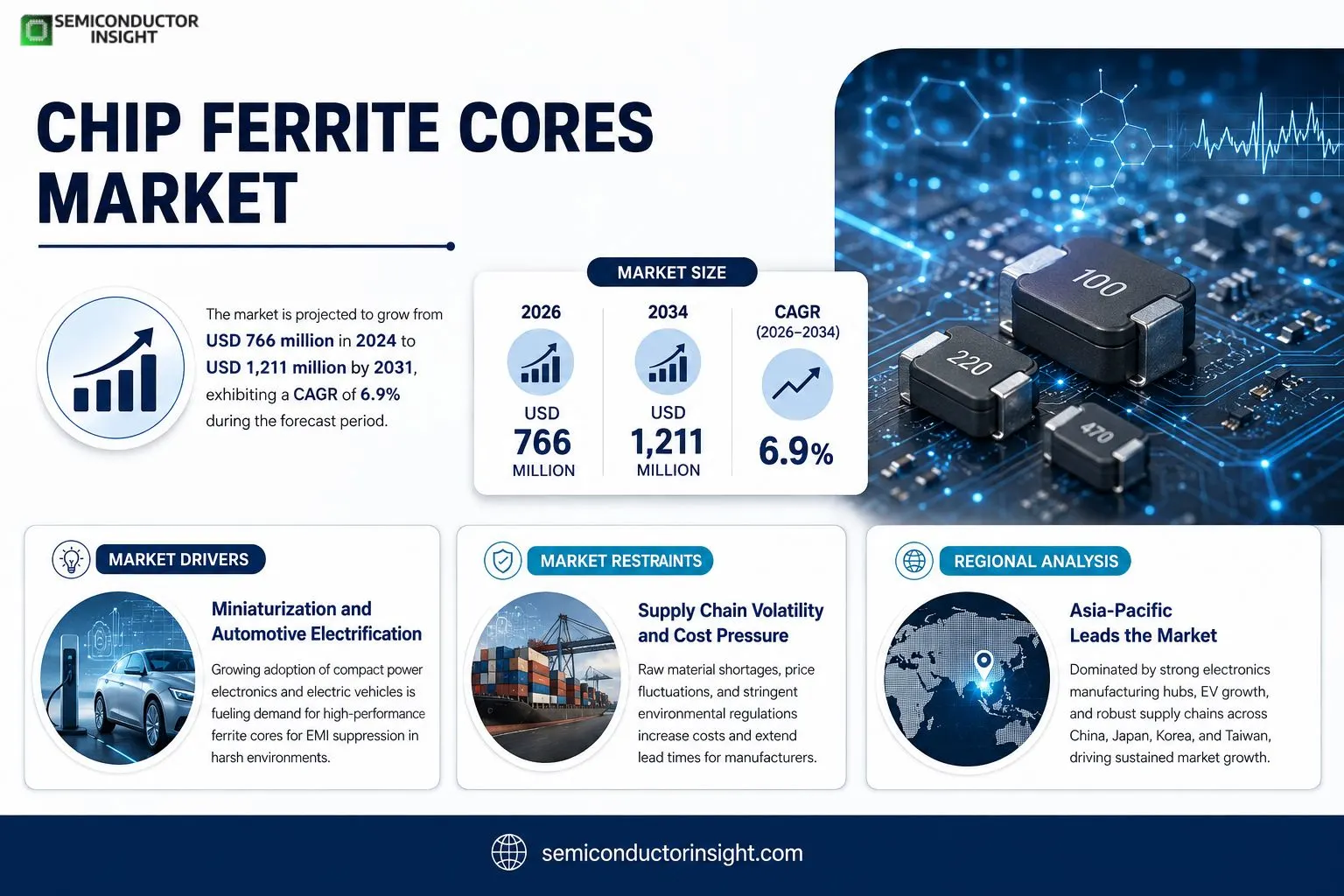
Chip Ferrite Cores market size was valued at USD 766 million in 2024. The market is projected to grow from USD 766 million in 2024 to USD 1,211 million by 2034, exhibiting a CAGR of 6.9% during the forecast period.
Chip ferrite cores are passive magnetic components used to suppress unwanted electromagnetic interference in electronic circuits. They work by converting high‑frequency differential‑mode noise into heat, thereby cleaning signal‑line or power‑line disturbances. Typical deployments include ferrite choke coils for automotive electronics, consumer devices, industrial automation and aerospace systems where reducing EMI enhances reliability and performance.
MARKET DRIVERS
Miniaturization of Power Electronics
Designers of portable devices are compressing power‑conversion modules into ever‑smaller footprints. Chip Ferrite Cores deliver high permeability in a compact form, enabling tighter board layouts without compromising thermal performance. This shift fuels demand for specialized cores that can operate at higher frequencies while maintaining low loss.
Automotive Electrification
The transition to electric drivetrains and advanced driver‑assistance systems introduces new filtering and inductance requirements. Ferrite cores suited for harsh temperature cycles and vibration are becoming integral to on‑board chargers and power‑train controllers, creating a steady pull on the market.
➤ Manufacturers that streamline core‑to‑module integration see faster time‑to‑market and higher gross margins.
Regulatory pressure for EMI compliance across consumer and industrial sectors pushes original equipment manufacturers to adopt ferrite solutions that meet stricter standards, further reinforcing the growth trajectory of Chip Ferrite Cores Market.
MARKET CHALLENGES
Supply‑Chain Volatility
Fluctuations in raw‑material availability, particularly high‑grade manganese‑zinc powders, cause lead times to extend beyond typical production cycles. Companies that lack diversified sourcing strategies may experience inventory shortages that impede delivery commitments.
Other Challenges
Cost Sensitivity
End‑users in consumer electronics are increasingly price‑pressured, forcing core suppliers to balance material cost reductions with performance specifications. Maintaining competitive pricing while preserving loss characteristics remains a delicate act.Environmental compliance adds another layer of complexity; stricter disposal regulations demand that manufacturers adopt greener processing methods, which can raise operational expenditures.
MARKET RESTRAINTS
Technical Trade‑offs at High Frequencies
While ferrite cores excel at suppressing electromagnetic interference, their permeability can degrade when operating above several megahertz. Designers face a trade‑off between size reduction and efficient energy transfer, limiting adoption in ultra‑high‑frequency applications.Furthermore, the need for precise temperature coefficients in automotive environments restricts the pool of viable core compositions, narrowing supplier options and potentially inflating costs.
MARKET OPPORTUNITIES
Advanced Material Formulations
Research into nano‑structured ferrite particles promises lower core loss and improved frequency response. Early adopters that commercialize such formulations could capture premium segments in aerospace and defense, where performance margins are critical.Additionally, the rise of modular power architectures in data centers creates a niche for plug‑and‑play ferrite modules that simplify system integration. Companies that develop standardized, interoperable core packages stand to benefit from recurring volume orders.
Chip Ferrite Cores Market Trends
Widespread Adoption of Ferrite Chokes in Automotive and Industrial Automation
Chip Ferrite Cores Market is feeling the pressure of stricter electromagnetic compatibility regulations across automotive power‑train modules and factory‑floor control systems. Engineers are turning to chip‑size ferrite chokes because they convert high‑frequency interference into harmless heat without adding appreciable bulk. As electric‑drive architectures proliferate, the number of signal‑line and power‑line interfaces that require differential‑mode filtering multiplies, prompting design teams to specify ferrite solutions at an earlier stage of the product development cycle. This shift reduces downstream redesign costs and improves time‑to‑market for new vehicle generations and automated production equipment.
Other Trends
Grade Differentiation and Tailored Performance
Manufacturers are segmenting their portfolios into General, Automotive, and specialty grades to match the thermal and magnetic characteristics demanded by each end‑use. Automotive‑grade ferrite cores now feature higher Curie temperatures and tighter tolerances, enabling reliable operation in under‑hood environments where temperature swings exceed 150 °C. In contrast, general‑grade components remain attractive for consumer‑electronics housings, where cost sensitivity outweighs the need for extreme thermal resilience. This bifurcation encourages suppliers to invest in material science that optimizes particle size distribution and binder composition, thereby delivering higher impedance per volume and extending the usable frequency range.
Geographic Shift Toward Asia‑Pacific Production Hubs
Regional analysis shows a pronounced realignment of manufacturing capacity toward Southeast Asian nations, driven by lower labor costs and emerging automotive factories. Companies based in China, Thailand, and Vietnam are scaling up wire‑wound ferrite choke lines to satisfy local demand for electric‑vehicle power modules and smart‑grid converters. Parallelly, European OEMs are collaborating with regional suppliers to secure a stable supply of aerospace‑grade ferrite cores, where stringent weight and reliability specifications dominate. This geographic diversification mitigates supply‑chain disruptions and offers end users a broader base of sourcing options, ultimately influencing pricing dynamics and competitive positioning across Chip Ferrite Cores Market.
COMPETITIVE LANDSCAPE
Key Industry Players
Chip Ferrite Cores: Competitive Overview
TDK commands the upper tier of the chip ferrite core arena, leveraging its extensive materials‑science portfolio and manufacturing footprint to serve automotive, industrial and consumer segments. Murata follows closely, differentiating through aggressive miniaturisation and a strong presence in high‑frequency communication equipment. Both firms operate with diversified product linesgeneral‑grade, automotive‑grade and specialty variantsallowing them to capture bulk orders while maintaining pricing discipline. Their scale enables vertical integration from raw ferrite powders to finished chokes, which translates into shorter lead‑times and a decisive edge in large‑volume contracts such as those originating from automotive OEMs and telecom infrastructure projects.Beyond the duopoly, a cohort of specialised suppliers fills niche corridors that larger players often overlook. Taiyo Yuden and Sunlord excel in high‑performance, low‑loss cores for aerospace and defense applications, where certification and reliability trump cost. Yageo, Chilisin and Vishay sustain a robust presence in consumer‑electronics through aggressive price positioning and widespread distribution networks. Companies like Bourns, Fenghua Advanced Technology, Würth Elektronik, Laird, Tecstar and Max Echo contribute innovative form‑factors or proprietary coating technologies, carving out defensible market slices in emerging fields such as electric‑vehicle power‑train control and industrial automation. Their agility in R&D and regional proximity to fast‑growing Asian manufacturers creates a competitive pressure that forces the market leaders to continually refine their value propositions.
List of Key Chip Ferrite Cores Companies Profiled
- TDK
- Murata
- Taiyo Yuden
- Sunlord
- Yageo
- Chilisin
- Microgate
- Samsung Electro‑Mechanics
- Bourns
- Fenghua Advanced Technology
- Würth Elektronik GmbH
- Vishay
- Tecstar
- Laird
- Max Echo
Segment Analysis:
| Segment Category | Sub-Segments | Key Insights |
| By Type |
|
General Grade dominates the market because it offers a versatile balance of performance and cost, making it suitable for a wide array of electronic devices.
|
| By Application |
|
Automotive Electronics is emerging as a critical application because modern vehicles embed increasing numbers of electronic control units that demand robust EMI protection.
|
| By End User |
|
Consumer Device Makers leverage chip ferrite cores to meet rising expectations for device compactness and electromagnetic compliance.
|
| By Material |
|
MnZn Ferrite is preferred for low‑to‑mid frequency noise suppression due to its high permeability and low loss characteristics.
|
| By Frequency Range |
|
Mid Frequency segment drives much of the design attention because modern communication and power‑management subsystems operate extensively within this band.
|
Regional Analysis: Chip Ferrite Cores Market
Asia‑Pacific
High‑frequency power converters for renewable‑energy inverters and telecom base stations are prompting designers to select ferrite cores with tighter loss tolerances. The shift toward miniaturised modules in wearables also adds pressure for smaller, higher‑performance chips, nudging manufacturers toward new alloy formulations.
Proximity between ferrite‑powder producers and semiconductor assembly plants shortens the procurement cycle. Recent investments in domestic rare‑earth processing in Japan and India mitigate the risk of cross‑border material shortages, allowing OEMs to maintain steady production volumes.
Harmonised electromagnetic‑compatibility directives across ASEAN simplify certification for multi‑country launches. Meanwhile, stricter RoHS limits on lead content push suppliers toward cleaner alloy mixes, influencing product design choices and cost structures.
Tier‑1 players leverage patented sintering techniques to deliver superior permeability, while niche firms compete on rapid prototyping services. The balance between scale and agility defines market share shifts as customers demand both volume discounts and quick design turn‑arounds.
North America
North America remains a critical market for high‑performance chip ferrite cores, driven largely by defense contracts and the presence of legacy semiconductor hubs in the United States. Defense specifications frequently demand tighter magnetic loss limits, prompting suppliers to invest in ultra‑precise composition control. The region’s emphasis on sustainability also encourages the adoption of lead‑free ferrite grades, which reshapes product development roadmaps. Because many automotive OEMs are relocating engineering functions to the U.S., there is a noticeable uptick in demand for ferrite components that can survive harsh thermal cycles in electric‑vehicle power modules. Suppliers that align their R&D with these dual pressuressecurity compliance and green‑techare better positioned to capture long‑term contracts.
Europe
European manufacturers benefit from a mature automotive supply chain and strong standards organisations that dictate magnetic‑characteristic testing. The bloc’s focus on energy‑efficiency directives accelerates the transition to low‑loss ferrite cores for industrial drives. In addition, the growing market for smart‑grid infrastructure creates a niche for high‑frequency cores capable of handling bidirectional power flow. Cross‑border collaborations among German and French research institutes have yielded novel nano‑structured ferrite powders, giving regional firms a technology edge. However, regulatory scrutiny around raw‑material sourcing compels companies to demonstrate responsible procurement, adding a compliance layer to product planning.
South America
South America’s chip ferrite core market is shaped primarily by expanding telecommunications networks and nascent electric‑vehicle assembly lines in Brazil and Argentina. Operators are modernising back‑haul links with 5G equipment that relies on compact, high‑frequency ferrite solutions, fostering incremental demand. Local incentives for renewable‑energy projects stimulate the adoption of inverter technologies where ferrite cores are essential for power‑quality management. The region’s limited domestic powder‑production capacity makes it dependent on imports, which can affect lead times but also opens opportunities for regional distributors to offer value‑added packaging services.
Middle East & Africa
In the Middle East & Africa, infrastructure development and data‑centre expansion drive modest growth for chip ferrite cores. Emerging smart‑city projects in the Gulf States call for high‑density power‑conversion modules, prompting designers to source ferrite components that balance size and efficiency. Meanwhile, Africa’s growing renewable‑energy installations, particularly solar‑farm inverters, create a niche for durable ferrite cores that can withstand harsh environmental conditions. The market is still fragmented, with many buyers relying on distributors, but increasing local procurement initiatives suggest a gradual shift toward region‑specific supply arrangements.
Report Scope
This market research report provides a comprehensive analysis of the Chip Ferrite Cores Market , covering the forecast period 2026–2034. It offers detailed insights into market dynamics, technological advancements, competitive landscape, and key trends shaping the industry.
Key focus areas of the report include:
- Market Overview: The report begins with an overview outlining its current market scenario, key growth indicators, and industry transformation drivers. It discusses macroeconomic factors, demand–supply balance, regulatory landscape, and the strategic role of semiconductors in powering advancements across industries such as automotive, telecommunications, consumer electronics, and industrial automation.
- Market Size & Forecast: Historical data and future projections for revenue, unit shipments, and market value across major regions and segments.
- Segmentation Analysis: Detailed breakdown by product type, technology, application, and end-user industry to identify high-growth segments and investment opportunities.
- Regional Insights: Insights into market performance across North America, Europe, Asia-Pacific, Latin America, and the Middle East & Africa, including country-level analysis where relevant.
- Competitive Landscape: Profiles of leading market participants, including their product offerings, R&D focus, manufacturing capacity, pricing strategies, and recent developments such as mergers, acquisitions, and partnerships.
- Technology Trends & Innovation: Assessment of emerging technologies, integration of AI/IoT, semiconductor design trends, fabrication techniques, and evolving industry standards.
- Market Drivers & Restraints: Evaluation of factors driving market growth along with challenges, supply chain constraints, regulatory issues, and market-entry barriers.
- Stakeholder Insights: Insights for component suppliers, OEMs, system integrators, investors, and policymakers regarding the evolving ecosystem and strategic opportunities.
Primary and secondary research methods are employed, including interviews with industry experts, data from verified sources, and real-time market intelligence to ensure the accuracy and reliability of the insights presented.
FREQUENTLY ASKED QUESTIONS:
What is the current market size of Chip Ferrite Cores Market?
-> Chip Ferrite Cores Market was valued at USD 766 million in 2024 and is expected to reach USD 1,211 million by 2034, growing at a CAGR of 6.9% during the forecast period.
Which key companies operate in Chip Ferrite Cores Market?
-> Key players include TDK, Murata, TAIYO YUDEN, Sunlord, Yageo, Chilisin, Microgate, Samsung, Bourns, Fenghua Advanced, Würth Elektronik GmbH, Vishay, Tecstar, Laird, Max Echo, among others.
What are the key growth drivers?
-> Key growth drivers include the widespread adoption of ferrite choke coils for electromagnetic interference reduction, increasing demand for wire‑wound ferrite chokes in automotive, aerospace, and industrial automation equipment, and the expanding use of Chip Ferrite Cores in high‑frequency noise suppression for electronic devices.
Which region dominates the market?
-> Asia‑Pacific leads the market owing to rapid growth in automotive electronics, consumer electronics manufacturing, and strong industrial automation activities across China, Japan, and South Korea.
What are the emerging trends?
-> Emerging trends include integration of Chip Ferrite Cores in electric vehicles, 5G infrastructure, Internet of Things (IoT) devices, and miniaturized modules for aerospace and defense applications, driven by the need for higher EMI filtering efficiency.
Get Sample Report PDF for Exclusive Insights
Report Sample Includes
- Table of Contents
- List of Tables & Figures
- Charts, Research Methodology, and more...
 Download Sample Report PDF