Consumer Electronics Sensor Market Insights
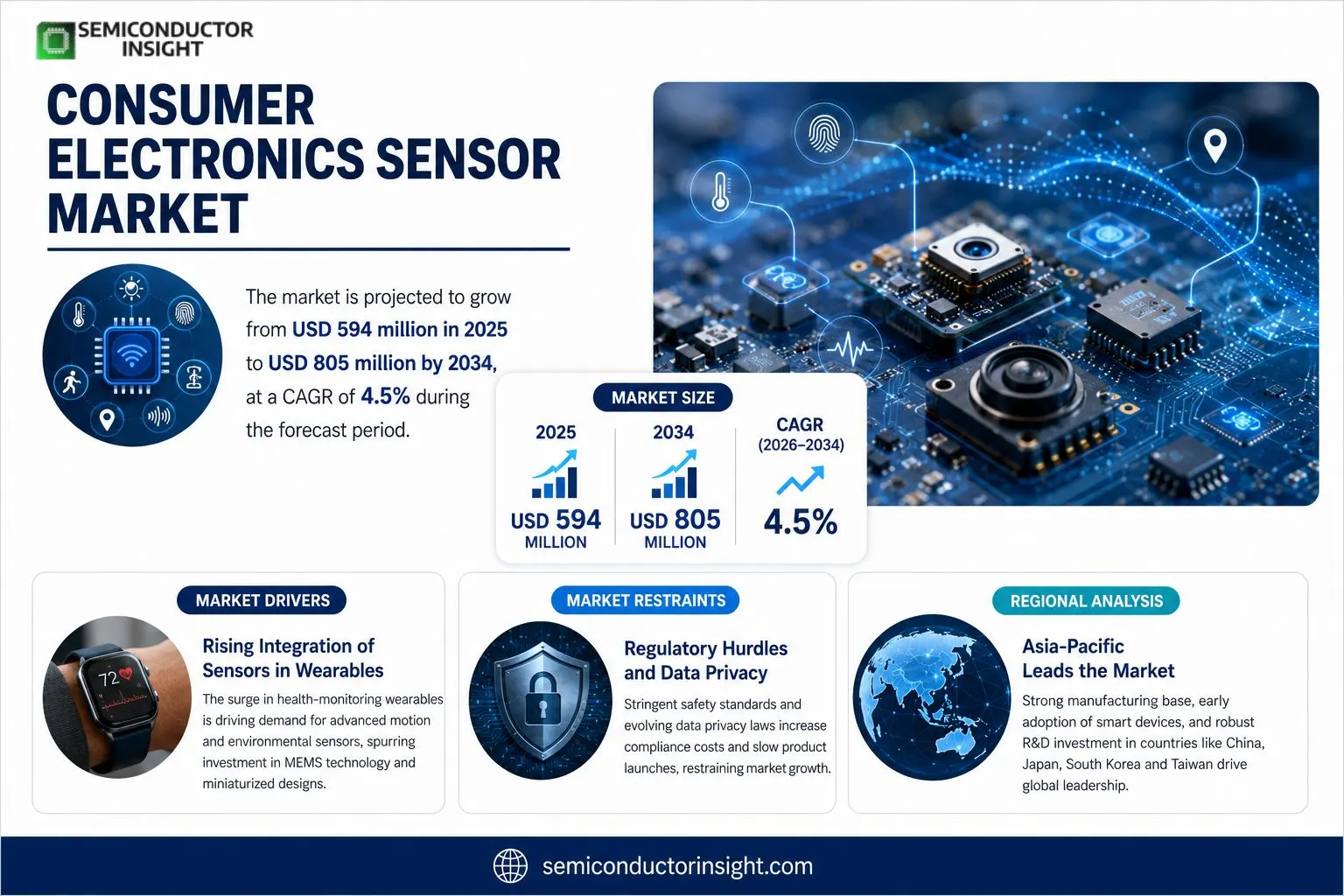
Consumer Electronics Sensor market was valued at USD 594 million in 2025 and is projected to reach USD 805 million by 2034, at a CAGR of 4.5 % during the forecast period.
Consumer electronics sensors are components that detect motion, touch, light, temperature, pressure or proximity and translate these physical inputs into electrical signals for processing by devices such as smartphones, wearables, gaming consoles and home appliances.The sector benefits from expanding smart‑device penetration, broader IoT deployments and ongoing cost reductions through MEMS‑based designs; manufacturers have recently announced new low‑power image sensors for AR headsets and integrated ambient‑light modules for ultra‑thin tablets.
MARKET DRIVERS
Rising Integration of Sensors in Wearables
The proliferation of health‑monitoring wearables has forced OEMs to embed increasingly sophisticated motion and environmental sensors. Manufacturers that can miniaturize functionality while preserving battery life gain a decisive advantage, prompting a wave of investment in MEMS technology across Consumer Electronics Sensor Market.
Smart‑Home Adoption Accelerates Demand
Connected thermostats, voice assistants, and security cameras rely on a dense network of temperature, acoustic, and proximity sensors. The convergence of broadband availability and consumer appetite for seamless automation fuels the need for higher‑resolution, low‑latency devices, expanding the addressable market for sensor suppliers.
➤ “Every new smart appliance introduces at least two additional sensing functions, effectively multiplying the revenue streams for sensor manufacturers.”
Beyond convenience, the data generated by these sensors underpins predictive maintenance services that manufacturers now package as recurring revenue. This shift from one‑time hardware sales to data‑driven models creates a self‑reinforcing loop, prompting further allocation of R&D budgets toward sensor innovation.
MARKET CHALLENGES
Cost Pressures in High‑Volume Production
Scale‑up of sensor fabrication demands advanced lithography equipment, which inflates capital expenditure. Tier‑1 suppliers are pressured to reduce unit costs while maintaining performance, leading to tighter margins and a constant search for cost‑effective materials.
Other Challenges
Supply Chain Volatility
Semiconductor shortages have exposed the fragility of component pipelines. Lead times for key substrates and packaging materials can extend to several months, forcing OEMs to hold higher inventory levels and eroding cash flow.Regulatory scrutiny of electromagnetic emissions and data security adds another layer of complexity. Compliance testing cycles lengthen product launch timelines, discouraging smaller players from entering the market.
MARKET RESTRAINTS
Regulatory Hurdles and Data Privacy
Stringent safety standards for consumer‑facing devices require exhaustive certification processes. Non‑compliance can result in costly recalls, deterring aggressive product cycles.The surge in sensor‑generated personal data has triggered privacy legislation that limits data collection and sharing. Companies must invest in encryption and anonymization technologies, which adds to development overhead.Additionally, cross‑border trade restrictions on certain sensor materials impede the ability to source the most advanced components, constraining design flexibility for multinational manufacturers.
MARKET OPPORTUNITIES
AI‑Enabled Edge Analytics
Embedding lightweight AI models directly on sensor chips allows real‑time inference without reliance on cloud connectivity. Edge analytics opens new revenue streams through subscription‑based analytics platforms, appealing to enterprises that prioritize latency and security.Emerging form‑factors such as flexible and textile‑integrated sensors present untapped application spaces in fashion, sports equipment, and automotive interiors. Early movers that secure intellectual property in these niches stand to capture significant market share as consumer preferences evolve.
Consumer Electronics Sensor Market Trends
Wearable devices drive sensor miniaturization and new interaction models
The rapid uptake of smart wearables has compelled hardware makers to compress sensor dimensions while preserving precision. Engineers are now embedding motion, touch and proximity elements into flexible laminates, enabling smart watches and fitness bands to interpret gestures without adding perceptible bulk. This push toward thinner packages trims assembly steps, reduces bill‑of‑materials, and opens pricing levers that appeal to cost‑conscious buyers. Suppliers that can mass‑produce sub‑millimeter MEMS arrays secure a competitive edge, because integration efficiency overtakes pure component cost as the decisive factor. The downstream impact is evident in software firms that design applications around uninterrupted sensor streams, spawning subscription‑based health analytics, context‑aware notifications and location‑sensitive services. Companies that own the full data pipeline can extract recurring revenue from richer user interactions, whereas firms that lag in miniaturization may find themselves edged out as platforms coalesce around slimmer, more capable hardware.
Other Trends
Environmental sensing in smart home appliances
Home automation products increasingly rely on ambient light, temperature and humidity detectors to fine‑tune performance without user input. By feeding real‑time environmental data to intelligent controllers, refrigerators can adjust interior cooling cycles, ovens can modify pre‑heat timing, and HVAC units can balance energy consumption with comfort thresholds. This sensor‑driven feedback loop delivers measurable energy savings, a selling point that resonates with eco‑aware consumers and regulatory frameworks promoting efficiency. Manufacturers that integrate calibrated environmental sensors early in the design phase can differentiate their appliances, command premium pricing, and build ecosystems that lock customers into brand‑specific smart platforms.
Advances in MEMS technology reshape motion detection capabilities
Recent breakthroughs in micro‑electromechanical systems have lowered fabrication costs while boosting signal‑to‑noise ratios, allowing motion sensors to capture subtle orientation changes previously unavailable in consumer devices. The cost reduction expands the feasibility of embedding accelerometers in low‑margin products such as entry‑level smartphones and budget tablets, widening the addressable market. At the same time, higher fidelity data fuels advanced algorithms for gesture recognition, gaming immersion and augmented reality overlays, creating new revenue streams for developers. Supply‑chain players that adopt the latest MEMS processes can offer faster time‑to‑market, positioning themselves as preferred partners for brands seeking to launch differentiated sensor‑rich experiences.
COMPETITIVE LANDSCAPE
Key Industry Players
Consumer Electronics Sensor Market – Competitive Overview
Among the incumbents, Sony commands the largest share of image and motion sensor shipments, leveraging its deep expertise in CMOS imaging and a robust OEM network that spans flagship smartphones to premium gaming consoles. The company’s ability to integrate advanced sensor packaging with proprietary signal‑processing algorithms has entrenched its position as a preferred supplier for high‑volume device makers. Sony’s extensive R&D pipeline, focused on shrinking pixel size while enhancing low‑light performance, creates a structural advantage that pressures rivals to either co‑develop or secure alternative technologies.Beyond Sony, the market features a heterogeneous set of manufacturers that specialize in distinct sensor modalities. Bosch and STMicroelectronics dominate the MEMS motion and environmental sensor segments, offering highly reliable accelerometers and ambient‑light solutions that align with the cost‑sensitivity of mid‑range smartphones and wearables. Samsung’s sensor division supplies a broad portfolio ranging from ultrasonic proximity detectors to integrated image‑signal processors, enabling tight coupling with its own consumer device ecosystem. Niche players such as AMS, NXP Semiconductors, and Omron contribute innovative optical and capacitive sensing capabilities that appeal to emerging IoT‑enabled home appliances. Meanwhile, Murata and TE Connectivity focus on miniaturized pressure and position sensors, carving out space in compact wearables and smart‑home hubs. This tiered structure reinforces a competitive environment where scale, application‑specific performance, and strategic partnerships shape market share.
List of Key Consumer Electronics Sensor Companies Profiled
- Sony Corporation
- Bosch Sensortec
- STMicroelectronics
- Samsung Electronics
- Panasonic Corporation
- AMS AG
- NXP Semiconductors
- Cypress Semiconductor
- Infineon Technologies AG
- Murata Manufacturing Co., Ltd.
- Omron Corporation
- TE Connectivity Ltd.
- Toshiba Corporation
- Aptina Imaging (now part of ON Semiconductor)
- Synaptic, Inc.
Segment Analysis:
| Segment Category | Sub-Segments | Key Insights |
| By Type |
|
Motion Sensors are pivotal in enabling interactive experiences across consumer devices. – Drive gesture‑based controls that enrich user interfaces. – Support activity tracking and motion‑aware applications in wearables and gaming. – Facilitate device orientation detection, improving ergonomics and usability. |
| By Application |
|
Smartphones remain the core driver for sensor integration. – Enable adaptive display brightness, proximity‑based call management, and facial recognition. – Enhance photography through image and depth sensors, supporting advanced computational imaging. – Provide seamless touch and gesture interfaces that define modern user interaction. |
| By End User |
|
Individual Consumers demand intuitive and responsive experiences. – Expect seamless integration of sensors that anticipate user needs. – Value battery‑efficient designs that do not compromise functionality. – Seek continual innovation that introduces new interaction paradigms, such as gesture‑only control. |
| By Technology |
|
MEMS technology underpins most motion and position sensing solutions. – Offers high integration density while maintaining low power consumption. – Enables miniaturization essential for wearables and ultra‑slim devices. – Provides robust performance across a wide temperature range, supporting diverse consumer applications. |
| By Functionality |
|
Gesture Recognition transforms how users interact without physical contact. – Enables touch‑free control in hygiene‑sensitive environments. – Expands possibilities for immersive gaming and AR/VR experiences. – Drives the development of contextual interfaces that adapt to user intent. |
Regional Analysis: Consumer Electronics Sensor Market
Asia‑Pacific
The region’s factories benefit from vertically integrated operations, where sensor wafer processing, packaging, and final assembly coexist within proximate industrial parks. This proximity reduces logistic delays and enables rapid feedback loops between design and production teams.
Heavy spending on research labs, especially in South Korea and Japan, drives breakthroughs in MEMS and optical sensor technologies, feeding the pipeline of next‑generation consumer gadgets.
Recent geopolitical shifts have prompted firms to diversify component sources, establishing secondary fabs and fostering regional supplier networks that cushion against disruptions.
Growth in smart‑city infrastructure, immersive gaming, and personalized health monitoring creates fresh demand for multi‑modal sensors that blend motion, ambient light, and biometric data.
North America
North America remains a hub for design excellence and software integration within Consumer Electronics Sensor Market. Companies headquartered in the United States and Canada excel at translating sensor hardware into user‑centric applications, leveraging advanced analytics platforms to turn raw data into actionable insights. The region’s strong intellectual‑property framework encourages firms to protect novel sensor architectures, fostering an environment where premium pricing can be justified by differentiated performance. Partnerships between semiconductor innovators and consumer‑brand leaders drive a steady influx of high‑resolution imaging and proximity sensors into flagship devices. However, the higher cost structure of domestic manufacturing pushes many OEMs to source components from abroad, underscoring the importance of robust supplier management and quality assurance processes.
Europe
European players contribute a reputation for precision engineering and stringent regulatory compliance, attributes that resonate with consumers demanding reliable, safe sensor‑enabled products. Countries such as Germany, France, and the United Kingdom host a network of specialist firms that focus on niche sensor segments, including environmental monitoring and industrial‑grade accelerometers used in premium wearables. The region’s emphasis on sustainability drives manufacturers to adopt low‑power sensor designs, aligning product roadmaps with broader eco‑efficiency goals. Collaborative research initiatives across the EU foster cross‑border knowledge exchange, which fuels incremental improvements in sensor miniaturization and durability. While Europe’s market share is modest compared with Asia‑Pacific, its influence lies in setting quality benchmarks that shape expectations.
South America
In South America, market momentum is anchored by increasing consumer appetite for affordable smart devices and a burgeoning interest in localized content. Nations such as Brazil and Argentina are witnessing a rise in assembly plants that integrate sensors into budget‑friendly smartphones and entry‑level wearables. Local distributors prioritize cost‑effective sensor modules, prompting suppliers to tailor product portfolios with simplified feature sets that still meet essential performance criteria. The region also benefits from government programs aimed at expanding digital connectivity, which indirectly boosts demand for sensor‑rich IoT solutions in agriculture and public‑transport systems. Companies entering this market must balance price sensitivity with the need to maintain baseline reliability to avoid brand erosion.
Middle East & Africa
The Middle East & Africa landscape reflects a blend of rapid urbanization and emerging digital lifestyles. Wealthier Gulf states invest heavily in smart‑city projects, creating opportunities for high‑resolution environmental and occupancy sensors that support energy‑efficient building management. Meanwhile, Sub‑Saharan markets exhibit growing adoption of low‑cost mobile devices, where sensor functionality enhances user engagement without inflating device price. Service providers in the region are beginning to explore sensor data for predictive maintenance in utilities and for localized health monitoring initiatives. Success in these markets hinges on flexible supply arrangements and the ability to adapt sensor specifications to diverse climatic and infrastructural conditions.
Report Scope
This market research report provides a comprehensive analysis of the Consumer Electronics Sensor Market , covering the forecast period 2026–2034. It offers detailed insights into market dynamics, technological advancements, competitive landscape, and key trends shaping the industry.
Key focus areas of the report include:
- Market Overview: The report begins with an overview outlining its current market scenario, key growth indicators, and industry transformation drivers. It discusses macroeconomic factors, demand–supply balance, regulatory landscape, and the strategic role of semiconductors in powering advancements across industries such as automotive, telecommunications, consumer electronics, and industrial automation.
- Market Size & Forecast: Historical data and future projections for revenue, unit shipments, and market value across major regions and segments.
- Segmentation Analysis: Detailed breakdown by product type, technology, application, and end-user industry to identify high-growth segments and investment opportunities.
- Regional Insights: Insights into market performance across North America, Europe, Asia-Pacific, Latin America, and the Middle East & Africa, including country-level analysis where relevant.
- Competitive Landscape: Profiles of leading market participants, including their product offerings, R&D focus, manufacturing capacity, pricing strategies, and recent developments such as mergers, acquisitions, and partnerships.
- Technology Trends & Innovation: Assessment of emerging technologies, integration of AI/IoT, semiconductor design trends, fabrication techniques, and evolving industry standards.
- Market Drivers & Restraints: Evaluation of factors driving market growth along with challenges, supply chain constraints, regulatory issues, and market-entry barriers.
- Stakeholder Insights: Insights for component suppliers, OEMs, system integrators, investors, and policymakers regarding the evolving ecosystem and strategic opportunities.
Primary and secondary research methods are employed, including interviews with industry experts, data from verified sources, and real-time market intelligence to ensure the accuracy and reliability of the insights presented.
FREQUENTLY ASKED QUESTIONS:
What is the current market size of Consumer Electronics Sensor Market?
-> Consumer Electronics Sensor Market was valued at USD 594 million in 2025 and is expected to reach USD 805 million by 2034.
Which key companies operate in Consumer Electronics Sensor Market?
-> Key players include Sony, Aptina Imaging, Synaptic, Bosch, STMicroelectronics, Samsung, Panasonic, Toshiba, AMS, NXP Semiconductors, Cypress Semiconductor Corporation, Infineon Technologies AG, Murata Manufacturing Co., Ltd., Nviso SA, Omron Corporation, TE Connectivity Ltd..
What are the key growth drivers?
-> Key growth drivers include increasing adoption of smart devices and wearables, integration of sensors in IoT applications, demand for enhanced user experience, and ongoing miniaturization and cost reduction of sensor technologies.
Which region dominates the market?
-> Asia-Pacific dominates the market, driven by strong demand in China, Japan, South Korea and emerging Southeast Asian economies.
What are the emerging trends?
-> Emerging trends include advanced MEMS designs, AI‑enabled sensor analytics, multimodal sensing solutions, and a focus on low‑power, high‑precision sensors.
Get Sample Report PDF for Exclusive Insights
Report Sample Includes
- Table of Contents
- List of Tables & Figures
- Charts, Research Methodology, and more...
 Download Sample Report PDF