Acoustic Beamforming Arrays Market Insights
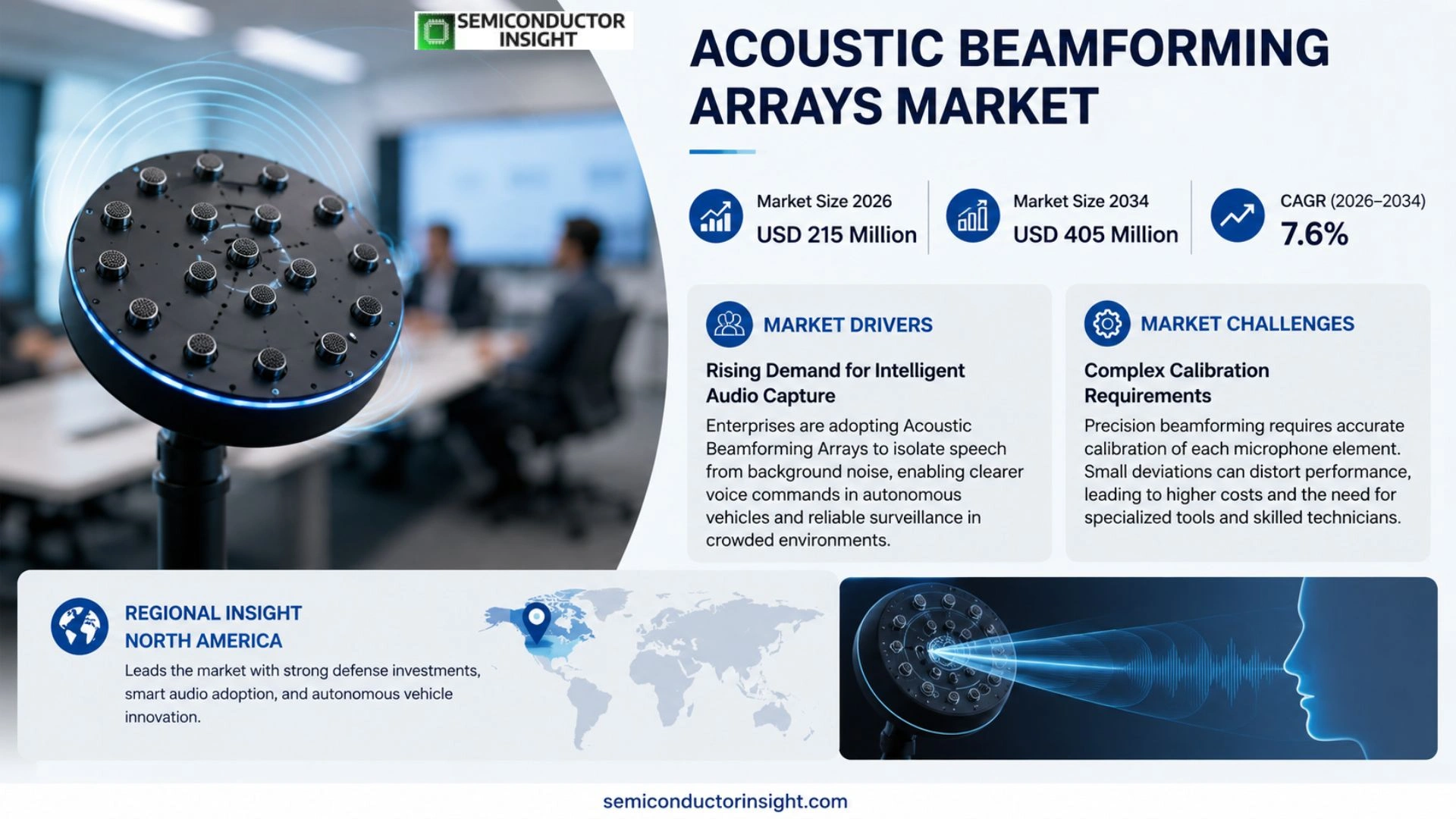
Global Acoustic Beamforming Arrays market size was valued at USD 208 million in 2025. The market is projected to grow from USD 215 million in 2026 to USD 405 million by 2034, exhibiting a CAGR of 7.6% during the forecast period.
Acoustic beamforming arrays are imaging devices that locate and characterize sound sources by processing signals from a coordinated set of microphones,often called a microphone array,to generate spatial acoustic images or videos. By visualising multiple sources across frequencies and amplitudes, these systems enable users to pinpoint noise origins, assess source strength, and evaluate acoustic signatures; resolution depends chiefly on array aperture and microphone count.
MARKET DRIVERS
Rising Demand for Intelligent Audio Capture
Enterprises across transportation, security, and consumer electronics are replacing legacy microphones with Acoustic Beamforming Arrays Market solutions that can isolate speech from background noise. This shift is fueled by the need for clearer voice commands in autonomous vehicles and more reliable surveillance in crowded venues, where conventional audio sensors struggle.
Advancements in Semiconductor Integration
Recent progress in CMOS‑based microphone chips has lowered power consumption while boosting array density. Manufacturers can now embed 32‑element arrays on a single silicon die, enabling compact form factors for wearables and IoT nodes. The cost advantage accelerates adoption in mid‑range products that previously could not justify beamforming technology.
➤ “Deploying beamforming chips reduces overall system latency by up to 30 % while delivering a 15 dB improvement in signal‑to‑noise ratio.”
These technical gains translate into faster time‑to‑market for new voice‑controlled services, prompting OEMs to allocate larger portions of R&D budgets toward beamforming research. The ripple effect is a noticeable uptick in component orders from both Tier‑1 suppliers and niche system integrators.
MARKET CHALLENGES
Complex Calibration Requirements
Precision beamforming hinges on accurate calibration of each microphone element. Small deviations in sensitivity can distort the directional pattern, forcing end‑users to invest in specialized software tools and skilled technicians. Companies that overlook this step often face higher warranty claims and diminished customer confidence.
Other Challenges
Supply‑Chain Volatility
The semiconductor shortage that began in 2022 still ripples through the supply chain, constraining the availability of high‑performance MEMS microphones. Lead times of 8‑12 weeks have become common, prompting OEMs to keep larger safety stocks, which in turn inflates inventory costs.
Moreover, regulatory scrutiny over acoustic surveillance devices is tightening in several regions, demanding additional compliance testing and documentation that can delay product launches.
MARKET RESTRAINTS
High Initial Capital Expenditure
Investing in full‑scale beamforming hardware and the associated signal‑processing platform requires a significant upfront outlay. Small and medium‑size enterprises often find the break‑even horizon longer than anticipated, which dampens enthusiasm for large‑scale rollout.
In addition, the learning curve for engineers transitioning from traditional microphone design to array‑based solutions can slow internal adoption, especially when legacy firmware must be rewritten to accommodate real‑time beam steering.
These financial and technical frictions combine to temper the pace at which new entrants can capture market share, leaving room for established players to consolidate their positions.
MARKET OPPORTUNITIES
Integration with Edge AI Platforms
Coupling acoustic beamforming arrays with edge‑compatible neural networks opens pathways for real‑time sound classification without reliance on cloud connectivity. This capability is particularly attractive for industrial safety systems that must react instantly to abnormal acoustic signatures.
Another promising avenue lies in the automotive sector, where manufacturers are embedding compact arrays within dashboard consoles to support multilingual voice assistants. Early pilots indicate a potential 20 % increase in driver satisfaction scores when beamforming is employed.
Finally, the rise of immersive media,augmented and virtual reality,creates demand for directional audio capture that can faithfully reproduce spatial soundscapes. Companies that can deliver low‑latency, high‑fidelity arrays stand to secure a foothold in this emerging entertainment niche.
Acoustic Beamforming Arrays Market Trends
Growing Adoption of 2D and 3D Acoustic Cameras in Automotive and Industrial Sectors
Acoustic Beamforming Arrays Market, valued at roughly $193 million in 2024, is moving toward a $320 million horizon by 2031 according to the latest forecasts. This trajectory reflects the widening use of both two‑dimensional and three‑dimensional acoustic imaging systems across vehicle manufacturers and heavy‑equipment producers. In automotive factories, engineers are leveraging acoustic cameras to pinpoint high‑frequency noise sources on electric drivetrains, enabling rapid design tweaks that preserve consumer comfort standards. Similarly, plant managers in the wind‑energy and rail sectors are integrating 3D acoustic arrays to localise turbulent flow‑induced emissions, thereby shortening troubleshooting cycles and reducing unplanned downtime.
Other Trends
Regulatory Pressure on Noise Emissions
Governments in North America and Europe have tightened permissible sound‑pressure levels for road vehicles and industrial installations. These policy shifts compel OEMs to embed acoustic analysis early in product development, creating a dependable demand pipeline for high‑resolution beamforming solutions. Companies that can demonstrate compliance‑ready measurement capabilities are gaining preference in supplier selection processes, prompting a modest repositioning of capital toward more sophisticated microphone‑array architectures.
Integration of Real‑Time Acoustic Video in Predictive Maintenance
Beyond traditional spot‑checking, manufacturers are now adopting continuous acoustic monitoring platforms that generate live acoustic video streams. The ability to visualise subtle changes in vibration signatures allows maintenance teams to anticipate bearing wear or air‑leak degradation before they manifest as costly failures. This shift toward proactive health monitoring expands the addressable user base of Acoustic Beamforming Arrays Market, particularly among facilities seeking to maximise asset uptime without incurring extensive sensor retrofits.
COMPETITIVE LANDSCAPE
Key Industry Players
Acoustic Beamforming Arrays: Competitive Dynamics 2024‑2031
Brüel & Kjær dominates the high‑end segment, leveraging a broad portfolio that couples precision microphone arrays with sophisticated signal‑processing software. Its global sales network, reinforced by longstanding contracts with automotive OEMs and aerospace integrators, secures a comfortable share of the $193 million 2024 market. Recent strategic moves,namely the acquisition of a niche 3‑D acoustic‑camera developer and an expanded service agreement with a leading electric‑vehicle manufacturer,have deepened its foothold in regions where regulatory pressure on noise emissions intensifies. The company’s emphasis on scalable architecture, allowing customers to augment microphone count without redesigning the core platform, creates a defensible barrier against emerging rivals.
Beyond the leader, the field fragments into specialist firms that target distinct verticals. Fluke and Siemens focus on portable diagnostic units for industrial maintenance, while Sorama and Norsonic AS cater to laboratory‑grade research applications with ultra‑high‑resolution imaging. Smaller innovators such as Distran, SM Instruments, and Gfai Tech differentiate through cost‑effective 2‑D camera kits aimed at small‑scale manufacturers. Recent collaborations,Teledyne FLIR’s partnership with automotive testing labs and CAE Software & Systems’ integration of acoustic modules into simulation suites,illustrate how cross‑industry alliances are reshaping value chains. Collectively, this diversity of business models fuels a competitive environment where technology leadership, application‑specific expertise, and geographic reach dictate market momentum.
List of Key Acoustic Beamforming Arrays Companies Profiled
- Brüel & Kjær
- Fluke
- Siemens
- Sorama
- Norsonic AS
- Distran
- SM Instruments
- Gfai Tech
- SDT
- KeyGo Technologies
- Teledyne FLIR
- CAE Software & Systems
- SONOTEC GmbH
- CRYSOUND
- SINUS Messtechnik
Segment Analysis:
| Segment Category | Sub-Segments | Key Insights |
| By Type |
|
Two-Dimensional arrays dominate early adoption because they provide intuitive visual maps of sound sources with relatively simple hardware.
|
| By Application |
|
Automotive application is a leading driver as manufacturers seek to tame noise from electric powertrains and comply with stricter emission standards.
|
| By End User |
|
Industrial equipment producers value beamforming arrays for preventive maintenance and fault detection.
|
| By Frequency Range |
|
Low‑frequency segment is critical for monitoring structural vibrations in large‑scale machinery.
|
| By Deployment Mode |
|
Integrated sensor networks are emerging as a strategic approach for continuous acoustic monitoring across distributed facilities.
|
Regional Analysis: Acoustic Beamforming Arrays Market
Persistent budgeting for next‑generation sonar and battlefield acoustics drives demand for high‑resolution arrays, prompting manufacturers to streamline integration pathways and certify solutions across multiple platforms.
The proliferation of voice‑activated assistants has forced OEMs to embed sophisticated beamforming microphones, fostering a competitive race to improve spatial filtering while reducing power consumption.
Autonomous vehicle developers are exploring acoustic arrays as complementary perception sensors, especially for detecting emergency vehicle sirens and pedestrian alerts in complex urban soundscapes.
Emerging safety and emissions guidelines for acoustic monitoring equipment incentivize firms to adhere to tighter specifications, accelerating the rollout of compliant, high‑performance products.
Europe
European manufacturers benefit from a regulatory climate that encourages acoustic transparency, especially in public transport hubs and smart city initiatives. Collaborative R&D programs across Germany, France, and the Nordics are advancing low‑latency beamforming algorithms, which in turn enable more responsive crowd‑control systems. The region’s strong emphasis on privacy‑by‑design forces suppliers to embed on‑device processing, creating a niche for compact, high‑efficiency arrays. These dynamics position Europe as a hub for privacy‑centric acoustic solutions that can be exported to markets with similar regulatory expectations.
Asia‑Pacific
Asia‑Pacific’s rapid urbanization fuels demand for acoustic monitoring in transportation and infrastructure projects. Countries such as China, Japan, and South Korea are investing heavily in intelligent surveillance networks that rely on beamforming arrays to isolate relevant sounds amidst dense noise. Simultaneously, burgeoning consumer electronics manufacturers are scaling production to meet local speaker and headset demand, often leveraging cost‑effective manufacturing ecosystems. The blend of government‑driven smart city deployments and aggressive consumer market growth creates a fertile environment for both high‑volume and specialized acoustic solutions.
South America
In South America, emerging investments in renewable energy installations and offshore exploration have sparked interest in acoustic arrays for structural health monitoring. Nations like Brazil and Chile are piloting projects that employ beamforming microphones to detect early signs of equipment fatigue, aligning with broader sustainability goals. While overall market size remains modest, the region’s focus on cost‑effective, durable technology solutions offers opportunities for suppliers willing to tailor products to rugged operating conditions.
Middle East & Africa
The Middle East & Africa region is characterized by strategic security contracts and a nascent interest in intelligent building management. Defense ministries across the Gulf are upgrading perimeter monitoring systems with sophisticated acoustic arrays that can differentiate between benign and threat sounds. In parallel, African urban centers are experimenting with acoustic traffic monitoring to improve congestion management. Although adoption rates vary, the convergence of security imperatives and smart‑city aspirations is gradually expanding Acoustic Beamforming Arrays Market footprint across this diverse geography.
Report Scope
This market research report provides a comprehensive analysis of the Acoustic Beamforming Arrays Market , covering the forecast period 2026–2034. It offers detailed insights into market dynamics, technological advancements, competitive landscape, and key trends shaping the industry.
Key focus areas of the report include:
- Market Overview: The report begins with an overview outlining its current market scenario, key growth indicators, and industry transformation drivers. It discusses macroeconomic factors, demand–supply balance, regulatory landscape, and the strategic role of semiconductors in powering advancements across industries such as automotive, telecommunications, consumer electronics, and industrial automation.
- Market Size & Forecast: Historical data and future projections for revenue, unit shipments, and market value across major regions and segments.
- Segmentation Analysis: Detailed breakdown by product type, technology, application, and end-user industry to identify high-growth segments and investment opportunities.
- Regional Insights: Insights into market performance across North America, Europe, Asia-Pacific, Latin America, and the Middle East & Africa, including country-level analysis where relevant.
- Competitive Landscape: Profiles of leading market participants, including their product offerings, R&D focus, manufacturing capacity, pricing strategies, and recent developments such as mergers, acquisitions, and partnerships.
- Technology Trends & Innovation: Assessment of emerging technologies, integration of AI/IoT, semiconductor design trends, fabrication techniques, and evolving industry standards.
- Market Drivers & Restraints: Evaluation of factors driving market growth along with challenges, supply chain constraints, regulatory issues, and market-entry barriers.
- Stakeholder Insights: Insights for component suppliers, OEMs, system integrators, investors, and policymakers regarding the evolving ecosystem and strategic opportunities.
Primary and secondary research methods are employed, including interviews with industry experts, data from verified sources, and real-time market intelligence to ensure the accuracy and reliability of the insights presented.
FREQUENTLY ASKED QUESTIONS:
What is the current market size of Acoustic Beamforming Arrays Market?
-> Acoustic Beamforming Arrays market is projected to grow from USD 215 million in 2026 to USD 405 million by 2034, exhibiting a CAGR of 7.6%
Which key companies operate in Acoustic Beamforming Arrays Market?
-> Key players include Fluke, Siemens, Brüel & Kjær, Sorama, Norsonic AS, Distran, SM Instruments, Gfai Tech, SDT, KeyGo Technologies, Teledyne FLIR, CAE Software & Systems, SONOTEC GmbH, CRYSOUND, SINUS Messtechnik, among others.
What are the key growth drivers?
-> Key growth drivers include growing adoption of 2‑D and 3‑D acoustic cameras across automotive, wind‑turbine, railway and heavy‑machinery sectors; stringent noise‑emission regulations; increased use in manufacturing for leak detection, mechanical troubleshooting and electrical partial‑discharge monitoring; and the broader focus on safety and efficiency of machines.
Which region dominates the market?
-> The market shows strong activity in both North America and Asia, driven by automotive and industrial manufacturing demand, while Europe also remains a significant contributor.
What are the emerging trends?
-> Emerging trends include expanding use of 2‑D and 3‑D acoustic cameras, integration of advanced imaging algorithms for higher resolution sound source localization, and broader deployment in electric and autonomous vehicle development as well as industrial safety monitoring.

Get Sample Report PDF for Exclusive Insights
Report Sample Includes
- Table of Contents
- List of Tables & Figures
- Charts, Research Methodology, and more...
 Download Sample Report PDF