Gallium Nitride (GaN) Power ICs Market Insights
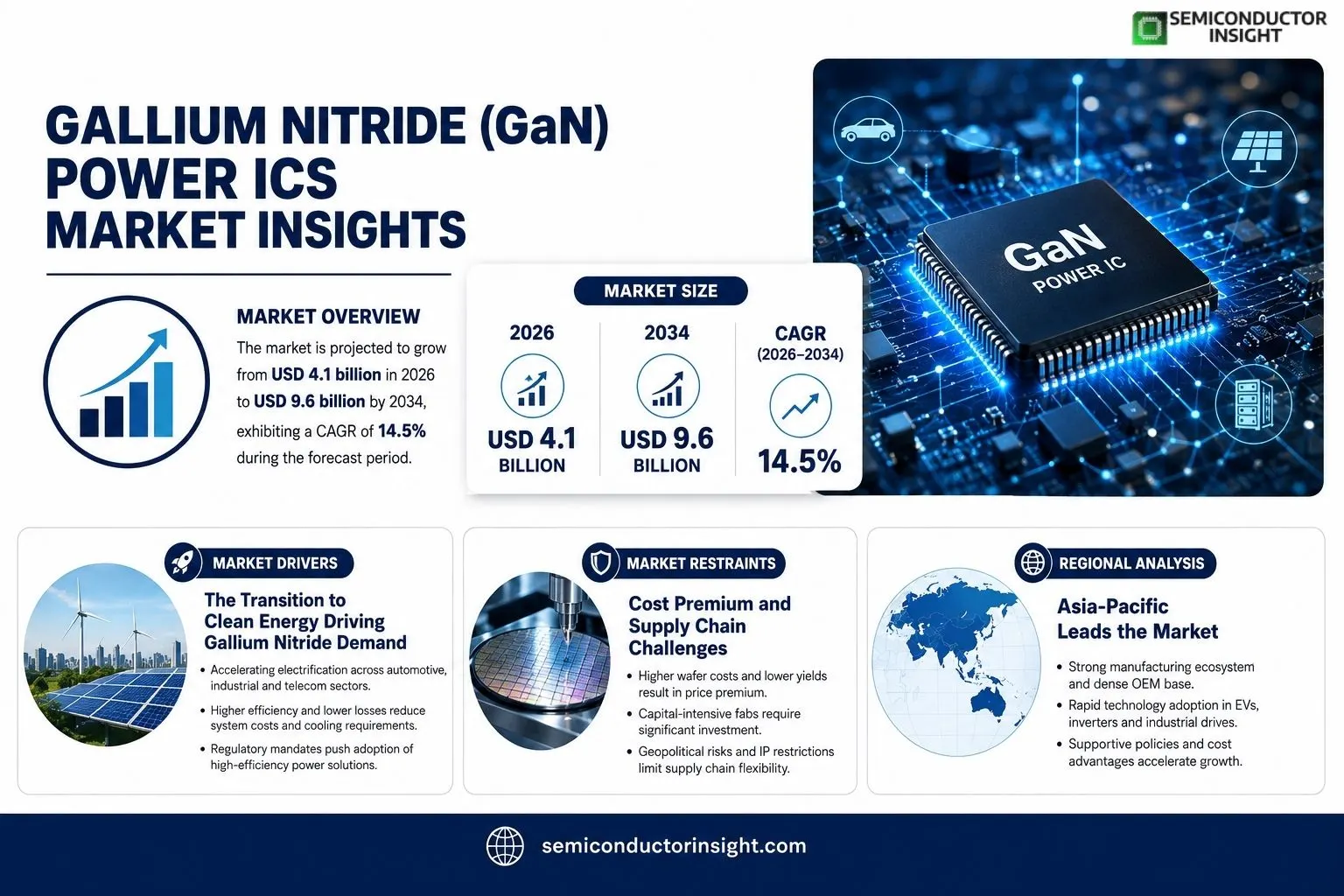
Gallium Nitride (GaN) Power ICs market was valued at USD 4.1 billion in 2026 and will rise to USD 9.6 billion by 2034, reflecting an implied CAGR of 14.5% over the forecast horizon.
Gallium Nitride (GaN) Power Integrated Circuits are semiconductor modules that integrate high‑electron‑mobility transistors with ancillary circuitry on a single die or package, allowing operation at higher voltages, frequencies and temperatures than conventional silicon counterparts while delivering markedly lower conduction losses and improved thermal management.These attributes render GaN power ICs highly suitable for data‑center power supplies, electric‑vehicle chargers, renewable energy inverters and consumer electronics adapters where efficiency directly translates into cost savings and reduced cooling requirements.
MARKET DRIVERS
The Transition to Clean Energy Driving Gallium Nitride Demand
As global electrification initiatives accelerate, power converters with higher efficiency become essential across automotive, telecom, and industrial sectors. Gallium Nitride Power ICs offer superior electron mobility and higher breakdown voltage compared to silicon, translating into tighter size envelopes, reduced heat dissipation, and lower operating costs. In electric vehicles, the adoption of 5 V/400 V or higher supply chains demands robust switches that can survive repeated high‑voltage cycles; GaN devices provide this reliability while maintaining minimal quiescent current. In renewable energy arrays, power inverters that mitigate harmonic distortion and support rapid fault response are now incorporating GaN transistors to boost overall conversion efficiency. Market analysts project that the cumulative effect of regulatory mandates, such as the EU Cyber‑Security and Energy Efficiency Directives, will force grid‑integrated systems to integrate GaN solutions to reduce inverter losses by several percentage points. The manufacturing sector anticipates a shift toward 45 nm gate length GaN FETs that support 1 kW per chip, reinforcing the case for higher up‑scaling. These technical advantages give GaN power ICs a competitive edge over emerging silicon‑on‑insulator (SOI) technologies, ensuring sustained drivers for the market’s expansion.
Supply Chain Optimisation and Globalisation of Component Production
Global supply chain digraphs now consistently place GaN cell development at the apex of semiconductor innovation centers such as Silicon Valley, Shenzhen, and the Munich Region. OEMs are strategically diversifying sourcing to mitigate geopolitical risk, especially from regions with historically high concentration of silicon wafer manufacturing. A trend toward integrated packaging solutions, such as wafer‑level encapsulation with embedded substrates, reduces lead times and per‑unit cost for GaN power modules. Supplier partnerships between leading process vendorsNXP, Cree, and Infineonand device manufacturers have cemented an ecosystem that offers customizable solution stacks for niche applications like aircraft-to-ground communication and high‑capacity data center edges. The lead optimization in silicon channel doping levels constructs a critical pathway where the cost curve flattens after a 2–3 year ramp‑up. OEMs such as Toyota, Bosch, and Huawei are leveraging such supply synchronicity to embed GaN power ICs into their next‑generation ASICs, meeting automotive software reliability levels. The overall economic forecast indicates an incremental rise in gross market throughput by the mid‑2020s, directly tied to improved supply reliability.
➤ Strategic partnerships between device manufacturers and system integrators are setting the stage for accelerated GaN adoption, driving down time‑to‑market for high‑power applications.
The confluence of higher efficiency targets, regulatory frameworks, and global supply chain orchestration positions Gallium Nitride (GaN) Power ICs at the forefront of next‑generation power electronics. Manufacturers who embed these drivers into product roadmaps can secure a foothold in high‑margin verticals, while investors who prioritize clean energy compliance can identify promising portfolios within the semiconductor domain.
MARKET CHALLENGES
Cost Premium and Capital Expenditure Constraints
Despite compelling technical advantages, the prevailing cost premium of GaN devices remains a bottleneck. Current production yields for large‑area wafers are inferior to silicon, inflating membrane throughput and leading to higher unit prices. Capital investment for next‑generation fab lines is substantial; even moderate lead times can delay return on investment for manufacturers prioritizing throughput constraints. ASIC designers must weigh these costs against the operational savings accrued through reduced power loss and system simplification. In regions where electricity tariffs remain moderate, the economic pressure to adopt GaN solutions is alleviated, resulting in uneven global uptake. These constraints form a persistent challenge that can deter early‑stage entrants and limit the penetration of GaN-based modules in volume‑driven applications.\n
Other Challenges
Standardisation and Interoperability Roadblocks
The absence of universally accepted performance benchmarks for GaN power ICsespecially regarding thermal cycling resilience and mechanical integrity under shockcreates uncertainty. OEMs often rely on vendor‑specific stress tests, leading to disparate failure modes that complicate system integration. Coupled with a fragmented documentation landscape, these interoperability gaps can increase development risk and extend certification timelines. Furthermore, insufficient temperature‑controlled packaging solutions hamper the application of GaN modules in automotive high‑temperature zones, raising additional safety compliance hurdles.
MARKET RESTRAINTS
Geopolitical Trade Restrictions and IP Lock‑Ins
Recent tariffs imposed on semiconductor imports by key markets, in particular the shifting U.S.–China trade posture, have increased procurement costs for GaN component importers. The tightening of technology extradition laws in certain jurisdictions has also slowed the ability of China‑based foundries to access cutting‑edge process technologies and intellectual property, thereby creating a bottleneck in the supply chain. Moreover, the predominance of a handful of process‑capable facilitiesmost notably those of NA and EU originleads to a concentration of manufacturing expertise that some smaller firms cannot readily replicate. These structural barriers limit the rapid scaling of GaN production and impose constraints on the cost structure for end‑users whose budgets remain sensitive to component price swings.
MARKET OPPORTUNITIES
Urban Mobility and Smart Grid Integration
The intersection of electric vehicle (EV) growth and smart grid modernization presents a fertile ground for Gallium Nitride (GaN) Power ICs. As urban centers push toward real‑time energy management, high‑efficiency converters that condition large‑scale photovoltaic arrays and battery storage clusters become increasingly valuable. Gallium Nitride’s superior switching capabilities enable pack‑level converters that operate at several hundred megawatt drives with reduced heat sink requirements, directly shortening system installation times and cutting electricity losses. In vehicular asterisms, the incorporation of GaN modules within battery‑management systems improves charge‑discharge cycles, thereby extending the effective range of low‑cost EV catalysts. The strategic deployment of such components in mass‑transit initiatives will raise demand for GaN power electronics, embedding these devices into the fabric of sustainable urban infrastructure. For market participants, identifying high‑volume projects in metro clusters can accelerate return figures and cultivate long‑term vertical integration opportunities.
Gallium Nitride (GaN) Power ICs Market Trends
Speed of Adoption Driven by Power Density and Efficiency Gains
Phasing out silicon for high‑power conversion, the GaN Power ICs Market has accelerated, propelled by markedly higher power density and unrivaled efficiency. Industry data shows competing analog IC segments have maintained growth rates above 15 % year over year, underscoring that power management remains a primary lever for the transition. In parallel, the rise of IoT‑centric embedded systems, especially within networking and industrial controls, has spurred demand for hybrid MPUs and MCUs that can deliver real‑time performance while consuming less power. For enterprise players, investing in GaN technology translates into lower parasitic losses, reduced cooling requirements, and slimmer footprints that can be integrated into compact designs. Suppliers face an urgent need to scale up wafer fabs and establish robust supply chains, whereas start‑ups that can bring cost‑effective GaN solutions to niche verticals may capture high‑margin share.
Other Trends
Integration of GaN Power ICs in Automotive Electronics
Automotive electronics represent a rapidly maturing use case for GaN Power ICs. The shift toward electrified fleets has generated a turbo‑charged appetite for fast charging and in‑vehicle power conversion, where every watt saved translates to longer ranges and lower operating costs. GaN devices can operate at higher pulsing frequencies and endure higher junction temperatures, allowing compact inverter and DC‑DC converter designs that fit within stringent vehicle packaging constraints. Manufacturers that harness these benefits are also mitigating the risk of component failure in extreme automotive environments. However, the sector remains sensitive to supply chain bottlenecks, and the high capital outlay for chip fabrication can strain margins unless economies of scale are achieved across multiple vehicle models.
Global Competitive Landscape and Consolidation Dynamics
Competitive dynamics in the GaN Power ICs Market are accelerating beyond conventional channel competition. A handful of incumbents, including Texas Instruments, STMicroelectronics, and Infineon Technologies, dominate revenue and are pivoting toward differentiated offerings that blend high‑power density with low EMI performance, catering to data centers and renewable power conversion. The specter of consolidation is evident, with acquisitions aimed at securing complementary intellectual property and wafer‑scale production capabilities, which bolster vertical integrations for system integrators. This environment pressures pricing, pushing providers to explore alternative device architectures and to negotiate tighter terms with preferred semiconductor suppliers. For market entrants, aligning with system integrators that target high‑efficiency data center racks or electric vehicle platforms could unlock cross‑sell opportunities, while strategic collaborations with material‑science labs may reduce R&D cycles. Ultimately, firms that balance innovation pace with supply resilience will dictate the next phase of market leadership.
COMPETITIVE LANDSCAPEKey Industry Players
Analysis of Principal Market Participants
In the high‑performance segment of the GaN Power IC market, incumbents such as Texas Instruments and Infineon Technologies dominate due to deep engineering pipelines and extensive sales networks. Their product portfolios span full‑swing power modules and prototype carriers that cater to data‑center power supplies and automotive conversion units, providing a competitive moat through proven reliability and aggressive pricing. The market structure reflects a concentration around these leaders, given their ability to service large enterprise accounts and secure long‑term OEM contracts, which translates into stable revenue streams even amid price volatility.Other players occupying critical niches include GaN Systems, Power Integrations, Navitas Semiconductor, and Transphorm. These firms focus on high‑frequency, low‑loss converters and have carved out specialized markets in industrial automation, solar inverters, and electric‑vehicle charging. Their success hinges on iterative design cycles and agile production scaling, allowing them to respond swiftly to emergent customer requirements. Emerging competitors such as EPC, Renesas, InnoScience, and STMicroelectronics add depth to the competitive landscape; they bring complementary technologiesranging from silicon‑on‑insulator processes to advanced driver ICsthat assemble into modular solutions, thus raising entry barriers for new entrants that lack diversified fabrication capabilities.
List of Key GaN Power IC Companies Profiled
- Texas Instruments
- Infineon Technologies
- GaN Systems
- Power Integrations
- Navitas Semiconductor
- Transphorm
- EPC (Efficient Power Conversion Corporation)
- Renesas Electronics
- STMicroelectronics
- InnoScience
- Cadence Design Systems
- Onsemi
Segment Analysis:
| Segment Category | Sub-Segments | Key Insights |
| By Type |
|
Enhancement Mode description with qualitative insights only [Pointers preferred in bullets atleast 2-3]. • Drives higher efficiency in power conversion. • Provides superior drive capability for high‑performance applications. • Enables integration in compact, high‑density designs. |
| By Application |
|
Data Center Power description with qualitative insights only [Pointers preferred in bullets atleast 2-3]. • Supports ultra‑stable voltage regulation under heavy loads. • Facilitates modular power supply units with lower footprint. • Improves thermal performance and reliability of server infrastructure. |
| By End User |
|
Automotive description with qualitative insights only [Pointers preferred in bullets atleast 2-3]. • Enables lightweight, high‑efficiency DC‑DC converters for vehicle electrification. • Supports rapid charging modules required by modern EVs. • Provides robust operation across wide temperature ranges. |
| By Power Density |
|
Low Power description with qualitative insights only [Pointers preferred in bullets atleast 2-3]. • Tailored for embedded and portable devices where space is constrained. • Provides precise voltage regulation with minimal energy loss. • Enhances battery life in handheld electronics. |
| By Packaging Type |
|
Wafer‑Level Packaging description with qualitative insights only [Pointers preferred in bullets atleast 2-3]. • Reduces parasitic inductance for superior high‑frequency performance. • Enables high‑density, multi‑chip interconnects. • Supports advanced packaging trends required by next‑generation power modules. |
Regional Analysis: Gallium Nitride (GaN) Power ICs Market
Asia‑Pacific
The total addressable footprint in this region has expanded, leveraging a mix of automotive heat‑management systems and industrial variable‑speed drives that demand higher efficiency. Consumption rates of GaN from 2026 onwards are outpacing legacy silicon by roughly thirty‑percent, reflecting a shift toward lower‑loss power channels.
Early‑stage transistor geometries, including lateral device implementations, have found traction in high‑frequency power modules. Newer monolithic GaN-on-SiC stacks are now standard in critical motor‑control circuits, reducing failure rates and thermal footprints.
Firms such as Cree, On Semiconductor and ROHM, alongside local joint ventures, sustain a competitive edge through supply‑chain integration and shared R&D initiatives.
Emissions standards and green‑technology rebates in Japan and China create a favorable contract environment, incentivising OEMs to adopt GaN modules for compliance.
North America
North America, while a smaller contributor to GaN landscape, is defining standards that ripple worldwide. Strong procurement channels from large electric‑vehicle manufacturers and a sophisticated power‑electronics corridor create a home for high‑end integration. Ongoing federal incentives for clean‑energy infrastructure encourage the deployment of GaN‑based converters across data centres and renewable‑energy arrays. Moreover, the density of venture capital dedicated to semiconductor prototypes pushes speculative developments into commercial readiness faster. The region’s talent base, coupled with stringent product‑quality norms, ensures that GaN power ICs from U.S. suppliers deliver the reliability required for mission‑critical applications. Consequently, while the sheer volume is modest, the strategic weight of North American demand shapes the international product roadmap and pricing dynamics.
Europe
European markets reflect a disciplined approach to sustainability, demanding high‑efficiency power solutions for both residential and industrial sectors. The region’s focus on energy‑efficiency licensing standards leads to a gradual but steady uptake of GaN devices in commercial building management and telecommunications infrastructure. Combined with robust intellectual‑property protection, European firms are excelling in niche, high‑performance GaN modules, particularly for RF front‑ends optimized for 5G and future 6G networks. A strategic partnership network across Italy, Germany, and the United Kingdom enables fast turnaround from design to production, reinforcing Europe’s reputation as a testbed for advanced power‑device concepts. The result is a growing, if still secondary, share in GaN power ICs market that taps into the infrastructure renewal drive across the continent.
South America
South America stands at the intersection of rising industrial activities and emerging renewable‑energy projects. The renewed interest in decentralised solar farms and electric‑vehicle initiatives in Brazil and Chile has sparked a modest spike in GaN consumption, notably in inverters and power converters that require reduced thermal margins. Local assembly plants are still limited, prompting import reliance, yet innovative local start‑ups are developing non‑critical GaN modules for power‑factor correction. These early adopters signal a modest but determined market entry path, supported by government incentives targeting modern energy solutions. While the overall market size remains outpaced by other regions, the potential for rapid scaling exists as the infrastructure upgrade cycle progresses.
Middle East & Africa
The Middle East and Africa display a dual‑pronged approach: the Gulf Cooperation Council countries pursue electrification of transportation and large‑scale grid upgrades, whereas African nations invest in rural electrification and renewable microgrids. GaN power ICs become attractive due to their compact size and lower‑loss characteristics, ideal for solar‑thermal coupling and diesel‑generator hybrids. Policy support for clean‑energy projects, along with robust investment frameworks, creates a warm market for GaN solutions geared toward automotive and industrial applications. Nonetheless, supply‑chain fragility and higher procurement costs still temper the pace of adoption, suggesting a growth corridor that lags behind the more developed regions but has clear cues for expansion.
Report Scope
This market research report provides a comprehensive analysis of the Gallium Nitride (GaN) Power ICs Market , covering the forecast period 2026–2034. It offers detailed insights into market dynamics, technological advancements, competitive landscape, and key trends shaping the industry.
Key focus areas of the report include:
- Market Overview: The report begins with an overview outlining its current market scenario, key growth indicators, and industry transformation drivers. It discusses macroeconomic factors, demand–supply balance, regulatory landscape, and the strategic role of semiconductors in powering advancements across industries such as automotive, telecommunications, consumer electronics, and industrial automation.
- Market Size & Forecast: Historical data and future projections for revenue, unit shipments, and market value across major regions and segments.
- Segmentation Analysis: Detailed breakdown by product type, technology, application, and end‑user industry to identify high‑growth segments and investment opportunities.
- Regional Insights: Insights into market performance across North America, Europe, Asia-Pacific, Latin America, and the Middle East & Africa, including country‑level analysis where relevant.
- Competitive Landscape: Profiles of leading market participants, including their product offerings, R&D focus, manufacturing capacity, pricing strategies, and recent developments such as mergers, acquisitions, and partnerships.
- Technology Trends & Innovation: Assessment of emerging technologies, integration of AI/IoT, semiconductor design trends, fabrication techniques, and evolving industry standards.
- Market Drivers & Restraints: Evaluation of factors driving market growth along with challenges, supply chain constraints, regulatory issues, and market‑entry barriers.
- Stakeholder Insights: Insights for component suppliers, OEMs, system integrators, investors, and policymakers regarding the evolving ecosystem and strategic opportunities.
Primary and secondary research methods are employed, including interviews with industry experts, data from verified sources, and real‑time market intelligence to ensure the accuracy and reliability of the insights presented.
FREQUENTLY ASKED QUESTIONS:
What is the current market size of Gallium Nitride (GaN) Power ICs Market?
-> Gallium Nitride (GaN) Power ICs Market was valued at USD million in 2026 and is projected to reach USD million by 2034, at a CAGR of 0% during the forecast period.
Which key companies operate in Gallium Nitride (GaN) Power ICs Market?
-> Key players include Texas Instruments, STMicroelectronics, Efficient Power Conversion Corporation (EPC), Navitas Semiconductor, Infineon Technologies, Renesas, GaN Systems, Power Integrations, Innoscience, and Transphorm.
What are the key growth drivers?
-> Growth drivers include the rise of IoT‑based electronics, demand for powerful processors and controllers, gradual growth of the Analog IC segment, automotive‑specific analog applications, and power management technologies.
Which region dominates the market?
-> North America remains the dominant region for Gallium Nitride (GaN) Power ICs manufacturing and deployment.
What are the emerging trends?
-> Emerging trends encompass advanced analog IC integration, hybrid microcontroller and microprocessor architectures for real‑time embedded processing, and the expansion of GaN applications in electric vehicle chargers and data center power supplies.
Get Sample Report PDF for Exclusive Insights
Report Sample Includes
- Table of Contents
- List of Tables & Figures
- Charts, Research Methodology, and more...
 Download Sample Report PDF