Wind Power Electronics Semiconductor Market Insights
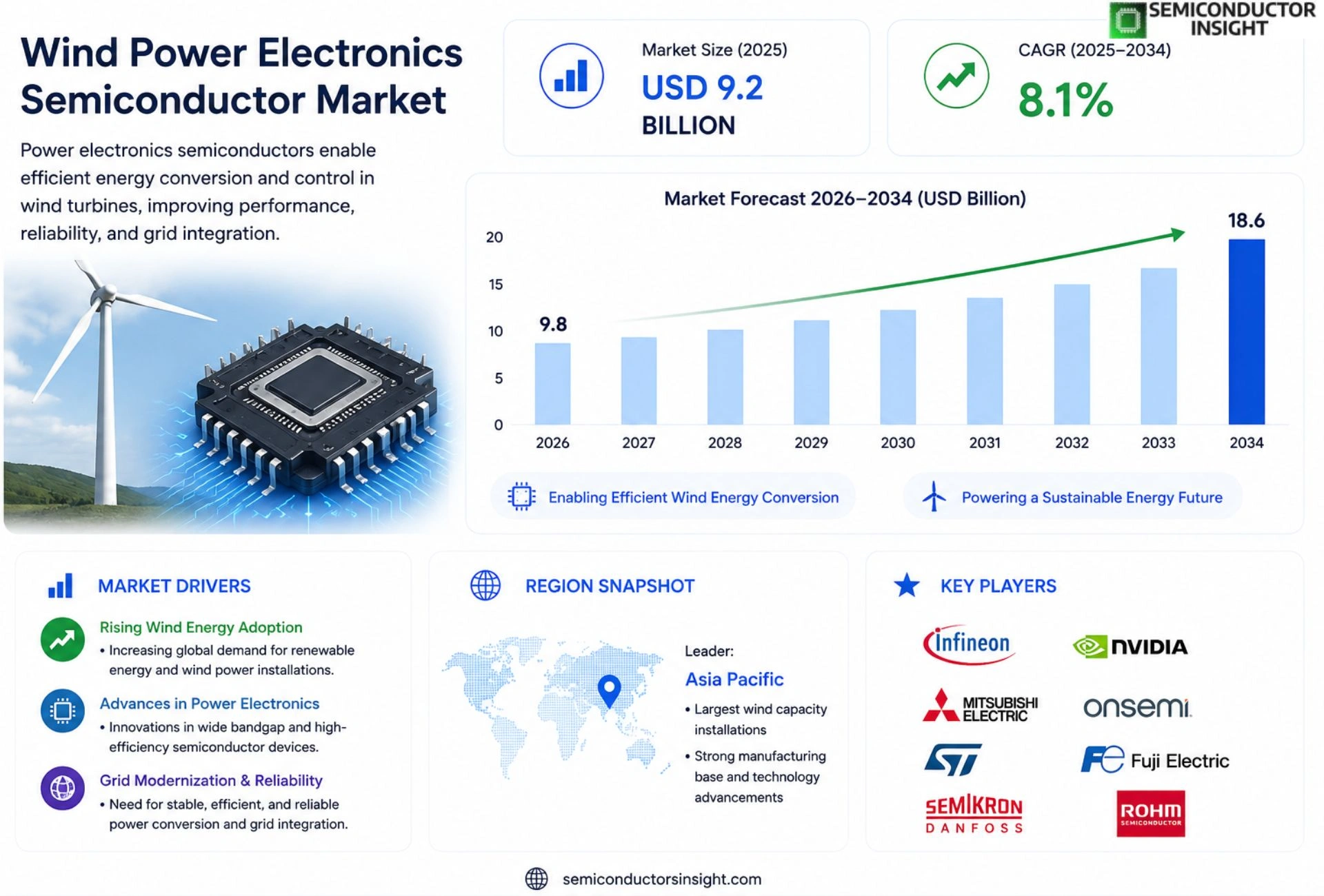
Global Wind Power Electronics Semiconductor market size was valued at USD 9.2 billion in 2025. The market is projected to grow from USD 9.8 billion in 2026 to USD 18.6 billion by 2034, exhibiting a CAGR of 8.1% during the forecast period.
Wind Power Electronics Semiconductors comprise high‑power devices such as IGBTs, MOSFETs, SiC and GaN transistors that enable grid‑connected converters, pitch‑control systems and fault‑ride‑through functions in modern turbines. These components manage voltage conversion, regulate frequency and ensure reliable energy capture across variable wind conditions.
The market is accelerating because of ambitious renewable‑energy targets worldwide, rising offshore wind capacity and declining costs of silicon‑carbide technology. Furthermore, increased turbine sizes demand more efficient power‑conversion solutions, prompting manufacturers like ABB, Siemens Energy, GE Renewable Energy and Mitsubishi Electric to expand their semiconductor portfolios. As utilities prioritize grid stability and storage integration, demand for advanced power‑electronics modules continues to surge.
MARKET DRIVERS
Growing Renewable Energy Capacity
The accelerating deployment of wind farms across North America, Europe, and Asia has increased demand for high‑efficiency power converters and control ASICs. Engineers are selecting silicon‑carbide (SiC) and gallium‑nitride (GaN) devices to improve inverter reliability and reduce losses, directly fueling Wind Power Electronics Semiconductor market.
Policy Incentives and Grid Modernization
Government‑backed renewable portfolio standards and tax credits are encouraging utilities to replace aging generation assets with wind turbines that require advanced semiconductor solutions. Simultaneously, grid‑integration projects demand smart converters that can respond to frequency and voltage fluctuations, creating a robust growth engine for the sector.
➤ “Semiconductor efficiency gains translate into 15‑20% lower levelized cost of energy for wind projects.”
Manufacturers are also leveraging economies of scale as turbine capacities exceed 10 MW, allowing volume production of power modules that further compress costs and expand market reach.
MARKET CHALLENGES
High Initial Capital Expenditure
Although long‑term savings are evident, the upfront cost of SiC and GaN devices remains higher than traditional silicon solutions. This price premium can delay adoption in cost‑sensitive regions and constrain capital‑intensive projects.
Other Challenges
Supply Chain Constraints
Limited wafer capacity and geopolitical tensions have occasionally disrupted the availability of key semiconductor materials, affecting delivery schedules for turbine manufacturers.
MARKET RESTRAINTS
Technical Integration Risks
Integrating next‑generation power semiconductors into existing turbine architectures requires redesign of control firmware and thermal management systems. Missteps can lead to reliability issues that erode confidence among OEMs, thereby restraining broader market penetration.
MARKET OPPORTUNITIES
Off‑shore Wind Expansion
The surge in offshore wind installations, projected to double by 2030, offers a fertile ground for high‑power semiconductor modules capable of operating under harsh marine conditions. Companies that can certify ruggedized SiC converters stand to capture a significant share of this emerging demand.
Wind Power Electronics Semiconductor Market Trends
Accelerating Adoption of High‑Power Devices
Wind Power Electronics Semiconductor market is being propelled by a confluence of policy ambition, turbine size growth, and technology cost reduction. Valued at USD 9.2 billion in 2025, the market is expected to rise to USD 9.8 billion in 2026 and reach approximately USD 18.6 billion by 2034, reflecting an average annual growth of about 8 percent. Core to this expansion are high‑power semiconductor families,IGBTs, MOSFETs, silicon‑carbide (SiC) and gallium‑nitride (GaN) transistors,that enable grid‑connected converters, pitch‑control mechanisms, and fault‑ride‑through functions. As turbine rotors become larger, the need for efficient voltage conversion and rapid switching intensifies, prompting manufacturers such as ABB, Siemens Energy, GE Renewable Energy and Mitsubishi Electric to broaden their semiconductor portfolios and invest in next‑generation device architectures.
Other Trends
Offshore Wind Expansion
Offshore wind installations are scaling rapidly, with new projects demanding power‑electronics that can tolerate the corrosive marine environment and higher thermal loads. The transition toward SiC technology is especially evident in offshore converters because SiC devices sustain higher temperatures while delivering lower conduction losses, which translates into higher overall turbine efficiency. OEMs are therefore prioritizing ruggedized packaging, advanced cooling schemes, and extended reliability testing to meet the stringent certification requirements of offshore farms.
Integration with Energy Storage and Grid Services
Grid operators are increasingly pairing wind farms with battery energy‑storage systems to mitigate intermittency and provide ancillary services such as frequency regulation and voltage support. This coupling creates a demand for semiconductor modules capable of bidirectional power flow, fast response times, and seamless coordination between generation and storage assets. Consequently, the market is seeing a rise in modular multilevel converters and intelligent gate‑drive circuits that simplify system integration while maintaining high reliability. The overall effect is a more resilient renewable‑energy portfolio that can participate actively in grid‑balancing markets, further reinforcing demand for advanced semiconductor solutions.
COMPETITIVE LANDSCAPE
Key Industry Players
Wind Power Electronics Semiconductor market Is Characterized by the Presence of Established Global Power Device Manufacturers and Specialized Semiconductor Companies Competing Across IGBT, SiC, GaN, and MOSFET Technology Segments
Wind Power Electronics Semiconductor market is dominated by a concentrated group of vertically integrated multinational corporations with deep expertise in high-power semiconductor design, manufacturing, and system-level integration. Infineon Technologies holds a commanding position in this space, leveraging its broad IGBT and SiC portfolio specifically engineered for wind turbine converter applications. The company’s CoolSiC and PrimePACK module families are widely adopted across utility-scale onshore and offshore wind installations. ABB and Hitachi Energy compete closely in the grid-tied power electronics domain, offering complete converter modules and semiconductor stacks that address fault-ride-through, pitch control, and frequency regulation requirements. Siemens Energy and GE Renewable Energy, while primarily turbine OEMs, maintain significant influence over semiconductor sourcing decisions and have been actively expanding their proprietary power electronics capabilities. Mitsubishi Electric and Fuji Electric represent strong Japanese semiconductor manufacturers with proven IGBT module technologies deployed across major wind turbine platforms globally. Wolfspeed, formerly known as Cree, has emerged as a disruptive force through its wide-bandgap silicon carbide power devices, which are increasingly preferred in next-generation turbine designs for their superior thermal efficiency and reduced switching losses at high frequencies.
Beyond the leading incumbents, several specialized and regional players contribute meaningfully to the competitive dynamics of Wind Power Electronics Semiconductor market. STMicroelectronics and ON Semiconductor offer competitive MOSFET and SiC transistor solutions targeting pitch-drive and auxiliary power subsystems within wind turbines. Semikron Danfoss, formed through the merger of two longtime power electronics specialists, is particularly well-positioned in modular IGBT assemblies favored by European turbine manufacturers. Vishay Intertechnology and Microchip Technology supply gate-driver ICs, protection components, and low-to-mid power semiconductor content supporting converter control architectures. ROHM Semiconductor has been gaining traction with its SiC MOSFET lineup as offshore wind project developers prioritize higher power density and longer operational lifespans. BYD Semiconductor and CRRC Times Electric represent China-based competitors that are rapidly scaling their IGBT and SiC manufacturing capacities to serve the country’s expanding domestic wind market and increasingly compete on the global stage, benefiting from strong state-backed policy support and vertically integrated supply chains.
List of Key Wind Power Electronics Semiconductor Companies Profiled
- Infineon Technologies AG
- Wolfspeed Inc.
- ABB Ltd.
- Hitachi Energy Ltd.
- Siemens Energy AG
- Mitsubishi Electric Corporation
- Fuji Electric Co., Ltd.
- Semikron Danfoss
- STMicroelectronics N.V.
- ON Semiconductor (onsemi)
- ROHM Semiconductor
- Vishay Intertechnology Inc.
- Microchip Technology Inc.
- BYD Semiconductor Co., Ltd.
- CRRC Times Electric Co., Ltd.
Segment Analysis:
| Segment Category | Sub-Segments | Key Insights |
| By Type |
|
SiC & GaN transistors
|
| By Application |
|
Grid‑connected converters
|
| By End User |
|
Wind turbine manufacturers
|
| By Technology Trend |
|
Wide‑bandgap devices
|
| By Market Driver |
|
Renewable‑energy policy incentives
|
Regional Analysis: North America
Focus on SiC and GaN semiconductors is driving efficiency gains in power electronics for wind turbines.
Federal and state initiatives support wind energy development and the adoption of advanced semiconductor technologies.
Ensuring a resilient and diversified supply chain for critical semiconductor components is a key concern.
The market features a mix of established semiconductor companies and emerging players specializing in power electronics.
Europe
Europe’s Wind Power Electronics Semiconductor Market is characterized by a strong emphasis on sustainability and renewable energy targets. Several European nations have ambitious goals for wind energy generation, creating significant demand for efficient power electronic solutions. The region’s commitment to decarbonization is driving innovation in wind turbine technology and grid integration, boosting the need for advanced semiconductors. Key players in Europe are focusing on developing highly integrated power modules and optimizing circuit designs to improve the performance and reliability of wind turbine converters. Furthermore, stringent environmental regulations are pushing the adoption of energy-efficient semiconductor technologies. The interplay of supportive government policies, technological innovation, and a growing renewable energy sector paints a promising outlook for Wind Power Electronics Semiconductor market in Europe.
Asia-Pacific
Asia-Pacific represents the fastest-growing market for Wind Power Electronics Semiconductors. Rapid industrialization, coupled with increasing investments in renewable energy infrastructure, is fueling demand. China, in particular, is a dominant force in the global wind energy market and a major consumer of power electronic components. The region’s focus on large-scale offshore wind projects further contributes to the demand for high-power semiconductors. Local manufacturers are expanding their capabilities, while international players are establishing a stronger presence. The cost-competitiveness of the Asia-Pacific region, along with government initiatives promoting renewable energy adoption, positions it as a key growth engine for Wind Power Electronics Semiconductor market.
South America
South America presents a moderate growth opportunity for Wind Power Electronics Semiconductor market. Countries like Brazil and Argentina have considerable wind energy potential, but development is often constrained by infrastructure limitations and regulatory uncertainties. Increasing energy demands and a growing awareness of environmental sustainability are creating a demand for modern power electronics. While the market is still relatively nascent compared to North America and Asia-Pacific, strategic investments and policy reforms could unlock significant growth potential for Wind Power Electronics Semiconductor market in the region.
Middle East & Africa
The Middle East and Africa represent a relatively emerging market for Wind Power Electronics Semiconductor market. Several countries in the region are actively pursuing renewable energy projects to diversify their energy mix and reduce reliance on fossil fuels. The large land areas and favorable wind resources offer significant potential for wind energy development. While the market is still in its early stages, growing investments in renewable energy and supportive government policies are expected to drive demand for power electronic components in the coming years, presenting an evolving landscape for Wind Power Electronics Semiconductor market.
Report Scope
This market research report provides a comprehensive analysis of the Wind Power Electronics Semiconductor Market , covering the forecast period 2026–2034. It offers detailed insights into market dynamics, technological advancements, competitive landscape, and key trends shaping the industry.
Key focus areas of the report include:
- Market Overview: The report begins with an overview outlining its current market scenario, key growth indicators, and industry transformation drivers. It discusses macroeconomic factors, demand–supply balance, regulatory landscape, and the strategic role of semiconductors in powering advancements across industries such as automotive, telecommunications, consumer electronics, and industrial automation.
- Market Size & Forecast: Historical data and future projections for revenue, unit shipments, and market value across major regions and segments.
- Segmentation Analysis: Detailed breakdown by product type, technology, application, and end-user industry to identify high-growth segments and investment opportunities.
- Regional Insights: Insights into market performance across North America, Europe, Asia-Pacific, Latin America, and the Middle East & Africa, including country-level analysis where relevant.
- Competitive Landscape: Profiles of leading market participants, including their product offerings, R&D focus, manufacturing capacity, pricing strategies, and recent developments such as mergers, acquisitions, and partnerships.
- Technology Trends & Innovation: Assessment of emerging technologies, integration of AI/IoT, semiconductor design trends, fabrication techniques, and evolving industry standards.
- Market Drivers & Restraints: Evaluation of factors driving market growth along with challenges, supply chain constraints, regulatory issues, and market-entry barriers.
- Stakeholder Insights: Insights for component suppliers, OEMs, system integrators, investors, and policymakers regarding the evolving ecosystem and strategic opportunities.
Primary and secondary research methods are employed, including interviews with industry experts, data from verified sources, and real-time market intelligence to ensure the accuracy and reliability of the insights presented.
FREQUENTLY ASKED QUESTIONS:
What is the current market size of Wind Power Electronics Semiconductor Market?
-> Wind Power Electronics Semiconductor market was valued at USD 9.2 billion in 2025 and is expected to reach USD 18.6 billion by 2034.
Which key companies operate Wind Power Electronics Semiconductor market?
-> Key players include ABB, Siemens Energy, GE Renewable Energy, and Mitsubishi Electric, among others.
What are the key growth drivers?
-> Key growth drivers include ambitious renewable‑energy targets worldwide, rising offshore wind capacity, declining costs of silicon‑carbide technology, and the demand for larger, more efficient turbines.
Which region dominates the market?
-> The reference does not specify a single dominant region; growth is globally distributed with strong activity in Europe, Asia‑Pacific and North America.
What are the emerging trends?
-> Emerging trends include adoption of SiC and GaN semiconductor technologies, integration of advanced power‑electronics modules for grid stability, and the development of higher‑efficiency conversion solutions for larger offshore turbines.

Get Sample Report PDF for Exclusive Insights
Report Sample Includes
- Table of Contents
- List of Tables & Figures
- Charts, Research Methodology, and more...
 Download Sample Report PDF