
Key Statistics
Key Takeaways
- Market expansion: Global sales of SiC power MOSFET switching devices stood at USD 555.8 million in 2025 and are projected to reach USD 1,153.8 million by 2034, representing 8.5% annual growth across the 2026–2034 window. Automotive inverter adoption, higher-power industrial converters and improving material yields are the principal demand channels.
- Voltage segmentation The 1000V–1500V band is the largest type at an estimated ~47% share, reflecting demand for 1200 V switches in traction and energy conversion. The 500V–1000V range follows with an estimated ~38%, while ratings below 500 V and above 1500 V remain narrower engineering niches.
- End-use mix Electric vehicles account for an estimated ~49% of sales by application because traction inverters purchase multiple high-value devices per platform. Smart grids contribute an estimated ~12%, communication power another ~16%, rail systems around ~8% and the remaining engineered uses an estimated ~15%.
- Regional supply chain Asia-Pacific represents an estimated ~49% of revenue, aided by car assembly and the broadest concentration of device processing. North America follows at an estimated ~23%, Europe holds ~22%, and South & Central America and Middle East & Africa contribute approximately ~3% each.
- Competitive challenge Leading suppliers must control substrate defects, high-temperature reliability and package inductance while automotive buyers impose lengthy qualification programmes. Rapid moves to 200 mm wafers promise more potential dice per process run, but lower yields and pricing pressure could limit how quickly that production advantage reaches selling prices.
Silicon Carbide (SiC) Power MOSFETs Market Overview
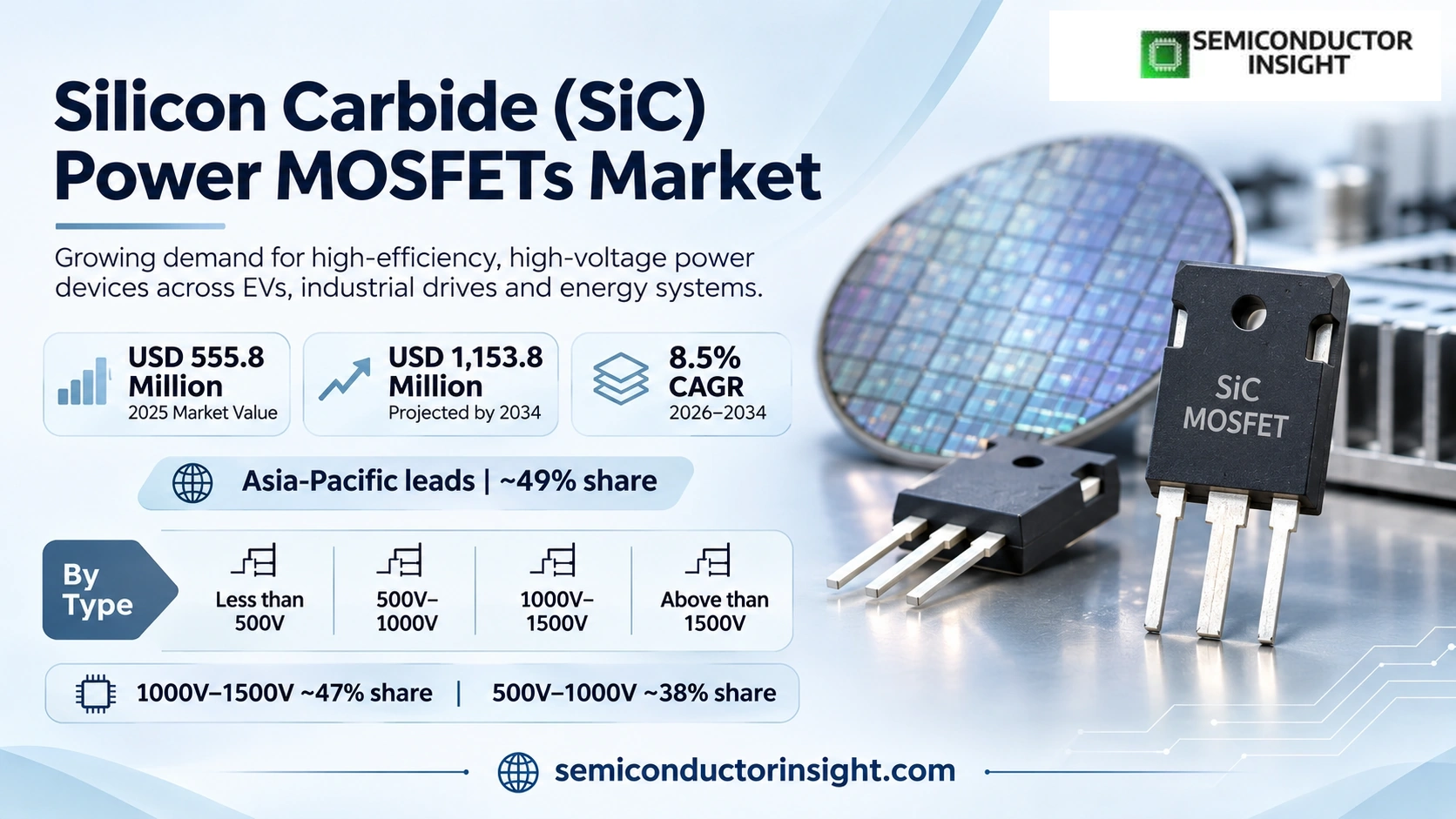
Silicon carbide (SiC) power MOSFET market was valued at USD 555.8 million in 2025 and is projected to reach USD 1,153.8 million by 2034, rising at a CAGR of 8.5% during 2026–2034. Asia-Pacific is the leading geographic market at an estimated ~49% share, reflecting its concentration of electric-vehicle manufacturing, inverter assembly and semiconductor component production.
Silicon carbide power MOSFETs are field-effect transistors that switch power at higher electric fields than traditional silicon parts. Their lower loss at demanding voltages allows compact gate-drive layouts, smaller cooling hardware and faster switching in electrical converters. Designers select 650 V, 750 V, 1200 V or 1700 V classes according to operating voltage, transient headroom and the thermal limits of the installed system rather than simply choosing the highest-rated component.
Revenue includes finished SiC MOSFET devices supplied as bare die, discrete packages and MOSFET-containing power modules where that is how the title product reaches a customer. It does not include silicon IGBTs, standalone SiC diodes, wafers and ingots sold as materials, traction inverter housings or complete solar and charging equipment. Such adjacent products influence demand and manufacturing costs but must not be mistaken for the revenue of power switching transistors.
Commercial specifications show the wide spread of electrical designs. Infineon offers 650 V and 750 V products alongside 1200 V and 1700 V industrial lines, while STMicroelectronics lists automotive-grade 1200 V devices with on-resistance down to single-digit milliohms. Gate-loop inductance, surge capability and junction-temperature operation are purchasing criteria because faster switching exposes weaknesses in the package and driver circuit before they appear on a conventional silicon power stage.
Automotive customers have particularly long validation cycles. A new powertrain may use several MOSFET dice in each phase leg, and its supplier must establish reproducibility across temperature cycling, short circuits, humidity and production lots. Equipment makers also seek lower switching losses on renewable inverters and data-centre power conversion, but a claimed device efficiency gain matters commercially only after qualification of the whole converter and cooling arrangement.
Segment Analysis: By Type
By type, the market comprises Less than 500V, 500V–1000V, 1000V–1500V and Above than 1500V MOSFETs. The 1000V–1500V group leads at an estimated ~47% share because 1200 V components suit high-voltage traction and industrial conversion, while 500V–1000V holds an estimated ~38% where 650 V and 750 V power stages need high-frequency switching and compact layouts.
| Type | Function | Market position |
|---|---|---|
| Less than 500V | Low-voltage SiC devices support specialist converter and protection architectures where rapid switching is valued but conventional silicon still offers an extensive low-cost catalogue. | The segment is small at an estimated ~7% share because sub-500 V applications can often avoid the material premium of wide-bandgap substrates. Engineers focus on switching charge, reverse recovery and transient immunity rather than blocking voltage alone. |
| 500V–1000V | An estimated ~38% of device revenue is associated with this range, including widely used 650 V and 750 V products for server power, charging auxiliaries and selected electric-car electrical subsystems. Package choices such as TO-247, TOLL and surface-mount footprints accommodate different board densities. | Low inductance and appropriate gate resistors are essential where fast voltage transitions create electromagnetic interference. |
| 1000V–1500V | The largest voltage class, estimated at ~47% share, contains 1200 V devices used in 800 V automotive electrical architectures, three-phase power stages, solar inverters and medium-power drives. Vendors compete on resistance at 25°C and at elevated junction temperatures, short-circuit withstand time and chip area. | Automotive-qualified packages often include Kelvin-source pins to keep driver voltage stable during high-current transients. |
| Above than 1500V | The high-voltage tier contributes an estimated ~8% of revenue and supplies 1700 V and higher-voltage designs for rail traction, heavy industry and utility infrastructure. Higher blocking capability can reduce series switching arrangements but brings challenges in insulation coordination, module construction and gate protection. | Purchasing volumes are smaller than mainstream automotive switches, and engineering approvals can determine product selection for many years. |
Secondary segmentation: procurement channel
The study also separates OEMs, System Integrators and Distributors and Resellers as an end-user axis. OEM buying represents an estimated ~64% of demand because automotive and converter makers qualify direct device supply, while system integrators hold ~25% in complex power projects and distribution accounts for the remaining ~11% in replacements, prototype work and small industrial runs.
| Axis | Members | Commercial role |
|---|---|---|
| End-User | OEMs · System Integrators · Distributors and Resellers | Design-in contracts, project-built equipment and stocked replacement components create different buying cycles and qualification responsibilities. |
Segment Analysis: By Application
Application demand spans Rail, Smart Grid, Electric Vehicle, Communication Power and Others. Electric vehicles lead at an estimated ~49% of value because wide-bandgap switching delivers a strong system efficiency benefit in high-energy traction systems, while communications power holds an estimated ~16% through rectifiers and backup conversion and smart-grid uses represent an estimated ~12% of demand.
| Application | Demand characteristics |
|---|---|
| Rail | Rail and heavy traction systems account for an estimated ~8% of market value, with SiC switches used where converters manage large motor currents and high-voltage supply variations. Operators prize lower cooling-system mass and reduced electrical loss, but approvals cover fault conditions, vibration and service lifetimes far beyond ordinary consumer electronics. Higher-voltage products can shorten switching strings while making insulation and module design more demanding. |
| Smart Grid | Grid-tied solar, storage and distribution applications represent an estimated ~12% of revenue. Conversion platforms must withstand changing dc-link voltage, harmonic limits and outdoor thermal cycles, so designers prioritize switching-loss improvement without compromising long-term reliability. A 1200 V MOSFET can support higher-frequency magnetics in certain inverter configurations, although gate-drive isolation and electromagnetic filtering remain substantial system cost items. |
| Electric Vehicle | Electric-vehicle systems contribute an estimated ~49% of value because high-voltage propulsion inverters and associated onboard power conversion buy qualified power devices in multiple positions per vehicle. International Energy Agency figures put global electric-car sales above 20 million in 2025. That vehicle figure is demand context, not the semiconductor revenue base: SiC adoption varies by battery architecture, motor power and automaker cost strategy. |
| Communication Power | Telecom rectifiers, uninterruptible power supplies and data-centre conversion represent an estimated ~16% of MOSFET sales. High-frequency switching reduces the size of inductors and transformer assemblies when thermal design permits, supporting dense equipment racks and 24-hour power continuity. Purchasing decisions depend on conversion efficiency, peak-load profiles, repair accessibility and line-replaceable power-module qualification. |
| Others | The remaining estimated ~15% is distributed across industrial motor drives, charging infrastructure, aerospace power conditioning, medical equipment and laboratory converters. A 650 V switch suits some ac-dc front ends, while 1200 V products serve higher-voltage conversion stages. Demand is diversified and project-led; the chosen device may need to work at elevated temperatures or intermittent high currents rather than steady automotive duty. |
Application design cycles create different commercial channels. An automaker may fix an approved 1200 V die and package for an entire vehicle platform, whereas an industrial supply designer can choose among several 650 V catalogue components when board qualification permits. Charging-equipment developers bridge these models: they want both volume pricing and fast access to new 750 V parts, with thermal and electromagnetic tests carried out on the assembled converter.
Regional Analysis
Asia-Pacific holds an estimated ~49% of SiC power MOSFET revenue, ahead of North America at ~23% and Europe at ~22%, because the region combines high-volume electric-vehicle assembly with semiconductor manufacturing and converter production. Asia-Pacific can grow at around ~9.4% CAGR, while the smaller Middle East & Africa and South & Central America markets gain from grid and charging investments but depend more heavily on imported devices and engineering support.
How do regional supply and end-use patterns shape power MOSFET demand?
Device demand follows the location where converters and modules are assembled, not necessarily where a vehicle, rail car or solar farm ultimately operates. China and Japan integrate SiC switches into vehicle and inverter designs; the United States combines domestic device technology with industrial and charging customers; European producers emphasize automotive qualifications, industrial drives and energy conversion. Emerging regions buy finished conversion assemblies as well as individual devices through distributors and system integrators.
| Region | Position | Growth outlook | Demand profile | What decides supplier selection |
|---|---|---|---|---|
| Asia-Pacific | Largest (~49%) | Fast (~9.4% CAGR) | EV traction, inverter assembly and device fabs | Cost, packaging yield and OEM qualification |
| North America | Second (~23%) | Steady (~7.7% CAGR) | Power semiconductor IP, grid and vehicle electrification | Domestic sourcing, availability and ruggedness |
| Europe | Third (~22%) | Steady (~7.9% CAGR) | Premium automotive and rail conversion | Functional safety, efficiency and validation |
| Middle East & Africa | Emerging (~3%) | Developing (~8.8% CAGR) | Renewables, utility equipment and charging | Import lead time and project approvals |
| South & Central America | Emerging (~3%) | Developing (~8.7% CAGR) | Distributed power, electric transit and mining | Local support, taxes and price stability |
Key Silicon Carbide (SiC) Power MOSFETs Manufacturers and Competitive Landscape
The SiC power MOSFET industry combines a small group of established wide-bandgap manufacturers with regional challengers and specialized module integrators. Suppliers compete on finished die cost, 650 V through 1700 V product breadth, defect control, automotive qualification and application engineering. A winning device is rarely sold on static resistance alone: gate-drive behavior, switching losses, long-term thermal cycling and a dependable production schedule influence purchase orders.
Infineon, Wolfspeed, STMicroelectronics, ROHM and onsemi are major names in the commercial SiC ecosystem. Infineon sells CoolSiC devices in both discrete and module forms and supports a broad voltage range, while Wolfspeed combines material expertise with power-switch products. Their customers buy documented device performance, quality-system continuity and a development pathway to higher-current generations. A customer qualified on one supplier may need considerable test work to change the die, package or switching arrangement.
Microchip, Mitsubishi Electric, Toshiba, Littelfuse and other power-device companies compete in industrial, railway, aerospace and automotive opportunities. Microchip lists a 1200 V, 180 milliohm SiC MOSFET bare die alongside 20 milliohm versions and conventional packaged components, demonstrating how much device geometry changes switching current and price. Some suppliers concentrate on qualification-intensive installations rather than the largest vehicle orders, and module integrators sometimes buy chips from more than one upstream vendor.
Competition is also geographic. Asian manufacturers aim to reduce cost through volume scale and shorter supply routes into vehicle factories, while European and North American suppliers differentiate with engineering tools, long warranties and detailed failure analysis. Manufacturers must also keep track of former corporate names: Microsemi products belong within Microchip, and the GeneSiC brand is associated with Navitas Semiconductor. Listing those names as independent current competitors would misstate the industry structure.
Tier structure
| Tier | Companies | Basis of competition |
|---|---|---|
| Global integrated leaders | Infineon, Wolfspeed, STMicroelectronics, ROHM, onsemi | Large product portfolios and manufacturing relationships spanning material acquisition, wafer processing, die fabrication and packaging. They supply automotive and industrial buyers through engineering teams, multi-year commitments and production traceability. Competitive advantages include validated switching models, process defect management, automotive grades and access to higher-diameter substrate supply rather than simply having the largest catalogue. |
| Established device makers | Microchip, Mitsubishi Electric, Toshiba, Littelfuse | Companies with power-electronics experience that target selected industrial, transportation and high-voltage applications. They provide bare-die or packaged device alternatives and often emphasize support across equipment lifetimes. Rail and utility buyers value service stability and fault withstand evidence; demanding system builders may prioritize a known qualification track record over the cheapest device at a single rated current. |
| Specialist and regional challengers | Navitas / GeneSiC, BASiC Semiconductor, InventChip, Yangzhou Yangjie | Focused or regionally concentrated suppliers addressing high-voltage conversion niches and cost-sensitive manufacturing channels. Their opportunity rises as multiple electrical architectures adopt SiC and original equipment manufacturers seek second sources. They still must demonstrate production repeatability, gate-oxide reliability, wafer quality and packaging performance to displace an approved switch in a safety-critical product. |
Key companies profiled
- Infineon Technologies
- Wolfspeed
- STMicroelectronics
- ROHM Semiconductor
- onsemi
- Microchip Technology
- Mitsubishi Electric
- Toshiba Electronic Devices & Storage
- Littelfuse
- Navitas Semiconductor / GeneSiC
- BASiC Semiconductor
- InventChip Technology
Silicon Carbide (SiC) Power MOSFETs Production Capacity Analysis
SiC power MOSFET output is constrained principally by good-quality crystal supply, wafer processing and qualified packaging. The transition from 150 mm to 200 mm substrates increases the available die area per wafer by roughly 78% before edge losses, but a larger wafer only lowers transistor cost when defect density, epitaxial uniformity and production yields remain under control. Manufacturing activity spans the United States, Europe, Japan, China and other East Asian electronics hubs.
Making a SiC transistor starts with bulk crystal growth, slicing, grinding and polishing before epitaxy and device fabrication. Defects that are acceptable in a passive ceramic component can create destructive leakage in an operating 1200 V switching device, so incoming substrates undergo strict metrology and inspection. Processing also requires gate-oxide reliability control and repeated measurements of on-resistance, leakage and breakdown voltage at wafer level before parts enter discrete packaging or power-module assembly.
Packaging capacity and tests become critical after fabrication. At a rated current of 100 A, stray inductance can change gate behavior during rapid current transitions and generate a voltage overshoot, even when the same MOSFET passed a static curve-tracer test. Sintered die attachment, Kelvin-source contacts, heat spreading, wire bonds or advanced interconnects influence module lifetime. Production plants therefore invest in thermal cycling, power cycling and lot traceability in addition to conventional end-of-line electrical checks.
The strongest capacity advantage is access to reliable, high-yield supply rather than gross wafer starts. Foundry and device makers can build extra processing lines yet remain short of automotive-approved 750 V or 1200 V products if substrate defects or gate-oxide variation increase scrap. Conversely, industry pricing can weaken when multiple suppliers ramp similar parts simultaneously. Commercial success depends on aligning crystal quality, device architecture, package output and confirmed converter design wins.
Silicon Carbide (SiC) Power MOSFETs Market Dynamics: Drivers, Restraints and Opportunities
Market growth is led by electric-vehicle traction conversion, better power efficiency in charging and renewable equipment, higher switching density in telecom and data-centre supplies, and gradual expansion of higher-voltage industrial uses. The principal counterweights are expensive defect-free substrates, costly thermal and safety qualification, the availability of silicon IGBTs in mature designs and the risk of overbuilding identical voltage grades before customer programmes reach volume.
MARKET DRIVERS
Drivers Impact Analysis*
| Market Drivers | Impact Rank | CAGR Contribution (%) | 2026–2028 | 2029–2031 | 2032–2034 |
|---|---|---|---|---|---|
| EV traction inverters and electric drivetrain adoption | High | +3.70% | High | High | Medium |
| Solar, grid storage and high-efficiency power conversion | Medium-High | +2.40% | High | High | High |
| Power supply efficiency in data centres and telecom | Medium | +1.65% | Medium | High | High |
| High-voltage industrial drives and rail conversion | Medium | +1.20% | Medium | Medium | High |
| 200 mm processing and improved device yields | Low-Medium | +1.00% | Medium | High | High |
| Others (fast charging, aerospace, power quality) | Low | +0.55% | Low | Medium | Medium |
Electric powertrains expand the installed switch base
The rapid global growth of electric-car production creates more high-voltage power stages that can use low-loss SiC switching. Each platform evaluates conduction loss, switching energy, cooling requirements and vehicle cost before choosing a 750 V or 1200 V device grade. Heavy-duty and premium passenger vehicles particularly value smaller thermal systems, although the net semiconductor opportunity depends on the actual share of vehicles specified with SiC rather than the entire electric-car sales tally.
Renewable converters reward energy-loss reduction
Grid-connected solar, battery systems and high-efficiency industrial power converters turn electrical energy repeatedly, so small loss differences accumulate over long operating periods. SiC MOSFETs enable higher switching frequency in certain topologies, reducing magnetics and supporting dense enclosures. The benefit must be measured with full switching waveforms and real load profiles, because better transistor efficiency can be offset by the need for additional electromagnetic filtering or more sophisticated cooling control.
Server and communications power increase switching density
Power supplies for communication racks and computing installations need predictable conversion performance at varying load. A 650 V or 750 V SiC transistor can be selected where switching speed reduces magnetic-component volume and conduction losses remain acceptable. Efficiency gains can free thermal capacity in high-density racks, while service agreements and protection circuits preserve uptime. Component makers offering validated gate drivers and reference designs can capture design-in opportunities beyond simply supplying the bare transistor.
Larger substrates enable new manufacturing economics
A transition from 150 mm wafers to 200 mm substrates offers significantly more nominal usable surface area and can improve the number of transistors processed per batch. That benefit is conditional on crystal quality and yield; a substrate with dislocations or variable epitaxy may waste more expensive processing than it saves. Power-semiconductor manufacturers therefore monitor micropipe density, wafer bow, oxide defects and electrical parametric spread as closely as the physical increase in production diameter.
MARKET RESTRAINTS
Restraints Impact Analysis*
| Market Restraints | Impact Rank | CAGR Contribution (%) | 2026–2028 | 2029–2031 | 2032–2034 |
|---|---|---|---|---|---|
| High cost of low-defect SiC material and device processing | Medium | -0.75% | High | Medium | Medium |
| Lengthy automotive and industrial qualification cycles | Medium | -0.55% | High | Medium | Low |
| Competition from mature silicon IGBT architectures | Low-Medium | -0.40% | Medium | Medium | Medium |
| Others (pricing pressure, package parasitics, supply imbalance) | Low | -0.30% | Medium | High | High |
Substrate and process losses lift device selling costs
High-temperature crystal growth, precision epitaxy and oxide processing are more difficult for SiC than for common silicon power wafers. Scrap from a defective 1200 V die carries the cost of several preceding steps, and automotive screening adds another layer of expense. These cost pressures favour established factories with stable material contracts and can slow adoption in converters that operate efficiently enough with less costly IGBT or super-junction silicon devices.
Qualification schedules delay commercial conversions
Switching to a new gate-oxide process or package can alter transient behavior, cooling balance and long-term failure modes, even if the replacement part has a similar voltage rating. An automotive inverter or rail converter may need extensive bench, environmental and field testing before procurement changes. Customers consequently maintain legacy devices for years, and rapid laboratory improvements in resistance or capacitance do not translate automatically into immediate high-volume order changes.
Silicon switching remains sufficient in many circuits
Traditional silicon IGBTs remain competitive in high-power converters with moderate switching frequency, and silicon MOSFETs serve low-voltage and cost-sensitive circuits particularly well. The advantages of SiC are strongest where high voltage, heat or switching loss impose a material system burden. Equipment designers must compare total converter cost and reliability; replacing a proven silicon stage solely to use a newer material can increase engineering effort without reducing customer operating expenses.
Price competition can outpace package innovation
A successful voltage class attracts many suppliers, particularly around common 650 V and 1200 V ratings. Aggressive quotations can reduce average selling prices even while design-in activity rises, and fast switching may force buyers to spend on snubbers, filters or isolation. Producers unable to differentiate on fault robustness, package thermals or reliable supply face margin pressure, which is especially difficult after committing capital to larger wafer processing lines.
MARKET OPPORTUNITIES
High-density onboard and roadside charging
Electric-car charging architecture continues moving toward higher operating power, faster switching and compact enclosure designs. Suppliers can win positions in rectifier, dc-dc and isolation stages if a validated MOSFET lowers thermal load without requiring excessive filtering. The engineering opportunity is strongest in selected 750 V and 1200 V stages, and suppliers with matching gate-driver application notes can shorten customer evaluations and improve their chance of being approved.
Higher voltage industrial solid-state equipment
The development of 1700 V and higher-rated SiC devices opens utility, rail and industrial systems that previously relied on multiple silicon parts or high-loss switching. Customer adoption is concentrated where lighter transformers, tighter controls or enhanced fault response have measurable value. Technical partnerships with integrators and stable long-term part availability are critical because installations may continue operating for well over a decade after commissioning.
Direct semiconductor-to-module supply relationships
Bare-die products allow module manufacturers to engineer their own substrates, cooling layers and interconnect layouts. This creates opportunities for power-chip makers to reach traction, industrial and renewable customers without competing only in off-the-shelf discrete packages. It also imposes higher screening expectations, because module assemblers want known-good die with predictable current sharing, oxide integrity and traceable manufacturing lots before committing to a multi-chip assembly.
Silicon Carbide (SiC) Power MOSFETs Supply Chain Analysis
The SiC power MOSFET supply chain runs from high-purity crystal growth and wafer substrates to epitaxy, transistor fabrication, final metallization, package assembly, screening and module integration. Qualified output is then sold to automotive and industrial equipment makers or through power-electronics distributors. Value concentration rises at the steps that determine defect density, device reliability and application-specific switching behavior, while the physical transistor may contain only a small fraction of the finished converter cost.
Materials. High-quality SiC substrate supply remains strategically significant because crystal defects influence the number of electrically usable transistors. Supplier agreements covering 150 mm and 200 mm material can help power-device companies stabilize procurement over multiple years, but a wafer purchase is not the same commercial transaction as the finished MOSFET sale. Incoming inspection examines defects, surface quality and epi compatibility before the costly diffusion and gate-forming steps begin.
Fabrication. Device factories form and test MOSFET cells, gate structures and junctions using equipment calibrated for wide-bandgap materials. A die may pass a 25°C static resistance check yet fail leakage or oxide endurance after thermal stress, so production testing must represent intended use conditions. High-volume output depends on stable parameters across wafer positions and lots, and an apparent production increase is valuable only when it generates more qualified devices.
Distribution. Large automotive and industrial buyers typically purchase through design-in agreements and demand long-term change notification, production traceability and engineering support. Smaller power-supply designers obtain discrete 650 V or 1200 V packages through distributors, often selecting parts available in several footprints. Distributors can help accelerate prototype work but cannot replace the converter maker’s responsibility for gate-drive tuning, thermal validation and regulatory compliance.
Integration. Downstream equipment makers compare MOSFET price against the full cost of magnetic components, cooling, enclosure volume and system downtime. A premium component can be justified in electric traction or power supplies when it improves lifetime efficiency, whereas conventional silicon often wins a low-cost application. The decisive purchasing evidence is a tested switching stage with repeatable electrical and thermal behavior rather than a single catalog figure or marketing claim.
Recent Developments in the Silicon Carbide (SiC) Power MOSFETs Market
- 11 November 2026 Product
Nexperia announced a family of 750 V SiC trench MOSFETs for industrial and automotive conversion, emphasizing temperature-stable resistance, reduced switching loss and new TOLL packaging options. The launch broadens competition in a rating class used in compact chargers and dense power supplies, and the package choices matter to designers who seek lower inductance without adding board area. The company described the portfolio as suitable for renewable energy, automation and electrified transportation. Source - 9 November 2026 Technology
Infineon announced the processing of functional power devices on a 300 mm silicon-carbide wafer at its Villach fabrication site in Austria. The achievement demonstrates technical feasibility at a diameter beyond the ongoing 150 mm to 200 mm transition, but does not by itself establish commercial-volume economics. Its relevance lies in potential future die-area utilization and substrate production scale for converters that require qualified power switches. Source - 15 October 2026 Supply
Wolfspeed and Infineon said they expanded a longstanding SiC wafer supply agreement to include 200 mm material alongside existing 150 mm supply. The contract extends a relationship of more than two decades and supports production planning as device manufacturers increase wafer diameter. A material agreement is an upstream capacity signal, rather than an immediate measure of demand for finished 1200 V MOSFETs. Source - 2 June 2026 Product
Infineon introduced a 750 V CoolSiC G2 bidirectional-switch configuration integrating two power switching elements with a common-drain structure in a top-side-cooled Q-DPAK package. The product announcement identified 14 to 66 milliohm variants, a 4.5 V typical threshold and a 2 microsecond short-circuit withstand specification. Such devices can simplify some charger and power-routing stages, although the bidirectional topology is not identical to a conventional single MOSFET. Source - 26 May 2026 Product
Microchip released 3.3 kV SiC power modules for solid-state transformer designs serving high-density computing and other medium-voltage applications. The announcement cited modules combining SiC MOSFETs and Schottky diodes in an industry-standard 62 mm package. This development extends the range of available voltage architectures, with demand dependent on infrastructure equipment qualification rather than existing traction-inverter volumes. Source
REPORT SCOPE & SEGMENTATION
| Attribute | Details |
|---|---|
| Study Period | 2018–2035 |
| Base Year | 2025 |
| Estimated Year | 2026 |
| Forecast Period | 2026–2034 |
| Historical Period | 2018–2024 |
| Market Size 2025 | USD 555.8 million |
| Market Size 2026 | USD 602.8 million |
| Market Size 2034 | USD 1,153.8 million |
| Growth Rate | CAGR of 8.5% from 2026–2034 |
| Unit | Value (USD Million) and device shipments |
| Segmentation | By Type, By Application, By End-User, and By Region |
| By Type | Less than 500V · 500V-1000V · 1000V-1500V · Above than 1500V |
| By Application | Rail · Smart Grid · Electric Vehicle · Communication Power · Others |
| By End-User | OEMs (Original Equipment Manufacturers) · System Integrators · Distributors and Resellers |
| By Region | Every region examined by voltage class, converter application, procurement channel and country Asia-PacificChina, Japan, South Korea, India, Rest of Asia-Pacific North AmericaUnited States, Canada, Mexico EuropeGermany, France, Italy, Austria, Rest of Europe Middle East & AfricaSaudi Arabia, United Arab Emirates, South Africa, Rest of region South & Central AmericaBrazil, Mexico, Chile, Argentina, Colombia and other markets |
| Key Companies Profiled | Infineon Technologies, Wolfspeed, STMicroelectronics, ROHM, onsemi, Microchip Technology, Mitsubishi Electric, Toshiba, Littelfuse, Navitas / GeneSiC, BASiC Semiconductor, InventChip Technology |
| Customization Scope | Optional country, customer-type, switching-voltage and package-category detail, with comparable device qualification and production-technology profiles. |
Frequently Asked Questions
How large is the silicon carbide power MOSFET market?
The global silicon carbide power MOSFET market was USD 555.8 million in 2025 and is projected to reach USD 1,153.8 million by 2034, corresponding to a CAGR of 8.5% across 2026–2034. Purchases arise from electric traction, power infrastructure, industrial conversion and communication power. Supply quality, packaging and qualification schedules influence adoption as much as the electrical efficiency gains of the transistor itself.
Which power MOSFET voltage class holds the largest share?
Devices rated from 1000 V to 1500 V lead with an estimated ~47% share because 1200 V switching is widely suited to high-voltage traction and industrial power systems. The 500 V to 1000 V range contributes about ~38%, offering practical choices for 650 V and 750 V converter stages. Higher-voltage and sub-500 V grades serve smaller specialized niches whose economics differ markedly from mainstream automotive supply.
How are SiC MOSFETs different from silicon IGBTs?
Silicon-carbide MOSFETs are field-effect switches designed to combine high blocking voltage with lower switching loss and fast control. A silicon IGBT is a bipolar device that can remain more economical in mature, moderate-frequency high-power converters. The best choice depends on current, thermal limits, switching waveform and lifetime cost, so a premium SiC die cannot be justified solely by comparing the voltage printed in two catalogues.
Why do electric vehicles use silicon-carbide switches?
A traction inverter converts battery electricity into the alternating phases required by a drive motor, causing power losses during both conduction and switching. Silicon carbide devices can reduce some losses and allow a smaller cooling assembly in suitable architectures. Adoption is strongest when the saving in mass, energy and thermal management exceeds the additional semiconductor price and the cost of qualifying a different gate-driver and module structure.
Which companies are principal MOSFET suppliers?
Global SiC portfolios include Infineon, Wolfspeed, ROHM, STMicroelectronics and onsemi, with Microchip, Mitsubishi Electric, Toshiba and Littelfuse supplying additional power-electronics designs. Navitas carries the GeneSiC business, and Microchip includes the former Microsemi operation. Customers compare each supplier by production traceability, technical support, 650 V to 1700 V availability, package options and the ability to sustain a qualified device through multiple equipment generations.
Which region purchases the largest share?
Asia-Pacific represents an estimated ~49% share because a substantial concentration of electric-car manufacturing, semiconductor processing and inverter assembly is located in the region. North America accounts for about ~23% and Europe about ~22%, supported by their automotive and industrial power engineering. Other regions import many finished conversion systems, which means final installation geography differs from the location where a transistor is purchased and integrated.
How do 150 mm and 200 mm SiC wafers affect production?
Increasing the wafer diameter from 150 mm to 200 mm yields approximately 78% more nominal circular area before edge exclusions, but the benefit depends on defects, epitaxial uniformity and wafer handling. A larger wafer with low usable device yield can cost more per qualified die than a smaller mature process. Manufacturers therefore measure material utilization and final electrical screening output, not simply the number of wafer starts in a new line.
What does a Kelvin-source terminal accomplish?
A Kelvin-source package supplies a separate, low-current return path for the gate driver so that voltage induced by power-current switching has less influence on the commanded gate voltage. This is valuable when a 750 V or 1200 V silicon-carbide device turns off quickly and the package has unavoidable parasitic inductance. Even with the extra terminal, engineers must choose an appropriate snubber, gate resistance and electromagnetic interference layout.
What are the main restraints on market growth?
Crystal and epitaxy defects, gate-oxide reliability, package thermal cycles and extensive qualification all raise the effective cost of SiC switches. Proven silicon IGBT and MOSFET designs retain a significant price advantage in less demanding converters, and identical voltage grades from competing suppliers may cause selling-price pressure. Power-equipment makers move cautiously because an untested substitute can affect fault protection and compliance for the entire operating system.
What exactly is covered by the market study?
The analysis covers the title-product revenue for SiC power MOSFET switching devices sold across voltage classes, converter applications and buyer channels. It includes discrete transistors, bare chips and MOSFET-containing modules when sold within the product category, while excluding raw ingots, wafers, non-MOSFET diodes, ordinary silicon switches and whole finished converters. Its geographic sections explain differences between device production, equipment assembly and final-use installations.
Research Sources & Evidence Base

Get Sample Report PDF for Exclusive Insights
Report Sample Includes
- Table of Contents
- List of Tables & Figures
- Charts, Research Methodology, and more...
 Download Sample Report PDF






Be the first to review “Silicon Carbide (SiC) Power MOSFETs Market Size, Share and Industry Analysis, 2026–2034”