Key Statistics
Key Takeaways
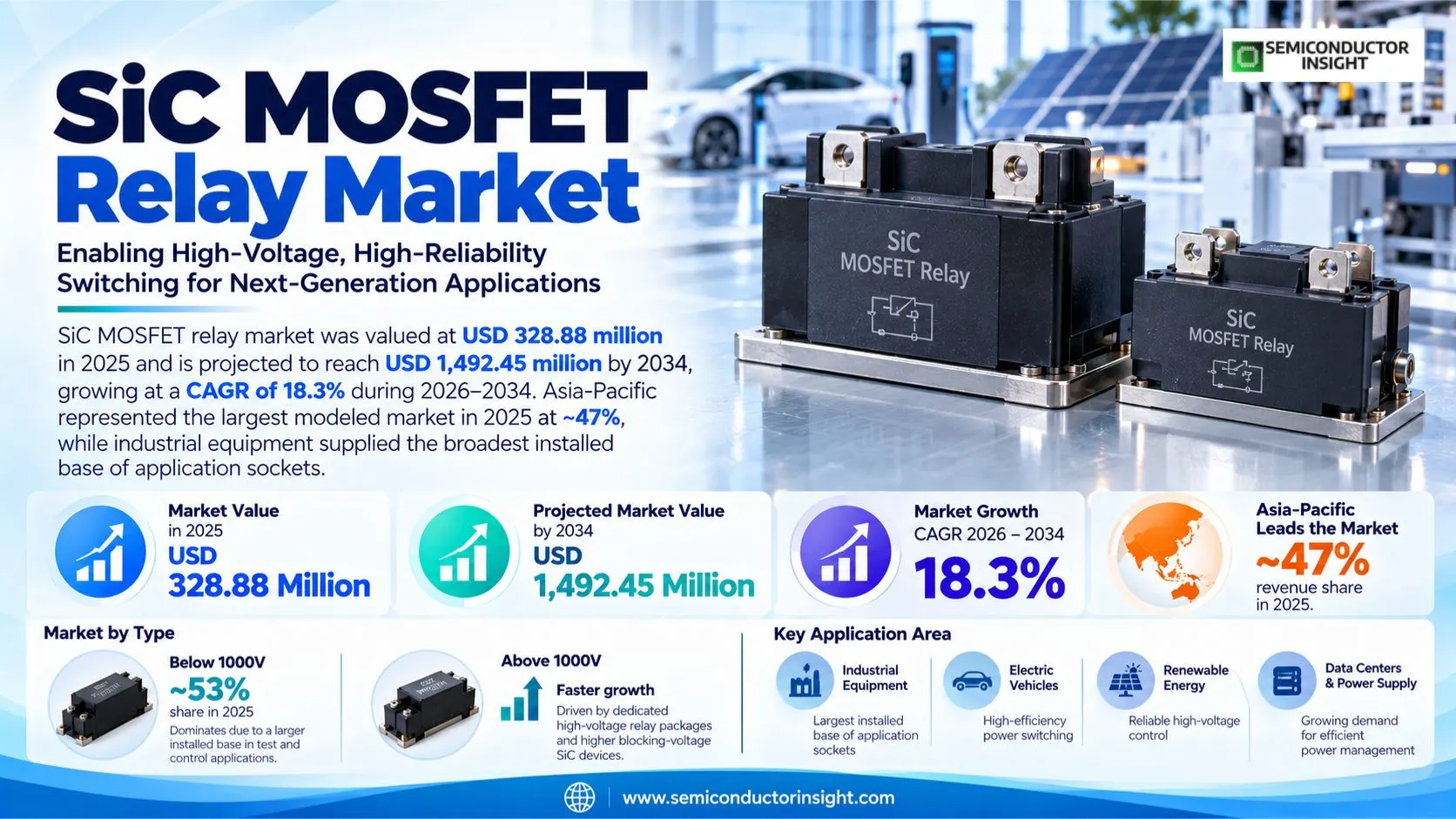
- Market trajectory: the global market reached USD 328.88 million in 2025 and is forecast at USD 1,492.45 million in 2034, with a 18.3% CAGR for 2026–2034 as electronic protection shifts from mechanical contacts toward fast, controllable switching at demanding voltage levels.
- Voltage split: below 1000V is the larger type at an estimated ~53% of 2025 sales, reflecting industrial sensing, automated test fixtures and compact control assemblies; the above-1000V class benefits from higher-value insulation and high-voltage qualification requirements.
- Application mix: industrial customers represent the largest application at an estimated ~38% of revenue, while automobile programmes have a modeled ~32% share and faster growth as vehicle architectures demand more sophisticated battery isolation and diagnostics.
- Regional position: Asia-Pacific accounts for an estimated ~47% of 2025 revenue, supported by its electronics manufacturing clusters and growing electric-mobility supply chain; North America follows at ~25% and Europe at ~19%.
- Commercial constraints: difficult insulation design, package thermal management and the price premium of qualified SiC components temper adoption; device availability, repeatable switching characteristics and lifetime validation determine whether customers move from trials into volume purchasing.
Global SiC MOSFET Relay Market Overview
SiC MOSFET relay market was valued at USD 328.88 million in 2025 and is projected to reach USD 1,492.45 million by 2034, growing at a CAGR of 18.3% during 2026–2034. Asia-Pacific represented the largest modeled market in 2025 at ~47%, while industrial equipment supplied the broadest installed base of application sockets.
A silicon carbide MOSFET relay is a semiconductor-based switching assembly that opens or closes an electrical path without the moving contacts used by an electromechanical relay. Its active switching elements are SiC MOSFETs, normally combined with isolation, control and protection functions suited to the rated load. The commercial distinction is not merely the transistor material: buyers purchase a qualified switching function with predictable leakage, insulation withstand, conduction loss and operating lifetime.
This market includes finished SiC MOSFET relay packages, high-voltage optically isolated switching devices and purpose-built solid-state switching or protection assemblies sold as relay functions. It does not include SiC MOSFET dies sold for general inverter manufacture, silicon-only PhotoMOS devices, electromechanical contactors or complete electric-vehicle traction inverters. The same device manufacturer may participate in both the relay and discrete transistor supply chains, but those revenue streams serve different purchasing decisions.
SiC devices allow switching functions to operate at elevated blocking voltages with relatively low conduction losses and rapid fault response. Aratas, formerly the Omron electronic-components business, lists G3VH relay variants rated for 1,800 V and 3,300 V loads, demonstrating the commercially available high-voltage end of this category. Engineers must still evaluate gate-drive isolation, transient overvoltage, short-circuit energy and heat removal, because semiconductor switching is not automatically a drop-in substitute for a mechanical contact.
Demand emerges first where a mechanical contact is slow, noisy, subject to wear or unable to switch frequently enough. Semiconductor automated test equipment repeatedly connects and disconnects devices during measurements; industrial power supplies require controlled pre-charge and fault isolation; and battery or grid protection designs increasingly investigate solid-state interruption. Each use case has a different qualification cycle, so the sales opportunity depends on validated system performance rather than the theoretical speed advantage of SiC alone.
The forecast reflects a widening voltage and application envelope rather than universal replacement of conventional relays. High-voltage prototypes and specialty protection systems can command a premium, whereas established low-voltage sockets face competition from silicon MOSFET relays with mature supply chains. The critical commercial threshold is whether reduced maintenance, faster switching and smaller equipment outweigh component cost, cooling requirements and the additional electronics needed to guarantee a safe failure state.
Segment Analysis: By Type
By type, SiC MOSFET relays are divided into below 1000V and above 1000V classes. The lower-voltage category holds an estimated ~53% share of 2025 revenue because test and control applications use a larger installed base of switching channels, while the above-1000V category is expanding more quickly as manufacturers introduce dedicated high-voltage relay packages and higher blocking-voltage SiC devices.
| Voltage type | Electrical role and customer requirement | Commercial position |
|---|---|---|
| below 1000V | Relays in this voltage class serve industrial measurement paths, signal isolation and controlled load switching where designers value repeatable timing, low leakage and compact printed-circuit-board integration. The requirement is often hundreds or thousands of cycles in automated equipment rather than a single high-energy interruption, so purchasing decisions emphasise contact-equivalent resistance, measurement accuracy, lifetime stability and component availability across successive equipment generations. | Largest type at ~53% of 2025 revenue. Customers can choose between established silicon MOSFET relay families and emerging SiC-based assemblies, making this the most price-sensitive portion of the market. SiC earns a place when thermal or transient conditions exceed the comfort zone of conventional devices; otherwise the cost advantage of silicon limits the addressable premium and makes design support a stronger differentiator than raw blocking voltage. |
| above 1000V | This class covers switching functions that require a blocking rating greater than 1 kV, including high-voltage automated test channels, laboratory power supplies and specialised protection cabinets. The G3VH range demonstrates 1,800 V and 3,300 V product ratings, but system designers must add suitable creepage, clearance and transient margins around the device. Higher voltages also raise the consequences of insulation breakdown, which lengthens qualification and increases the value of supplier documentation. | Modeled at ~47% of 2025 revenue and ~20.0% annual growth. High-voltage relay designs can reduce contact erosion and enable faster isolation in applications where mechanical solutions require substantial maintenance or cannot meet switching-time targets. Premium pricing compensates for difficult packaging and limited supplier choice, while production volumes remain concentrated in specialised industrial and test installations rather than consumer electronics. |
Voltage rating and system integration
A relay voltage rating describes the load that the packaged switching element can withstand under specified conditions; it is not the same as the DC bus voltage of a complete inverter or the absolute maximum rating of an unpackaged MOSFET. Designers commonly require margin for inductive transients and consider whether a bidirectional pair of devices is necessary to block current in both directions. This engineering distinction separates saleable relay assemblies from upstream transistor components.
Segment Analysis: By Application
By application, the market is segmented into Industrial, Automobile, Military, Aerospace and Others. Industrial uses account for an estimated ~38% of 2025 sales, reflecting equipment testing and machine protection, while automobile uses hold ~32% and grow more quickly as vehicle power architectures increase voltage and demand more controlled isolation functions.
| Application | Demand characteristics |
|---|---|
| Industrial | Largest application at ~38% share. Industrial users require repetitive switching in semiconductor test racks, production automation, grid-interface cabinets and power-quality systems. The same factory may operate low-voltage test channels and higher-voltage protective switches, making this segment commercially diverse. Qualification centres on repeatability, safe shutdown behaviour and the cost of an unplanned service visit, while the ability to fit existing control-board footprints affects supplier selection. |
| Automobile | Estimated ~32% share and ~20.6% modeled growth. Battery systems, charging equipment and high-voltage vehicle auxiliaries create opportunities for solid-state switching, particularly where rapid fault isolation or diagnostic operation is important. Nevertheless, automotive designers must prove performance under vibration, temperature cycling and stringent functional-safety requirements. High vehicle volumes can magnify a small component cost difference, so adoption follows platform-level engineering decisions rather than broad substitution of contactors. |
| Military | Modeled at ~12% of the market. Defence electronics favour predictable switching under harsh electrical conditions and long operating lives, including power-distribution and mission-equipment isolation. Procurement volumes are lower than industrial volumes, but qualification records, traceability and stable supply can justify higher unit prices. Designs may remain in service for many years, creating aftermarket demand but slowing rapid migration to newly introduced semiconductor packages. |
| Aerospace | Estimated ~9% of revenue. Aircraft electrical architectures seek lighter power-distribution equipment, fault containment and monitoring that can support more-electric platforms. Certification, thermal constraints and failure-mode analysis are unusually demanding, so adoption is concentrated in carefully defined subsystems rather than wholesale replacement of existing relays. Suppliers with dependable process control and extended product availability have an advantage over vendors offering only peak switching specifications. |
| Others | Remaining ~9% of modeled demand. The residual group includes laboratory instruments, specialised energy-storage installations and selected telecommunications or data-centre protection applications that do not fit the four named sectors. Orders tend to be project-based and specification-heavy, with the strongest opportunities where fast semiconductor interruption prevents damage to expensive equipment. This group is heterogeneous, so its aggregate growth does not imply uniform adoption across every downstream industry. |
Application economics differ as much as electrical specifications. Automated test operators may justify a semiconductor relay through reduced replacement downtime across millions of cycles, whereas an electric-vehicle platform must prove its isolation function under severe transients and cost constraints. Aerospace purchasers place unusual weight on documentation and product longevity, and defence customers may require controlled sourcing. Those differences explain why a single generic relay catalogue cannot address every part of the market.
Regional Analysis
Asia-Pacific is the largest SiC MOSFET relay region at an estimated ~47% of 2025 revenue, with North America at ~25%, Europe at ~19%, South America at ~5% and the Middle East and Africa at ~4%. Regional differences arise from manufacturing concentration, electrical-safety qualification, electric-mobility deployment and the maturity of local equipment supply chains; these factors determine whether customers buy catalogued devices or commission custom switching assemblies.
Where is demand for high-voltage semiconductor relays developing most quickly?
Asia-Pacific combines high-volume electronics production with the industrial laboratories that qualify switching devices, so suppliers can move from sample lots to factory orders relatively quickly. North American purchases are shaped by advanced protection research and industrial design approvals, while European demand emphasises reliability in automotive and energy equipment. South America and the Middle East and Africa remain more project-led, where system integrators often source qualified relays through imported control assemblies rather than local device manufacturing.
| Region | Position | Growth outlook | Demand profile | What decides supplier selection |
|---|---|---|---|---|
| Asia-Pacific | Largest (~47%) | Fastest (~19.2% CAGR) | Electronics and vehicle production | Design qualification, factory yield, multi-source assurance |
| North America | Second (~25%) | Steady (~16.7% CAGR) | Grid protection and test equipment | Safety evidence, fault response and technical support |
| Europe | Third (~19%) | Selective (~17.3% CAGR) | Automotive and industrial engineering | Lifecycle validation, thermal performance and documentation |
| South America | Emerging (~5%) | Expanding (~18.8% CAGR) | Renewable installations and imported machinery | Distributor access, serviceability and delivered cost |
| Middle East & Africa | Specialised (~4%) | Project-led (~19.7% CAGR) | Grid modernization and critical facilities | Harsh-environment ratings, engineering partners and tender timing |
SiC MOSFET Relay Manufacturers and Competitive Landscape
Competition in SiC MOSFET relays is defined by the distinction between manufacturers of finished switching packages and the much larger group supplying SiC power transistors, conventional MOSFET relays or protection assemblies. Direct product documentation for high-voltage SiC relays is more concentrated than the wider semiconductor supplier universe. Buyers therefore scrutinise part-number availability, technical support and qualification evidence before attributing a general power-device portfolio to this specialist market.
Aratas markets the G3VH high-voltage SiC MOSFET relay family through the electronic-components business formerly associated with Omron. Its published product catalogue establishes specific 1,800 V and 3,300 V offerings, whereas the conventional G3VM MOSFET relay family serves different switching requirements. This product-level distinction matters because an investor or procurement team cannot infer dedicated SiC relay revenue from a manufacturer’s total solid-state relay catalogue or from a broad semiconductor revenue figure.
The competitive set also includes Toshiba, Littelfuse, Omch, Refurvo, Bright Toward Industrial, Teledyne Relays and Manufacturer Group of Technology as names associated with the wider relay and switching supply chain. Their involvement varies by technology, product format and distribution role; listing a company in the category does not establish that every catalogued relay contains SiC. Technical comparisons must identify the actual switching die, rated load, isolation method and qualification status rather than relying on corporate-level branding.
Power-device producers including Wolfspeed, Microchip, onsemi, Infineon and STMicroelectronics influence the relay ecosystem by supplying SiC switching technology or competing protection architectures. Their discrete MOSFET sales are upstream revenue unless an integrated relay function is sold. The division is important because device improvements may accelerate new designs while commercial relay revenue remains dependent on system engineering, packaging, control electronics and a successful customer qualification programme.
Competition is strongest around the engineering services attached to a device. Industrial test customers seek stable switching resistance and low leakage; high-voltage protection integrators need credible fault-energy and thermal behaviour; automotive purchasers require traceable process control and long-lived component support. A vendor able to document those requirements can win a higher-value design even without the lowest nominal on-resistance, while a catalog-only supplier may struggle to move beyond evaluation samples.
Tier structure
| Tier | Companies | Basis of competition |
|---|---|---|
| Direct SiC relay products | Aratas (formerly Omron electronic components) | The G3VH product family is documented as a SiC MOSFET relay with 1,800 V and 3,300 V ratings, providing a direct reference point for high-voltage switching specifications. Buyers can compare available package versions, leakage characteristics and operating conditions against their test or protection circuit. The ability to supply repeatable production lots and updated documentation supports qualification beyond a one-off laboratory demonstration. |
| Relay and switching specialists | Toshiba; Littelfuse; Omch; Refurvo; Bright Toward Industrial; Teledyne Relays; Manufacturer Group of Technology | These companies appear in the broader relay and power-switching competitive environment, but their portfolios span multiple semiconductor materials and electromechanical formats. Product-by-product verification is necessary before assigning any specific device to the SiC MOSFET relay category. Their channel networks, design relationships and safety documentation can still affect purchasing decisions and competitive pressure in adjacent switching applications. |
| Upstream technology and substitutes | Wolfspeed; Microchip; onsemi; Infineon; STMicroelectronics; Panasonic Industry | SiC power-device developers supply the transistors that can enable integrated switching assemblies, while silicon PhotoMOS and other semiconductor relays offer established alternatives. This group influences achievable voltage, conduction loss and component cost without necessarily selling finished SiC relays. System integrators determine whether those devices are packaged into a relay product that competes for the end-customer switching socket. |
Key companies profiled
- Aratas (formerly Omron electronic components)
- Toshiba
- Littelfuse
- Omch
- Refurvo
- Bright Toward Industrial
- Teledyne Relays
- Manufacturer Group of Technology
- Wolfspeed (upstream)
- Microchip Technology (upstream)
- onsemi (upstream)
- Infineon Technologies (adjacent)
- STMicroelectronics (upstream)
- Panasonic Industry (silicon relay alternative)
SiC MOSFET Relay Manufacturing and Qualification Capacity
Manufacturing capacity for SiC MOSFET relays cannot be read directly from the wafer capacity of a power-semiconductor producer. Finished relays require die selection, assembly, electrical isolation, package design, production screening and traceable application qualification. Production flexibility depends on access to suitable SiC devices and on test infrastructure capable of measuring leakage, on-resistance and switching behaviour at the voltage class customers specify.
The supply chain begins with silicon-carbide crystal growth, wafer processing and fabrication of MOSFET dies, then moves to device assembly and the manufacture of isolated switching packages. Each step imposes a different yield constraint. A die that meets an inverter application may not meet the leakage or bidirectional blocking requirements of a precision relay, so manufacturing capability must be assessed at the finished-product level rather than by multiplying available wafers by an assumed number of relays.
High-voltage relay assembly demands particular attention to creepage, clearance, encapsulation and heat removal. As the blocking requirement moves from sub-1 kV to 1,800 V or 3,300 V, electrical testing becomes more demanding and qualification lots may remain relatively small. Suppliers can improve economics through common packages and automated final tests, but a broader range of voltage options also increases inventory complexity and the engineering burden of supporting multiple customer designs.
Production availability is also shaped by the demand for SiC MOSFETs in vehicle inverters, charging systems and industrial drives. When those larger sectors absorb fabrication output, relay integrators may face longer lead times or tighter device allocation even if the end-market for relays is comparatively small. Qualified alternative sources and stable die revisions can therefore be as important as nominal wafer capacity, particularly for aerospace and defence programmes with long maintenance lives.
SiC MOSFET Relay Market Dynamics: Drivers, Restraints and Opportunities
The strongest growth factors are fast fault interruption, higher-voltage switching requirements, repeated operation in automated equipment and expansion of high-voltage electrical platforms. Adoption is constrained by component premiums, difficult protection design and long customer qualification cycles. The modeled driver and restraint impacts distinguish the demand for complete relay functions from broader SiC transistor shipments, which may expand for reasons unrelated to electronic isolation.
MARKET DRIVERS
Drivers Impact Analysis*
| Market Drivers | Impact Rank | CAGR Contribution (%) | 2026–2028 | 2029–2031 | 2032–2034 |
|---|---|---|---|---|---|
| Rapid electronic fault isolation in industrial and grid equipment | High | +8.20% | High | High | Medium |
| Higher-voltage EV battery and charging architectures | High | +5.30% | Medium | High | High |
| Automated test equipment requiring frequent switching | Medium-High | +4.10% | High | Medium | Medium |
| Low-maintenance switching in critical power systems | Medium | +2.70% | Medium | High | High |
| Miniaturization and thermal performance improvements | Low-Medium | +1.80% | Medium | Medium | High |
| Others (aerospace electrification, pulsed-power research and specialty instruments) | Low | +1.20% | Low | Medium | Medium |
Fault response creates a measurable equipment benefit
Solid-state switching can interrupt a current path without waiting for contacts to separate, making it attractive in selected high-value protection functions. That advantage must be evaluated with sensing and gate-drive delay, but it can reduce damage to downstream equipment when the complete circuit is engineered correctly. Industrial buyers value the avoided outage and maintenance expense, which can support a higher acquisition price than a conventional contactor.
Vehicle voltage upgrades widen the engineering envelope
Electric-vehicle electrical systems increasingly use higher bus voltages to reduce current for a given power level, increasing the importance of reliable isolation and diagnostic functions. The relay opportunity is concentrated in auxiliary and protection designs that need semiconductor switching rather than in the traction inverter itself. Vehicle-platform validation is lengthy, but a successful qualification can create recurring demand across several model years and multiple assembly locations.
Automated testing rewards contactless switching
Semiconductor test equipment may switch measurement channels far more frequently than an industrial safety cabinet, exposing mechanical contacts to wear and contact-resistance variation. A solid-state relay can offer repeatable timing and a compact interface, provided leakage and capacitance remain within the measurement specification. The economic benefit depends on test throughput, fixture maintenance and the value of avoiding false failures, not simply on the number of relays installed.
Power infrastructure introduces specialist high-voltage uses
Grid interfaces, critical facilities and industrial power systems require fast isolation of faults that can propagate through expensive electronics. Silicon-carbide devices permit designers to investigate compact solid-state protection at voltage levels that once required bulky assemblies. Such projects often begin as engineering prototypes and pilot cabinets, with commercial adoption depending on standards compliance, field reliability and integration with existing circuit breakers.
MARKET RESTRAINTS
Restraints Impact Analysis*
| Market Restraints | Impact Rank | CAGR Contribution (%) | 2026–2028 | 2029–2031 | 2032–2034 |
|---|---|---|---|---|---|
| Premium device and high-voltage package cost | High | -1.90% | High | Medium | Medium |
| Safety validation and difficult fault-energy management | Medium-High | -1.30% | High | High | Medium |
| Competition from silicon relays and mechanical contactors | Medium | -1.00% | High | Medium | Low |
| Others (supply concentration, redesign expense and lengthy procurement) | Low | -0.80% | Medium | Medium | Low |
Higher initial cost narrows the feasible socket base
SiC switching devices and the insulation needed for high-voltage packages generally cost more than mature silicon relay components. In applications with infrequent switching, a mechanical contactor can provide acceptable lifetime at a lower purchase price. Suppliers must demonstrate reduced downtime, faster protection or smaller installation size before a customer can justify the premium, and this requirement keeps many ordinary control circuits outside the practical addressable market.
Fast switching shifts risk into system engineering
A semiconductor relay does not provide the visible contact gap of a mechanical isolator, and its failure behaviour depends on gate control, device stress and thermal conditions. Engineers must assess transient overvoltage, short-circuit energy, leakage and coordination with backup protection. These design tasks extend qualification schedules and can require custom hardware, limiting the speed at which an attractive prototype becomes a certified industrial or vehicle product.
Established alternatives retain substantial advantages
Silicon MOSFET relays offer mature manufacturing, broad distribution and attractive prices for many lower-voltage switching functions. Mechanical relays and contactors remain compelling where galvanic isolation, low standby loss or a clear open circuit is required. As a result, SiC suppliers compete selectively in demanding electrical conditions rather than replacing every existing relay technology, and customer education alone cannot overcome an unfavourable lifecycle cost comparison.
Supplier and procurement risks complicate long-lived programmes
Aerospace, defence and critical infrastructure customers may require identical components over many years, but specialist high-voltage SiC packages can have narrower sourcing options than standard control relays. A die revision or package discontinuation may trigger renewed qualification. Equipment makers therefore weigh inventory strategy, alternative part availability and the supplier’s technical-support commitments when selecting a switching architecture for long-lived installations.
MARKET OPPORTUNITIES
Bidirectional solid-state protection assemblies
Many high-voltage DC applications require interruption regardless of current direction, encouraging paired SiC MOSFET arrangements and sophisticated gate control. Research on common-source switching topologies supports development of compact protection products for equipment that must manage reverse current and fast transients. Suppliers that integrate sensing, isolation and fault handling into a qualified assembly can capture more value than sellers of individual power dies.
Test-equipment channels with high replacement costs
High-throughput production testers create a clear financial case for reducing relay wear and maintenance visits. A component supplier that proves low leakage, stable on-resistance and repeatable timing can become part of a test-platform design used across several factories. This channel also provides feedback on field reliability, helping manufacturers improve packaging and screening before entering more demanding safety-critical applications.
Specialised electric-mobility auxiliaries
Vehicle power distribution and charging equipment increasingly require diagnostic switching and controlled isolation alongside their main power-conversion stages. SiC relays can compete in narrowly defined functions where rapid electronic control or high-voltage endurance offers a system benefit. Suppliers must partner early with platform engineers to establish safety requirements, because a part selected late in the design process faces expensive requalification and little pricing flexibility.
Critical-facility and industrial power continuity
Data-centre power equipment, industrial plants and distributed energy assets place high value on avoiding destructive faults and unscheduled downtime. Advanced semiconductor switching may reduce interruption times in certain architectures, but its use depends on robust thermal and protection coordination. Vendors offering tested subassemblies, application notes and integration support can win projects that would be inaccessible to a seller of discrete transistors alone.
SiC MOSFET Relay Supply Chain Analysis
The value chain connects SiC substrate and wafer producers, transistor fabrication, relay packaging, electronic control design and original-equipment manufacturers. Technical value increases when suppliers move from selling a transistor to guaranteeing a switching function with known isolation, fault behaviour and service life. The final buyer is usually an equipment maker or integrator, not the operator of the electrical installation.
Upstream devices. Crystal quality, MOSFET yield and high-voltage device availability influence the cost of the relay’s active elements. Suppliers of 1,200 V, 1,700 V and higher-voltage transistors participate upstream, but their product sales should not be treated as completed relay shipments. Designers may use multiple devices in a bidirectional arrangement, so the die count and total assembly value depend on the chosen topology and protective electronics.
Assembly and testing. The manufacturer must combine semiconductor dies with an isolated control interface, insulation materials and a package that can remove heat under continuous current. Production tests verify blocking voltage, leakage, conduction behaviour and switching operation, with additional screening for demanding end markets. This stage converts a general-purpose transistor into a repeatable switching product, and poor assembly yield can outweigh improvements in upstream device cost.
Distribution and design-in. Industrial distributors supply catalogue relays for evaluation, but high-voltage protection projects often require direct contact between an application engineer and the original-equipment manufacturer. Technical support must address fault waveforms, cooling, electromagnetic interference and safe shutdown. Once the customer qualifies a specific part, changing suppliers can require substantial redesign, making continuity of supply and documentation important competitive advantages.
Downstream equipment. The end market includes testers, battery-system auxiliaries, electrical protection cabinets and specialised aerospace or defence electronics. Buyers judge the relay as part of a complete system, considering whether it reduces service costs or improves fault response without introducing unacceptable failure modes. The same installation may use SiC MOSFET relays for one demanding function while retaining mechanical contacts or silicon devices elsewhere.
Recent Developments in the SiC MOSFET Relay Market
- 12 June 2026 Product documentation
Aratas updated its G3VH high-voltage SiC MOSFET relay data sheet, documenting variants with 1,800 V and 3,300 V load ratings. The publication provides engineers with a defined component reference for qualification of high-voltage switching channels. Its significance lies in a finished relay product rather than an upstream transistor announcement, allowing customers to assess package selection, electrical conditions and production availability. Source - 9 June 2026 Technology launch
Wolfspeed introduced a new generation of SiC MOSFET technology targeting improved conduction performance in 750 V and 1,200 V device classes. The announcement concerns power transistors, not a dedicated relay product. Lower device losses can nonetheless improve the economics of future solid-state switching assemblies if integrators can translate the technology into qualified isolation, thermal and fault-protection designs. Source - 28 April 2026 Automotive collaboration
onsemi described an expanded collaboration with Geely around advanced power electronics for a 900 V vehicle architecture. The development indicates continued investment in high-voltage vehicle platforms and associated component qualification, but it does not document SiC relay sales. Its relevance to the relay category is the growing engineering attention to reliable electronic isolation and controlled power distribution around higher-voltage systems. Source - 5 May 2025 Portfolio expansion
Infineon detailed a CoolSiC JFET product portfolio intended for industrial protection and switching uses. JFET devices are distinct from MOSFET relays and should not be counted as finished products in this category. The development is commercially relevant because competing semiconductor topologies influence the design choices and cost benchmarks that manufacturers face when creating high-voltage solid-state switching equipment. Source - 24 September 2024 Device generation
STMicroelectronics announced its fourth generation of SiC MOSFET technology for automotive and industrial applications. Improved transistor performance expands the set of components available to switching-system developers, but relay functionality still requires package insulation, control electronics and verified fault behaviour. The event illustrates how upstream semiconductor advances may precede, rather than coincide with, qualification of finished relay assemblies. Source - 2025 Technical research
An IEEE conference contribution investigated bidirectional common-source SiC MOSFET arrangements for solid-state circuit protection. The work addresses the practical requirement to control current in either direction while managing conduction loss and switching transients. Its significance is technical validation of a possible relay architecture; commercial adoption still depends on engineering a manufacturable package and meeting the electrical safety conditions of the intended installation. Source
REPORT SCOPE & SEGMENTATION
| Attribute | Details |
|---|---|
| Study Period | 2021–2034 |
| Base Year | 2025 |
| Estimated Year | 2026 |
| Forecast Period | 2026–2034 |
| Historical Reference | 2021–2024 |
| Market Size 2025 | USD 328.88 million |
| Market Size 2026 | USD 389.06 million |
| Market Size 2034 | USD 1,492.45 million |
| Growth Rate | CAGR of 18.3% from 2026–2034 |
| Unit | Revenue (USD million); switching packages and assemblies |
| Segmentation | By Type, By Application and By Region |
| By Type | below 1000V · above 1000V |
| By Application | Industrial · Automobile · Military · Aerospace · Others |
| By Region | Each region analysed by voltage type, application and country North AmericaUnited States, Canada, Mexico EuropeGermany, United Kingdom, France, Italy, Nordics, Rest of Europe Asia-PacificChina, Japan, South Korea, India, Southeast Asia, Rest of Asia-Pacific South AmericaBrazil, Argentina, Chile, Colombia, Rest of South America Middle East & AfricaSaudi Arabia, United Arab Emirates, South Africa, Egypt, Nigeria, Rest of Middle East & Africa |
| Key Companies Profiled | Aratas (formerly Omron electronic components), Toshiba, Littelfuse, Omch, Refurvo, Bright Toward Industrial, Teledyne Relays, Manufacturer Group of Technology; upstream and adjacent ecosystem: Wolfspeed, Microchip, onsemi, Infineon, STMicroelectronics, Panasonic Industry |
| Customization Scope | Country-level and voltage-class detail, application-level demand, product qualification and supplier ecosystem assessment can be added to the purchased research scope. |
Frequently Asked Questions
How large is the global SiC MOSFET relay market?
The market was valued at USD 328.88 million in 2025 and is projected to reach USD 1,492.45 million by 2034, with a CAGR of 18.3% across 2026–2034. The forecast covers packaged and integrated silicon-carbide MOSFET switching functions rather than all SiC power transistors. Demand is tied to industrial testing, high-voltage protection and specialised electrical systems that benefit from fast contactless operation.
What is the difference between a SiC MOSFET relay and a power MOSFET?
A MOSFET is a semiconductor switching device, while a relay is a complete controllable switching function that normally includes isolation and defined operating characteristics. SiC power transistors can be components inside a relay, but a transistor sold for an inverter is not automatically relay revenue. The distinction matters because high-voltage relay buyers also need insulation, control, fault handling and product qualification.
Which voltage class accounts for the largest share?
The below-1000V class leads with an estimated ~53% of 2025 revenue because industrial test channels and compact control functions provide numerous switching sockets. Above-1000V products represent the balance and can command a premium where electrical insulation and blocking requirements are more demanding. The higher-voltage category is expected to gain relevance as qualified 1,800 V and 3,300 V switching products become easier to integrate.
Which end-use application is most important?
Industrial equipment accounts for an estimated ~38% of the market, spanning automated test stations, power-system control and machine protection. Automotive applications follow at ~32%, driven by high-voltage platforms and diagnostic switching requirements, but adoption is selective. Military, aerospace and other uses demand specialised qualifications, and their smaller purchasing volumes can carry greater engineering content per device than standard industrial orders.
Which region leads SiC MOSFET relay demand?
Asia-Pacific has the largest modeled share at ~47%, reflecting its semiconductor manufacturing, electronics testing and electric-mobility ecosystems. North America represents ~25% and Europe ~19%, with the remainder distributed across South America and the Middle East and Africa. These shares describe the finished relay category, not the geographical sales mix of all silicon-carbide transistor suppliers or downstream vehicle manufacturers.
What makes SiC relays attractive for high-voltage equipment?
Silicon carbide can combine high blocking capability with rapid electronic switching and relatively low conduction losses in suitable designs. The benefit is most pronounced where a conventional contact is worn by frequent operation or cannot interrupt quickly enough for the intended protection function. Engineers must still manage thermal stress, transient voltage, gate-drive isolation and failure modes, so the value proposition is determined by the complete system.
What are the largest barriers to wider adoption?
A higher component price is only the first obstacle: users must also pay for safe gate control, electrical insulation, cooling and qualification of the assembled switch. Mechanical relays remain economical for infrequent operation, while silicon MOSFET relays are well established in many lower-voltage sockets. Suppliers gain traction when they can document reduced service costs or a measurable protection benefit rather than relying on general efficiency claims.
Which companies are active in the competitive environment?
Aratas provides direct high-voltage SiC MOSFET relay product documentation through the former Omron components business. Other names associated with relay and switching supply include Toshiba, Littelfuse, Omch, Refurvo, Bright Toward Industrial and Teledyne Relays, with differing product portfolios. Wolfspeed, Microchip, onsemi, Infineon and STMicroelectronics influence available semiconductor technology, but upstream device sales must be distinguished from finished relay shipments.
Can SiC MOSFET relays replace mechanical contactors in every circuit?
No single switching technology is optimal across all electrical conditions. Mechanical contacts can provide a visible open gap, low steady-state losses and cost-effective isolation where switching frequency is modest. Solid-state assemblies may be preferable for fast fault response or frequent operation, but leakage, heat and fail-safe behaviour must be considered. Many practical installations use a coordinated combination of mechanical and electronic protection.
What does the market study include and exclude?
The study uses 2025 as its base year, 2026 as the estimate and 2034 as the forecast endpoint, with Type and Application segmentation across five world regions. It includes finished SiC MOSFET relay packages and dedicated solid-state switching assemblies. It excludes discrete transistors sold for unrelated power conversion, silicon-only relay products, conventional contactors and complete inverters or charging stations.
Research Sources & Evidence Base
Get Sample Report PDF for Exclusive Insights
Report Sample Includes
- Table of Contents
- List of Tables & Figures
- Charts, Research Methodology, and more...
 Download Sample Report PDF