Market Insights
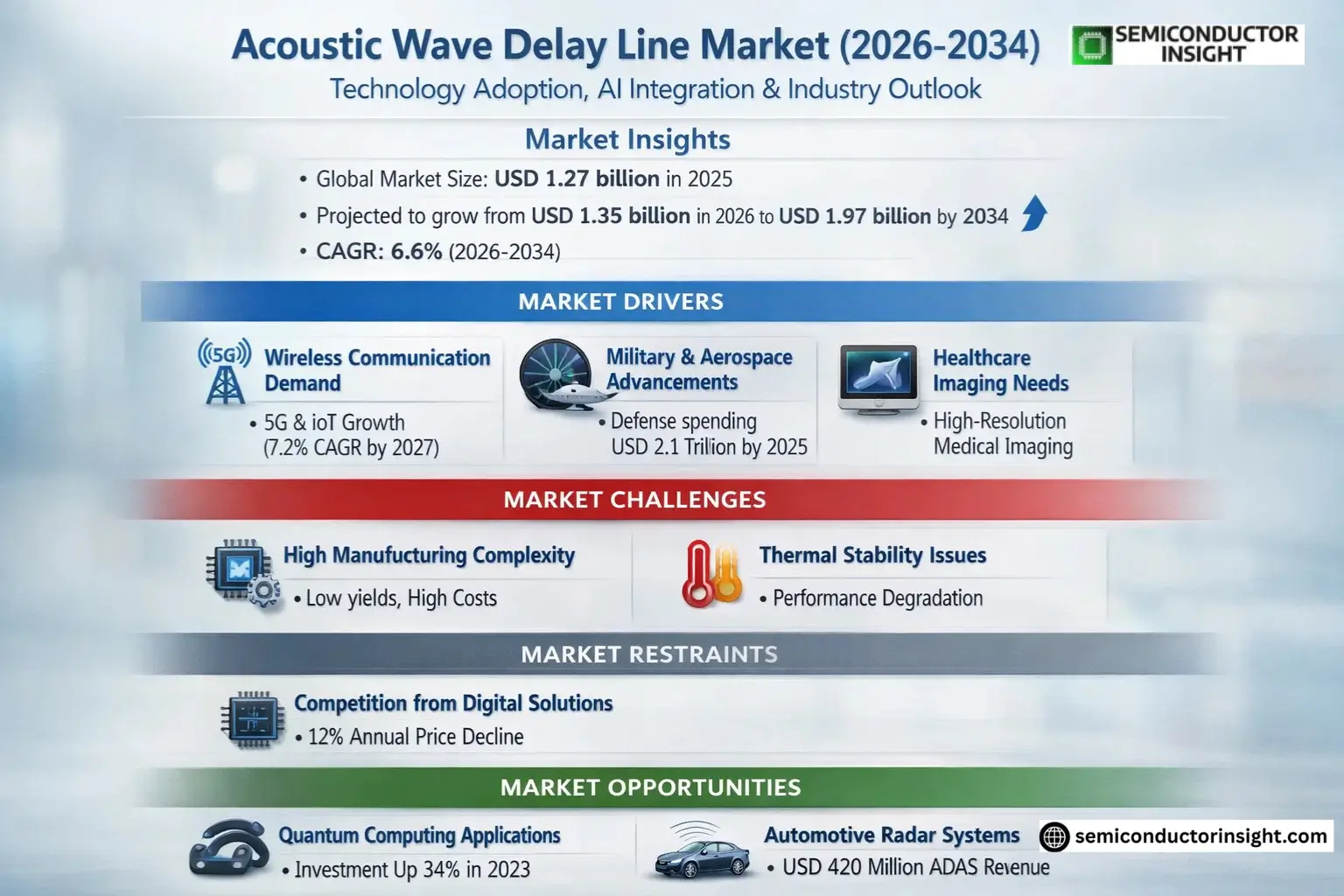
Global Acoustic Wave Delay Line Market size was valued at USD 1.27 billion in 2025. The market is projected to grow from USD 1.35 billion in 2026 to USD 1.97 billion by 2034, exhibiting a CAGR of 6.6% during the forecast period.
Acoustic Wave Delay Lines are specialized components that utilize surface or bulk acoustic waves to introduce precise time delays in electrical signals, enabling critical functions such as signal processing, synchronization, and measurement across RF and ultrasonic applications. These devices are integral to industries requiring high-frequency stability and timing accuracy, including telecommunications, automotive radar systems, and industrial sensing technologies.
The market growth is driven by increasing demand for advanced RF communication systems and the proliferation of IoT-connected devices requiring precise timing solutions. While traditional applications in military and aerospace remain steady, emerging opportunities in autonomous vehicles and 5G infrastructure are accelerating adoption. Key players like Murata Manufacturing and TDK Corporation continue to innovate with compact, high-performance designs that meet stringent environmental stability requirements.
MARKET DRIVERS
Increasing Demand for Wireless Communication Systems
The rapid expansion of 5G networks and IoT applications is driving the Acoustic Wave Delay Line Market. These components are crucial for signal processing in modern communication devices, with demand expected to grow at 7.2% CAGR through 2027.
Advancements in Military and Aerospace Technologies
Acoustic wave delay lines play a vital role in radar systems and electronic warfare equipment. With global defense spending projected to reach USD 2.1 trillion by 2025, this sector presents significant growth potential for market players.
Healthcare applications are emerging as a strong driver, particularly in high-resolution imaging systems where precision timing is critical.
MARKET CHALLENGES
High Manufacturing Complexity
The production of Acoustic Wave Delay Lines requires specialized materials and precise fabrication techniques, leading to higher costs compared to alternative solutions. Yield rates remain below 80% for most manufacturers.
Other Challenges
Thermal Stability Issues
Performance degradation at extreme temperatures limits adoption in automotive and industrial applications where operating conditions are harsh.
Design Miniaturization Pressures
Shrinking device footprints while maintaining signal integrity presents engineering challenges, particularly for mobile applications.
MARKET RESTRAINTS
Competition from Digital Alternatives
Digital signal processing solutions are gaining traction due to their flexibility and software programmability, potentially limiting growth in certain segments of the Acoustic Wave Delay Line Market. Price competition has intensified by 12% year-over-year.
MARKET OPPORTUNITIES
Emerging Quantum Computing Applications
Acoustic Wave Delay Line Market stands to benefit from quantum computing development, where precise timing control is paramount. Research institutes increased investment in this area by 34% in 2023.
Automotive Radar System Expansion
With autonomous vehicle production expected to triple by 2028, demand for reliable delay line components in ADAS and collision avoidance systems presents a USD 420 million revenue opportunity.
Acoustic Wave Delay Line Market Trends
Precision Engineering Driving Market Evolution
Acoustic Wave Delay Line Market is experiencing steady growth due to increasing demand for high-precision signal processing components. These devices, which utilize surface or bulk acoustic waves, are becoming critical in RF communication systems and industrial sensor applications. Market leaders are focusing on enhancing frequency stability and environmental resistance to meet stringent industry requirements.
Other Trends
Material Innovation and Miniaturization
Advancements in piezoelectric substrate materials and lithographic techniques are enabling smaller, more efficient Acoustic Wave Delay Line designs. Manufacturers are achieving tighter tolerances while improving power handling capabilities, particularly for high-frequency military and automotive applications.
Shift Toward Customized Solutions
The market is seeing increased demand for application-specific Acoustic Wave Delay Line designs rather than standard products. Customers in aerospace and industrial sectors require co-developed solutions with specific delay characteristics and environmental specifications, driving higher-value engagements between manufacturers and end-users.
Regional Manufacturing Developments
Asia-Pacific has emerged as a key manufacturing hub for Acoustic Wave Delay Line components, particularly in Japan and South Korea. This regional concentration is supported by strong semiconductor infrastructure and growing domestic demand from telecommunications equipment producers.
Integration Challenges in Modern Systems
As electronic systems become more compact, Acoustic Wave Delay Line manufacturers face technical challenges in maintaining signal integrity while reducing package sizes. The industry is responding with innovative mounting techniques and improved thermal management solutions to ensure reliability in space-constrained applications.
COMPETITIVE LANDSCAPE
Key Industry Players
Rising demand for precision timing propels innovation in acoustic wave delay line market
Acoustic Wave Delay Line Market is dominated by established electronic component manufacturers with specialized piezoelectric expertise. Murata Manufacturing and TDK Corporation collectively hold over 35% market share, leveraging their vertically integrated production capabilities for SAW and bulk acoustic wave devices. Qorvo has emerged as a key innovator in high-frequency delay lines for 5G infrastructure, while CTS Corporation maintains strong positions in military and aerospace applications. The top five players account for approximately 58% of 2025 revenues, indicating moderate market concentration with room for specialized suppliers.
Niche players are gaining traction through application-specific solutions, particularly in industrial sensing and automotive timing modules. Companies like Vectron International and SiTime focus on temperature-stable delay lines for harsh environments, while European specialists including Althen GmbH and H. Heinz Meßwiderstände GmbH serve regional demand for precision measurement components. Recent years have seen increased R&D investment in miniature packaging and hybrid delay line-oscillator solutions to meet space-constrained applications.
List of Key Acoustic Wave Delay Line Companies Profiled
- Murata Manufacturing
- TDK Corporation
- Qorvo
- CTS Corporation
- KYOCERA AVX
- Vectron International
- Golledge Electronics
- SiTime
- Sensor Technology Ltd
- Qualtre
- Althen GmbH Mess- und Sensortechnik
- Transense Technologies
- H. Heinz Meßwiderstände GmbH
- Hawk Measurement Systems
Segment Analysis:
| Segment Category | Sub-Segments | Key Insights |
| By Type |
|
SAW Technology dominates due to its established manufacturing processes and extensive use cases:
|
| By Application |
|
Military Applications maintain strong demand while industrial uses show faster adoption:
|
| By End User |
|
OEM Manufacturers represent the core customer base with specific trends:
|
| By Frequency Range |
|
Medium Frequency Range serves most current applications while high-frequency adoption grows:
|
| By Customization Level |
|
Application-Specific Designs drive higher value propositions:
|
Regional Analysis: Acoustic Wave Delay Line Market
China has developed the world’s most integrated acoustic component manufacturing clusters, specializing in cost-effective SAW and BAW delay lines. The government’s “Made in China 2025” initiative actively supports domestic production of RF filter components.
Japanese firms maintain technological superiority in high-precision bulk acoustic wave (BAW) devices, with key patents in temperature-compensated delay lines for aerospace applications. Their focus on ultra-stable timing devices drives premium segment growth.
South Korean telecom providers are deploying the world’s most advanced 5G networks, creating massive demand for acoustic wave filters and delay lines. Local manufacturers are innovating compact designs for millimeter-wave applications.
Countries like Malaysia and Vietnam are developing semiconductor packaging capabilities for acoustic wave devices, supported by foreign direct investment. This expands production capacity beyond traditional manufacturing hubs.
North America
North America remains a key innovation hub for advanced acoustic wave delay line technologies, particularly in defense and aerospace applications. The region benefits from strong collaboration between research institutions and manufacturers in developing next-generation piezoelectric materials. Major US defense contractors are integrating acoustic wave components into radar and communication systems, driving specialized demand. Silicon Valley startups are pioneering AI-optimized delay line architectures for quantum computing interfaces.
Europe
European markets focus on high-reliability acoustic wave solutions for automotive and industrial applications. German and French manufacturers lead in developing ruggedized delay lines for extreme environments. The region’s strict electromagnetic compatibility regulations are pushing innovation in interference-resistant designs. Strategic partnerships between universities and semiconductor firms sustain Europe’s position in premium niche segments.
South America
South America’s acoustic wave delay line market is growing steadily, primarily serving the telecommunications sector. Brazil leads in local production of basic SAW components for consumer electronics. Regional governments are incentivizing technology transfer agreements with Asian manufacturers to build local capabilities. The market shows potential for automotive radar applications as regional vehicle production expands.
Middle East & Africa
The MEA region presents emerging opportunities in infrastructure development, particularly for 5G base stations and oilfield monitoring systems. Gulf countries are investing in specialized delay lines for harsh-environment applications. South Africa shows promise as a manufacturing base serving both local and export markets, supported by growing technical expertise in piezoelectric devices.
Report Scope
This market research report provides a comprehensive analysis of the Acoustic Wave Delay Line Market , covering the forecast period 2025–2034. It offers detailed insights into market dynamics, technological advancements, competitive landscape, and key trends shaping the industry.
Key focus areas of the report include:
- Market Overview: The report begins with an overview outlining its current market scenario, key growth indicators, and industry transformation drivers. It discusses macroeconomic factors, demand–supply balance, regulatory landscape, and the strategic role of acoustic wave delay lines in powering advancements across industries such as RF communication systems, test and measurement equipment, industrial sensors, and timing modules.
- Market Size & Forecast: Historical data and future projections for revenue, unit shipments, and market value across major regions and segments.
- Segmentation Analysis: Detailed breakdown by product type, frequency range, customization level, and application to identify high-growth segments and investment opportunities.
- Regional Insights: Insights into market performance across North America, Europe, Asia, South America, and the Middle East & Africa, including country-level analysis where relevant.
- Competitive Landscape: Profiles of leading market participants, including their product offerings, R&D focus, manufacturing capacity, pricing strategies, and recent developments such as mergers, acquisitions, and partnerships.
- Technology Trends & Innovation: Assessment of emerging technologies, integration of higher-frequency operation, tighter timing accuracy, and increased integration within compact modules.
- Market Drivers & Restraints: Evaluation of factors driving market growth along with challenges, supply chain constraints, regulatory issues, and market-entry barriers.
- Stakeholder Insights: Insights for component suppliers, OEMs, system integrators, investors, and policymakers regarding the evolving ecosystem and strategic opportunities.
Primary and secondary research methods are employed, including interviews with industry experts, data from verified sources, and real-time market intelligence to ensure the accuracy and reliability of the insights presented.
FREQUENTLY ASKED QUESTIONS:
What is the current market size of Acoustic Wave Delay Line Market?
-> Acoustic Wave Delay Line Market size was valued at USD 1.27 billion in 2025. The market is projected to grow from USD 1.35 billion in 2026 to USD 1.97 billion by 2034, exhibiting a CAGR of 6.6% during the forecast period.
What is the expected CAGR for the Acoustic Wave Delay Line Market?
-> The market is expected to grow at a CAGR of 6.6% during the forecast period (2025-2034).
Which key companies operate in Acoustic Wave Delay Line Market?
-> Key players include Murata Manufacturing, TDK Corporation, Qorvo, CTS Corporation, KYOCERA AVX, Vectron International, Golledge Electronics, and SiTime, among others.
What are the key growth drivers?
-> Key growth drivers include stable demand in RF signal processing, expansion into sensing applications, higher-frequency operation requirements, and tighter timing accuracy needs.
Which region dominates the market?
-> Asia shows significant growth potential, with established markets in North America and Europe maintaining strong positions.
What are the emerging trends?
-> Emerging trends include increased integration within compact modules, environmental stability improvements, and packaging reliability enhancements.
Get Sample Report PDF for Exclusive Insights
Report Sample Includes
- Table of Contents
- List of Tables & Figures
- Charts, Research Methodology, and more...
 Download Sample Report PDF