Key Statistics
Key Takeaways
- Market scale: The global silicon carbide MOSFET market stands at USD 752.3 million in 2025 and is projected to reach USD 9,997.3 million in 2034, representing 33.3% annualized growth as higher-voltage power electronics gain adoption.
- Near-term outlook: The 2026 estimate is USD 1,002.9 million, with new vehicle platforms, industrial power conversion and power semiconductor technology generations expanding the addressable market beyond early premium electric vehicles.
- Voltage mix: The 1200V class leads with an estimated ~49% of 2025 revenue, followed by 650V at ~30%, 1700V at ~16% and other voltage classes at ~5%; applications require different combinations of blocking voltage, switching speed and current.
- End-market split: Automotive accounts for ~56% of revenue, industrial equipment for ~23%, photovoltaic conversion for ~15% and other uses for ~6%; vehicle traction remains the largest growth engine, but grid and infrastructure applications diversify demand.
- Geographic concentration: Asia-Pacific holds an estimated ~49% share, North America ~26%, Europe ~18%, South America ~4% and the Middle East and Africa ~3%, reflecting EV production, chip fabrication and power-conversion design activity.
Global SiC MOSFETs Market Overview
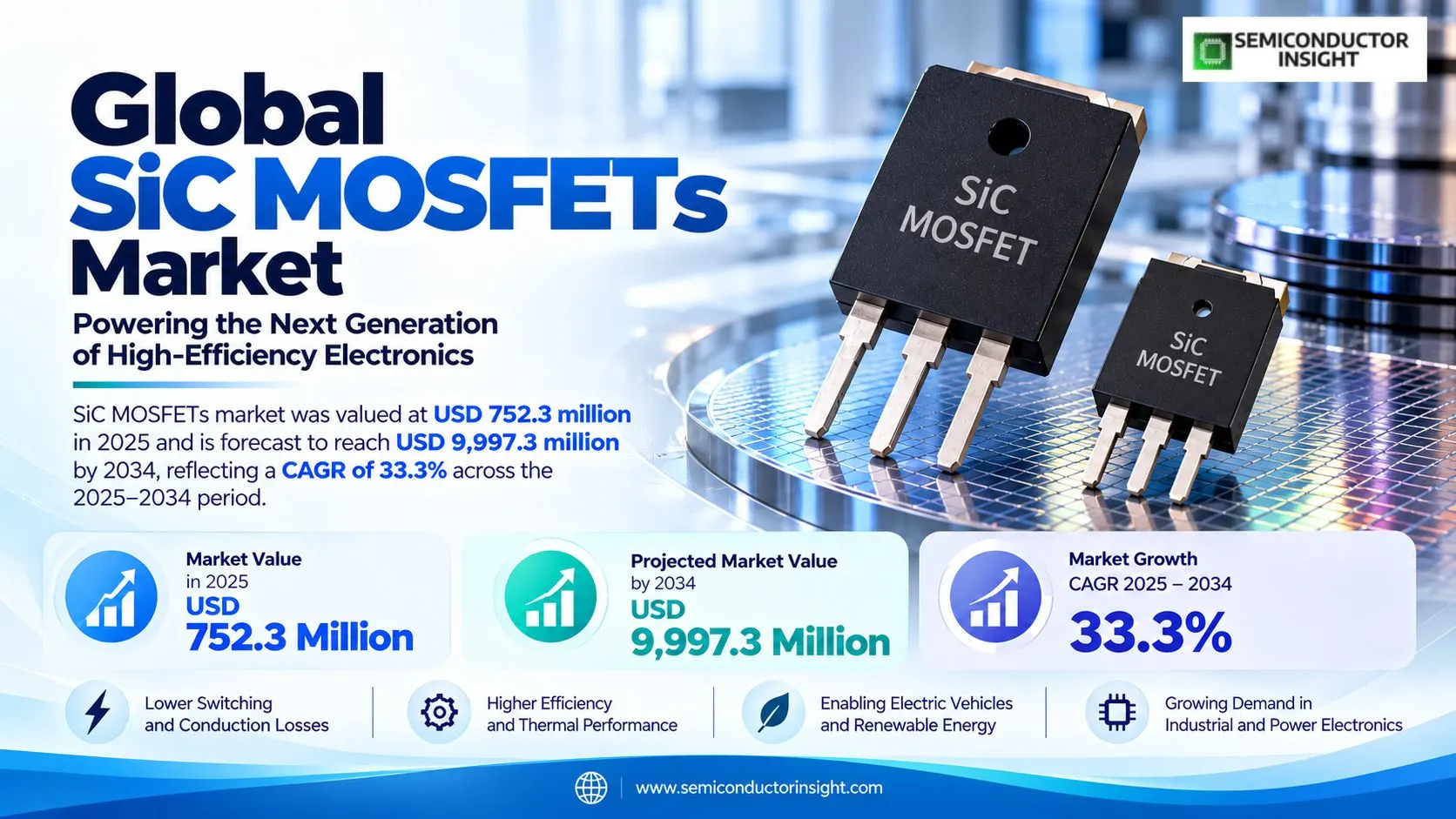
SiC MOSFETs market was valued at USD 752.3 million in 2025 and is forecast to reach USD 9,997.3 million by 2034, reflecting a CAGR of 33.3% across the 2025–2034 period. Silicon carbide MOSFETs reduce switching and conduction losses in high-voltage power conversion; Asia-Pacific was the largest regional market in 2025, with an estimated ~49% share supported by electric vehicle manufacturing and semiconductor supply chains.
A silicon carbide metal-oxide-semiconductor field-effect transistor controls high-voltage current with lower switching losses and higher temperature tolerance than many conventional silicon alternatives. Its value is most visible when designers can shrink magnetics, improve cooling or raise power density without sacrificing reliability. In electric vehicles, these advantages influence traction inverter efficiency and charging architecture; in industrial equipment, they can reduce converter footprint and energy losses. Adoption depends on total system cost rather than on a device specification considered in isolation.
The market is progressing through several voltage classes rather than a single universal component. A 650V MOSFET is relevant to many power supplies and charging circuits, while 1200V products serve 800V vehicle platforms and higher-power conversion stages. The 1700V class addresses demanding industrial insulation and voltage margins, and specialist devices extend well above those ratings. Microchip documents production 1700V discrete and bare-die options, while Wolfspeed announced a commercially available 10kV MOSFET in March 2026 for selected high-voltage infrastructure.
Product innovation is reducing the device area needed for a target on-resistance. Wolfspeed introduced its fifth-generation technology in June 2026, describing improved specific on-resistance and manufacturing on its 200 mm platform. Infineon, onsemi, STMicroelectronics and ROHM also compete through cell structure, packaging, thermal performance and automotive qualification. These engineering differences matter because a transistor must satisfy short-circuit, gate-drive and lifetime requirements in addition to achieving low electrical losses at a single operating point.
Commercial demand is strongly connected to vehicle architecture choices. A manufacturer moving from a 400V battery bus toward 800V or 900V operation may redesign its inverter and charging system around different semiconductor voltage margins. Onsemi disclosed collaborations with Geely and NIO involving higher-voltage electric vehicle platforms in April 2026, while Infineon identified CoolSiC adoption in Toyota’s bZ4X charging and conversion functions. Such design wins establish technical relevance, although the announcements do not disclose an independent market revenue total.
The revenue boundary covers SiC MOSFET die and packaged transistors, including MOSFET-based module products represented by the supplier and application mix, without adding unrelated semiconductor categories. Raw SiC substrates, standalone Schottky rectifiers, JFET-only products and finished inverters or vehicle charging stations are excluded. The model treats automotive, industrial, photovoltaic and other applications as separate end uses of the same transistor technology, with sales measured at the device or applicable MOSFET module level.
Segment Analysis: By Type
Voltage segmentation comprises 1200V, 1700V, 650V and Others. The 1200V class accounts for an estimated ~49% of 2025 revenue and modeled ~33.1% growth, while 650V represents ~30% and grows at ~35.0%. Devices rated 1700V hold ~16% with ~32.0% modeled growth; the ~5% residual includes specialized ratings and expands at ~27.0%. These classes address distinct converter topologies and insulation requirements.
| Voltage class | Function | Market position |
|---|---|---|
| 1200V | A 1200V MOSFET provides blocking-voltage headroom for traction inverters and other converters operating with elevated DC-link voltages. Device selection involves on-resistance, switching energy, body-diode behavior, package inductance and fault tolerance. Manufacturers offer bare die, discrete packages and module configurations, allowing system engineers to trade cooling complexity against integration density. This class is prominent in 800V vehicle designs and higher-power industrial stages. | Largest voltage class, ~49% of 2025 sales. Modeled growth is ~33.1% annually as automotive platforms and industrial converters adopt SiC. Wolfspeed Gen 5 and ST fourth-generation announcements include 1200V technology, while ROHM reports automotive use of its SiC MOSFET die. Competition centers on efficient switching under realistic thermal loads, repeatable automotive qualification and cost per ampere rather than only the nominal voltage rating. |
| 650V | The 650V class targets power factor correction, on-board charging, DC/DC conversion, server power supplies and industrial circuits whose voltage requirements do not justify a 1200V device. Smaller die and optimized packaging can support high switching frequencies, reducing the size of magnetic components and passive filters. The application choice depends on transient margins and control architecture; nearby 750V and 950V products may compete but are not silently relabeled as 650V. | Estimated ~30% share and ~35.0% modeled CAGR. Faster growth reflects expanding charger and power-supply applications where switching frequency and compact packaging matter. Onsemi launched 650V EliteSiC MOSFETs in top-cooled T2PAK packages in December 2025, demonstrating how thermal packaging creates differentiation. Customers evaluate efficiency at partial load and cost of the complete converter, not merely the purchase price of the transistor. |
| 1700V | Devices rated 1700V are selected where higher DC-link voltage, switching transients or industrial insulation requirements demand more headroom than a 1200V transistor provides. Applications include industrial drives, high-voltage power supplies and selected renewable energy conversion stages. Package creepage, gate isolation and fault energy become especially important. Microchip lists 1700V MOSFETs in both discrete and bare-die formats, illustrating the need for several integration routes. | Estimated ~16% of revenue with ~32.0% modeled growth. The class commands value from its demanding electrical and reliability requirements rather than from broad consumer-electronics volume. Adoption can be slowed by more complex gate-drive design and competition from established IGBT modules. Buyers value predictable avalanche behavior, short-circuit withstand and high-temperature operation, and a supplier must support extensive qualification before entering long-lived industrial equipment platforms. |
| Others | This group includes MOSFET voltage ratings outside the three named classes, such as 750V, 950V, 2300V, 3300V and emerging 10kV products where appropriate to the transistor or MOSFET module revenue boundary. These devices serve particular converter designs rather than a single mainstream market. They should not be merged with JFET-only switches or diode-only rectifiers, which have different electrical characteristics and product definitions. | Smaller ~5% segment, modeled ~27.0% growth. Specialized ratings can carry high unit value but limited production runs and long qualification cycles. Wolfspeed’s 10kV introduction and 3.3kV MOSFET module families demonstrate the technical range available beyond automotive voltage classes. These offerings may open solid-state transformer and grid applications, yet the pace of commercial adoption depends on system redesign, standards and total installed cost. |
Design selection: discrete die, packaging and voltage margin
Voltage rating alone does not determine converter efficiency. Engineers evaluate the product of on-resistance and switching charge, body-diode recovery, junction temperature and package parasitics at the operating current. A 1200V device may deliver attractive conduction losses but require a different gate driver than an established silicon IGBT. Packaging can reduce stray inductance and improve heat extraction, allowing the same die technology to perform differently in discrete and module configurations. These trade-offs explain why several suppliers can coexist in the ~49% leading voltage class.
The transition to 200 mm wafer fabrication affects cost and supply assurance across voltage classes. More die area per processed wafer can support scale, but yields, defect density and qualification determine whether the advantage is realized. Wolfspeed described Gen 5 development on a qualified 200 mm platform, while Infineon and Wolfspeed announced a wafer supply extension in October 2026. Substrate transactions are upstream context and are not included as separate MOSFET device revenue.
Segment Analysis: By Application
Applications are divided into Automotive, Industrial, PV and Others. Automotive leads at an estimated ~56% of 2025 sales and ~34.8% modeled annual growth, followed by industrial uses at ~23% and ~31.0%, photovoltaic conversion at ~15% and ~32.0%, and other applications at ~6% and ~30.0%. The mix reflects both vehicle electrification and rising demand for efficient conversion in stationary power systems.
| Application | Demand characteristics |
|---|---|
| Automotive | Largest application, ~56% share and modeled ~34.8% CAGR. Traction inverters are the highest-value use, while on-board chargers, DC/DC converters and battery disconnect systems provide additional opportunities. Onsemi’s Geely and NIO collaborations involve 900V architectures, and Infineon supplies CoolSiC MOSFETs for Toyota charging functions. Automotive qualification is demanding because switching devices must tolerate vibration, temperature cycling and fault events over many years of vehicle service. |
| Industrial | Estimated ~23% share, modeled ~31.0% growth. Industrial drives, uninterruptible power supplies, grid converters and data-center power distribution can use SiC MOSFETs to reduce heat loss or increase switching frequency. Equipment lifetimes and maintenance requirements differ from those in vehicles, and system designers may favor higher-voltage packages or robust power modules. Wolfspeed’s 10kV and 3.3kV announcements illustrate emerging high-power designs beyond the mainstream automotive classes. |
| PV | Estimated ~15% of revenue and ~32.0% modeled CAGR. Photovoltaic inverters benefit from efficient high-frequency switching, especially in systems that must convert variable DC output into grid-compatible power. Designers weigh switching losses, thermal management and lifetime cost across residential, commercial and utility-scale installations. SiC MOSFETs compete with established silicon IGBTs and other topologies, so adoption depends on whether smaller magnetics and lower losses justify device premiums. |
| Others | Estimated ~6% share and ~30.0% modeled growth. This category covers selected charging infrastructure, aerospace, power supplies and other applications not already allocated to automotive, industrial or PV. Some specialized uses require very high voltage or strict reliability testing and therefore progress through extended qualification. Their small share can still support attractive technology development, but individual demonstrations should not be treated as evidence of immediate mass-market revenue. |
Automotive customers make long-duration sourcing decisions because a powertrain platform can remain in production for several model years. Semiconductor suppliers need device reliability data, thermal models, gate-driver guidance and assurance that wafers and packaging capacity can support the launch schedule. The shift toward 800V and 900V platforms raises the value of efficient SiC switching but does not guarantee adoption in every vehicle segment, especially where silicon remains cost competitive.
Stationary conversion has a different adoption path. A solar inverter manufacturer may prioritize efficiency at common irradiance levels, whereas an industrial drive supplier may focus on fault tolerance and maintenance life. Data-center power designers are concerned with thermal density and uptime, while grid equipment faces high-voltage standards and lengthy field trials. The ~23% industrial and ~15% PV shares therefore represent distinct purchasing criteria rather than a homogeneous non-automotive market.
Regional Analysis
Asia-Pacific is the largest regional SiC MOSFET market at an estimated ~49% of 2025 sales, with modeled growth near ~34.8% annually. North America holds ~26% and expands at ~31.0%, Europe contributes ~18% with ~32.0% growth, South America ~4% with ~34.0%, and the Middle East and Africa ~3% with ~33.0%. The regional distribution reflects device sourcing and conversion-system production rather than only where finished electric vehicles are registered.
Which regions shape SiC MOSFET adoption and supply?
Automotive manufacturing, semiconductor device fabrication and converter engineering are spread across different countries. China has the largest electric vehicle production base and a broadening domestic power semiconductor ecosystem, while Japan and South Korea support device technology and high-specification applications. The United States contributes SiC wafer fabrication and device innovation, and Europe links automotive qualification with industrial power-electronics design. Smaller regions are principally customers for imported devices used in chargers, solar systems and industrial equipment.
The private allocation places Asia-Pacific at ~49%, North America at ~26%, Europe at ~18%, South America at ~4% and the Middle East and Africa at ~3% in 2025. Modeled annual regional growth rates are ~34.8%, ~31.0%, ~32.0%, ~34.0% and ~33.0%, respectively. These shares are market estimates based on product and demand evidence, not claims that electric-car sales or wafer announcements measure MOSFET revenue directly.
| Region | Position | Growth outlook | Demand profile | What decides supplier selection |
|---|---|---|---|---|
| Asia-Pacific | Largest (~49%) | Modeled ~34.8% CAGR | Vehicle powertrains and semiconductor manufacturing | Vehicle platform qualification, local device availability and cost per inverter |
| North America | Second (~26%) | Modeled ~31.0% CAGR | 200 mm SiC technology and industrial power | Domestic supply resilience, high-voltage reliability and design support |
| Europe | Third (~18%) | Modeled ~32.0% CAGR | Automotive and renewable conversion engineering | Automotive-grade reliability, package integration and energy efficiency |
| South America | Smaller (~4%) | Modeled ~34.0% CAGR | Imported EV and PV conversion components | Distribution, converter service support and landed cost |
| Middle East & Africa | Emerging (~3%) | Modeled ~33.0% CAGR | Solar, grid and industrial electrification | Heat tolerance, high-voltage certification and local technical service |
Key SiC MOSFET Manufacturers and Competitive Landscape
Competition centers on device efficiency, qualified fabrication capacity, automotive design wins and the ability to supply several voltage ratings. Wolfspeed, Infineon, STMicroelectronics, ROHM, onsemi and Microchip have documented SiC power-device products or programs, while Mitsubishi Electric and other suppliers contribute to industrial and module markets. Buyers compare electrical performance with thermal behavior, supply continuity and the cost of integrating the MOSFET into a reliable converter.
Wolfspeed differentiates through silicon carbide material and device technology and its 200 mm fabrication platform. Its Gen 5 announcement highlighted improvements in specific on-resistance and the ability to develop new 750V and 1200V devices without a new manufacturing toolset. The company also markets specialized high-voltage products, including a 10kV MOSFET and 3.3kV module families. Commercial execution depends on qualification, manufacturing yield and the timing of customer platform ramps.
Infineon competes through CoolSiC product breadth and application support. Its 750V G2 technology targets efficient vehicle and industrial conversion, and Toyota selected CoolSiC devices for bZ4X on-board charging and DC/DC functions. The company also supplies MOSFET-based modules for high-voltage energy systems. A broad portfolio helps customers maintain supplier continuity when different converter stages require different voltage ratings and package types, although qualification remains product-specific.
Onsemi has emphasized automotive system partnerships and packaging. Its 900V vehicle collaborations with Geely and NIO address high-voltage architecture transitions, while its 650V and 950V top-cooled MOSFET packaging targets thermal efficiency in several end uses. STMicroelectronics and ROHM also develop new SiC transistor generations for traction and industrial systems. These companies compete on design-in support, lifetime performance and cost reduction as much as on isolated electrical benchmarks.
Microchip lists 1700V SiC MOSFETs in discrete and die formats, making it relevant to higher-voltage industrial applications. GeneSiC is a historical supplier name in the publisher list and should not automatically be counted as a separate contemporary corporate group without ownership reconciliation. Microsemi likewise belongs to Microchip following its 2018 acquisition. Competitive comparisons must distinguish transistor makers, module integrators and system manufacturers rather than treating every brand as an independent MOSFET vendor.
Tier structure
| Tier | Companies | Basis of competition |
|---|---|---|
| Broad SiC power device portfolios | Wolfspeed; Infineon Technologies; STMicroelectronics; onsemi; ROHM | Multiple voltage classes, automotive qualification programs and investment in process generations characterize this group. The suppliers compete for vehicle traction and charging designs that require long support cycles, and they can extend qualified transistor technology into industrial or renewable conversion products. Fabrication yield and packaging integration remain decisive when customers compare system cost over several production years. |
| Industrial and specialized device suppliers | Microchip Technology; Mitsubishi Electric; Littelfuse | Companies with power semiconductor capabilities relevant to industrial equipment, higher voltage ratings or discrete device supply. Their product positioning can differ from the largest automotive suppliers, with emphasis on robust packages, high-voltage operation and application engineering. Availability of MOSFET die and finished devices allows customers to choose between internal module assembly and standardized packages. |
| Regional and historical participants | BASiC Semiconductor; GeneSiC Semiconductor | Participants associated with silicon carbide technology and regional or specialized device markets. Product portfolios, ownership structures and sales scale require company-specific assessment rather than assumed equivalence to major multinational suppliers. GeneSiC is included as a publisher-listed name without attributing a separate unverified present-day revenue share; sourcing decisions depend on current product support and manufacturing continuity. |
Key companies profiled
- Wolfspeed
- Infineon Technologies
- STMicroelectronics
- ROHM
- onsemi
- Microchip Technology
- Littelfuse
- Mitsubishi Electric
- GeneSiC Semiconductor
- BASiC Semiconductor
SiC MOSFET Production Capacity Analysis
SiC MOSFET capacity depends on substrate supply, epitaxial quality, wafer fabrication, device yield, packaging and automotive qualification. A larger wafer diameter can increase theoretical die output, but manufacturing defects and process variability determine the usable supply. Leading producers are expanding or adapting 200 mm operations while maintaining 150 mm product lines, and the economic challenge is to improve cost per qualified transistor rather than simply install more equipment.
Wafer fabrication combines high-temperature semiconductor processing, gate-oxide formation, implantation, metallization and wafer-level electrical testing. Silicon carbide’s material properties make defect control and oxide reliability especially important. A fabrication plant must demonstrate stable electrical characteristics across many wafers before its output can support automotive programs. Wolfspeed’s Gen 5 devices were developed on a 200 mm platform, illustrating the connection between technology generations and factory qualification.
Packaging can determine the practical current and thermal performance of a MOSFET even when the die has excellent electrical characteristics. Onsemi’s top-cooled T2PAK introduction and Infineon’s high-power modules show different approaches to heat extraction and assembly. Automotive designs often require stringent cycling and reliability tests, while industrial systems may emphasize serviceability and long operating life. Packaging capacity and material quality therefore matter alongside front-end wafer starts.
Supply planning is complicated by demand across multiple voltage ratings and end markets. A 650V power-supply product may require different die size and packaging than a 1200V traction device or 1700V industrial transistor. Manufacturers must allocate qualified wafer output among these programs while improving yields and avoiding excess inventory. Upstream 200 mm substrate agreements support supply continuity, but substrate contract announcements do not equal completed MOSFET sales or independently establish future industry revenue.
SiC MOSFETs Market Dynamics
The main drivers are vehicle electrification, the migration to higher-voltage electrical architectures, wider industrial and renewable conversion use, and continued improvement in device cost and efficiency. The constraints are more complex fabrication, packaging and gate-drive requirements, price competition from silicon and alternative wide-bandgap devices, and long qualification cycles. The impact tables allocate the headline growth rate among these forces over three forecast windows.
MARKET DRIVERS
Drivers Impact Analysis*
| Market Drivers | Impact Rank | CAGR Contribution (%) | 2026–2028 | 2029–2031 | 2032–2034 |
|---|---|---|---|---|---|
| EV traction and charging electrification | High | +15.20% | High | High | Medium |
| 800V and 900V vehicle architecture transition | High | +9.00% | High | High | High |
| Industrial and grid power conversion | Medium-High | +6.40% | Medium | High | High |
| Renewable energy and storage inverters | Medium | +4.30% | Medium | High | High |
| Improved 200 mm wafer and device yields | Low-Medium | +3.40% | Medium | High | High |
| Others (high-voltage pilots, compact power supplies) | Low | +1.90% | Low | Medium | Medium |
Electric vehicle platforms create long-duration transistor demand
Automakers use SiC MOSFETs to improve conversion efficiency in traction and charging functions, and a successful design win can support multiple years of production. Infineon, onsemi and ROHM have disclosed named vehicle applications or collaborations, showing that the technology is entering several architectures rather than a single premium model. Device revenue grows as more vehicle platforms adopt SiC and as additional conversion stages use the material, although semiconductor content varies by design.
Higher-voltage architectures increase the value of switching performance
Moving from a conventional 400V battery system toward 800V or 900V changes the operating stresses and efficiency trade-offs in traction inverters and chargers. A well-chosen SiC MOSFET can reduce switching losses and cooling requirements, enabling smaller power electronics. Onsemi’s 2026 Geely and NIO announcements are examples of this engineering direction. The transition requires system redesign and qualification, so the market effect unfolds through vehicle model cycles rather than immediate replacement of existing fleets.
Industrial power and grid equipment broaden the addressable base
Silicon carbide MOSFETs can support higher switching frequency and improved power density in drives, power supplies, storage converters and emerging solid-state grid equipment. Wolfspeed’s 10kV transistor and 3.3kV module introductions expand the available technical range, while Infineon offers MOSFET-based modules for high-voltage energy systems. These applications can diversify supplier demand beyond automotive cycles, but they also have lengthy certification and maintenance requirements.
Manufacturing improvements lower cost per qualified device
Larger wafer formats, better material quality and new cell designs can reduce die area and improve usable output. Wolfspeed reported an improvement in specific on-resistance with Gen 5 technology, and supplier investments in 200 mm manufacturing aim to support more scalable production. The commercial benefit depends on wafer yield and package cost as well as nominal device performance. Lower costs can open industrial and mid-priced vehicle designs that previously relied on silicon.
MARKET RESTRAINTS
Restraints Impact Analysis*
| Market Restraints | Impact Rank | CAGR Contribution (%) | 2026–2028 | 2029–2031 | 2032–2034 |
|---|---|---|---|---|---|
| Substrate and fabrication cost premium | High | -3.10% | High | Medium | Medium |
| Reliability qualification and gate-drive complexity | Medium-High | -2.00% | High | High | Medium |
| Silicon IGBT and GaN competition | Medium | -1.30% | Medium | Medium | High |
| Others (inventory cycles, capacity ramp delays) | Low | -0.50% | Medium | Medium | Low |
Wafer quality and process complexity raise manufacturing expense
Silicon carbide substrates and epitaxial layers require specialized manufacturing processes, and transistor yield can be affected by defects and gate-oxide reliability. Advanced packages add thermal and electrical design cost. As a result, the device price may remain above a mature silicon alternative even when the SiC converter uses fewer supporting components. Buyers adopt the technology most readily where efficiency, cooling or space savings compensate for the initial premium.
System qualification lengthens commercial conversion cycles
A SiC MOSFET needs a compatible gate driver, protection strategy and thermal interface, and high switching speed can increase electromagnetic interference if layout is poorly controlled. Automotive customers also demand rigorous lifetime and fault testing. A supplier cannot rely on a favorable data-sheet on-resistance alone; it must support a complete design and demonstrate reliability across temperature and voltage extremes. This requirement slows substitution in established industrial equipment.
Competing device technologies remain relevant
Silicon IGBTs retain cost and supply advantages in many established high-power designs, while gallium nitride can be attractive at selected lower-voltage and high-frequency operating points. Some customers therefore use a mix of technologies across different conversion stages. SiC adoption accelerates where higher blocking voltage and thermal performance create clear system benefits, but the market does not assume that every silicon power transistor will be replaced during the forecast period.
MARKET OPPORTUNITIES
Compact traction systems for mid-market electric vehicles
Lower on-resistance and improved device manufacturing can make SiC more affordable beyond premium vehicle platforms. Automakers seek to reduce battery cost and cooling hardware while maintaining range and charging performance, so powertrain teams evaluate transistor efficiency at realistic drive cycles. Suppliers with qualified 1200V technology and cost-effective packages can gain additional model programs as 800V architectures spread to higher-volume vehicle categories.
Solid-state grid and data-center power protection
Very high-voltage MOSFETs open the possibility of new converter and protection designs that would be difficult with conventional switching devices. Wolfspeed’s 10kV product and its collaboration with GE Aerospace illustrate early commercial and engineering activity. The opportunity depends on creating reliable modules, isolation systems and standards suitable for field operation, so near-term revenue is likely to be concentrated in selected programs rather than universal deployment.
Improved thermal packages and system-level design tools
Customers can extract more value from SiC transistors when packages reduce inductance, improve heat flow and simplify assembly. Top-cooled discrete devices and integrated MOSFET modules are two different approaches. Suppliers that provide accurate switching models, reference layouts and qualification support can shorten design cycles and strengthen relationships with inverter manufacturers. This service advantage matters as multiple competitors offer broadly similar nominal voltage ratings.
SiC MOSFETs Supply Chain Analysis
The SiC MOSFET supply chain links crystal growth and wafer production to epitaxy, transistor fabrication, packaging and converter integration. Quality at each stage affects device yield and long-term reliability. A supplier can control several stages internally or purchase qualified wafers and outsource packaging, but customers increasingly require visibility into material origin, manufacturing capacity and product traceability before committing to automotive or industrial programs.
Materials. Upstream supply begins with silicon carbide crystal growth and wafer finishing, followed by epitaxial layers suitable for high-voltage transistor fabrication. Defects and thickness variation can affect downstream device yield. The October 2026 wafer supply extension involving Infineon and Wolfspeed illustrates how device makers seek long-term access to 200 mm material. Those material purchases are an input to the market and should not be added again as finished MOSFET revenue.
Fabrication. Manufacturers form the transistor structure through specialized implantation, oxidation, lithography and metallization steps, then screen electrical characteristics at wafer level. Gate-oxide reliability and short-circuit robustness are critical for high-voltage operation. A new process generation can reduce specific on-resistance, but production economics improve only when the technology delivers stable yield. Automotive qualification requires repeatable device behavior over many lots and operating conditions.
Packaging and qualification. Bare die may be assembled into automotive or industrial modules, while discrete devices are sold in packages selected for cooling, creepage and mounting requirements. Onsemi’s T2PAK top-cooled products and Microchip’s 1700V discrete offerings demonstrate different integration approaches. Qualification covers electrical loss, thermal cycling, fault tolerance and package reliability. The cost of packaging can offset some die-level savings, making system-level design assistance a competitive advantage.
Downstream converters. Automotive suppliers, industrial equipment makers and renewable inverter manufacturers integrate MOSFETs with gate drivers, capacitors, cooling and protection systems. The final converter’s value is much larger than the transistor content and is not counted as semiconductor revenue. A 1200V traction inverter design may use different die and module quantities from a 650V charger or 1700V industrial drive, so end-market growth must be interpreted through actual component architectures.
Recent Developments in SiC MOSFET Technology and Applications
- 9 June 2026 DEVICE GENERATION
Wolfspeed announced its fifth-generation SiC MOSFET technology for 1200V and 750V designs, citing an improvement of up to 27% in specific on-resistance against referenced competing solutions. The products are developed on a qualified 200 mm platform. The commercial significance is the potential for smaller transistor die and more efficient power systems, subject to production yield and customer qualification. Source - 8 June 2026 HIGH-VOLTAGE COLLABORATION
GE Aerospace and Wolfspeed signed a memorandum of understanding to advance high-voltage silicon carbide applications, including supply of 10kV MOSFET die and exploration of module formats. The work targets industrial, aerospace and defense systems rather than conventional vehicle traction. It could support future high-voltage adoption if engineering teams establish reliable protection, packaging and long-term operating standards. Source - 28 April 2026 AUTOMOTIVE PLATFORM
Onsemi and Geely expanded their collaboration on EliteSiC power technology for vehicles using Geely’s SEA-S architecture, with higher-voltage 900V system designs. The announcement illustrates how semiconductor choices become part of vehicle-platform planning and can influence efficiency and charging performance. It does not disclose a direct global MOSFET sales value, so the market implication is design qualification and potential future content. Source - 9 February 2026 VEHICLE DESIGN WIN
Infineon reported that its CoolSiC MOSFETs were selected for the on-board charger and DC/DC converter in Toyota’s new bZ4X. The announcement confirms use in specific vehicle power-conversion functions rather than only a general supplier technology roadmap. Automotive component qualification can sustain demand over a model cycle, provided reliability, capacity and cost targets remain competitive. Source - 4 December 2025 THERMAL PACKAGING
Onsemi introduced EliteSiC MOSFETs in T2PAK top-cooled packages, including 650V and 950V products for vehicle, solar and storage applications. The packaging approach targets improved heat removal and design flexibility, showing that system-level thermal management remains a differentiator even when transistor electrical performance is strong. The development broadens application options without implying that every converter will replace silicon devices. Source
REPORT SCOPE & SEGMENTATION
| Attribute | Details |
|---|---|
| Report Title | Global SiC MOSFETs Market Size, Share and Industry Analysis |
| Market Size 2025 | USD 752.3 million |
| Market Size 2026 | USD 1,002.9 million |
| Market Size 2034 | USD 9,997.3 million |
| Growth Rate | CAGR of 33.3% from 2025–2034 |
| Unit | Value in USD million; SiC MOSFET die, packaged transistors and included MOSFET module products |
| Historical Reference | 2023–2024 |
| Base / Estimate / Forecast | 2025 base; 2026 estimate; 2034 forecast |
| By Type | 1200V · 1700V · 650V · Others |
| By Application | Automotive · Industrial · PV · Others |
| By Region | Regions evaluated by transistor voltage rating, application and country-level semiconductor demand North AmericaUnited States, Canada, Mexico EuropeGermany, United Kingdom, France, Italy, Austria, Rest of Europe Asia-PacificChina, Japan, South Korea, India, Taiwan, Southeast Asia, Rest of Asia-Pacific South AmericaBrazil, Argentina, Chile, Colombia, Rest of South America Middle East & AfricaSaudi Arabia, UAE, Egypt, Nigeria, South Africa, Rest of Middle East & Africa |
| Key Companies Profiled | Wolfspeed, Infineon Technologies, STMicroelectronics, ROHM, Microchip Technology, onsemi, Littelfuse, Mitsubishi Electric, GeneSiC Semiconductor, BASiC Semiconductor |
| Customization Scope | Country, voltage-class, device packaging and end-application breakdowns may be extended to support specific power-conversion programs and supplier comparisons. |
Frequently Asked Questions
What is the size of the global SiC MOSFETs market?
The market is valued at USD 752.3 million in 2025 and is projected to reach USD 9,997.3 million in 2034, representing 33.3% CAGR across the 2025–2034 interval. The 2026 estimate is USD 1,002.9 million. Demand is driven by electric vehicle traction and charging systems, industrial power conversion and the adoption of higher-voltage silicon carbide transistor designs.
What is a silicon carbide MOSFET and why is it used?
A SiC MOSFET is a power transistor made using silicon carbide semiconductor material. It can switch high voltage efficiently and tolerate demanding thermal conditions, allowing converter designers to reduce switching losses, cooling burden or component size. The device must still be integrated with appropriate gate drivers, protection and packaging, so the advantage is judged at the complete power system level.
Which voltage class has the largest market share?
The 1200V class is the largest category, representing an estimated ~49% of 2025 revenue, followed by 650V at ~30%, 1700V at ~16% and other ratings at ~5%. The 1200V class is important for elevated DC-link voltages in vehicles and industrial equipment, while 650V products serve many charging and power-supply circuits. Higher ratings address specialized applications.
Which application is the largest purchaser of SiC MOSFETs?
Automotive is the largest application at an estimated ~56% of global value, supported by traction inverters, on-board chargers and DC/DC converters. Industrial applications account for ~23%, photovoltaic conversion for ~15%, and other uses for ~6%. The mix depends on the number of devices designed into each system, qualification cycles and the adoption of silicon carbide rather than silicon alternatives.
Which region leads SiC MOSFET revenue?
Asia-Pacific leads with an estimated ~49% of 2025 market value, reflecting its electric vehicle manufacturing and power semiconductor supply chains. North America contributes ~26% and Europe ~18%, while South America and the Middle East and Africa account for ~4% and ~3%. These modeled shares refer to semiconductor sales and should not be confused with the regional distribution of all electric vehicle registrations.
How do 800V and 900V vehicle platforms affect demand?
Higher-voltage battery architectures can enable faster charging and more efficient high-power traction systems, but they require careful selection of semiconductor voltage margins and protection. SiC MOSFETs are attractive because they can reduce switching losses in these designs. Supplier collaborations with Geely and NIO demonstrate current engineering activity, while actual device volumes depend on vehicle production and the final inverter topology.
What are the main technical challenges?
Important challenges include SiC substrate quality, gate-oxide reliability, device fabrication yield, packaging heat removal and protection against short-circuit events. Fast switching can increase electromagnetic interference if a converter layout is poorly designed. Automotive and industrial customers therefore require extensive validation and may retain silicon IGBTs where the efficiency benefits do not justify higher semiconductor and integration costs.
What are the leading SiC MOSFET manufacturers?
Major participants include Wolfspeed, Infineon Technologies, STMicroelectronics, ROHM, onsemi and Microchip Technology, alongside Mitsubishi Electric, Littelfuse and specialized suppliers. Their roles differ by voltage rating, die production, package design and customer qualification. Microsemi is part of Microchip following a completed acquisition in 2018, so the historical brand should not be counted as an independent current supplier.
How does 200 mm manufacturing influence the market?
Moving from 150 mm to 200 mm wafers can increase potential die output per processed substrate, but economic benefits depend on material quality and fabrication yield. Device makers must qualify the manufacturing process before shipping automotive-grade products at scale. Wolfspeed’s fifth-generation MOSFET program uses a 200 mm platform, illustrating the connection between wafer size and device technology development without proving an industry-wide cost reduction.
What segmentation and forecast years are covered?
The analysis uses 2025 as the base year, 2026 as the estimate and 2034 as the forecast endpoint, with historical reference to 2023 and 2024. The type axis includes 1200V, 1700V, 650V and other ratings; applications comprise automotive, industrial, photovoltaic and other uses. Five global regions are covered with country-level discussion of technology and demand.
Research Sources & Evidence Base

Get Sample Report PDF for Exclusive Insights
Report Sample Includes
- Table of Contents
- List of Tables & Figures
- Charts, Research Methodology, and more...
 Download Sample Report PDF