Key Statistics
Key Takeaways
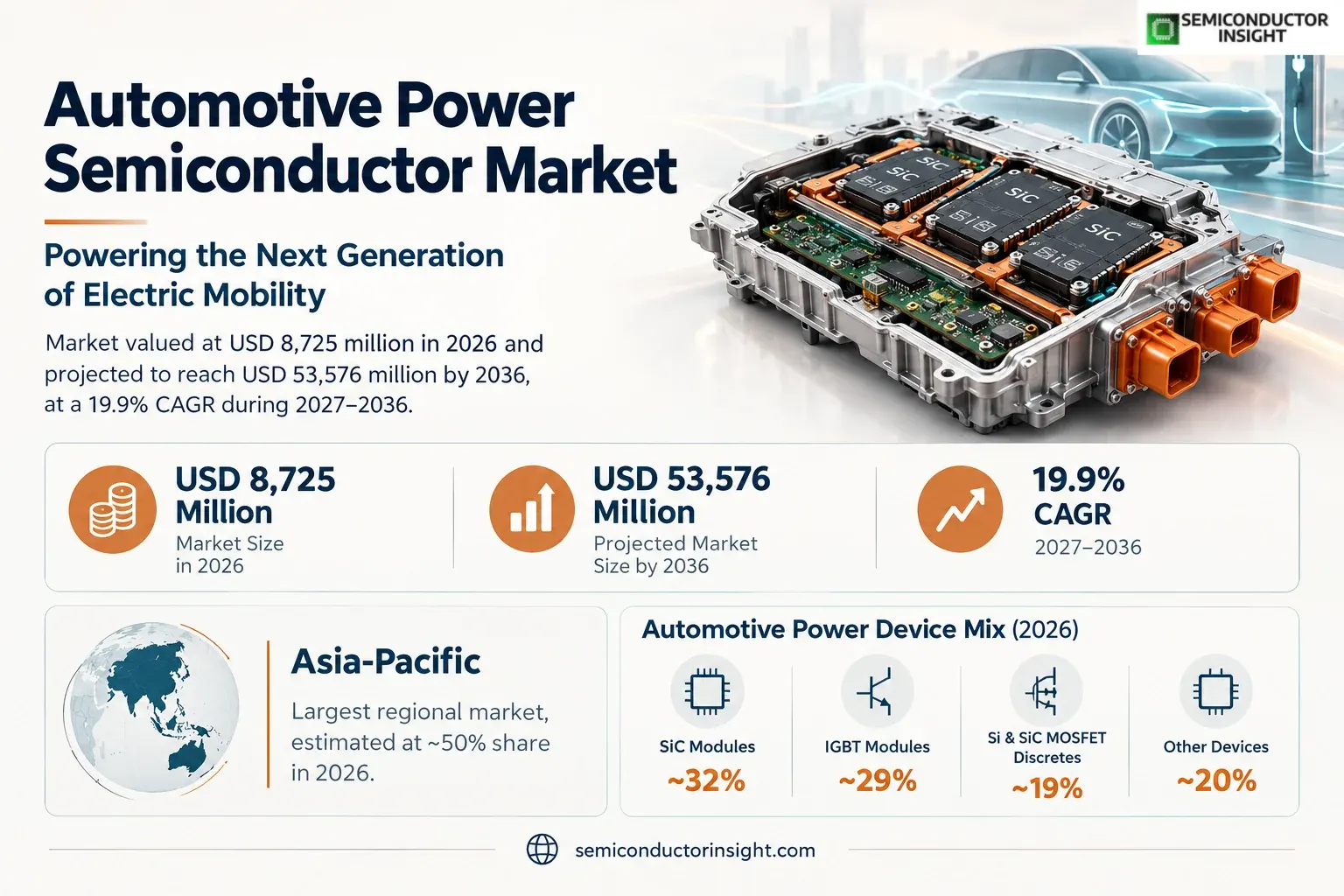
- Market trajectory: Automotive power semiconductor sales are valued at USD 8,725 million in 2026 and are projected to reach USD 53,576 million in 2036, representing a 19.9% CAGR during 2027–2036. Traction-electrification content and greater adoption of high-voltage conversion stages underpin the expansion.
- Automotive Grade SiC Module: This is the leading type at an estimated ~32% of 2026 revenue; Automotive Grade IGBT Module follows at ~29%, showing that silicon switching platforms remain commercially important even while silicon carbide advances in premium high-voltage vehicle programmes.
- Main Inverter (Electric Traction): This application accounts for an estimated ~68% of 2026 sales, compared with ~18% for onboard chargers and ~14% for vehicle DC/DC converters. Main-inverter purchases are closely tied to the number, voltage and power rating of electrified propulsion platforms.
- Asia-Pacific: The region holds an estimated ~50% of 2026 market value, ahead of North America at ~25% and Europe at ~19%. China, Japan and South Korea combine major automotive assembly operations with deep semiconductor packaging and power-electronics supplier networks.
- Technology and competition: Qualified automotive-grade silicon IGBT and SiC devices compete on thermal performance, switching loss, lifetime reliability, qualification cycles and total installed system cost. Component suppliers must secure vehicle-platform nominations well before model launch, which makes design wins more durable than spot-market orders.
Power Semiconductor in Automotive Market Overview
Power semiconductor in automotive market reached USD 8,725 million in 2026 and is projected to attain USD 53,576 million by 2036, registering a CAGR of 19.9% during 2027–2036. Asia-Pacific represented an estimated ~50% of 2026 revenue, reflecting its vehicle-production footprint, supplier qualification base and growing mix of electrified drivetrains.
Automotive power semiconductor demand matters because electrified powertrains require controlled conversion of battery energy into motor torque and auxiliary low-voltage supply. In automotive sourcing, automotive power semiconductor demand influences the mix of die, discrete switches and packaged modules that an original-equipment manufacturer specifies, shaping qualification, packaging, component cost and lifetime performance across 2027–2036. The market encompasses automotive-grade SiC modules, silicon IGBT modules, IGBT discretes, Si and SiC MOSFET discretes, automotive diodes and other relevant devices. For automotive power semiconductor demand, the commercial consequence is a higher value of automotive-qualified power silicon and silicon carbide per electrified platform, as engineers compare silicon IGBT and SiC switching efficiency, heat dissipation, automotive reliability and supply assurance.
The revenue boundary matters because the same vehicle may contain a traction module, a charger power stage and a DC/DC switching stage. In automotive sourcing, the revenue boundary influences the treatment of separately invoiced semiconductors compared with the larger equipment assemblies into which they are installed, shaping qualification, packaging, component cost and lifetime performance across 2027–2036. Merchant SiC substrates, stand-alone gate-driver integrated circuits and complete power-conversion systems are outside the defined component sales. For the revenue boundary, the commercial consequence is a device-level market that does not count the entire value of the traction inverter, complete charger or electric vehicle, as engineers compare silicon IGBT and SiC switching efficiency, heat dissipation, automotive reliability and supply assurance.
Traction inverter design matters because motor drive cycles combine high current, rapid switching and repeated thermal cycling. In automotive sourcing, traction inverter design influences module layouts, solder and sinter interfaces, substrate insulation and gate-control specifications, shaping qualification, packaging, component cost and lifetime performance across 2027–2036. Infineon documents automotive HybridPACK solutions across IGBT and SiC variants, while ST markets ACEPACK families for vehicle conversion duties. For traction inverter design, the commercial consequence is greater demand for proven automotive qualification and power-density improvements across 400V and 800V architectures, as engineers compare silicon IGBT and SiC switching efficiency, heat dissipation, automotive reliability and supply assurance.
Silicon and silicon carbide coexistence matters because silicon IGBTs offer an established manufacturing and cost base while SiC can reduce switching losses at demanding operating points. In automotive sourcing, silicon and silicon carbide coexistence influences platform decisions made by engineering teams balancing lifetime energy savings against initial semiconductor cost, shaping qualification, packaging, component cost and lifetime performance across 2027–2036. The estimated 2026 type split places SiC modules at ~32%, IGBT modules at ~29% and combined Si/SiC MOSFET discretes at ~19%. For silicon and silicon carbide coexistence, the commercial consequence is continued silicon module revenue even when new high-performance programmes specify SiC switches, as engineers compare silicon IGBT and SiC switching efficiency, heat dissipation, automotive reliability and supply assurance.
Electrification supply commitments matters because device and module qualification precedes production awards by multiple vehicle development stages. In automotive sourcing, electrification supply commitments influences long-term supply contracts, second-source strategies and thermal validation capacity, shaping qualification, packaging, component cost and lifetime performance across 2027–2036. The IEA Global EV Outlook 2026 supplies adjacent evidence on vehicle electrification, while manufacturer announcements establish direct device adoption examples. For electrification supply commitments, the commercial consequence is a competitive market in which securing a design slot can matter more than publishing a wider catalogue, as engineers compare silicon IGBT and SiC switching efficiency, heat dissipation, automotive reliability and supply assurance.
Segment Analysis: By Type
Type segmentation matters because the semiconductor bill of materials varies with the inverter or converter topology. In automotive sourcing, type segmentation influences the choice between integrated power modules and separately packaged switches, shaping qualification, packaging, component cost and lifetime performance across 2027–2036. The leading automotive-grade SiC module category represents ~32% of 2026 sales; silicon IGBT modules retain ~29%, and the remaining four types form the balance. For type segmentation, the commercial consequence is distinct unit-value and qualification patterns by technology class, as engineers compare silicon IGBT and SiC switching efficiency, heat dissipation, automotive reliability and supply assurance.
| Type | Function | Market position |
|---|---|---|
| Automotive Grade SiC Module | Automotive Grade SiC Module matters because high-voltage traction bridge assemblies using silicon-carbide switches and insulated thermal substrates. In automotive sourcing, automotive grade sic module influences electrical performance specifications and package integration requirements, shaping qualification, packaging, component cost and lifetime performance across 2027–2036. Its estimated 2026 market share is ~32% and its indicative modeled segment growth is ~22.4% CAGR. For automotive grade sic module, the commercial consequence is clear differentiation for vehicle OEMs seeking lower switching losses and more compact thermal systems, as engineers compare silicon IGBT and SiC switching efficiency, heat dissipation, automotive reliability and supply assurance. | Automotive Grade SiC Module commercial position matters because vehicle OEMs seeking lower switching losses and more compact thermal systems must compare qualification evidence across multiple model-year platforms. In automotive sourcing, automotive grade sic module commercial position influences price negotiation, thermal validation and production sourcing, shaping qualification, packaging, component cost and lifetime performance across 2027–2036. These estimates describe the segment share of device revenue rather than vehicle unit share or the value of an entire inverter. For automotive grade sic module commercial position, the commercial consequence is a 2026 share near ~32% and a distinct trajectory around ~22.4% CAGR, as engineers compare silicon IGBT and SiC switching efficiency, heat dissipation, automotive reliability and supply assurance. |
| Automotive Grade IGBT Module | Automotive Grade IGBT Module matters because packaged silicon IGBT half-bridge or six-pack structures qualified for automotive traction duty. In automotive sourcing, automotive grade igbt module influences electrical performance specifications and package integration requirements, shaping qualification, packaging, component cost and lifetime performance across 2027–2036. Its estimated 2026 market share is ~29% and its indicative modeled segment growth is ~18.6% CAGR. For automotive grade igbt module, the commercial consequence is clear differentiation for cost-optimised drive platforms with proven silicon manufacturing and cooling infrastructure, as engineers compare silicon IGBT and SiC switching efficiency, heat dissipation, automotive reliability and supply assurance. | Automotive Grade IGBT Module commercial position matters because cost-optimised drive platforms with proven silicon manufacturing and cooling infrastructure must compare qualification evidence across multiple model-year platforms. In automotive sourcing, automotive grade igbt module commercial position influences price negotiation, thermal validation and production sourcing, shaping qualification, packaging, component cost and lifetime performance across 2027–2036. These estimates describe the segment share of device revenue rather than vehicle unit share or the value of an entire inverter. For automotive grade igbt module commercial position, the commercial consequence is a 2026 share near ~29% and a distinct trajectory around ~18.6% CAGR, as engineers compare silicon IGBT and SiC switching efficiency, heat dissipation, automotive reliability and supply assurance. |
| Automotive Grade IGBT Discrete | Automotive Grade IGBT Discrete matters because individual automotive-qualified insulated-gate bipolar transistor components for selected power stages. In automotive sourcing, automotive grade igbt discrete influences electrical performance specifications and package integration requirements, shaping qualification, packaging, component cost and lifetime performance across 2027–2036. Its estimated 2026 market share is ~10% and its indicative modeled segment growth is ~17.4% CAGR. For automotive grade igbt discrete, the commercial consequence is clear differentiation for engineering teams requiring flexible topology and established discrete-device qualification, as engineers compare silicon IGBT and SiC switching efficiency, heat dissipation, automotive reliability and supply assurance. | Automotive Grade IGBT Discrete commercial position matters because engineering teams requiring flexible topology and established discrete-device qualification must compare qualification evidence across multiple model-year platforms. In automotive sourcing, automotive grade igbt discrete commercial position influences price negotiation, thermal validation and production sourcing, shaping qualification, packaging, component cost and lifetime performance across 2027–2036. These estimates describe the segment share of device revenue rather than vehicle unit share or the value of an entire inverter. For automotive grade igbt discrete commercial position, the commercial consequence is a 2026 share near ~10% and a distinct trajectory around ~17.4% CAGR, as engineers compare silicon IGBT and SiC switching efficiency, heat dissipation, automotive reliability and supply assurance. |
| Si & SiC MOSFET Discrete | Si & SiC MOSFET Discrete matters because separately packaged silicon and silicon-carbide MOSFET switches for OBC and DC/DC conversion. In automotive sourcing, si & sic mosfet discrete influences electrical performance specifications and package integration requirements, shaping qualification, packaging, component cost and lifetime performance across 2027–2036. Its estimated 2026 market share is ~19% and its indicative modeled segment growth is ~19.2% CAGR. For si & sic mosfet discrete, the commercial consequence is clear differentiation for vehicle converter designers choosing gate charge, on-resistance and switching-frequency trade-offs, as engineers compare silicon IGBT and SiC switching efficiency, heat dissipation, automotive reliability and supply assurance. | Si & SiC MOSFET Discrete commercial position matters because vehicle converter designers choosing gate charge, on-resistance and switching-frequency trade-offs must compare qualification evidence across multiple model-year platforms. In automotive sourcing, si & sic mosfet discrete commercial position influences price negotiation, thermal validation and production sourcing, shaping qualification, packaging, component cost and lifetime performance across 2027–2036. These estimates describe the segment share of device revenue rather than vehicle unit share or the value of an entire inverter. For si & sic mosfet discrete commercial position, the commercial consequence is a 2026 share near ~19% and a distinct trajectory around ~19.2% CAGR, as engineers compare silicon IGBT and SiC switching efficiency, heat dissipation, automotive reliability and supply assurance. |
| Automotive Grade Diode | Automotive Grade Diode matters because qualified rectifier and Schottky devices supporting power-factor correction and freewheel paths. In automotive sourcing, automotive grade diode influences electrical performance specifications and package integration requirements, shaping qualification, packaging, component cost and lifetime performance across 2027–2036. Its estimated 2026 market share is ~8% and its indicative modeled segment growth is ~18.6% CAGR. For automotive grade diode, the commercial consequence is clear differentiation for charger and auxiliary-converter engineers controlling reverse-recovery and thermal losses, as engineers compare silicon IGBT and SiC switching efficiency, heat dissipation, automotive reliability and supply assurance. | Automotive Grade Diode commercial position matters because charger and auxiliary-converter engineers controlling reverse-recovery and thermal losses must compare qualification evidence across multiple model-year platforms. In automotive sourcing, automotive grade diode commercial position influences price negotiation, thermal validation and production sourcing, shaping qualification, packaging, component cost and lifetime performance across 2027–2036. These estimates describe the segment share of device revenue rather than vehicle unit share or the value of an entire inverter. For automotive grade diode commercial position, the commercial consequence is a 2026 share near ~8% and a distinct trajectory around ~18.6% CAGR, as engineers compare silicon IGBT and SiC switching efficiency, heat dissipation, automotive reliability and supply assurance. |
| Others | Others matters because specialised automotive power switches and supporting semiconductor components outside the main classes. In automotive sourcing, others influences electrical performance specifications and package integration requirements, shaping qualification, packaging, component cost and lifetime performance across 2027–2036. Its estimated 2026 market share is ~2% and its indicative modeled segment growth is ~17.9% CAGR. For others, the commercial consequence is clear differentiation for niche vehicle programmes with unusual temperature, voltage or packaging requirements, as engineers compare silicon IGBT and SiC switching efficiency, heat dissipation, automotive reliability and supply assurance. | Others commercial position matters because niche vehicle programmes with unusual temperature, voltage or packaging requirements must compare qualification evidence across multiple model-year platforms. In automotive sourcing, others commercial position influences price negotiation, thermal validation and production sourcing, shaping qualification, packaging, component cost and lifetime performance across 2027–2036. These estimates describe the segment share of device revenue rather than vehicle unit share or the value of an entire inverter. For others commercial position, the commercial consequence is a 2026 share near ~2% and a distinct trajectory around ~17.9% CAGR, as engineers compare silicon IGBT and SiC switching efficiency, heat dissipation, automotive reliability and supply assurance. |
Automotive qualification and package selection
Power module qualification matters because repeated temperature excursions, vibration and humidity exposure can dominate device lifetime. In automotive sourcing, power module qualification influences manufacturer application engineering, materials selection and quality documentation, shaping qualification, packaging, component cost and lifetime performance across 2027–2036. IGBT and SiC alternatives require separate electrical and mechanical validation even when they share a vehicle powertrain architecture. For power module qualification, the commercial consequence is a premium for packages with stable thermal interfaces and verified reliability evidence, as engineers compare silicon IGBT and SiC switching efficiency, heat dissipation, automotive reliability and supply assurance.
Discrete-device integration matters because the charger and DC/DC converter may use several switching stages rather than a single traction module. In automotive sourcing, discrete-device integration influences PCB layout, thermal spreaders, gate-drive compatibility and assembly yield, shaping qualification, packaging, component cost and lifetime performance across 2027–2036. The market separates discrete semiconductors from the value of the finished charger or power-distribution unit. For discrete-device integration, the commercial consequence is greater product variety across silicon MOSFET, SiC MOSFET and diode families, as engineers compare silicon IGBT and SiC switching efficiency, heat dissipation, automotive reliability and supply assurance.
Segment Analysis: By Application
Application segmentation matters because traction, onboard charging and DC/DC conversion impose different electrical and reliability loads. In automotive sourcing, application segmentation influences the choice of module ratings, discrete switches and automotive-grade diodes, shaping qualification, packaging, component cost and lifetime performance across 2027–2036. Main inverters account for ~68% of estimated 2026 value, OBC for ~18% and vehicle DC/DC for ~14%. For application segmentation, the commercial consequence is different revenue intensity per vehicle and different switching-technology adoption rates, as engineers compare silicon IGBT and SiC switching efficiency, heat dissipation, automotive reliability and supply assurance.
| Application | Demand characteristics |
|---|---|
| Main Inverter (Electric Traction) | Main Inverter (Electric Traction) matters because traction motors need controlled three-phase conversion under acceleration and regenerative braking. In automotive sourcing, main inverter (electric traction) influences vehicle platform specifications, semiconductor device selection and thermal validation, shaping qualification, packaging, component cost and lifetime performance across 2027–2036. This application represents an estimated ~68% of 2026 component revenue and an indicative ~20.5% segment CAGR; these shares are modeled rather than vehicle registration statistics. For main inverter (electric traction), the commercial consequence is a commercially distinct demand pool among powertrain suppliers balancing switching loss, peak current and cooling cost, as engineers compare silicon IGBT and SiC switching efficiency, heat dissipation, automotive reliability and supply assurance. |
| OBC | OBC matters because the onboard charger converts grid input into a controlled battery-charging profile. In automotive sourcing, obc influences vehicle platform specifications, semiconductor device selection and thermal validation, shaping qualification, packaging, component cost and lifetime performance across 2027–2036. This application represents an estimated ~18% of 2026 component revenue and an indicative ~18.9% segment CAGR; these shares are modeled rather than vehicle registration statistics. For obc, the commercial consequence is a commercially distinct demand pool among converter suppliers optimising power-factor correction and high-frequency isolation, as engineers compare silicon IGBT and SiC switching efficiency, heat dissipation, automotive reliability and supply assurance. |
| DC/DC Converter for EV/HEV | DC/DC Converter for EV/HEV matters because high-voltage traction batteries must feed low-voltage loads and auxiliary subsystems. In automotive sourcing, dc/dc converter for ev/hev influences vehicle platform specifications, semiconductor device selection and thermal validation, shaping qualification, packaging, component cost and lifetime performance across 2027–2036. This application represents an estimated ~14% of 2026 component revenue and an indicative ~18.4% segment CAGR; these shares are modeled rather than vehicle registration statistics. For dc/dc converter for ev/hev, the commercial consequence is a commercially distinct demand pool among vehicle electronics teams requiring compact, efficient and fault-tolerant conversion, as engineers compare silicon IGBT and SiC switching efficiency, heat dissipation, automotive reliability and supply assurance. |
Automotive application purchasing matters because traction modules are usually selected early in the propulsion programme whereas OBC and DC/DC components follow converter design reviews. In automotive sourcing, automotive application purchasing influences timing of supplier nominations, component qualification and platform reuse, shaping qualification, packaging, component cost and lifetime performance across 2027–2036. ST ACEPACK DMT-32 and Infineon HybridPACK illustrate how separate product families address different stages of the same electric vehicle. For automotive application purchasing, the commercial consequence is multi-year sales visibility for qualified suppliers and replacement demand when vehicle generations change, as engineers compare silicon IGBT and SiC switching efficiency, heat dissipation, automotive reliability and supply assurance.
Regional Analysis
Regional market composition matters because vehicle assembly locations and power-module supply chains are distributed unevenly. In automotive sourcing, regional market composition influences regional procurement priorities, local qualification support and shipment logistics, shaping qualification, packaging, component cost and lifetime performance across 2027–2036. Asia-Pacific leads with an estimated ~50% of 2026 value; North America contributes ~25% and Europe ~19%, with smaller but growing demand in the other two regions. For regional market composition, the commercial consequence is different device adoption rates despite shared global powertrain architectures, as engineers compare silicon IGBT and SiC switching efficiency, heat dissipation, automotive reliability and supply assurance.
How do regional automotive power-semiconductor requirements differ?
Regional demand comparison matters because electrification rates, local automotive manufacturing and supplier qualification are not uniform. In automotive sourcing, regional demand comparison influences the location of device assembly, customer engineering and final vehicle production, shaping qualification, packaging, component cost and lifetime performance across 2027–2036. The regional model totals 100% of 2026 component revenue and uses region-specific growth estimates rather than reusing historical country shares. For regional demand comparison, the commercial consequence is distinct commercial entry routes across the five global markets, as engineers compare silicon IGBT and SiC switching efficiency, heat dissipation, automotive reliability and supply assurance.
| Region | Position | Growth outlook | Demand profile | What decides supplier selection |
|---|---|---|---|---|
| Asia-Pacific | Largest (~50%) | ~20.9% CAGR | Automotive platform and supplier qualification | Asia-Pacific procurement weighs china, japan and south korea combine vehicle assembly, power-device production and module integration against unit economics and production support. |
| North America | Second Largest (~25%) | ~18.2% CAGR | Automotive platform and supplier qualification | North America procurement weighs vehicle electrification programmes and north american semiconductor sourcing favour qualified multi-year supply against unit economics and production support. |
| Europe | Third Largest (~19%) | ~19.2% CAGR | Automotive platform and supplier qualification | Europe procurement weighs european automakers and tier-1 powertrain suppliers emphasize efficiency and supply assurance against unit economics and production support. |
| Middle East & Africa | Emerging (~3%) | ~20.7% CAGR | Automotive platform and supplier qualification | Middle East & Africa procurement weighs new electric-vehicle assembly and charging ecosystems create selective device demand against unit economics and production support. |
| South America | Emerging (~3%) | ~20.7% CAGR | Automotive platform and supplier qualification | South America procurement weighs regional assembly and electrified fleet programmes support gradual device content growth against unit economics and production support. |
Automotive Power Semiconductor Manufacturers and Competitive Landscape
Automotive device competition matters because suppliers must meet vehicle-grade quality requirements while offering both cost-effective silicon and high-efficiency SiC options. In automotive sourcing, automotive device competition influences long qualification cycles, packaging partnerships and direct engineering support, shaping qualification, packaging, component cost and lifetime performance across 2027–2036. Major names include Infineon, STMicroelectronics, onsemi, ROHM, Mitsubishi Electric and Semikron Danfoss, but each serves a different portion of the silicon and SiC product mix. For automotive device competition, the commercial consequence is a competitive field with integrated manufacturers, module specialists and automotive system partners, as engineers compare silicon IGBT and SiC switching efficiency, heat dissipation, automotive reliability and supply assurance.
Integrated device manufacturers matters because wafer fabrication, automotive device design and in-house qualification. In automotive sourcing, integrated device manufacturers influences supplier selection, cost targets and design-for-manufacture decisions, shaping qualification, packaging, component cost and lifetime performance across 2027–2036. The 2026 product mix includes ~32% SiC modules, ~29% IGBT modules and ~19% Si/SiC MOSFET discretes, reinforcing the need to compete across technologies. For integrated device manufacturers, the commercial consequence is differentiated bargaining positions for integrated device manufacturers, as engineers compare silicon IGBT and SiC switching efficiency, heat dissipation, automotive reliability and supply assurance.
Automotive module specialists matters because thermal packaging, power-module architecture and Tier-1 vehicle integration. In automotive sourcing, automotive module specialists influences supplier selection, cost targets and design-for-manufacture decisions, shaping qualification, packaging, component cost and lifetime performance across 2027–2036. The 2026 product mix includes ~32% SiC modules, ~29% IGBT modules and ~19% Si/SiC MOSFET discretes, reinforcing the need to compete across technologies. For automotive module specialists, the commercial consequence is differentiated bargaining positions for automotive module specialists, as engineers compare silicon IGBT and SiC switching efficiency, heat dissipation, automotive reliability and supply assurance.
Discrete and supporting device suppliers matters because MOSFET, diode and selected IGBT packages for auxiliary converters. In automotive sourcing, discrete and supporting device suppliers influences supplier selection, cost targets and design-for-manufacture decisions, shaping qualification, packaging, component cost and lifetime performance across 2027–2036. The 2026 product mix includes ~32% SiC modules, ~29% IGBT modules and ~19% Si/SiC MOSFET discretes, reinforcing the need to compete across technologies. For discrete and supporting device suppliers, the commercial consequence is differentiated bargaining positions for discrete and supporting device suppliers, as engineers compare silicon IGBT and SiC switching efficiency, heat dissipation, automotive reliability and supply assurance.
Supply-chain resilience matters because multi-year automotive platform commitments and second-source planning. In automotive sourcing, supply-chain resilience influences supplier selection, cost targets and design-for-manufacture decisions, shaping qualification, packaging, component cost and lifetime performance across 2027–2036. The 2026 product mix includes ~32% SiC modules, ~29% IGBT modules and ~19% Si/SiC MOSFET discretes, reinforcing the need to compete across technologies. For supply-chain resilience, the commercial consequence is differentiated bargaining positions for supply-chain resilience, as engineers compare silicon IGBT and SiC switching efficiency, heat dissipation, automotive reliability and supply assurance.
Tier structure
| Tier | Companies | Basis of competition |
|---|---|---|
| Tier 1 | Infineon Technologies; STMicroelectronics; onsemi; ROHM Semiconductor; Mitsubishi Electric | Tier 1 competition matters because broad automotive power device families, scale and OEM design access. In automotive sourcing, tier 1 competition influences engineering qualification and lifetime supply commitments, shaping qualification, packaging, component cost and lifetime performance across 2027–2036. Commercial differentiation is based on published portfolio and programme evidence, not an unsupported numerical supplier concentration claim. For tier 1 competition, the commercial consequence is a defined route to automotive customer nominations for Infineon Technologies and peers, as engineers compare silicon IGBT and SiC switching efficiency, heat dissipation, automotive reliability and supply assurance. |
| Tier 2 | Semikron Danfoss; Fuji Electric; Toshiba; Wolfspeed; Denso | Tier 2 competition matters because specialised module architectures, device performance and converter integration. In automotive sourcing, tier 2 competition influences engineering qualification and lifetime supply commitments, shaping qualification, packaging, component cost and lifetime performance across 2027–2036. Commercial differentiation is based on published portfolio and programme evidence, not an unsupported numerical supplier concentration claim. For tier 2 competition, the commercial consequence is a defined route to automotive customer nominations for Semikron Danfoss and peers, as engineers compare silicon IGBT and SiC switching efficiency, heat dissipation, automotive reliability and supply assurance. |
| Tier 3 | Nexperia; Littelfuse; Microchip Technology; BYD Semiconductor; StarPower Semiconductor | Tier 3 competition matters because targeted discrete portfolios, regional sourcing or focused automotive programmes. In automotive sourcing, tier 3 competition influences engineering qualification and lifetime supply commitments, shaping qualification, packaging, component cost and lifetime performance across 2027–2036. Commercial differentiation is based on published portfolio and programme evidence, not an unsupported numerical supplier concentration claim. For tier 3 competition, the commercial consequence is a defined route to automotive customer nominations for Nexperia and peers, as engineers compare silicon IGBT and SiC switching efficiency, heat dissipation, automotive reliability and supply assurance. |
Key companies profiled
- STMicroelectronics
- Infineon Technologies
- Wolfspeed
- ROHM Semiconductor
- onsemi
- Microchip Technology
- Mitsubishi Electric
- Semikron Danfoss
- Fuji Electric
- Toshiba
- Bosch
- Littelfuse
- Nexperia
- Denso
- Texas Instruments
- MinebeaMitsumi
- KEC
Automotive Power Semiconductor Manufacturing and Capacity Analysis
Automotive power-device production matters because semiconductor fabrication and power-module assembly require different capital equipment and qualification capabilities. In automotive sourcing, automotive power-device production influences wafer process planning, substrate supply and package manufacturing, shaping qualification, packaging, component cost and lifetime performance across 2027–2036. Asia-Pacific represents ~50% of modeled 2026 market demand, but regional demand share should not be mistaken for a measured wafer-fab capacity share. For automotive power-device production, the commercial consequence is a geographically distributed supply chain that must still satisfy vehicle OEM traceability, as engineers compare silicon IGBT and SiC switching efficiency, heat dissipation, automotive reliability and supply assurance.
Wafer fabrication matters because silicon IGBT and SiC MOSFET processes have different material yield and defect-density constraints. In automotive sourcing, wafer fabrication influences factory capital decisions, component lead times and vehicle quality controls, shaping qualification, packaging, component cost and lifetime performance across 2027–2036. SiC devices may deliver efficiency benefits in high-voltage systems, while silicon IGBT manufacturing continues to serve cost-sensitive applications. For wafer fabrication, the commercial consequence is a capacity-planning challenge that cannot be inferred solely from EV registration totals, as engineers compare silicon IGBT and SiC switching efficiency, heat dissipation, automotive reliability and supply assurance.
Module assembly matters because die attach, wire bonding or advanced interconnect and substrate thermal performance determine package reliability. In automotive sourcing, module assembly influences factory capital decisions, component lead times and vehicle quality controls, shaping qualification, packaging, component cost and lifetime performance across 2027–2036. SiC devices may deliver efficiency benefits in high-voltage systems, while silicon IGBT manufacturing continues to serve cost-sensitive applications. For module assembly, the commercial consequence is a capacity-planning challenge that cannot be inferred solely from EV registration totals, as engineers compare silicon IGBT and SiC switching efficiency, heat dissipation, automotive reliability and supply assurance.
Automotive validation matters because qualification demands electrical, environmental and lifetime tests before platform nominations. In automotive sourcing, automotive validation influences factory capital decisions, component lead times and vehicle quality controls, shaping qualification, packaging, component cost and lifetime performance across 2027–2036. SiC devices may deliver efficiency benefits in high-voltage systems, while silicon IGBT manufacturing continues to serve cost-sensitive applications. For automotive validation, the commercial consequence is a capacity-planning challenge that cannot be inferred solely from EV registration totals, as engineers compare silicon IGBT and SiC switching efficiency, heat dissipation, automotive reliability and supply assurance.
Capacity allocation matters because power semiconductor fabs supply automotive and industrial customers with different order timing. In automotive sourcing, capacity allocation influences factory capital decisions, component lead times and vehicle quality controls, shaping qualification, packaging, component cost and lifetime performance across 2027–2036. SiC devices may deliver efficiency benefits in high-voltage systems, while silicon IGBT manufacturing continues to serve cost-sensitive applications. For capacity allocation, the commercial consequence is a capacity-planning challenge that cannot be inferred solely from EV registration totals, as engineers compare silicon IGBT and SiC switching efficiency, heat dissipation, automotive reliability and supply assurance.
Automotive Power Semiconductor Market Dynamics: Drivers, Restraints and Opportunities
Market growth dynamics matters because EV traction electrification, higher bus voltages and converter integration raise the value of qualified switching devices. In automotive sourcing, market growth dynamics influences the balance between silicon IGBT economics and SiC switching performance, shaping qualification, packaging, component cost and lifetime performance across 2027–2036. Driver and restraint contributions are modeled for 2027–2029, 2030–2032 and 2033–2036; they are not vendor-reported market shares. For market growth dynamics, the commercial consequence is new design wins and production capacity demand, tempered by costs and validation hurdles, as engineers compare silicon IGBT and SiC switching efficiency, heat dissipation, automotive reliability and supply assurance.
MARKET DRIVERS
Drivers Impact Analysis*
| Market Drivers | Impact Rank | CAGR Contribution (%) | 2027–2029 | 2030–2032 | 2033–2036 |
|---|---|---|---|---|---|
| Electric-vehicle traction powertrain adoption | High | +9.10% | High | High | High |
| 800V architecture and high-efficiency SiC modules | High | +6.20% | High | High | Medium |
| Onboard charger and vehicle DC/DC content | Medium-High | +4.50% | High | Medium | Medium |
| Automotive module thermal and packaging innovation | Medium | +3.10% | Medium | High | High |
| Supply localisation and platform qualification | Low-Medium | +2.10% | Medium | Medium | High |
| Others (hybrid powertrains, auxiliary electrification and replacement programmes) | Low | +1.50% | Medium | Medium | Medium |
Electric traction platforms
Electric traction platforms matters because motor-control inverters are essential to every battery-electric drivetrain. In automotive sourcing, electric traction platforms influences automotive module and discrete-device specifications, shaping qualification, packaging, component cost and lifetime performance across 2027–2036. Manufacturer examples include Infineon HybridPACK, ST ACEPACK and onsemi EliteSiC; the products differ in semiconductor composition and target use. For electric traction platforms, the commercial consequence is additional qualified semiconductor content across electrified vehicle platforms, as engineers compare silicon IGBT and SiC switching efficiency, heat dissipation, automotive reliability and supply assurance.
High-voltage power electronics
High-voltage power electronics matters because 800V-class systems reward lower switching loss and efficient thermal design. In automotive sourcing, high-voltage power electronics influences automotive module and discrete-device specifications, shaping qualification, packaging, component cost and lifetime performance across 2027–2036. Manufacturer examples include Infineon HybridPACK, ST ACEPACK and onsemi EliteSiC; the products differ in semiconductor composition and target use. For high-voltage power electronics, the commercial consequence is additional qualified semiconductor content across electrified vehicle platforms, as engineers compare silicon IGBT and SiC switching efficiency, heat dissipation, automotive reliability and supply assurance.
Vehicle onboard charging
Vehicle onboard charging matters because AC charging and bidirectional charging architectures require semiconductor conversion stages. In automotive sourcing, vehicle onboard charging influences automotive module and discrete-device specifications, shaping qualification, packaging, component cost and lifetime performance across 2027–2036. Manufacturer examples include Infineon HybridPACK, ST ACEPACK and onsemi EliteSiC; the products differ in semiconductor composition and target use. For vehicle onboard charging, the commercial consequence is additional qualified semiconductor content across electrified vehicle platforms, as engineers compare silicon IGBT and SiC switching efficiency, heat dissipation, automotive reliability and supply assurance.
Thermal package improvements
Thermal package improvements matters because sintered interconnects and substrate selection affect current density and reliability. In automotive sourcing, thermal package improvements influences automotive module and discrete-device specifications, shaping qualification, packaging, component cost and lifetime performance across 2027–2036. Manufacturer examples include Infineon HybridPACK, ST ACEPACK and onsemi EliteSiC; the products differ in semiconductor composition and target use. For thermal package improvements, the commercial consequence is additional qualified semiconductor content across electrified vehicle platforms, as engineers compare silicon IGBT and SiC switching efficiency, heat dissipation, automotive reliability and supply assurance.
MARKET RESTRAINTS
Restraints Impact Analysis*
| Market Restraints | Impact Rank | CAGR Contribution (%) | 2027–2029 | 2030–2032 | 2033–2036 |
|---|---|---|---|---|---|
| High SiC wafer and device manufacturing costs | High | -2.70% | High | Medium | Medium |
| Automotive qualification and redesign cycles | Medium-High | -1.90% | High | High | Medium |
| EV programme timing and inventory volatility | Medium | -1.30% | High | Medium | Medium |
| Others (package yield, thermal validation and sourcing friction) | Low | -0.70% | Medium | Medium | Low |
SiC device cost premium
SiC device cost premium matters because SiC crystal growth, epitaxy and device processing remain more complex than mature silicon routes. In automotive sourcing, sic device cost premium influences purchasing negotiations and component qualification calendars, shaping qualification, packaging, component cost and lifetime performance across 2027–2036. Automakers compare a 2026 semiconductor budget with multi-year lifetime performance, so component selection cannot be reduced to die price alone. For sic device cost premium, the commercial consequence is slower adoption or higher cost for sic device cost premium, as engineers compare silicon IGBT and SiC switching efficiency, heat dissipation, automotive reliability and supply assurance.
Long design-in cycles
Long design-in cycles matters because automotive-grade devices must pass demanding reliability and functional-safety reviews. In automotive sourcing, long design-in cycles influences purchasing negotiations and component qualification calendars, shaping qualification, packaging, component cost and lifetime performance across 2027–2036. Automakers compare a 2026 semiconductor budget with multi-year lifetime performance, so component selection cannot be reduced to die price alone. For long design-in cycles, the commercial consequence is slower adoption or higher cost for long design-in cycles, as engineers compare silicon IGBT and SiC switching efficiency, heat dissipation, automotive reliability and supply assurance.
Programme timing uncertainty
Programme timing uncertainty matters because vehicle production forecasts can change before the semiconductor supply chain can adjust. In automotive sourcing, programme timing uncertainty influences purchasing negotiations and component qualification calendars, shaping qualification, packaging, component cost and lifetime performance across 2027–2036. Automakers compare a 2026 semiconductor budget with multi-year lifetime performance, so component selection cannot be reduced to die price alone. For programme timing uncertainty, the commercial consequence is slower adoption or higher cost for programme timing uncertainty, as engineers compare silicon IGBT and SiC switching efficiency, heat dissipation, automotive reliability and supply assurance.
Thermal and packaging yield
Thermal and packaging yield matters because power cycling and interface fatigue can reduce qualification yield. In automotive sourcing, thermal and packaging yield influences purchasing negotiations and component qualification calendars, shaping qualification, packaging, component cost and lifetime performance across 2027–2036. Automakers compare a 2026 semiconductor budget with multi-year lifetime performance, so component selection cannot be reduced to die price alone. For thermal and packaging yield, the commercial consequence is slower adoption or higher cost for thermal and packaging yield, as engineers compare silicon IGBT and SiC switching efficiency, heat dissipation, automotive reliability and supply assurance.
MARKET OPPORTUNITIES
SiC migration in mass-market EVs
SiC migration in mass-market EVs matters because efficiency gains can justify device premiums when module integration costs decline. In automotive sourcing, sic migration in mass-market evs influences engineering demonstrations, platform nominations and qualification support, shaping qualification, packaging, component cost and lifetime performance across 2027–2036. The opportunity extends across 2027–2036 model launches without treating charging stations or completed vehicle systems as semiconductor revenue. For sic migration in mass-market evs, the commercial consequence is an addressable opportunity for suppliers with reliable automotive-grade portfolios, as engineers compare silicon IGBT and SiC switching efficiency, heat dissipation, automotive reliability and supply assurance.
Automotive charger integration
Automotive charger integration matters because compact OBC topologies can benefit from fast-switching MOSFETs and qualified diodes. In automotive sourcing, automotive charger integration influences engineering demonstrations, platform nominations and qualification support, shaping qualification, packaging, component cost and lifetime performance across 2027–2036. The opportunity extends across 2027–2036 model launches without treating charging stations or completed vehicle systems as semiconductor revenue. For automotive charger integration, the commercial consequence is an addressable opportunity for suppliers with reliable automotive-grade portfolios, as engineers compare silicon IGBT and SiC switching efficiency, heat dissipation, automotive reliability and supply assurance.
Regional second-source programmes
Regional second-source programmes matters because automakers seek supply resilience for components with long model lives. In automotive sourcing, regional second-source programmes influences engineering demonstrations, platform nominations and qualification support, shaping qualification, packaging, component cost and lifetime performance across 2027–2036. The opportunity extends across 2027–2036 model launches without treating charging stations or completed vehicle systems as semiconductor revenue. For regional second-source programmes, the commercial consequence is an addressable opportunity for suppliers with reliable automotive-grade portfolios, as engineers compare silicon IGBT and SiC switching efficiency, heat dissipation, automotive reliability and supply assurance.
Higher-power auxiliary systems
Higher-power auxiliary systems matters because electric compressors, thermal management and low-voltage loads create additional conversion duties. In automotive sourcing, higher-power auxiliary systems influences engineering demonstrations, platform nominations and qualification support, shaping qualification, packaging, component cost and lifetime performance across 2027–2036. The opportunity extends across 2027–2036 model launches without treating charging stations or completed vehicle systems as semiconductor revenue. For higher-power auxiliary systems, the commercial consequence is an addressable opportunity for suppliers with reliable automotive-grade portfolios, as engineers compare silicon IGBT and SiC switching efficiency, heat dissipation, automotive reliability and supply assurance.
Automotive Power Semiconductor Supply Chain Analysis
Automotive semiconductor supply chains matters because wafers, discrete device assembly, module packaging and vehicle integration are separate commercial stages. In automotive sourcing, automotive semiconductor supply chains influences supplier contracts and component traceability, shaping qualification, packaging, component cost and lifetime performance across 2027–2036. A 2026 base-year component model separates upstream SiC substrate inputs from packaged SiC and silicon power products sold into vehicle programmes. For automotive semiconductor supply chains, the commercial consequence is value capture at qualified device and module sale rather than complete automotive powertrain assembly, as engineers compare silicon IGBT and SiC switching efficiency, heat dissipation, automotive reliability and supply assurance.
Upstream material control. Upstream material control matters because silicon and SiC wafers determine defect exposure and device cost before packaging. In automotive sourcing, upstream material control influences supplier contracts, traceability requirements and testing lead times, shaping qualification, packaging, component cost and lifetime performance across 2027–2036. Separately sold substrates, gate drivers and complete inverters are excluded to avoid inflating the component revenue object. For upstream material control, the commercial consequence is a distinct bargaining position for upstream material control, as engineers compare silicon IGBT and SiC switching efficiency, heat dissipation, automotive reliability and supply assurance.
Power module production. Power module production matters because insulated substrates, thermal interfaces and interconnects define module current capability. In automotive sourcing, power module production influences supplier contracts, traceability requirements and testing lead times, shaping qualification, packaging, component cost and lifetime performance across 2027–2036. Separately sold substrates, gate drivers and complete inverters are excluded to avoid inflating the component revenue object. For power module production, the commercial consequence is a distinct bargaining position for power module production, as engineers compare silicon IGBT and SiC switching efficiency, heat dissipation, automotive reliability and supply assurance.
Automotive purchasing channel. Automotive purchasing channel matters because vehicle manufacturers typically award multi-year nominations through direct supplier or Tier-1 programmes. In automotive sourcing, automotive purchasing channel influences supplier contracts, traceability requirements and testing lead times, shaping qualification, packaging, component cost and lifetime performance across 2027–2036. Separately sold substrates, gate drivers and complete inverters are excluded to avoid inflating the component revenue object. For automotive purchasing channel, the commercial consequence is a distinct bargaining position for automotive purchasing channel, as engineers compare silicon IGBT and SiC switching efficiency, heat dissipation, automotive reliability and supply assurance.
Downstream integration. Downstream integration matters because traction, charger and DC/DC teams qualify different packages and switching devices. In automotive sourcing, downstream integration influences supplier contracts, traceability requirements and testing lead times, shaping qualification, packaging, component cost and lifetime performance across 2027–2036. Separately sold substrates, gate drivers and complete inverters are excluded to avoid inflating the component revenue object. For downstream integration, the commercial consequence is a distinct bargaining position for downstream integration, as engineers compare silicon IGBT and SiC switching efficiency, heat dissipation, automotive reliability and supply assurance.
Recent Developments in Automotive Power Semiconductors
- 28 April 2023 Product launch
Infineon introduced its HybridPACK Drive G2 automotive power-module generation, presenting silicon IGBT and silicon carbide alternatives for traction duty. The release matters because OEMs can evaluate package and current-density improvements within familiar automotive integration approaches, and because the continued availability of IGBT configurations demonstrates why silicon remains relevant alongside SiC for cost-sensitive propulsion programmes. Source - 24 October 2023 Product launch
STMicroelectronics released its ACEPACK DMT-32 SiC module family for automotive onboard charging and DC/DC conversion. Its multiple topologies and 1200V device class illustrate the component requirements of auxiliary power conversion, where compact packaging and thermal reliability can be more important than traction-level peak current. The announcement supports direct device demand without counting the entire charger system as semiconductor sales. Source - 24 September 2024 Technology launch
STMicroelectronics announced fourth-generation SiC MOSFET technology targeted at electric-vehicle traction inverters, including 750V and 1200V classes. The development matters because lower switching and conduction losses can reduce cooling requirements and improve inverter power density. Its stated qualification and ramp timetable concerns semiconductor technology, not a reported total for the automotive device market. Source - 15 October 2024 Technology launch
Infineon described its silicon and silicon-carbide Fusion approach for automotive traction modules. The announcement is important because hybrid semiconductor designs can provide an intermediate cost-performance option between mature silicon IGBT architectures and fully SiC switching assemblies. In evaluating the market, hybrid modules should be classified by their actual device mix rather than described as entirely silicon-carbide products. Source - 3 December 2024 Supply agreement
STMicroelectronics and Ampere announced a multi-year SiC module supply agreement connected to Renault Group electric-drive development. The arrangement highlights how device qualification and supply security are negotiated before mass vehicle output, giving semiconductor vendors longer production planning visibility. It is evidence of an automotive power-module commercial programme, not a measurement of completed inverter or vehicle sales. Source - 9 February 2026 Design win
Infineon announced Toyota bZ4X use of CoolSiC technology in onboard charger and DC/DC functions. This example connects an automotive-qualified semiconductor portfolio to two specific converter applications beyond the main traction inverter. Its commercial relevance is broader content per electrified platform, while the vehicle programme does not establish a standalone market-size figure for either converter category. Source - 28 April 2026 OEM collaboration
onsemi reported an expanded relationship with Geely around its EliteSiC portfolio and higher-voltage vehicle architectures. The development illustrates how power-device selection is becoming part of the OEM platform roadmap, including efficiency and packaging choices. It supports a shift toward SiC in selected vehicles while leaving room for silicon IGBT and MOSFET solutions in other price and power classes. Source
REPORT SCOPE & SEGMENTATION
| Attribute | Details |
|---|---|
| Study Period | 2021–2036 |
| Base Year | 2026 |
| Estimated Year | 2027 |
| Forecast Period | 2027–2036 |
| Historical Period | 2021–2025 |
| Market Size 2026 | USD 8,725 million |
| Market Size 2027 | USD 10,462 million |
| Market Size 2036 | USD 53,576 million |
| Growth Rate | CAGR of 19.9% from 2027–2036 |
| Unit | Value (USD Million) |
| Segmentation | By Type, By Application and By Region |
| By Type | Automotive Grade SiC Module · Automotive Grade IGBT Module · Automotive Grade IGBT Discrete · Si & SiC MOSFET Discrete · Automotive Grade Diode · Others |
| By Application | Main Inverter (Electric Traction) · OBC · DC/DC Converter for EV/HEV |
| By Region | Each region analysed by Type, Application and Country North AmericaUnited States, Canada, Mexico EuropeGermany, France, Italy, United Kingdom, Rest of Europe Asia-PacificChina, Japan, South Korea, India, Southeast Asia, Rest of Asia-Pacific South AmericaBrazil, Argentina, Chile, Rest of South America Middle East & AfricaUnited Arab Emirates, Saudi Arabia, South Africa, Rest of Middle East & Africa |
| Key Companies Profiled | STMicroelectronics, Infineon Technologies, Wolfspeed, ROHM Semiconductor, onsemi, Microchip Technology, Mitsubishi Electric, Semikron Danfoss, Fuji Electric, Toshiba, Bosch, Littelfuse, Nexperia, Denso, Texas Instruments, MinebeaMitsumi, KEC, BYD Semiconductor, StarPower Semiconductor, Zhuzhou CRRC Times Electric, BASiC Semiconductor, CETC 55, Guangdong AccoPower Semiconductor, Grecon Semiconductor (Shanghai) |
| Customization Scope | Country, technology, application and company-level adjustments available for licensed research deliverables. |
Frequently Asked Questions
How large is the global automotive power semiconductor market?
Global automotive power semiconductor sales were USD 8,725 million in 2026 and are projected to reach USD 53,576 million by 2036, a 19.9% CAGR over 2027–2036. The outlook covers automotive-qualified switching devices and modules for traction inverters, onboard chargers and vehicle DC/DC stages, rather than the complete value of electric vehicles or finished inverter assemblies.
Which power semiconductor technology leads automotive demand?
Automotive Grade SiC Module technology matters because high-voltage traction designs increasingly seek efficient power switching. In automotive sourcing, automotive grade sic module technology influences the division of module and discrete sales across silicon and SiC, shaping qualification, packaging, component cost and lifetime performance across 2027–2036. Silicon IGBTs remain relevant for programmes where proven manufacturing and installed system cost dominate selection. For automotive grade sic module technology, the commercial consequence is a leading estimated ~32% 2026 type share, with IGBT modules following at ~29%, as engineers compare silicon IGBT and SiC switching efficiency, heat dissipation, automotive reliability and supply assurance.
Why do traction inverters account for the largest application share?
Main Inverter (Electric Traction) demand matters because battery power must be modulated into three-phase motor current and regenerative braking energy. In automotive sourcing, main inverter (electric traction) demand influences the quantity and current rating of packaged power devices per vehicle, shaping qualification, packaging, component cost and lifetime performance across 2027–2036. OBC and DC/DC components account for ~18% and ~14%, respectively, reflecting separate conversion functions. For main inverter (electric traction) demand, the commercial consequence is an estimated ~68% 2026 application share, as engineers compare silicon IGBT and SiC switching efficiency, heat dissipation, automotive reliability and supply assurance.
What is the position of onboard chargers in this market?
Onboard charger semiconductor demand matters because AC-to-DC conversion needs qualified switches, rectifiers and power-factor-correction stages. In automotive sourcing, onboard charger semiconductor demand influences converter thermal layouts and switching-frequency choices, shaping qualification, packaging, component cost and lifetime performance across 2027–2036. The charger housing, magnetics, control electronics and installation costs are not included in device-level market revenue. For onboard charger semiconductor demand, the commercial consequence is an estimated ~18% of 2026 application revenue, as engineers compare silicon IGBT and SiC switching efficiency, heat dissipation, automotive reliability and supply assurance.
What does the DC/DC converter application include?
EV/HEV DC/DC power devices matters because traction battery energy must be stepped down to supply vehicle auxiliary electrical networks. In automotive sourcing, ev/hev dc/dc power devices influences the selection of automotive MOSFETs, diodes and selected modules, shaping qualification, packaging, component cost and lifetime performance across 2027–2036. The segment covers semiconductor components inside the converter and not the assembled vehicle power-distribution system. For ev/hev dc/dc power devices, the commercial consequence is an estimated ~14% of 2026 application sales, as engineers compare silicon IGBT and SiC switching efficiency, heat dissipation, automotive reliability and supply assurance.
Which region has the highest automotive power semiconductor revenue?
Asia-Pacific automotive semiconductor demand matters because vehicle production, battery supply chains and module manufacturing are concentrated across major Asian markets. In automotive sourcing, asia-pacific automotive semiconductor demand influences engineering qualification and local OEM supplier relationships, shaping qualification, packaging, component cost and lifetime performance across 2027–2036. North America follows at ~25% and Europe at ~19%; these are modeled current shares, not historical country percentages. For asia-pacific automotive semiconductor demand, the commercial consequence is the largest modeled 2026 regional share of ~50%, as engineers compare silicon IGBT and SiC switching efficiency, heat dissipation, automotive reliability and supply assurance.
How do silicon IGBT modules differ from SiC modules?
Silicon IGBT and SiC module comparison matters because silicon IGBTs offer established cost and production maturity whereas SiC devices can reduce high-voltage switching loss. In automotive sourcing, silicon igbt and sic module comparison influences vehicle cooling design, efficiency targets and component budgets, shaping qualification, packaging, component cost and lifetime performance across 2027–2036. In the estimated 2026 type mix, silicon IGBT modules hold ~29% and automotive SiC modules ~32%. For silicon igbt and sic module comparison, the commercial consequence is different powertrain design wins rather than a universal technology replacement, as engineers compare silicon IGBT and SiC switching efficiency, heat dissipation, automotive reliability and supply assurance.
Which manufacturers supply automotive power devices?
Automotive power-device suppliers matters because Infineon, STMicroelectronics, onsemi, ROHM, Mitsubishi Electric and others offer distinct automotive-qualified product families. In automotive sourcing, automotive power-device suppliers influences module qualification, long-term reliability evidence and vehicle programme sourcing, shaping qualification, packaging, component cost and lifetime performance across 2027–2036. Company revenue totals cannot be directly interpreted as automotive component market shares because their portfolios include industrial and other semiconductor businesses. For automotive power-device suppliers, the commercial consequence is competition among integrated manufacturers and module specialists, as engineers compare silicon IGBT and SiC switching efficiency, heat dissipation, automotive reliability and supply assurance.
What limits the pace of SiC adoption in automotive platforms?
Automotive SiC adoption constraints matters because wafer manufacturing complexity, device cost and automotive qualification increase initial investment. In automotive sourcing, automotive sic adoption constraints influences vehicle platform timing, thermal validation and supply-chain risk, shaping qualification, packaging, component cost and lifetime performance across 2027–2036. Silicon IGBT and silicon MOSFET technologies remain commercially relevant through the forecast window. For automotive sic adoption constraints, the commercial consequence is a staged migration toward SiC in the applications where lifetime efficiency gains justify the premium, as engineers compare silicon IGBT and SiC switching efficiency, heat dissipation, automotive reliability and supply assurance.
What years and market segments are covered?
Automotive semiconductor segmentation matters because the analysis uses 2026 as base year and 2027 as the first forecast year. In automotive sourcing, automotive semiconductor segmentation influences separate type and application axes across five geographic regions, shaping qualification, packaging, component cost and lifetime performance across 2027–2036. The type split contains six classes and the application split covers traction inverter, onboard charging and vehicle DC/DC functions. For automotive semiconductor segmentation, the commercial consequence is a comparable view of component-level demand through 2036, as engineers compare silicon IGBT and SiC switching efficiency, heat dissipation, automotive reliability and supply assurance.
Research Sources & Evidence Base
Get Sample Report PDF for Exclusive Insights
Report Sample Includes
- Table of Contents
- List of Tables & Figures
- Charts, Research Methodology, and more...
 Download Sample Report PDF