Key Statistics
Key Takeaways
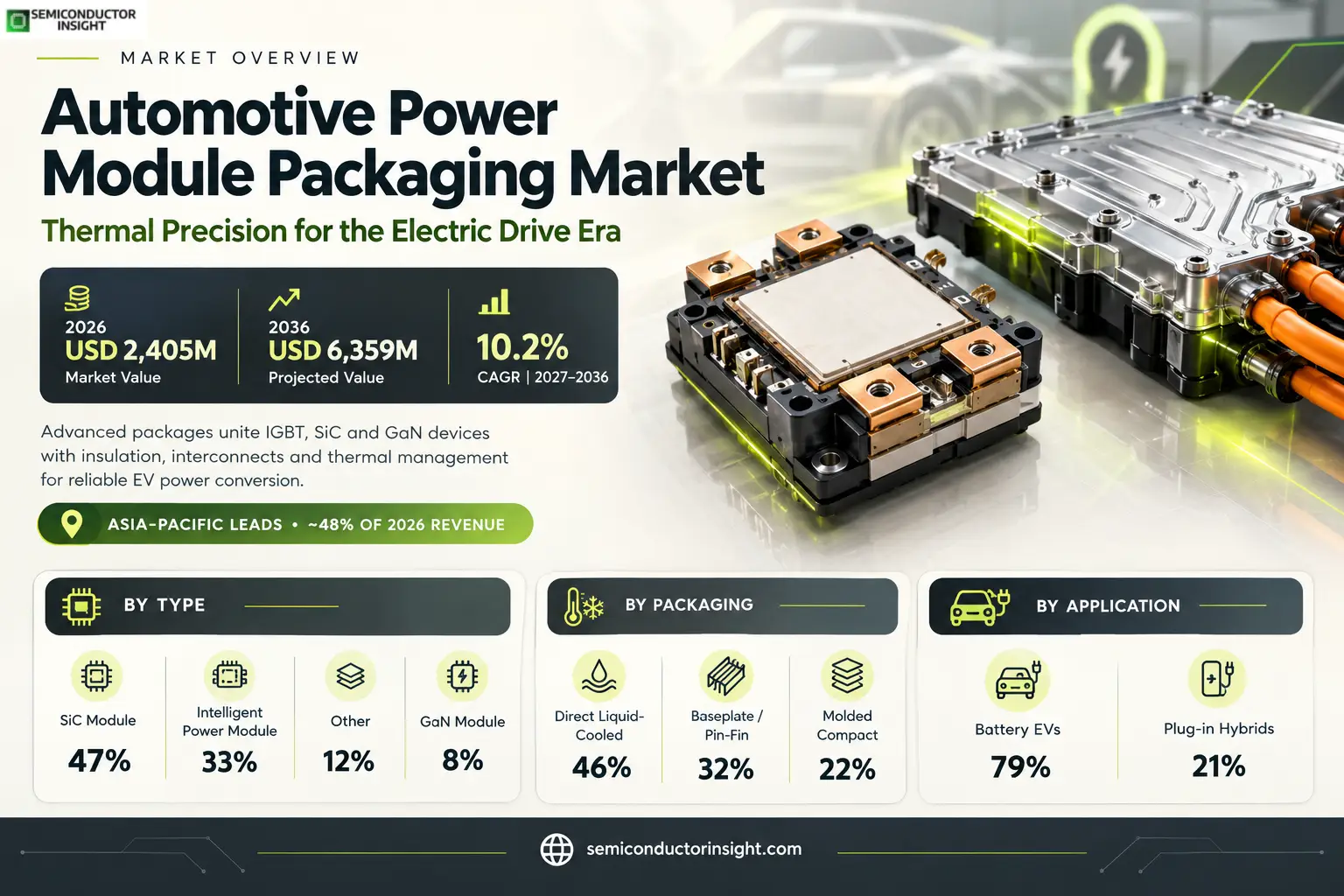
- Market value: The automotive power module packaging market stands at USD 2,405 million in 2026 and is projected to reach USD 6,359 million by 2036, a CAGR of 10.2% during 2027–2036 as vehicle inverters adopt higher power-density modules.
- SiC modules lead: SiC Module is the largest type at an estimated ~47% of 2026 revenue; GaN Module is smaller at ~8% but the fastest growing, with modeled ~14.9% CAGR from a low base.
- BEV applications dominate: Battery Electric Vehicles account for an estimated ~79% of packaged-module revenue, while Plug-in Hybrid Electric Vehicles retain ~21% through dual-propulsion and charging architectures.
- Regional leadership: Asia-Pacific holds an estimated ~48% of 2026 value and modeled ~11.3% regional CAGR, reflecting vehicle manufacturing in China and packaging capabilities in Japan, Korea and Southeast Asia.
- Engineering constraint: Thermal-cycle endurance, ceramic-substrate supply, die-attach quality and automotive qualification determine supplier selection more directly than headline semiconductor switching efficiency alone.
Automotive Power Module Packaging Market Overview
The automotive power module packaging market was valued at USD 2,405 million in 2026 and is projected to reach USD 6,359 million by 2036, representing a 10.2% CAGR during 2027–2036. Asia-Pacific held the largest regional position at an estimated ~48% of 2026 revenue, reflecting concentrated electric-vehicle manufacturing and power-electronics assembly.
Automotive power module packaging converts individual silicon IGBT, silicon-carbide MOSFET and emerging gallium-nitride switching devices into mechanically robust, electrically insulated and thermally managed assemblies for electrified vehicles. A power module combines semiconductor dice, a ceramic-metal substrate, interconnections, terminals, an encapsulation or housing, and a heat-removal interface. Vehicle engineers buy the resulting package for current capability, reliability, parasitic inductance and integration time rather than merely the properties of its semiconductor wafer. STMicroelectronics ACEPACK and Infineon HybridPACK Drive G2 demonstrate how module architecture influences converter performance.
The commercial revenue boundary is the factory-gate value of packaged automotive power modules supplied for traction inverters, onboard chargers, DC-DC converters and auxiliary high-voltage conversion, including integrated packaging and qualified contract assembly when separately billed without double counting. Bare SiC wafers, unencapsulated dies, standalone discrete transistors, complete traction inverter assemblies, finished chargers, batteries and vehicles are outside this product boundary. This distinction matters because a vehicle maker may purchase a packaged six-switch module and integrate it into a much more expensive inverter; adding both transactions would exaggerate the packaged-module market.
Power density is increasingly constrained by the module rather than by switching-device characteristics alone. Direct-bonded copper or active-metal-brazed ceramic substrates carry current while insulating high-voltage nodes; sintered die attachment and low-inductance terminals reduce thermal and electrical penalties. NGK describes silicon-nitride AMB substrates for electric-vehicle power modules, while Semikron Danfoss documents double-sided sintering and low stray inductance in its eMPack platform. A packaging design that survives repetitive temperature cycling and vibration can qualify for a vehicle program even when another design has marginally better laboratory switching efficiency.
Automotive demand is driven by the number and mix of electrified vehicles, but module value does not move one-for-one with vehicle unit sales. The International Energy Agency reports more than 20 million electric-car sales worldwide in 2025, with battery electric and plug-in hybrid models included in that total. A BEV usually requires high-power traction conversion and charging electronics, whereas PHEV architectures combine combustion propulsion with electrified traction. Voltage migration from 400 V to 800 V, cooling choice and silicon-carbide adoption can change packaging content per vehicle independently of overall EV registration growth.
The present product transition is visible in commercial module programs rather than only in laboratory roadmaps. Infineon selected its HybridPACK Drive G2 silicon and SiC families for Rivian R2 traction inverters with supply expected in 2026; STMicroelectronics supplies ACEPACK DRIVE modules for Hyundai electric-vehicle architecture; and ROHM announced compact HSDIP20 SiC modules for onboard chargers in April 2025. These examples show separate demand for high-current direct-cooled traction modules and smaller molded charging modules. Suppliers must balance efficiency gains against substrate cost, thermal interfaces, automotive traceability and multiyear qualification.
Segment Analysis: By Type
By Type, SiC Module represents an estimated ~47% of 2026 packaged-module revenue and modeled ~11.3% CAGR, reflecting high-voltage traction adoption. Intelligent Power Module follows at ~33% with ~8.3% CAGR; Other accounts for ~12% with ~6.0% CAGR; GaN Module contributes ~8% but has the fastest modeled expansion at ~14.9% CAGR, mainly in compact conversion stages rather than large traction bridges.
| Type | Function | Market position |
|---|---|---|
| Intelligent Power Module | Intelligent power modules integrate switching devices with protection, sensing or driver functions in a package intended to simplify system integration. In electrified vehicles, these assemblies suit auxiliary motors, thermal-management loads and some power conversion stages where a compact, qualified solution is more valuable than maximum traction current. Infineon’s driver-and-module integration and Mitsubishi Electric’s sensor-equipped J1 family illustrate how the packaging boundary can incorporate control and monitoring functions without becoming a complete inverter. | An estimated ~33% of 2026 revenue belongs to intelligent power modules, with modeled ~8.3% CAGR through 2036. Demand is supported by mature silicon platforms and repeated use of proven package footprints, although higher-voltage traction applications increasingly select dedicated SiC solutions. Procurement emphasizes fault protection, integration support, predictable heat removal and low redesign risk. The category is not equivalent to all automotive power electronics because standalone controllers and finished drive units are excluded. |
| SiC Module | Silicon-carbide modules package fast-switching MOSFET dice into insulated high-current assemblies using ceramic substrates, sintered joints and low-inductance interconnects. They are prominent in 750 V and 1200 V traction designs and in high-voltage onboard chargers. Infineon HybridPACK Drive G2, ST ACEPACK DRIVE and Semikron Danfoss eMPack are direct examples. Their engineering function is to control switching loss and thermal impedance under repetitive acceleration, regenerative braking and temperature cycling while meeting automotive electrical isolation requirements. | SiC Module is the largest type at an estimated ~47% of 2026 revenue, with modeled ~11.3% CAGR. Higher voltage capability and improved inverter efficiency support value growth, but the market is not immune to price pressure from competing silicon designs. Infineon’s 2024 Fusion concept deliberately combines silicon and SiC to reduce semiconductor cost, illustrating the importance of total module-system economics. Supplier selection depends on qualification history, sintering quality, ceramic availability and validated thermal-cycle performance. |
| GaN Module | Gallium-nitride modules package high-frequency switches into compact power stages where short current loops and careful thermal spreading are critical. Automotive uses are more closely associated with charging and auxiliary DC-DC conversion than with the highest-current traction inverter bridges. Packaging must limit voltage overshoot and parasitic inductance because faster edges expose weaknesses in conventional interconnects. The module category is distinct from individual GaN transistors sold as discrete devices; only automotive-qualified integrated packaged power modules belong within this market boundary. | GaN Module holds an estimated ~8% of 2026 revenue but the highest modeled type growth at ~14.9% CAGR from a relatively small base. Adoption is constrained by automotive validation, converter redesign, switching-noise control and thermal interfaces, so a rapid percentage increase does not imply immediate displacement of SiC traction modules. The strongest commercial opportunities involve compact charging stages and auxiliary converters where higher switching frequency can reduce passive component size without compromising vehicle lifetime requirements. |
| Other | Other power-module packaging covers automotive silicon IGBT modules and specialized hybrid or legacy configurations that do not fit the named intelligent, SiC or GaN classes. Mitsubishi Electric’s J1 six-pack direct-cooled silicon modules and Infineon’s HybridPACK Drive G2 silicon variants show continued demand for cost-sensitive traction designs. Hybrid configurations require a consistent accounting convention to avoid counting a combined silicon-SiC product in both technology categories. Packaging value includes housing, terminals, substrate, cooling interface and qualified assembly within the same product boundary. | The Other class accounts for an estimated ~12% of 2026 revenue, with modeled ~6.0% CAGR, slower than wide-bandgap module categories. Established silicon packages remain attractive where vehicle efficiency targets can be met without the additional device and qualification cost of full SiC. The category is commercially important for hybrid technology migration: Infineon’s Fusion announcement describes a cost-performance compromise within an existing module footprint, allowing system engineers to preserve mechanical integration while adjusting semiconductor content. |
Additional segmentation: By Packaging Architecture
A separate packaging-architecture view distinguishes direct liquid-cooled modules, baseplate and pin-fin modules, and compact molded modules. These are commercial design choices rather than alternative semiconductor chemistries. A traction SiC module can use direct cooling, while an onboard charger may use molded encapsulation with a ceramic substrate. The estimated 2026 distribution is ~46% direct liquid-cooled, ~32% baseplate and pin-fin, and ~22% compact molded. Package architecture influences supplier qualification because thermal interfaces, welding, solder joints and housing stress govern field reliability.
| Axis | Members | Commercial role |
|---|---|---|
| Packaging Architecture | Direct liquid-cooled module; Baseplate and pin-fin module; Molded compact module | Direct liquid-cooled designs lead at an estimated ~46% of 2026 module value with modeled ~11.3% CAGR. Their strong position follows high-current traction inverters, which require short thermal paths and durable interfaces. Baseplate designs hold ~32% and molded modules ~22%, serving different packaging density and manufacturing needs. ST ACEPACK DRIVE, Mitsubishi J-series and ROHM HSDIP20 illustrate these choices. |
Segment Analysis: By Application
By Application, Battery Electric Vehicles account for an estimated ~79% of 2026 module-packaging revenue with modeled ~11.0% CAGR, while Plug-in Hybrid Electric Vehicles represent ~21% with ~6.6% CAGR. These are application categories, not package technologies: both may use SiC, silicon intelligent modules and liquid-cooled traction assemblies, but their vehicle architectures create different unit demand and performance priorities.
| Application | Demand characteristics |
|---|---|
| Battery Electric Vehicles (BEV) | BEVs require packaged modules for traction inverters, onboard charging and high-voltage conversion, making power-electronics content central to drivetrain architecture. An estimated ~79% of 2026 packaged-module revenue is associated with BEV platforms, with modeled ~11.0% CAGR. IEA 2026 EV Outlook documents record 2025 EV sales and a shift toward BEVs in European registrations. Infineon’s announced Rivian R2 traction supply and ST’s Hyundai ACEPACK DRIVE program illustrate how vehicle-platform wins translate into multiyear module demand, although announced supply schedules are not equivalent to realized shipment volumes. |
| Plug-in Hybrid Electric Vehicles (PHEV) | PHEVs use both combustion and electric propulsion, creating demand for traction switching and onboard charging while often prioritizing lower battery voltage and cost balance. Their estimated 2026 share is ~21%, with modeled ~6.6% CAGR through 2036. A hybrid platform may use silicon IGBT or mixed silicon-SiC modules to meet efficiency requirements without paying for a full wide-bandgap architecture. IEA vehicle mix data show that PHEV adoption differs materially between China and Europe, so module specification and regional sourcing should not be inferred from global vehicle sales alone. |
Automotive supply channels differ from ordinary component distribution. Module manufacturers usually qualify directly with an OEM or a Tier 1 inverter integrator; the approved module footprint, cooling interface and joining process are then locked into a platform. BEV contracts can require higher continuous-current capacity and 800 V compatibility, while PHEV programs may emphasize low total system cost and package reuse. A package supplier can win business years before mass vehicle production, but design approval does not by itself establish commercial revenue or guaranteed volumes.
Regional Analysis
Asia-Pacific leads with an estimated ~48% of 2026 packaged-module revenue, followed by Europe at ~23% and North America at ~20%. South America holds ~5% and Middle East & Africa ~4%. Modeled regional CAGRs are Asia-Pacific ~11.3%, Europe ~9.2%, North America ~8.8%, South America ~9.9% and Middle East & Africa ~10.1%. The estimates reflect differences in vehicle production, module assembly and qualification rather than a published audited regional revenue series.
Which regions lead and what shapes module sourcing?
Regional demand follows vehicle manufacturing and high-voltage drivetrain adoption, but the geographic attribution of module revenue depends on where a qualified package is sold, not simply where the finished car is registered. Asia-Pacific combines Chinese vehicle scale with Japanese and Korean power-electronics capabilities. European suppliers emphasize thermal-cycle endurance and package-platform reuse, while North American programs are influenced by model launches and policy volatility. The smaller emerging regions create opportunities through vehicle imports and local system integration rather than extensive established module-package production.
| Region | Position | Growth outlook | Demand profile | What decides supplier selection |
|---|---|---|---|---|
| Asia-Pacific | Largest regional position at an estimated ~48% of 2026 packaged-module revenue. China contributes exceptional electric-car production scale, while Japanese suppliers support advanced module designs and ceramic substrates. The IEA production evidence explains a major demand and supply concentration, but the 48% is a modeled module-value allocation rather than a directly reported vehicle-production percentage. The regional market also includes Korean platform integration and Southeast Asian assembly demand. | Modeled ~11.3% CAGR through 2036 reflects expansion in high-voltage traction conversion and onboard charging. China’s vehicle platform diversity supports multiple module price points, while Japan’s ROHM HSDIP20 charger packages and Mitsubishi J-series traction designs illustrate different technology routes. The regional forecast is sensitive to SiC penetration, export vehicle mix and automotive qualification of module manufacturing lines. | The Asia-Pacific demand profile combines large BEV traction-inverter programs with power conversion in PHEVs and smaller auxiliary systems. Japanese suppliers demonstrate 750 V and 1200 V module formats, while the IEA describes a rapid increase in electric-car sales across Southeast Asia during 2025. These forces create a broad addressable market but do not mean every vehicle produced in Asia uses an Asian-made power module. | Asia-Pacific procurement emphasizes qualified local sourcing, cost control, ceramic substrate consistency and module thermal endurance. A Chinese OEM evaluating a 1200 V SiC package faces different integration risks from a Japanese supplier selling a compact 750 V charger module. High-volume vehicle output increases the importance of stable package yield and traceability across manufacturing batches; a bare-die supplier cannot substitute for a qualified module assembler. |
| Europe | Second regional position with an estimated ~23% of 2026 packaged-module value. Europe combines automotive engineering centers, supplier qualification and growing electric-car demand. The IEA reported European EV sales growth exceeding 30% in 2025, but module revenue also depends on platform sourcing and negotiated package prices. Infineon and Semikron Danfoss offer European-linked examples of differentiated automotive module families. | Europe’s modeled ~9.2% CAGR through 2036 is below the global module trajectory despite strong 2025 EV sales growth. Mature vehicle supply chains impose demanding reliability, cost and qualification standards, which can slow the replacement of approved silicon packages. New 800 V programs and SiC traction designs support value growth, while weaker PHEV registrations in France illustrate that application mix differs by country. | European buyers combine battery electric traction conversion with charging and thermal-management requirements. German module engineering supports 400 V and 800 V architectures, while ST ACEPACK DMT-32 provides an example of compact molded charging packaging. The market rewards repeatable assembly, package footprint reuse and validated cooling connections rather than simple adoption of the fastest switching semiconductor available. | In Europe, module suppliers must document thermal-cycle life, die-attach integrity and component change control to automotive customers. The Infineon HybridPACK Fusion architecture highlights a trade-off between full SiC and mixed silicon-SiC packaging, while Semikron Danfoss eMPack emphasizes double-sided sintering. Such differentiated package strategies matter because vehicle makers require reliable high-volume integration as well as efficiency gains. |
| North America | Third regional position at an estimated ~20% of 2026 module-packaging revenue. The United States contributes identifiable vehicle-platform procurement, exemplified by Infineon’s announced Rivian R2 module supply. North American module demand must be separated from wafer production and from complete vehicle assembly. The IEA recorded approximately 1.5 million US electric-car sales in 2025, providing downstream context rather than a packaged-module sales figure. | Modeled ~8.8% CAGR through 2036 reflects both vehicle electrification and heightened policy-related demand uncertainty. The IEA observed a sharp US electric-car sales decline in the final quarter of 2025 after incentive changes. Module qualifications can persist through slower sales periods, but shipment revenue follows actual vehicle production and inverter assembly. The forecast therefore assumes platform diversification instead of uninterrupted growth from any single OEM. | North American applications emphasize traction inverters for battery electric vehicles, onboard charging and high-voltage conversion in selected plug-in hybrids. Infineon’s HybridPACK Drive G2 silicon and SiC selection for Rivian R2 demonstrates the need for more than one semiconductor technology within a vehicle-program family. The region also has automotive assembly-service providers, but their total company revenue should not be counted as complete packaged-module sales. | Supplier access in North America depends on OEM design wins, traceable module production, qualified cooling interfaces and continuity of supply across model years. The Rivian R2 announcement anticipated 2026 deliveries, so contract selection and shipped revenue require separate treatment. Thermal management and package validation are critical for both 750 V silicon modules and 1200 V SiC architectures under automotive duty cycles. |
| South America | Emerging regional position at an estimated ~5% of 2026 module-packaging revenue. Brazil anchors much of the opportunity through rising electrified-vehicle adoption, but the evidence primarily concerns finished vehicles rather than local power-module factories. Brazil’s energy ministry reported an 89% increase in electrified-vehicle sales in 2024. The packaged-module allocation remains a modeled estimate rather than an audited national production statistic. | South America has a modeled ~9.9% CAGR through 2036, reflecting potential growth from a relatively small revenue base. The IEA reported 75% electric-car sales growth in Latin America during 2025, led by Brazil and Mexico. Regional module demand could expand through imported EV platforms, but higher vehicle sales do not automatically create local ceramic substrate or sintering capacity. | The regional demand profile favors packaged traction and charger modules supplied through established global vehicle platforms. Brazil’s planning documents include future electric bus and light-vehicle adoption, creating different current and duty-cycle requirements. Smaller markets such as Chile and Argentina may rely on imported powertrain systems. Module pricing, vehicle mix and service access are more immediately relevant than speculative large domestic semiconductor packaging investment. | South American customers and integrators require approved module supply, robust field support and realistic replacement logistics. Vehicle-platform imports can bring SiC or silicon modules without a corresponding local module production footprint. The Brazil PDE 2035 scenario informs downstream planning, while automotive package qualification still rests with the global module supplier and OEM. Sourcing decisions must separate converter assembly, maintenance and semiconductor packaging economics. |
| Middle East & Africa | Developing regional position with an estimated ~4% of 2026 automotive packaged-module value. Saudi Arabia has documented electric-vehicle assembly and engineering initiatives, but local semiconductor module-packaging production is not established by those announcements. The Public Investment Fund described Lucid vehicle assembly beginning in 2023. The revenue share is therefore an estimated demand allocation rather than a claim that regional module factories supply a comparable share. | Modeled ~10.1% CAGR through 2036 reflects potential growth from a small installed base and selective vehicle manufacturing programs. Saudi Press Agency documented Hyundai-PIF automotive plant plans with targeted 2026 startup, but the project covers both combustion and electric vehicles. The forecast does not assume that every planned vehicle will use locally packaged SiC modules or that targeted capacity becomes realized production immediately. | The Middle East and African demand profile combines imported EV powertrains, fleet conversion and early vehicle assembly ambitions. Lucid’s Saudi facility began with semi-knocked-down assembly rather than integrated semiconductor packaging, and the KACST-Lucid innovation center focuses on vehicle development. These activities may eventually support local testing and supplier qualification, while current module procurement remains tied to established global automotive platform specifications. | Market access depends on automotive platform approval, import logistics, thermal robustness in demanding operating conditions and long-term service capability. Saudi vehicle projects create possible demand for qualified inverter and charger modules, but local assembly does not prove module manufacture. The relevant supply-chain questions concern who specifies the package, where the 750 V or 1200 V module is built, and how its cooling interface is validated. |
Competitive Landscape of Automotive Power Module Packaging
Competition spans integrated semiconductor manufacturers that sell qualified packaged modules, specialist module assemblers and materials or equipment companies supporting the package supply chain. Infineon, STMicroelectronics, Semikron Danfoss, ROHM and Mitsubishi Electric have direct automotive module product evidence. Amkor offers adjacent automotive semiconductor assembly, while NGK supplies ceramic-metal substrates. Vehicle manufacturers and packaging equipment suppliers influence specifications but should not automatically be ranked as external packaged-module sellers.
Infineon competes with a scalable traction module family covering 750 V and 1200 V products, silicon IGBT, SiC and hybrid silicon-SiC designs. Its 2025 Rivian announcement identifies a vehicle-platform supply selection, while the 2024 Fusion introduction illustrates cost-performance differentiation inside a common package footprint. These claims establish product and customer relevance, not a numerical global market-share ranking. Customers still validate thermal resistance, current sensing, module mounting and long-term production readiness for each vehicle program.
STMicroelectronics offers ACEPACK DRIVE for high-power traction conversion and ACEPACK DMT-32 for compact onboard charging and DC-DC applications. Its Hyundai E-GMP selection demonstrates direct automotive relevance, while the DMT-32 uses an aluminum-nitride direct-bonded copper substrate to manage heat. Semikron Danfoss positions eMPack around low-inductance, double-sided sintered packages for 400 V and 800 V vehicle systems. These vendors compete on converter-level performance, package integration, reliability documentation and ability to support multiple powertrain variants.
ROHM targets compact SiC molded-module demand with HSDIP20 configurations for 750 V and 1200 V onboard charger circuits. Mitsubishi Electric retains a production J1 silicon automotive module and has described a J3 SiC automotive design as under development. That distinction prevents a product-development listing from being counted as a commercial shipment. Supplier comparison should consider package thermal paths, substrate materials, die-attach reliability, available current ratings and vehicle qualification stage before extrapolating from product announcements.
The published company universe also includes Amkor Technology, Kulicke and Soffa Industries, Fuji Electric, Toshiba Electronic Device & Storage Corporation, STATS ChipPAC, Starpower Semiconductor, Bosch and Toyota. These names span distinct economic roles. Amkor provides automotive assembly capabilities, Kulicke and Soffa supplies packaging equipment, Bosch documents a SiC module concept, and Toyota is principally a vehicle manufacturer. Historical Semikron operations are now within Semikron Danfoss. Companies without directly verified current packaged automotive module offerings remain profiled for ecosystem context rather than being assigned Tier 1 or Tier 2 module-supplier positions.
Tier structure
| Tier | Companies | Basis of competition |
|---|---|---|
| Tier 1 | Infineon Technologies; STMicroelectronics; Semikron Danfoss | These suppliers have directly documented automotive packaged-module families and application coverage. Infineon HybridPACK Drive G2 supports 750 V and 1200 V traction inverters; ST ACEPACK DRIVE and DMT-32 cover traction and charging; Semikron Danfoss eMPack targets 400 V and 800 V platforms. Their competitive basis is qualification breadth, package architecture, thermal reliability and multiyear vehicle-program support, not an asserted numerical revenue ranking. |
| Tier 2 | ROHM; Mitsubishi Electric | ROHM markets HSDIP20 molded SiC modules for automotive onboard charging, while Mitsubishi Electric lists its production J1 direct-cooled silicon module. Both show direct product fit, but they address different current and application ranges. Mitsubishi J3 development status must not be conflated with mass supply. These suppliers compete through thermal performance, package compactness, automotive-grade materials and integration documentation rather than assumed global share. |
| Ecosystem and adjacent | Amkor Technology; Kulicke and Soffa Industries; Fuji Electric; Toshiba Electronic Device & Storage Corporation; STATS ChipPAC; Starpower Semiconductor; Bosch; Toyota | The broader profile set includes semiconductor assembly, packaging equipment, automotive electronics and vehicle manufacturing. Amkor documents automotive xEV packaging capabilities, Bosch describes a SiC module concept, and Toyota is a downstream OEM. Inclusion here preserves the original competitive universe without asserting that every company currently sells a standalone automotive packaged power module. Commercial verification should distinguish direct module products from substrate supply, equipment, system integration and historical branding. |
Key companies profiled
- Amkor Technology
- Kulicke and Soffa Industries
- Infineon Technologies
- STMicroelectronics
- Fuji Electric
- Toshiba Electronic Device & Storage Corporation
- Semikron Danfoss
- STATS ChipPAC
- Starpower Semiconductor
- Bosch
- Toyota
- Mitsubishi Electric
Production Capacity and Automotive Qualification Analysis
Automotive power-module production combines wafer fabrication, ceramic-metal substrate manufacturing, die attachment, interconnection, encapsulation, module testing and final vehicle-platform qualification. Capacity for SiC dice alone does not equal available automotive packaged-module output. The constrained operation may instead be sintering, substrate yield, terminal welding, thermal cycling or end-of-line high-voltage test. Production geography and sourcing resilience therefore depend on multiple linked processes, not a single semiconductor fab announcement.
Asia-Pacific combines large EV assembly demand with Japanese power-module and substrate expertise. Mitsubishi Electric documents automotive J1 and developing J3 module families, ROHM offers molded SiC charger modules, and NGK supplies silicon-nitride AMB substrates used in EV power electronics. These facts support a regional engineering and manufacturing base, although they do not provide audited annual package-unit capacity. Automotive programs require traceable material lots and stable process windows across die attach, copper bonding and encapsulation.
European supplier networks contribute module architecture, packaging materials and high-current integration. Infineon describes shared SiC technology and manufacturing coordination between Kulim in Malaysia and Villach in Austria, while Semikron Danfoss documents eMPack direct-pressed-die technology. Globalized production can diversify sourcing, but qualification transfer between factories is not automatic. A customer may require equivalence testing for substrate batches, thermal impedance and process control before accepting the same nominal package from a different manufacturing line.
Upstream materials and production tools can become the binding constraint even when semiconductor wafers are available. Silicon-nitride AMB substrates must balance thermal conductivity, electrical insulation and mechanical robustness; sintered interconnects require controlled pressure, temperature and cleanliness. High-current terminals and liquid-cooling interfaces introduce additional assembly and leak-test requirements. Suppliers that qualify alternative materials or second-source production may protect vehicle programs against disruptions, although such redundancy carries engineering and inventory costs.
Market Dynamics, Drivers, Restraints and Opportunities
Automotive power module packaging growth is shaped by electrified-vehicle production, higher converter voltage, power-density requirements and the reliability cost of advanced joining and cooling. These forces do not affect all packages equally. SiC traction modules gain from 800 V architectures, compact molded packages respond to onboard charging, and silicon solutions remain important where vehicle-level economics favor lower-cost switching. The impact estimates below are directional sensitivities, not additive components of the headline growth rate.
MARKET DRIVERS
Drivers Impact Analysis*
| Driver | (~) % impact on CAGR forecast | Geographic relevance | Impact timeline |
|---|---|---|---|
| Higher BEV platform production | +2.1% | China, Europe and selected North American platforms | 2027–2031 |
| SiC traction module penetration | +1.8% | 800 V traction designs across major EV markets | 2027–2036 |
| Compact OBC module integration | +0.9% | Global BEV and PHEV charging converters | 2027–2033 |
| Direct cooling and sintered joining | +0.7% | Premium and commercial EV traction systems | 2028–2036 |
| Automotive qualification reuse | +0.5% | Multiplatform global vehicle programs | 2027–2034 |
Vehicle electrification and converter content
IEA Global EV Outlook 2026 documents more than 20 million electric-car sales in 2025 and an expected expansion of electrified mobility. Each new BEV platform requires power conversion that can withstand vibration, temperature cycling and high current. Module packaging demand depends on converter count and design, not simply vehicle registrations: a higher-voltage drivetrain may use different substrate materials and thermal interfaces even when the vehicle unit count is unchanged.
Wide-bandgap switching and package redesign
SiC MOSFET adoption raises demands on module parasitic inductance, thermal resistance and insulation. Infineon HybridPACK Drive G2 and ST ACEPACK DRIVE show how 750 V and 1200 V architectures integrate sintered chips, ceramic substrates and direct cooling. Faster switching can improve inverter efficiency but makes the physical current loop more consequential. Suppliers gain when they can deliver a validated package that translates semiconductor performance into reliable vehicle operation.
Onboard charging miniaturization
ROHM announced 4-in-1 and 6-in-1 molded SiC modules in April 2025 for onboard chargers, while ST offers ACEPACK DMT-32 for compact automotive conversion. These products address limited installation volume and thermal constraints in the charging stage. Integrated packaging can reduce board area and assembly complexity, creating demand for qualified ceramic substrates, encapsulation and interconnect design. The market opportunity differs from high-current traction because charging duty cycles and topology are distinct.
Qualification-led platform standardization
Vehicle makers can reuse a proven package footprint across multiple motor power ratings and battery-voltage options. Infineon’s HybridPACK G2 family and Semikron Danfoss eMPack illustrate scalable platform approaches, including 400 V and 800 V compatibility. Standardized mechanical interfaces can reduce development cycles, but new die technologies still require electrical and thermal validation. Packaging suppliers benefit when qualification effort becomes a barrier to substitution during a long vehicle-production program.
MARKET RESTRAINTS
Restraints Impact Analysis*
| Restraint | (~) % impact on CAGR forecast | Geographic relevance | Impact timeline |
|---|---|---|---|
| Ceramic and sinter material costs | −1.1% | SiC modules with AMB and advanced die attach | 2027–2032 |
| EV incentive and model-cycle volatility | −0.9% | North America and price-sensitive markets | 2027–2030 |
| Automotive reliability qualification | −0.7% | All traction and charging module platforms | 2027–2036 |
| Packaging yield and supply concentration | −0.6% | High-current modules and specialized substrates | 2028–2034 |
High materials and assembly cost
Silicon-nitride ceramic substrates, copper metallization, pressure-assisted sintering and direct-liquid cooling can raise package cost relative to conventional silicon modules. NGK describes AMB substrate construction, while Infineon’s Fusion architecture explicitly addresses the cost-performance balance between SiC and silicon. Suppliers must show that lower switching losses or improved lifetime justify the higher packaged-module price. Cost sensitivity is especially acute in lower-priced vehicles and plug-in hybrids.
Vehicle-demand volatility
The IEA reports that US electric-car sales softened in late 2025 following policy changes, even as European and Chinese markets showed different trajectories. Packaging suppliers may commit tooling and qualification resources before a vehicle launch, leaving utilization exposed to model delays or weaker orders. Diversified customers and adaptable package footprints can mitigate the risk, but automotive-grade production cannot always be redirected quickly to industrial markets without requalification.
Thermal-cycle and joining failures
A packaged module may fail because of substrate cracking, solder fatigue, sinter voids, terminal stress or coolant-interface degradation even when the semiconductor die remains electrically sound. Mitsubishi J1 direct cooling and ST ACEPACK sintering address some of these stresses, but qualification still requires repeated testing under realistic loads. Manufacturers must manage process variation across 750 V and 1200 V designs; a compact footprint alone does not establish automotive reliability.
Incomplete supplier and capacity visibility
Published wafer investment announcements often omit the capacity of automotive-qualified packaging lines and the yield of specialized ceramic-metal substrates. An announced development-stage product, such as Mitsubishi’s J3 variant, should not be counted as an available production module. The resulting visibility gap complicates procurement forecasts, especially for high-current SiC packages. Supplier selection requires verified production status, approved materials, tested interfaces and realistic lead-time commitments.
MARKET OPPORTUNITIES
Hybrid silicon-SiC modules
Infineon introduced HybridPACK Drive G2 Fusion in October 2024 to combine silicon and SiC switching devices in a familiar package. The company described a design that can approach full-SiC system efficiency with less SiC content, creating a differentiated packaging opportunity. Hybrid modules may serve vehicles whose efficiency targets are demanding but whose price points cannot absorb a full wide-bandgap solution. Engineering value shifts toward balanced thermal design and gate-drive compatibility.
High-density charger packages
Compact molded modules offer a route to reduce onboard charger footprint and simplify converter assembly. ROHM’s HSDIP20 range integrates multiple SiC switches and insulated thermal substrates; ST’s ACEPACK DMT-32 provides a different automotive module architecture. Opportunities arise from qualifying packages for higher power density and consistent high-voltage isolation, particularly where vehicle makers want common charging hardware across battery sizes. Packaging suppliers must support real-world thermal tests rather than rely on datasheet current ratings alone.
Localized automotive supply chains
The IEA documents the concentration of electric-car production in China and growing adoption in Southeast Asia and Latin America. Saudi announcements also show emerging vehicle assembly ambitions. These shifts may create demand for regional testing, package assembly partnerships and technical support, but vehicle assembly alone does not establish local semiconductor packaging. A disciplined supplier can enter through qualified module distribution and powertrain integration before considering capital-intensive local sintering or substrate manufacturing.
Advanced thermal interface materials
The move toward higher power density increases the value of silicon-nitride substrates, optimized copper patterns and reliable cooling connections. NGK’s AMB products and Semikron Danfoss double-sided sintering illustrate technologies that address these constraints. Suppliers able to demonstrate stable thermal resistance after cycling may differentiate beyond semiconductor chip specifications. Future module designs can also use improved temperature sensing and lower-inductance terminal layouts to protect switching performance over vehicle life.
Supply Chain and Automotive Module Packaging Architecture
The supply chain begins with semiconductor dice and insulated ceramic-metal substrates, proceeds through die attach and high-current interconnection, and ends with module test and vehicle-system integration. Power-module packaging has distinct manufacturing economics from wafer fabrication: yield depends on substrate integrity, sintering consistency, encapsulation and thermal interfaces. Qualification documents, traceability and controlled second sourcing are central because a vehicle inverter cannot substitute an unapproved package simply because the semiconductor voltage rating matches.
Substrate selection. NGK describes silicon-nitride AMB substrates that bond copper to ceramic for insulation and thermal conduction. ST also uses aluminum-nitride direct-bonded copper in a compact molded automotive module. The choice affects heat spreading, cracking resistance and cost. Substrate availability is especially important for high-current SiC designs, where higher operating temperatures and rapid thermal cycling can expose defects in bonding and ceramic processing.
Die attach and interconnect. Sintered joints and low-inductance current paths are core differentiators in automotive power modules. Infineon describes chip sintering in HybridPACK Drive G2, while Semikron Danfoss specifies double-sided sintering and direct-pressed-die technology. These approaches can improve thermal performance and cycling durability, but their production value depends on repeatable pressure, cleanliness and inspection. Package geometry must also accommodate welding and assembly at the vehicle inverter level.
Thermal and electrical validation. Automotive power modules require insulation tests, thermal impedance characterization, power cycling and mechanical interface validation. Mitsubishi J1 integrates direct cooling, and ST ACEPACK DRIVE uses pin-fin cooling and press-fit interfaces in documented traction applications. Qualification should assess the complete package under expected vehicle loads; nominal semiconductor voltage and current ratings do not prove long-term resistance to coolant vibration, solder fatigue or substrate stress.
Procurement and inventory. Automotive platform programs can lock package footprints and approved material stacks for several model years. Procurement therefore depends on supplier change-control discipline, alternate production qualification and realistic lead times for substrates and specialized assembly. A module design win may be announced before volume shipment begins, as shown by the Infineon-Rivian supply schedule. Purchasing teams should distinguish design approval, planned production and delivered parts when assessing revenue timing.
Recent Developments in Automotive Power Module Packaging
- 20 May 2026 Published
The International Energy Agency released its Global EV Outlook 2026, documenting more than 20 million electric-car sales in 2025 and a sharply differentiated regional picture. China remained the dominant manufacturing center, Europe grew strongly, and US demand softened late in the year. The figures establish the downstream vehicle context for module packaging, but the agency does not present a separate global revenue estimate for qualified automotive power-module packages. Source - 14 December 2025 Announced
Saudi authorities reported the inauguration of a KACST-Lucid electric-vehicle innovation center. The facility is intended to support vehicle performance and technology development, offering a potential regional engineering interface for future power electronics. It is not described as a commercial semiconductor packaging plant, so the event signals ecosystem development rather than proven local automotive power-module production or shipments. Source - 4 December 2025 Announced
onsemi introduced EliteSiC MOSFETs in the T2PAK top-cool discrete package for demanding power applications including electric vehicles. The product is a discrete semiconductor, not a complete packaged traction power module, and its sales fall outside the defined module revenue boundary. Its relevance is technical: top-side thermal extraction and reduced component stress may influence how future integrated automotive modules are cooled and assembled. Source - 19 May 2025 Announced
Infineon announced that Rivian selected HybridPACK Drive G2 silicon and silicon-carbide modules for traction inverters on the R2 vehicle platform, with supply expected to begin in 2026. The award establishes an identifiable module design-in and illustrates the use of both silicon and SiC within a common automotive product family. The announcement does not disclose contract revenue or prove that all planned deliveries had already occurred. Source - 24 April 2025 Announced
ROHM announced compact four-in-one and six-in-one SiC molded modules in its HSDIP20 package for electric-vehicle onboard chargers. The range includes 750 V and 1200 V variants intended to support PFC and LLC converter circuits. The commercial significance is a denser, integrated package that can reduce charger board area while preserving insulation and heat-removal performance; automotive design qualification remains a separate procurement step. Source - 28 January 2025 Announced
Infineon introduced isolated EiceDRIVER gate-driver ICs for traction inverters that support silicon IGBT and SiC technologies, including HybridPACK Drive G2 Fusion. These are companion control components rather than packaged power modules. Their importance to module suppliers lies in switching coordination, protection and inverter integration: a change in the module power stage often requires a compatible driver strategy and renewed vehicle-system validation. Source - 15 October 2024 Announced
Infineon launched HybridPACK Drive G2 Fusion, combining silicon and silicon-carbide switches within a familiar automotive traction-module footprint. The company described a cost-performance compromise in which reduced SiC content can approach the efficiency of a full-SiC solution. The packaging innovation gives OEM engineers another way to balance thermal behavior, inverter redesign cost and vehicle range without assuming that one semiconductor chemistry must dominate every application. Source - 28 April 2023 Announced
Infineon introduced HybridPACK Drive G2 for automotive traction inverters, describing 750 V and 1200 V variants, higher power density, new package materials and chip-sintering interconnect technology. The platform illustrates how packaging and semiconductor advances are commercialized together. Its relevance persists in 2026 because common footprints and validated cooling interfaces support later vehicle programs, even though the original launch predates the current forecast window. Source
REPORT SCOPE & SEGMENTATION
| Attribute | Details |
|---|---|
| Market definition | Factory-gate revenue from automotive packaged power modules for traction inverters, onboard chargers and vehicle DC-DC conversion, including integrated qualified packaging value but excluding finished inverter systems, standalone discrete devices and complete vehicles. |
| Base year | 2026 |
| Estimated year | 2027 |
| Forecast period | 2027–2036 |
| Historical period | 2021–2025 |
| 2026 market size | USD 2,405 million |
| 2027 estimate | USD 2,651 million |
| 2036 projected market size | USD 6,359 million |
| Growth rate | 10.2% |
| Measurement | Revenue, USD million; global automotive packaged-module sales; market technology and regional shares are 2026 estimates. |
| By Type | Intelligent Power Module · SiC Module · GaN Module · Other |
| By Application | Battery Electric Vehicles (BEV) · Plug-in Hybrid Electric Vehicles (PHEV) |
| By Packaging Architecture | Direct liquid-cooled module · Baseplate and pin-fin module · Molded compact module |
| By Region | Global regions cover the same 2026 packaged-module revenue denominator. All regional shares are estimates, not vehicle-production shares. Asia-PacificChina, Japan, South Korea, India and Southeast Asia EuropeGermany, France, Italy, United Kingdom and other European markets North AmericaUnited States, Canada and Mexico South AmericaBrazil, Argentina, Chile and neighboring markets Middle East & AfricaSaudi Arabia, United Arab Emirates, South Africa and other markets |
| Key Companies Profiled | Amkor Technology; Kulicke and Soffa Industries; Infineon Technologies; STMicroelectronics; Fuji Electric; Toshiba Electronic Device & Storage Corporation; Semikron Danfoss; STATS ChipPAC; Starpower Semiconductor; Bosch; Toyota; Mitsubishi Electric |
| Customization Scope | Vehicle-platform module qualification, package cooling architecture, technology transition, supplier sourcing, and country-specific power-electronics integration can be examined separately without treating vehicle or finished-inverter revenue as packaged-module revenue. |
Frequently Asked Questions
How large is the automotive power module packaging market and how fast is it growing?
The global market is valued at USD 2,405 million in 2026 and is projected to reach USD 6,359 million in 2036, representing a 10.2% CAGR during 2027–2036. These figures describe packaged automotive power modules for traction and vehicle power conversion, not all semiconductor devices or completed inverter systems. The forecast is sensitive to EV platform launches, silicon-carbide content and module pricing.
Which type holds the largest share of automotive module packaging?
SiC Module leads with an estimated ~47% of 2026 revenue and modeled ~11.3% CAGR. SiC devices benefit high-voltage traction inverters, but their commercial value depends on the package: ceramic insulation, sintered die attachment, low inductance and direct cooling. Intelligent Power Module follows at ~33%, while GaN Module holds ~8% and Other ~12%, so no technology should be confused with the whole automotive power-electronics market.
Which packaging type is expected to grow fastest?
GaN Module has the fastest modeled type growth at ~14.9% CAGR, but it begins from an estimated ~8% of 2026 module revenue. Its early opportunities center on compact charging and DC-DC stages where high switching frequency can reduce passive components. High-current traction inverters continue to rely substantially on SiC and silicon packages because vehicle qualification, cooling and current handling impose different constraints.
Which application is the largest buyer of packaged automotive power modules?
Battery Electric Vehicles are the largest application with an estimated ~79% of 2026 module-packaging revenue and modeled ~11.0% CAGR. BEVs require traction inversion and onboard high-voltage conversion, while Plug-in Hybrid Electric Vehicles account for ~21% and modeled ~6.6% CAGR. The figures represent package-value allocation, not vehicle sales share; package content per vehicle varies with voltage, cooling and inverter architecture.
Which region leads the automotive power module packaging market?
Asia-Pacific leads with an estimated ~48% of 2026 packaged-module revenue and modeled ~11.3% regional CAGR. Europe follows at ~23% and North America at ~20%, with South America ~5% and Middle East & Africa ~4%. The IEA documents concentrated Chinese EV production, while Japanese and Korean suppliers contribute module engineering. Vehicle output is contextual evidence rather than a direct measurement of packaged-module sales.
Why are ceramic substrates important in automotive power modules?
Ceramic-metal substrates electrically isolate high-voltage switching nodes while transferring heat toward the cooling system. NGK documents silicon-nitride active-metal-brazed substrates, and ST describes aluminum-nitride direct-bonded copper in ACEPACK DMT-32. Substrate quality affects thermal resistance, mechanical fatigue and package lifetime under repeated traction loads. A semiconductor with superior switching efficiency cannot compensate for a package that cracks or loses thermal contact during vehicle operation.
What is the difference between an automotive power module and a finished inverter?
A power module packages semiconductor switches, insulation, terminals and thermal interfaces into a qualified component. A finished inverter adds gate control, busbars, capacitors, coolant plumbing, protection and vehicle-system integration. The market includes the packaged module but excludes the separately valued finished inverter to prevent double counting. Infineon HybridPACK Drive G2 and ST ACEPACK DRIVE are examples of modules integrated by vehicle-system manufacturers.
How does silicon carbide change module-packaging requirements?
Silicon carbide supports higher switching speeds and high-voltage traction designs, increasing the importance of low-stray-inductance current paths and robust thermal interfaces. Suppliers use sintered die attachment, ceramic substrates and direct cooling to translate device efficiency into vehicle-level performance. Infineon offers 750 V and 1200 V HybridPACK Drive G2 variants, while Semikron Danfoss eMPack supports 400 V and 800 V battery platforms. Qualification still depends on actual power cycling.
Which companies directly supply automotive packaged power modules?
Direct documented suppliers include Infineon Technologies, STMicroelectronics, Semikron Danfoss, ROHM and Mitsubishi Electric, each with identifiable automotive module products or qualified application families. The wider industry includes Amkor automotive assembly, NGK substrate materials and equipment suppliers. A packaging-service provider, a vehicle OEM and a power-module manufacturer perform different commercial roles, so their total corporate revenues cannot be combined to infer module market share.
What are the main risks to automotive power module packaging growth?
The leading risks are volatile vehicle production, expensive ceramic and sintering materials, package qualification delays, and supply constraints in specialized assembly processes. The IEA recorded softer US EV demand late in 2025, while Europe and China followed different trajectories. Suppliers can mitigate exposure through multiple vehicle platforms, common package footprints, validated alternative materials and strong thermal-cycle performance. An announced module or factory is not proof of production revenue.
Research Sources & Evidence Base

Get Sample Report PDF for Exclusive Insights
Report Sample Includes
- Table of Contents
- List of Tables & Figures
- Charts, Research Methodology, and more...
 Download Sample Report PDF