Key Statistics
Key Takeaways
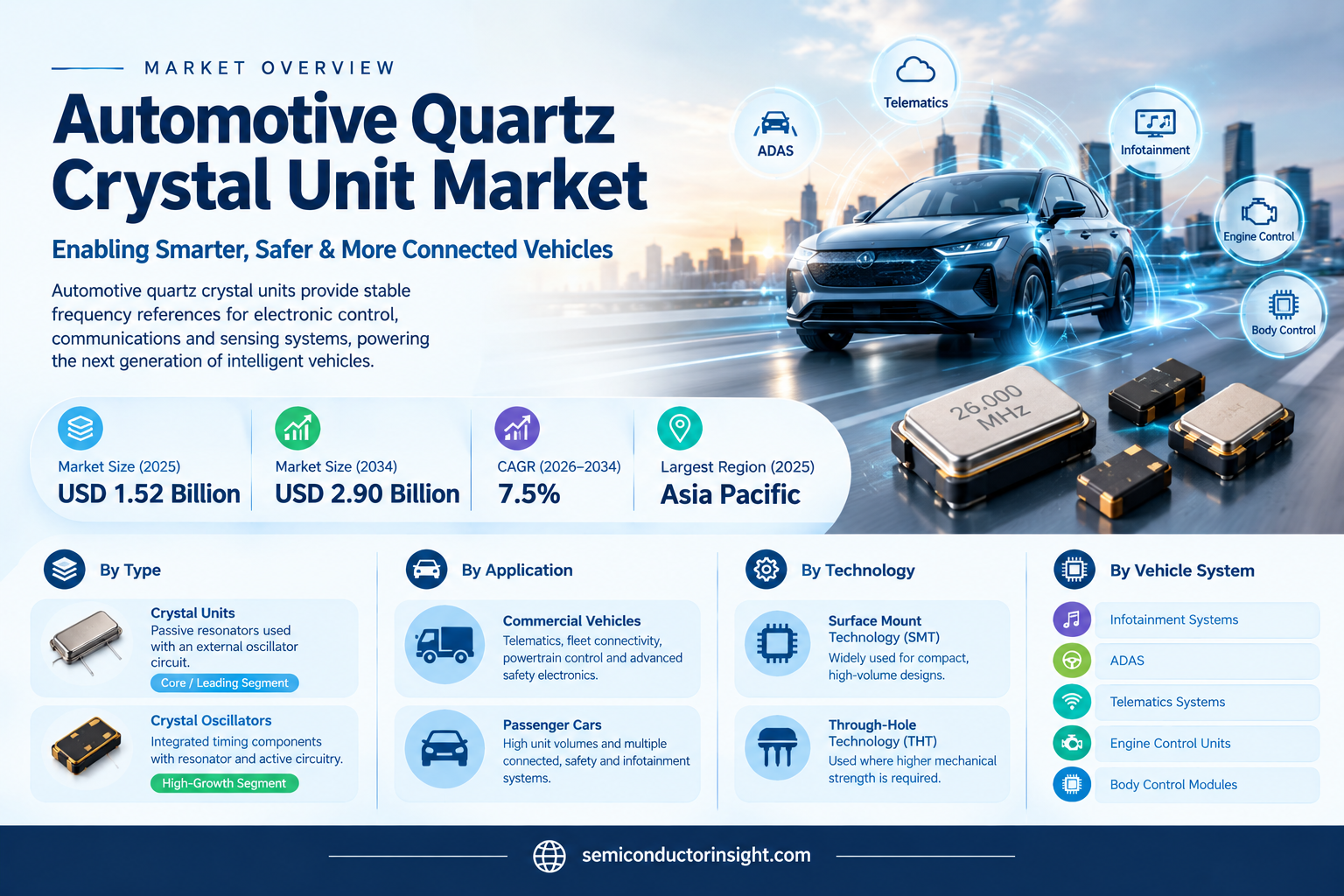
- Market size and growth: USD 1.52 billion in 2025, rising to USD 2.90 billion by 2034 at a 7.5% CAGR over 2026–2034.
- Asia Pacific is the largest regional market in 2025, supported by the location of relevant manufacturing, customers and supply chains.
- Crystal Units is a core product segment, while newer or more integrated variants create higher-value growth opportunities.
- Commercial Vehicles represents an important application cluster because purchasing is directly linked to system performance and qualification requirements.
- Primary driver: ADAS, infotainment, telematics and domain controllers increase the number of oscillators and crystal references designed into each platform.
- Structural restraint: Timing components are purchased in large quantities, so automotive Tier-1s exert strong cost-down pressure across long model cycles.
Automotive Quartz Crystal Unit Market Overview
automotive quartz crystal unit market was valued at USD 1.52 billion in 2025 and is projected to reach USD 2.90 billion by 2034, expanding at a CAGR of 7.5% during 2026–2034. Asia Pacific is the largest regional market in 2025.
Automotive quartz crystal units provide stable frequency references for electronic control, communications and sensing systems. The market includes passive crystal resonators and active crystal oscillators used in electronic control units, infotainment, telematics, in-vehicle networking, advanced driver-assistance systems and body electronics. Timing stability becomes more valuable as vehicles integrate higher data rates, more domain controllers and tighter synchronization requirements.
Automotive qualification materially changes supplier economics. Components must maintain frequency accuracy across wide temperature ranges, vibration and long service lives, while meeting automotive reliability standards and customer-specific qualification. Murata, for example, markets automotive crystal units supporting in-vehicle Ethernet and FlexRay and identifies AEC-Q200-qualified series, illustrating how timing-device selection is linked to network architecture and reliability rather than only nominal frequency.
Asia Pacific leads because it combines the largest vehicle-production base with major timing-device manufacturing capacity. OICA’s 2024 production data show China produced more than 31 million vehicles when cars and commercial vehicles are combined, while Japan, India and South Korea also rank among the world’s largest producers. This concentration supports high-volume local demand and close supplier relationships with automotive electronics manufacturers.
Segment Analysis: By Type
By type, the market is segmented into Crystal Units, Crystal Oscillators. Product selection reflects performance, integration requirements, qualification burden and total lifecycle economics. The leading categories benefit from established installed bases, while newer technologies gain share when they solve a measurable system constraint or reduce ownership cost.
| Type | Commercial role | Market position |
|---|---|---|
| Crystal Units | Passive resonators used with an external oscillator circuit. They are cost-effective and widely deployed where the system designer controls the oscillation architecture. | Core / leading segment |
| Crystal Oscillators | Integrated timing components combining the resonator and active circuitry. They command higher value where tighter stability, startup behavior or system integration is required. | High-growth segment |
Segment Analysis: By Application
By application, demand spans Commercial Vehicles, Passenger Cars. Purchasing behavior varies because operating conditions, product life, reliability thresholds and unit volumes differ by application. High-value applications emphasize qualification and engineering support, while high-volume uses add stronger cost and supply-continuity pressure.
| Application | Demand characteristics |
|---|---|
| Commercial Vehicles | Demand is driven by telematics, fleet connectivity, powertrain control and advanced safety electronics, with long service life and environmental robustness especially important. |
| Passenger Cars | The largest application because passenger vehicles account for very high global unit volumes and increasingly carry multiple connected, safety and infotainment systems requiring stable clock sources. |
By Technology
| Technology | Market relevance |
|---|---|
| Surface Mount Technology (SMT) | Creates a distinct design, manufacturing or procurement requirement within the market. |
| Through-Hole Technology (THT) | Creates a distinct design, manufacturing or procurement requirement within the market. |
By Vehicle System
| Vehicle System | Market relevance |
|---|---|
| Infotainment Systems | Creates a distinct design, manufacturing or procurement requirement within the market. |
| ADAS | Creates a distinct design, manufacturing or procurement requirement within the market. |
| Telematics Systems | Creates a distinct design, manufacturing or procurement requirement within the market. |
| Engine Control Units | Creates a distinct design, manufacturing or procurement requirement within the market. |
| Body Control Modules | Creates a distinct design, manufacturing or procurement requirement within the market. |
Regional Analysis
Asia Pacific leads the Automotive Quartz Crystal Unit market in 2025. Regional demand differs according to manufacturing concentration, end-use investment, qualification practices and local supplier support. The largest region combines the strongest near-term demand base with established customers and supply-chain infrastructure, while other regions create opportunities around localization, research, specialty manufacturing or fast-growing end uses.
How does regional demand differ across the market?
Regional market structure is not simply a difference in size. Asia Pacific typically benefits from manufacturing density and electronics supply chains, North America from system design and advanced technology investment, Europe from specialized industrial and automotive applications, and emerging regions from selective infrastructure and localization projects. Supplier strategy therefore needs to account for qualification, service coverage, logistics and customer concentration in each geography.
| Region | Position | Growth outlook | Demand profile | What decides supplier selection |
|---|---|---|---|---|
| Asia Pacific | Largest / major | High | Manufacturing-led | Local qualification and scale |
| North America | Major | High-value | Design and investment-led | Engineering support and supply security |
| Europe | Established | Moderate | Specialty industrial-led | Quality, compliance and lifecycle support |
| South America | Emerging | Selective | Import-led | Landed cost and channel access |
| Middle East & Africa | Emerging | Selective | Project-led | Project timing and local support |
Competitive Landscape
The Automotive Quartz Crystal Unit market is shaped by qualification depth, process know-how and customer support rather than by price alone. Leading suppliers use installed-base relationships, intellectual property, manufacturing quality and field engineering to protect design wins. Competition is strongest when customers can qualify multiple technically comparable suppliers, while highly specialized applications remain concentrated among vendors with proven reliability records.
Large suppliers typically compete across several adjacent product families, allowing them to bundle technical support and simplify customer sourcing. Specialized companies compete by focusing on a narrower technology, material set or performance envelope. In both cases, the ability to maintain consistent quality during volume production is essential because a component or material change can require renewed process qualification.
Regional presence is also strategic. Customers increasingly value local application engineering, shorter repair or replenishment cycles and geographically diversified production. This favors suppliers that can combine global process standards with local service infrastructure close to major manufacturing clusters.
| Company | Competitive position | Primary basis of competition |
|---|---|---|
| Murata Manufacturing | Tier 1 / established | Competes through qualified products, technical support and customer integration. |
| Seiko Epson | Tier 1 / established | Competes through qualified products, technical support and customer integration. |
| Nihon Dempa Kogyo (NDK) | Tier 1 / established | Competes through qualified products, technical support and customer integration. |
| TXC Corporation | Tier 1 / established | Competes through qualified products, technical support and customer integration. |
| Microchip Technology | Established / specialized | Competes through qualified products, technical support and customer integration. |
| Daishinku | Established / specialized | Competes through qualified products, technical support and customer integration. |
| Kyocera | Established / specialized | Competes through qualified products, technical support and customer integration. |
| Abracon | Established / specialized | Competes through qualified products, technical support and customer integration. |
Companies Profiled
Murata Manufacturing; Seiko Epson; Nihon Dempa Kogyo (NDK); TXC Corporation; Microchip Technology; Daishinku; Kyocera; Abracon.
Production Capacity Analysis
Production capacity is constrained less by nominal factory floor space than by precision process capability, clean manufacturing, calibrated equipment and qualified upstream materials. Expanding output therefore requires more than adding assembly stations: suppliers must preserve contamination control, statistical process capability and traceability as volume increases. Capacity decisions are also influenced by the need to remain close to key customers and reduce logistics risk.
The strongest capacity additions are likely to follow major customer clusters. This favors Asia Pacific for high-volume electronics and semiconductor production, while the United States and Europe attract selective localization in strategic technologies. Suppliers that can duplicate qualified processes across regions gain resilience, but transferring a tightly controlled process between sites can itself require customer revalidation.
Market Dynamics
Vehicle electronics require a growing number of stable clock references as communication bandwidth, sensing and control complexity increase. The strongest growth comes from systems that cannot tolerate timing drift or network synchronization errors.
Market Drivers
Drivers Impact Analysis
| Driver | Impact | Why it matters |
|---|---|---|
| Higher electronic content per vehicle | High | ADAS, infotainment, telematics and domain controllers increase the number of oscillators and crystal references designed into each platform. |
| Automotive Ethernet adoption | High | Higher-speed in-vehicle networks require tighter frequency tolerance and low-jitter timing, supporting qualified automotive crystal products. |
| Electrification and centralized computing | Medium-High | EV architectures consolidate more processing and connectivity into high-value control modules, increasing performance requirements for clock sources. |
| Large Asia vehicle-production base | Medium-High | High production volumes in China, Japan, India and South Korea support regional scale and recurring design-win demand. |
Higher electronic content per vehicle
ADAS, infotainment, telematics and domain controllers increase the number of oscillators and crystal references designed into each platform. The commercial implication is stronger design-in activity for suppliers that can translate the technical requirement into reliable volume production and responsive customer support.
Automotive Ethernet adoption
Higher-speed in-vehicle networks require tighter frequency tolerance and low-jitter timing, supporting qualified automotive crystal products. The commercial implication is stronger design-in activity for suppliers that can translate the technical requirement into reliable volume production and responsive customer support.
Electrification and centralized computing
EV architectures consolidate more processing and connectivity into high-value control modules, increasing performance requirements for clock sources. The commercial implication is stronger design-in activity for suppliers that can translate the technical requirement into reliable volume production and responsive customer support.
Large Asia vehicle-production base
High production volumes in China, Japan, India and South Korea support regional scale and recurring design-win demand. The commercial implication is stronger design-in activity for suppliers that can translate the technical requirement into reliable volume production and responsive customer support.
Market Restraints
Restraints Impact Analysis
| Restraint | Impact | Commercial effect |
|---|---|---|
| Price pressure in high-volume platforms | High | Timing components are purchased in large quantities, so automotive Tier-1s exert strong cost-down pressure across long model cycles. |
| Long qualification cycles | Medium | AEC-Q200 and customer-specific validation lengthen time to revenue and make design wins difficult to displace once awarded. |
| Alternative timing technologies | Medium | MEMS oscillators and silicon timing devices compete in selected applications where shock tolerance, programmability or integration outweigh quartz advantages. |
Price pressure in high-volume platforms
Timing components are purchased in large quantities, so automotive Tier-1s exert strong cost-down pressure across long model cycles. This restraint does not eliminate demand, but it changes the pace of adoption and favors suppliers with stronger balance sheets, technical data and established qualification histories.
Long qualification cycles
AEC-Q200 and customer-specific validation lengthen time to revenue and make design wins difficult to displace once awarded. This restraint does not eliminate demand, but it changes the pace of adoption and favors suppliers with stronger balance sheets, technical data and established qualification histories.
Alternative timing technologies
MEMS oscillators and silicon timing devices compete in selected applications where shock tolerance, programmability or integration outweigh quartz advantages. This restraint does not eliminate demand, but it changes the pace of adoption and favors suppliers with stronger balance sheets, technical data and established qualification histories.
Market Opportunities
Automotive Ethernet and zonal architecture
Higher data rates and centralized compute increase demand for low-jitter timing near network switches, processors and gateways. The opportunity is strongest where the supplier can document a system-level benefit and support the customer through integration, qualification and scale-up.
ADAS sensor synchronization
Camera, radar and fusion systems require reliable frequency references and synchronized data paths. The opportunity is strongest where the supplier can document a system-level benefit and support the customer through integration, qualification and scale-up.
High-temperature timing products
Powertrain and under-hood electronics create demand for qualified devices with wider operating temperature ranges. The opportunity is strongest where the supplier can document a system-level benefit and support the customer through integration, qualification and scale-up.
Long-life platform supply
Suppliers that commit to long product availability and stable quality can strengthen positions with automotive Tier-1 customers. The opportunity is strongest where the supplier can document a system-level benefit and support the customer through integration, qualification and scale-up.
Supply Chain Analysis
Stage 1 — Synthetic quartz and resonator materials: Value capture depends on process control, yield and the ability to meet downstream qualification requirements. Bottlenecks at this stage can propagate quickly because customers often depend on validated materials, calibrated components or approved production routes rather than interchangeable spot-market supply.
Stage 2 — Wafer cutting, lapping, electrode formation and resonator processing: Value capture depends on process control, yield and the ability to meet downstream qualification requirements. Bottlenecks at this stage can propagate quickly because customers often depend on validated materials, calibrated components or approved production routes rather than interchangeable spot-market supply.
Stage 3 — Ceramic/metal package assembly, oscillator IC integration and test: Value capture depends on process control, yield and the ability to meet downstream qualification requirements. Bottlenecks at this stage can propagate quickly because customers often depend on validated materials, calibrated components or approved production routes rather than interchangeable spot-market supply.
Stage 4 — Automotive qualification, Tier-1 module integration and OEM platform deployment: Value capture depends on process control, yield and the ability to meet downstream qualification requirements. Bottlenecks at this stage can propagate quickly because customers often depend on validated materials, calibrated components or approved production routes rather than interchangeable spot-market supply.
Recent Developments
Report Scope & Segmentation
| Attribute | Coverage |
|---|---|
| Market | Automotive Quartz Crystal Unit |
| Base Year | 2025 |
| Estimated Year | 2026 |
| Forecast Period | 2026–2034 |
| 2025 Market Size | USD 1.52 billion |
| 2034 Projected Market Size | USD 2.90 billion |
| CAGR (2026–2034) | 7.5% |
| Largest Market in 2025 | Asia Pacific |
| By Type | Crystal Units, Crystal Oscillators |
| By Application | Commercial Vehicles, Passenger Cars |
| By Technology | Surface Mount Technology (SMT), Through-Hole Technology (THT) |
| By Vehicle System | Infotainment Systems, ADAS, Telematics Systems, Engine Control Units, Body Control Modules |
| Companies Profiled | Murata Manufacturing, Seiko Epson, Nihon Dempa Kogyo (NDK), TXC Corporation, Microchip Technology, Daishinku, Kyocera, Abracon |
| Regions | North America; Europe; Asia Pacific; South America; Middle East & Africa |
Frequently Asked Questions
What is the Automotive Quartz Crystal Unit market size in 2025?
The global Automotive Quartz Crystal Unit market is valued at USD 1.52 billion in 2025.
What is the projected Automotive Quartz Crystal Unit market size by 2034?
The market is projected to reach USD 2.90 billion by 2034.
What is the CAGR of the Automotive Quartz Crystal Unit market from 2026 to 2034?
The market is projected to expand at a 7.5% CAGR during 2026–2034.
Which region leads the Automotive Quartz Crystal Unit market?
Asia Pacific is the largest market in 2025.
What are the main product types?
Crystal Units, Crystal Oscillators.
What are the key applications?
Commercial Vehicles, Passenger Cars.
What is the main growth driver?
ADAS, infotainment, telematics and domain controllers increase the number of oscillators and crystal references designed into each platform.
What is the main restraint?
Timing components are purchased in large quantities, so automotive Tier-1s exert strong cost-down pressure across long model cycles.
Where are the strongest opportunities?
Higher data rates and centralized compute increase demand for low-jitter timing near network switches, processors and gateways. Camera, radar and fusion systems require reliable frequency references and synchronized data paths.
Which companies are active in the market?
Murata Manufacturing, Seiko Epson, Nihon Dempa Kogyo (NDK), TXC Corporation, Microchip Technology, Daishinku, Kyocera, Abracon are among the companies active in the market.
Research Sources & Evidence Base
View primary and official sources used in this overview
- OICA — World Motor Vehicle Production 2024. Vehicle production by country.
- Murata Manufacturing — Crystal Units for Automotive Applications. Automotive timing specifications and AEC-Q200 positioning.
- SEMI — 300mm Fab Outlook. Automotive and semiconductor-capacity investment context.
Get Sample Report PDF for Exclusive Insights
Report Sample Includes
- Table of Contents
- List of Tables & Figures
- Charts, Research Methodology, and more...
 Download Sample Report PDF