Intelligent Power Module (IPM) Market Insights
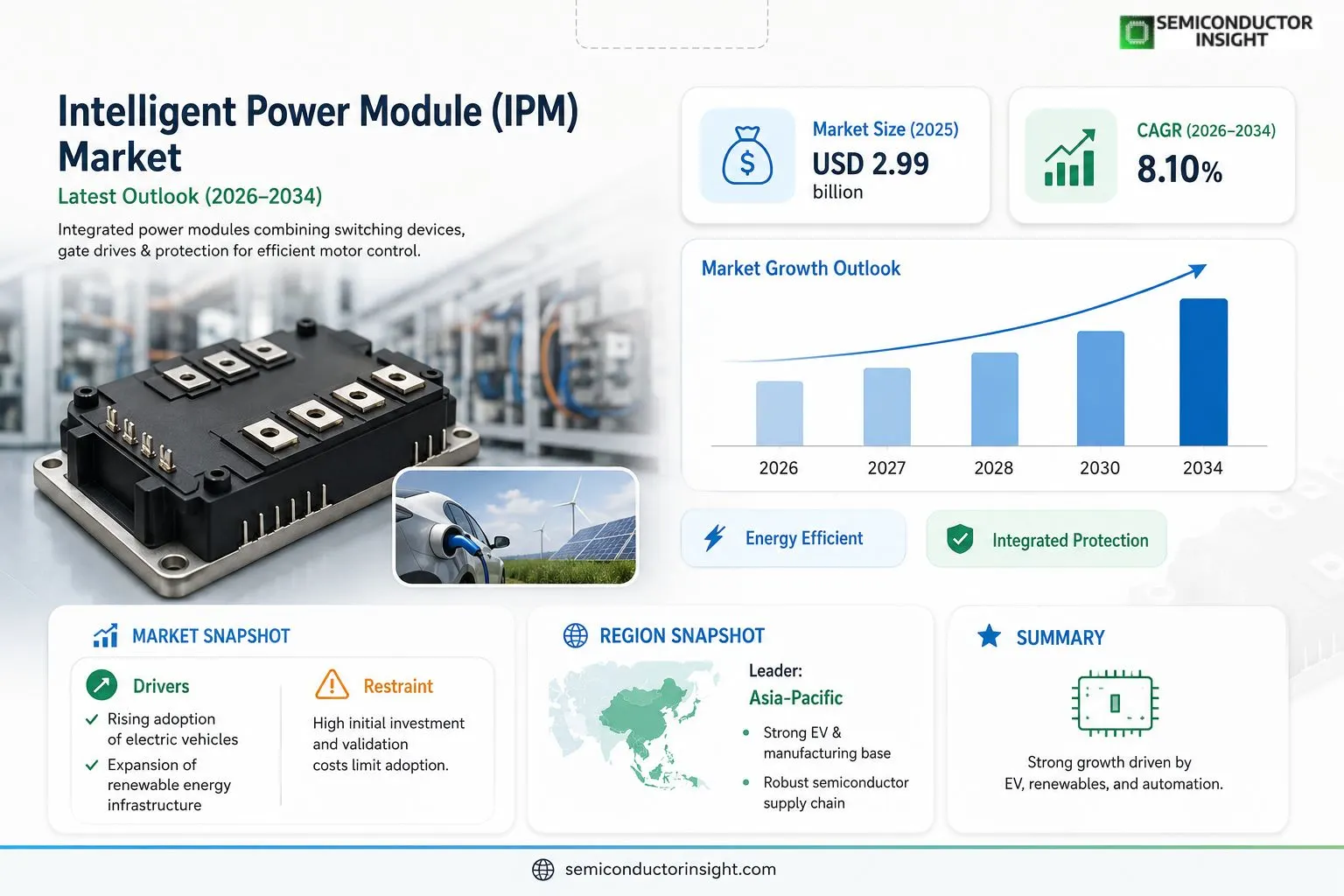
Global Intelligent Power Module (IPM) market size was valued at USD 2.99 billion in 2025. The market is projected to grow from USD 3.23 billion in 2026 to USD 6.03 billion by 2034, exhibiting a CAGR of 8.10% during the forecast period.
Intelligent Power Modules (IPMs) are advanced integrated power devices that combine high-power switching elements such as IGBTs or MOSFETs with dedicated gate drive circuits, protection features, and sometimes sensing capabilities into a single compact package. These modules facilitate efficient power conversion and motor control by incorporating over-current, short-circuit, under-voltage, and over-temperature protections, simplifying system design while enhancing reliability and performance.
The market is experiencing robust growth due to several factors, including the accelerating adoption of electric vehicles, rising demand for energy-efficient solutions in industrial automation, and the expansion of renewable energy infrastructure. Furthermore, advancements in wide-bandgap semiconductors and the need for compact, high-performance power electronics in consumer appliances and servo drives are contributing to market expansion. Initiatives by key players continue to drive innovation, with developments focused on higher voltage ratings and improved thermal management. Mitsubishi Electric Corporation, Infineon Technologies AG, Fuji Electric Co., Ltd., ON Semiconductor, and Semikron Danfoss are some of the key players that operate in the market with a wide range of portfolios.
MARKET DRIVERS
Rising Adoption of Electric Vehicles
Intelligent Power Module (IPM) Market is experiencing robust growth driven by the accelerating transition to electric vehicles worldwide. IPMs play a critical role in EV powertrains, enabling efficient motor control, onboard charging, and DC-DC conversion with integrated protection features. Major automakers are increasingly adopting SiC-based IPMs to achieve higher efficiency and extended driving range, particularly in 800V battery architectures.
Expansion of Renewable Energy Infrastructure
Growing investments in solar and wind power generation are fueling demand for Intelligent Power Modules in inverters and energy storage systems. IPMs provide compact, reliable solutions for power conversion with enhanced thermal management and protection, supporting higher power densities in utility-scale installations. Regulatory mandates for energy efficiency further accelerate deployment across renewable projects.
➤ Industrial automation and Industry 4.0 initiatives continue to boost IPM utilization in servo drives and robotics, where precise power control and diagnostic capabilities deliver significant productivity gains.
Advancements in wide-bandgap semiconductors, including SiC and GaN integration into IPMs, are enhancing switching speeds and reducing losses, positioning these modules as essential components in next-generation energy-efficient applications.
MARKET CHALLENGES
Supply Chain Disruptions and Material Shortages
Intelligent Power Module (IPM) Market faces persistent challenges from semiconductor supply constraints, particularly for wide-bandgap wafers. Extended lead times for SiC materials have impacted production schedules in automotive and renewable energy sectors, requiring manufacturers to navigate complex global supply networks.
Other Challenges
High Manufacturing Costs
Complex fabrication processes involving advanced packaging, precise die placement, and rigorous testing drive up production expenses for IPMs, limiting adoption in highly price-sensitive applications.
Integration Complexity
Incorporating IPMs into existing systems demands specialized expertise in thermal management and electromagnetic compatibility, posing hurdles for smaller manufacturers and system integrators.
MARKET RESTRAINTS
High Initial Investment and Validation Costs
Significant capital requirements for advanced manufacturing lines and stringent automotive-grade qualifications, such as AEC-Q101 testing, restrain broader market penetration for Intelligent Power Modules. These costs particularly affect smaller players and delay new product introductions in cost-sensitive segments.
Thermal Management and Reliability Issues
Ensuring long-term reliability under high-voltage and high-temperature conditions remains a key restraint. Challenges with thermal interfaces in modules exceeding 1200V ratings can limit power density and require ongoing material innovations to meet demanding application requirements.
MARKET OPPORTUNITIES
Emerging Applications in IoT and Smart Systems
The proliferation of IoT-enabled devices and smart appliances creates substantial opportunities for Intelligent Power Module (IPM) Market. Low-power IPMs with advanced power management and monitoring features are ideally suited for energy-efficient operation in connected consumer and industrial ecosystems.
Technological Advancements in Wide-Bandgap Semiconductors
Ongoing developments in SiC and GaN technologies present opportunities for higher-performance IPMs with superior efficiency and power density. These innovations are expected to expand addressable markets in high-voltage EV inverters, data centers, and advanced industrial drives, supporting sustained long-term growth.
Intelligent Power Module (IPM) Market Trends
Accelerating Adoption in Electric Vehicles and Renewable Energy Systems
Intelligent Power Module (IPM) Market continues to witness strong momentum propelled by the accelerating adoption of electric vehicles and the expansion of renewable energy infrastructure. As automotive manufacturers shift toward electrification, IPMs play a critical role in efficient motor control and power conversion systems. These modules integrate high-power switching elements such as IGBTs or MOSFETs with dedicated gate drive circuits and comprehensive protection features, enabling reliable performance under demanding conditions. Similarly, the growth of solar and wind energy installations requires advanced power electronics for inverters and converters, where IPMs contribute to improved energy efficiency and system stability. This dual demand creates sustained opportunities for innovation in compact, high-performance solutions tailored for modern power management needs.
Other Trends
Advancements in Industrial Automation and Consumer Applications
Industrial automation represents another key area of expansion for Intelligent Power Module (IPM) Market, with rising demand for energy-efficient solutions in servo drives, robotics, and manufacturing equipment. IPMs simplify system design by incorporating over-current, short-circuit, under-voltage, and over-temperature protections, which enhances overall reliability while reducing component count. In consumer appliances, the need for compact and high-performance power electronics drives further integration of these modules. Key industry participants including Mitsubishi Electric Corporation, Infineon Technologies AG, Fuji Electric Co., Ltd., ON Semiconductor, and Semikron Danfoss continue to invest in product development, focusing on higher voltage ratings and improved thermal management to meet evolving application requirements across sectors.
Integration of Wide-Bandgap Semiconductors and Enhanced Protection Capabilities
Technological progress in wide-bandgap semiconductors is shaping the future trajectory of Intelligent Power Module (IPM) Market by enabling higher efficiency and power density. Manufacturers are increasingly incorporating these materials to support advanced applications that demand superior switching performance and thermal characteristics. The embedded sensing and protection functionalities within IPMs further streamline design processes for engineers, making them preferred choices in complex power systems. Ongoing initiatives by leading players emphasize continuous improvement in module architecture, ensuring better compatibility with next-generation power conversion and motor control solutions while addressing the growing emphasis on sustainability and operational efficiency across global industries.
COMPETITIVE LANDSCAPE
Key Industry Players
Dynamic Competitive Landscape in Intelligent Power Module (IPM) Market
Intelligent Power Module (IPM) Market is led by a select group of established semiconductor and power electronics giants who command significant market share through extensive R&D investments, broad product portfolios, and strong global distribution networks. Mitsubishi Electric Corporation stands out as a pioneering leader, offering highly reliable IPM solutions that integrate advanced IGBT and MOSFET technologies with comprehensive protection features, particularly excelling in industrial automation, electric vehicles, and renewable energy applications. The market exhibits moderate concentration, with the top five players collectively accounting for over half of Global revenue, driven by continuous innovation in wide-bandgap semiconductors and improved thermal management.
Complementing the market leaders are several niche and emerging players who contribute to technological diversity and regional supply chain resilience. Companies such as ROHM Co., Ltd., STMicroelectronics, and Texas Instruments focus on specialized high-efficiency modules for consumer appliances and servo drives, while others emphasize customized solutions for specific voltage ranges and compact designs. Strategic collaborations, product launches with higher voltage ratings, and expansions into emerging markets further intensify competition, fostering overall industry growth at a robust CAGR.
List of Key Intelligent Power Module Companies Profiled
- Mitsubishi Electric Corporation
- Infineon Technologies AG
- Fuji Electric Co., Ltd.
- ON Semiconductor Corporation (onsemi)
- Semikron Danfoss
- ABB
- Hitachi, Ltd.
- ROHM Co., Ltd.
- STMicroelectronics
- Toshiba Electronic Devices & Storage Corporation
- Schneider Electric
- Texas Instruments Incorporated
- Sanken Electric Co., Ltd.
- Alpha & Omega Semiconductor
- Microchip Technology Inc.
Segment Analysis:
| Segment Category | Sub-Segments | Key Insights |
| By Type |
|
IGBT-based IPMs represent the leading segment due to their proven reliability in high-power switching applications. These modules deliver robust performance with integrated protection features that minimize design complexity for engineers. They excel in balancing switching speed and thermal management, making them ideal for demanding operational environments. Their maturity in manufacturing processes ensures consistent quality and easier integration into existing systems. |
| By Application |
|
Motor Drives emerge as the dominant application area for Intelligent Power Modules. These modules enable precise control and enhanced efficiency in variable speed operations across diverse machinery. Their built-in protection circuits significantly reduce downtime risks in continuous industrial processes. Advanced thermal characteristics support sustained performance under heavy loads, while compact designs facilitate space-saving installations in modern equipment. |
| By End User |
|
Industrial Automation stands out as the leading end-user segment for IPMs. Manufacturers benefit from simplified system architectures and improved operational safety provided by these intelligent modules. Enhanced diagnostic capabilities allow predictive maintenance strategies that optimize overall equipment effectiveness. Their adaptability to various voltage and current requirements supports diverse automation solutions, from robotics to heavy machinery control systems. |
| By Voltage Rating |
|
Medium Voltage IPMs lead this category with versatile performance across multiple industrial and commercial uses. They provide optimal power handling for applications requiring balanced efficiency and control precision. Integrated sensing and protection features enhance system reliability under fluctuating load conditions. These modules support seamless scalability in power electronics designs, enabling manufacturers to address evolving technical demands effectively. |
| By Technology |
|
Silicon-based Technology continues to dominate due to its cost-effectiveness and widespread compatibility with existing infrastructure. These IPMs offer reliable thermal performance and straightforward implementation for standard power conversion needs. Continuous improvements in gate drive integration have further strengthened their position in mainstream applications. Their established supply chains ensure stable availability, supporting long-term project planning across various industries. |
Regional Analysis: Intelligent Power Module (IPM) Market
Asia-Pacific
The Asia-Pacific region boasts an integrated manufacturing ecosystem that supports seamless production of Intelligent Power Modules (IPM). This includes access to specialized semiconductor fabrication facilities and component suppliers, enabling cost-effective scaling while maintaining high quality standards. Local expertise in power electronics packaging and testing accelerates time-to-market for new IPM variants designed for diverse applications.
Explosive growth in electric vehicles and renewable energy projects creates substantial opportunities for IPM adoption. The modules play a critical role in motor drives, inverters, and power conversion systems, offering enhanced reliability and efficiency. Strategic partnerships between automakers and technology providers drive the development of specialized IPMs optimized for high-voltage operations in next-generation mobility and solar infrastructure.
Leading technology firms in the region pioneer advancements in IPM design, focusing on miniaturization, thermal performance, and smart diagnostics. Emphasis on wide-bandgap semiconductors enhances switching speeds and reduces energy losses, making these modules ideal for demanding industrial and automotive environments. This innovation culture sustains competitive advantages in Global Intelligent Power Module (IPM) market.
Supportive regulatory frameworks and infrastructure development initiatives promote widespread deployment of energy-efficient technologies. Investments in smart grids, high-speed rail, and industrial digitization increase reliance on advanced power management solutions like IPMs. These policies create a fertile ground for sustained market expansion and technology adoption.
North America
North America exhibits strong momentum in Intelligent Power Module (IPM) Market, driven by its advanced industrial base and focus on energy efficiency. The United States leads with significant activity in electric vehicle manufacturing, renewable energy integration, and industrial automation. Emphasis on grid modernization and smart infrastructure boosts demand for reliable power modules that ensure system stability and performance. Companies prioritize IPMs with integrated protection and diagnostic capabilities to meet stringent safety and efficiency standards. Collaboration between technology providers and end-user industries fosters tailored solutions for applications ranging from data centers to automotive powertrains. The region’s innovation ecosystem supports research into advanced materials and designs, positioning it as a key player in high-performance IPM segments.
Europe
Europe maintains a prominent position in Intelligent Power Module (IPM) Market through its commitment to sustainability and technological excellence. Countries such as Germany, France, and the United Kingdom drive adoption in automotive, renewable energy, and industrial sectors. Strict environmental regulations encourage the use of efficient power electronics, with IPMs playing a vital role in reducing energy consumption and emissions. The region’s robust automotive industry integrates these modules in electric and hybrid vehicles for optimal power control. Investments in Industry 4.0 initiatives further enhance demand for intelligent modules that support automation and predictive maintenance. European manufacturers emphasize quality, reliability, and compliance with international standards, strengthening their competitive edge in specialized IPM applications.
South America
South America shows emerging potential in Intelligent Power Module (IPM) Market, supported by growing industrialization and renewable energy projects. Brazil and other nations invest in expanding manufacturing capabilities and energy infrastructure, creating opportunities for power electronics adoption. The focus on mining operations, agricultural automation, and urban development drives demand for durable IPMs suited to challenging operating conditions. While the market is developing, increasing awareness of energy efficiency benefits encourages integration of these modules in motor drives and power systems. Regional collaborations and technology transfers from global leaders help build local expertise, laying the foundation for future growth in the Intelligent Power Module (IPM) sector.
Middle East & Africa
The Middle East and Africa region demonstrates accelerating interest in Intelligent Power Module (IPM) Market, fueled by ambitious energy diversification and infrastructure programs. Investments in solar and wind projects require advanced power conversion solutions where IPMs excel in efficiency and reliability. Urbanization and industrial expansion in key economies boost demand for automation technologies incorporating intelligent power management. The modules support applications in oil and gas, transportation, and utilities, offering robust performance in harsh environments. Strategic initiatives to develop local manufacturing and technology capabilities are enhancing regional self-sufficiency. This evolving landscape positions the area as an important emerging contributor to global IPM dynamics.
Report Scope
This market research report provides a comprehensive analysis of the Intelligent Power Module (IPM) Market , covering the forecast period 2026–2034. It offers detailed insights into market dynamics, technological advancements, competitive landscape, and key trends shaping the industry.
Key focus areas of the report include:
- Market Overview: The report begins with an overview outlining its current market scenario, key growth indicators, and industry transformation drivers. It discusses macroeconomic factors, demand–supply balance, regulatory landscape, and the strategic role of semiconductors in powering advancements across industries such as automotive, telecommunications, consumer electronics, and industrial automation.
- Market Size & Forecast: Historical data and future projections for revenue, unit shipments, and market value across major regions and segments.
- Segmentation Analysis: Detailed breakdown by product type, technology, application, and end-user industry to identify high-growth segments and investment opportunities.
- Regional Insights: Insights into market performance across North America, Europe, Asia-Pacific, Latin America, and the Middle East & Africa, including country-level analysis where relevant.
- Competitive Landscape: Profiles of leading market participants, including their product offerings, R&D focus, manufacturing capacity, pricing strategies, and recent developments such as mergers, acquisitions, and partnerships.
- Technology Trends & Innovation: Assessment of emerging technologies, integration of AI/IoT, semiconductor design trends, fabrication techniques, and evolving industry standards.
- Market Drivers & Restraints: Evaluation of factors driving market growth along with challenges, supply chain constraints, regulatory issues, and market-entry barriers.
- Stakeholder Insights: Insights for component suppliers, OEMs, system integrators, investors, and policymakers regarding the evolving ecosystem and strategic opportunities.
Primary and secondary research methods are employed, including interviews with industry experts, data from verified sources, and real-time market intelligence to ensure the accuracy and reliability of the insights presented.
FREQUENTLY ASKED QUESTIONS:
What is the current market size of Intelligent Power Module (IPM) Market?
-> Intelligent Power Module (IPM) Market was valued at USD 2.99 billion in 2025 and is expected to reach USD 6.03 billion by 2034.
Which key companies operate in Intelligent Power Module (IPM) Market?
-> Key players include Mitsubishi Electric Corporation, Infineon Technologies AG, Fuji Electric Co., Ltd., ON Semiconductor, and Semikron Danfoss, among others.
What are the key growth drivers?
-> Key growth drivers include accelerating adoption of electric vehicles, rising demand for energy-efficient solutions in industrial automation, and the expansion of renewable energy infrastructure.
Which region dominates the market?
-> Asia-Pacific is the fastest-growing region with strong demand from manufacturing and EV sectors.
What are the emerging trends?
-> Emerging trends include advancements in wide-bandgap semiconductors, higher voltage ratings, and improved thermal management.

Get Sample Report PDF for Exclusive Insights
Report Sample Includes
- Table of Contents
- List of Tables & Figures
- Charts, Research Methodology, and more...
 Download Sample Report PDF