Edge AI SoC (System on Chip) Market Insights
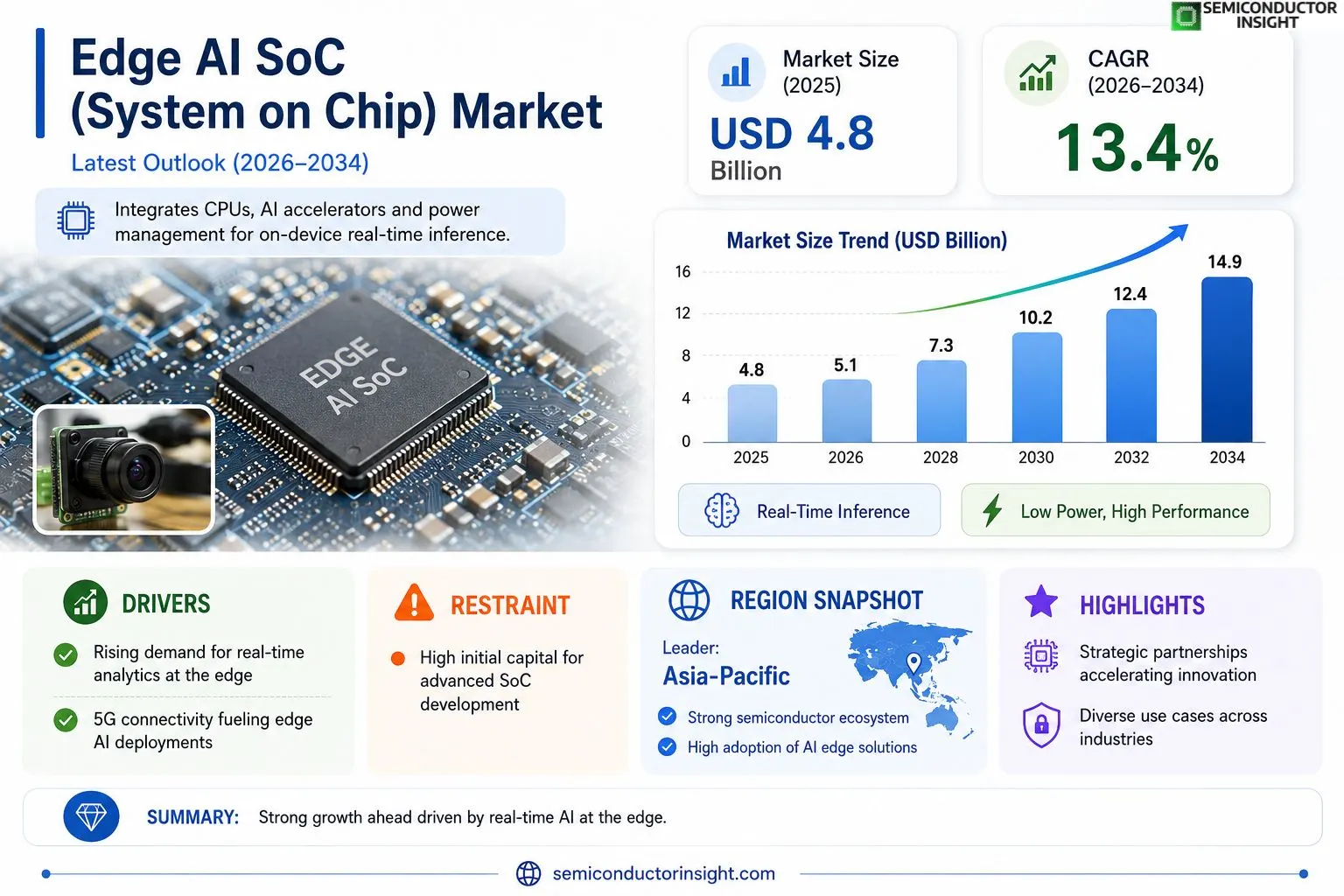
Global Edge AI SoC (System on Chip) market size was valued at USD 4.8 billion in 2025. The market is projected to grow from USD 5.1 billion in 2026 to USD 14.9 billion by 2034, exhibiting a 13.4% CAGR during the forecast period.
Edge AI System‑on‑Chip integrates high‑performance processors, dedicated neural‑network accelerators, memory subsystems and power‑management units onto a single die, enabling real‑time inference directly at the device edge without reliance on cloud connectivity.The market is experiencing rapid growth due to several factors, including soaring investment in edge computing infrastructure, escalating demand for low‑latency analytics in IoT devices, autonomous vehicles and smart cameras, and continuous advancements in semiconductor process technologies that reduce power consumption while boosting performance.
Furthermore, strategic collaborations such as NVIDIA’s partnership with Microsoft Azure announced in March 2024 to deliver accelerated edge services, Qualcomm’s launch of the Snapdragon X Elite platform for industrial robotics earlier this year, and Intel’s expansion of its Mobileye portfolio through targeted acquisitions are fueling adoption.
Key players operating in this space,NVIDIA Corporation, Qualcomm Technologies Inc., MediaTek Inc., Intel Corporation and Samsung Electronics,are expanding their portfolios with increasingly versatile Edge AI SoCs.
MARKET DRIVERS
Rising Demand for Real‑Time Analytics
Edge AI SoC (System on Chip) Market is being propelled by the need for instantaneous data processing in autonomous vehicles, industrial automation, and smart retail. On‑device inference eliminates latency associated with cloud round‑trips, enabling real‑time decision making that is critical for safety‑sensitive applications.
Proliferation of 5G Connectivity
5G rollout expands bandwidth and reduces latency, creating an ecosystem where edge AI workloads can be offloaded from central data centers to compact SoC solutions. This network evolution accelerates adoption across mobile edge computing nodes and remote sensor clusters.
➤ Manufacturers are integrating heterogeneous compute units,CPU, GPU, NPU,into single chips, delivering higher performance per watt for AI inference at the edge.
In addition, growing concerns about data privacy and regulatory compliance are encouraging enterprises to keep sensitive data on‑device, further strengthening the demand for robust Edge AI SoC platforms.
MARKET CHALLENGES
Power and Thermal Management Constraints
Designing high‑performance AI accelerators within the limited power envelope of edge devices remains a technical hurdle. Excess heat can degrade reliability, requiring sophisticated thermal mitigation techniques that increase bill‑of‑materials.
Other Challenges
Software Ecosystem Fragmentation
A diverse set of development frameworks and toolchains leads to integration complexity, slowing time‑to‑market for new AI applications on Edge AI SoC platforms.
Furthermore, the scarcity of skilled engineers proficient in both hardware design and AI algorithm optimization adds to development risk, especially for small and medium‑sized enterprises.
MARKET RESTRAINTS
High Initial Capital Expenditure
Investing in cutting‑edge Edge AI SoC technology requires substantial upfront spending on silicon design, validation, and tooling. This financial barrier can deter early‑stage adopters, particularly in cost‑sensitive markets such as consumer wearables.
MARKET OPPORTUNITIES
Emerging Applications in Healthcare
Portable diagnostic devices and remote patient monitoring systems increasingly rely on on‑device AI to analyze biosignals without internet dependence. Edge AI SoC (System on Chip) Market stands to capture significant growth by delivering low‑power, secure inference engines tailored for medical-grade reliability.
Edge AI SoC (System on Chip) Market Trends
Rising Adoption Driven by Edge Computing Investments
Edge AI SoC (System on Chip) Market is experiencing a pronounced acceleration as enterprises allocate substantial capital to edge‑computing infrastructure. Valued at roughly USD 4.8 billion in 2025, the market is slated to expand to around USD 5.1 billion in 2026 and reach USD 14.9 billion by 2034. This trajectory reflects a compound growth rate exceeding 13 % annually, underpinned by the demand for real‑time inference in IoT devices, autonomous vehicles, and smart‑camera applications. Integrated processors that combine high‑performance cores, neural‑network accelerators, and power‑management units enable manufacturers to meet low‑latency requirements without relying on cloud links. Consequently, OEMs are favoring single‑die solutions that simplify board design, lower BOM costs, and improve energy efficiency,key considerations for battery‑operated edge nodes.
Other Trends
Strategic Partnerships Accelerate Innovation
Collaborations between semiconductor leaders and cloud providers are reshaping the competitive landscape. Notably, NVIDIA’s alliance with Microsoft Azure, announced in early 2024, delivers accelerated edge services that streamline deployment of AI workloads. Qualcomm’s launch of the Snapdragon X Elite platform for industrial robotics has broadened the portfolio of high‑throughput Edge AI SoCs, while Intel’s continued expansion of its Mobileye portfolio through targeted acquisitions strengthens its foothold in autonomous‑driving segments. These joint ventures reduce time‑to‑market for new solutions and foster ecosystem development, allowing developers to leverage standardized software stacks across heterogeneous hardware.
Diversification of Use Cases Across Industries
Edge AI SoC (System on Chip) Market is no longer confined to a narrow set of applications. Beyond traditional consumer electronics, sectors such as healthcare, retail, and logistics are integrating edge‑enabled AI to enhance operational efficiency. For example, smart cameras equipped with on‑device inference can detect safety incidents in real time, while edge‑powered diagnostic devices process medical images locally, preserving patient privacy. In manufacturing, predictive‑maintenance nodes run neural models at the sensor level, reducing downtime without transmitting raw data to central servers. This widening of use cases reinforces demand for versatile SoCs that balance compute density with stringent power budgets, propelling ongoing investments in advanced process technologies.
COMPETITIVE LANDSCAPEKey Industry Players
Edge AI SoC Market Competitive Overview
Edge AI SoC market is dominated by a handful of semiconductor giants that command the majority of revenue and roadmap influence. NVIDIA leads with its Jetson family, leveraging deep learning accelerators and a robust software stack that has become the de‑facto standard for autonomous robotics and smart cameras. Qualcomm follows closely, exporting its Snapdragon X Elite platform that integrates high‑performance CPU cores, AI‑specific tensor processors, and power‑efficient graphics. Intel’s acquisition‑driven expansion of Mobileye and its Xe‑Edge portfolio adds a strong industrial‑grade offering, while Samsung Electronics differentiates through advanced 3‑nm process nodes that enable ultra‑low‑power edge inference. MediaTek rounds out the top tier by targeting consumer‑grade IoT devices, delivering SoCs that combine AI engines with 5G connectivity. Collectively, these leaders shape a market hierarchy where scale, ecosystem support, and silicon performance create high entry barriers for newcomers.
Beyond the primary tier, several specialized and regionally strong players are carving out niche positions. Google’s Coral Edge TPU delivers a compact, purpose‑built AI accelerator for edge deployments, primarily through its partner ecosystem. Apple integrates on‑device neural engines within its custom silicon, focusing on privacy‑preserving AI for iPhone and iPad peripherals. Huawei’s HiSilicon Kirin series, despite export restrictions, continues to serve domestic smart‑city and automotive projects. Texas Instruments supplies low‑power microcontroller‑centric Edge AI solutions for industrial sensors, while STMicroelectronics and Renesas offer automotive‑grade vision and radar SoCs. Xilinx (now under AMD) contributes reconfigurable FPGA‑based AI fabric, and Graphcore provides the IPU architecture for high‑throughput inference in data‑center‑edge hybrid workloads. These companies collectively expand the competitive fabric, delivering differentiated performance, power, and integration strategies that address the diverse requirements of edge AI applications.
List of Key Edge AI SoC Companies Profiled
- NVIDIA Corporation
- Qualcomm Technologies Inc.
- MediaTek Inc.
- Intel Corporation
- Samsung Electronics
- Google (Coral Edge TPU)
- Apple Inc.
- Huawei Technologies Co., Ltd.
- Texas Instruments
- STMicroelectronics
- Renesas Electronics
- Xilinx (AMD)
- Graphcore Ltd.
Segment Analysis:
| Segment Category | Sub-Segments | Key Insights |
| By Type |
|
Dedicated Neural Accelerators drive the competitive edge of Edge AI SoCs by offering:
|
| By Application |
|
Autonomous Vehicles represent a focal application because:
|
| By End User |
|
Automotive OEMs prioritize Edge AI SoCs to:
|
| By Deployment Model |
|
On‑Device Edge is gaining momentum because:
|
| By Functional Tier |
|
Edge Analytics distinguishes itself by:
|
Regional Analysis: North America
United States
The industrial sector is witnessing increasing adoption of Edge AI SoCs for predictive maintenance, quality control, and process optimization. This trend is propelled by the need for real-time insights and autonomous decision-making in manufacturing facilities.
The automotive industry is a significant driver for Edge AI SoC demand, particularly in applications such as autonomous driving, advanced driver-assistance systems (ADAS), and in-vehicle infotainment. The quest for enhanced safety and intelligent vehicle features is fueling this segment’s growth.
Edge AI SoCs are transforming retail and logistics through applications like smart inventory management, customer analytics, and optimized supply chain operations. Real-time data processing is crucial for enhancing efficiency and improving customer experiences.
The healthcare industry is leveraging Edge AI for applications like medical imaging analysis, remote patient monitoring, and personalized medicine. The need for faster and more accurate diagnostics is accelerating the adoption of Edge AI solutions.
Europe
With a strong emphasis on data protection and sustainability, Europe presents a significant and growing market for Edge AI SoC. The region’s robust industrial base, particularly in automotive and manufacturing, is driving demand for intelligent systems. Government initiatives supporting technological advancement and a focus on energy efficiency further contribute to the market’s expansion.
Asia-Pacific
Asia-Pacific is poised for rapid growth in Edge AI SoC market, propelled by increasing adoption in developing economies like China and India. The proliferation of IoT devices, coupled with government support for digital transformation, is creating a fertile ground for Edge AI solutions. The region’s extensive manufacturing capabilities and burgeoning technology sector further solidify its potential.
South America
South America presents a moderate growth opportunity for Edge AI SoCs, driven by increasing investments in infrastructure and expanding IoT deployments. The agricultural sector and mining industries are key adopters, seeking to optimize operations and improve efficiency with edge intelligence.
Middle East & Africa
The Middle East and Africa represent an emerging market for Edge AI SoC, with growing investments in smart city initiatives, industrial automation, and healthcare. The region’s focus on digital transformation and technological advancement is creating new avenues for Edge AI adoption.
Report Scope
This market research report provides a comprehensive analysis of the Edge AI SoC (System on Chip) Market , covering the forecast period 2026–2034. It offers detailed insights into market dynamics, technological advancements, competitive landscape, and key trends shaping the industry.
Key focus areas of the report include:
- Market Overview: The report begins with an overview outlining its current market scenario, key growth indicators, and industry transformation drivers. It discusses macroeconomic factors, demand–supply balance, regulatory landscape, and the strategic role of semiconductors in powering advancements across industries such as automotive, telecommunications, consumer electronics, and industrial automation.
- Market Size & Forecast: Historical data and future projections for revenue, unit shipments, and market value across major regions and segments.
- Segmentation Analysis: Detailed breakdown by product type, technology, application, and end-user industry to identify high-growth segments and investment opportunities.
- Regional Insights: Insights into market performance across North America, Europe, Asia-Pacific, Latin America, and the Middle East & Africa, including country-level analysis where relevant.
- Competitive Landscape: Profiles of leading market participants, including their product offerings, R&D focus, manufacturing capacity, pricing strategies, and recent developments such as mergers, acquisitions, and partnerships.
- Technology Trends & Innovation: Assessment of emerging technologies, integration of AI/IoT, semiconductor design trends, fabrication techniques, and evolving industry standards.
- Market Drivers & Restraints: Evaluation of factors driving market growth along with challenges, supply chain constraints, regulatory issues, and market-entry barriers.
- Stakeholder Insights: Insights for component suppliers, OEMs, system integrators, investors, and policymakers regarding the evolving ecosystem and strategic opportunities.
Primary and secondary research methods are employed, including interviews with industry experts, data from verified sources, and real-time market intelligence to ensure the accuracy and reliability of the insights presented.
FREQUENTLY ASKED QUESTIONS:
What is the current market size of Edge AI SoC (System on Chip) Market?
-> Edge AI SoC (System on Chip) Market was valued at USD 4.8 billion in 2025 and is expected to reach USD 14.9 billion by 2034.
Which key companies operate in Edge AI SoC (System on Chip) Market?
-> Key players include NVIDIA Corporation, Qualcomm Technologies Inc., MediaTek Inc., Intel Corporation, Samsung Electronics.
What are the key growth drivers?
-> Key growth drivers include intensified investment in edge computing infrastructure, rising demand for low‑latency AI analytics in IoT devices, autonomous vehicles and smart cameras, and continual advancements in semiconductor process technologies that lower power consumption while boosting performance.
Which region dominates the market?
-> Asia‑Pacific is emerging as the fastest‑growing region due to strong semiconductor manufacturing bases and increasing adoption of AI‑enabled edge solutions, while North America maintains a leading market share driven by high‑value technology deployments.
What are the emerging trends?
-> Emerging trends include strategic collaborations such as NVIDIA‑Microsoft Azure partnership, Qualcomm’s Snapdragon X Elite platform for industrial robotics, Intel’s Mobileye expansion, and the convergence of AI, IoT and 5G to create more versatile Edge AI SoCs.
Get Sample Report PDF for Exclusive Insights
Report Sample Includes
- Table of Contents
- List of Tables & Figures
- Charts, Research Methodology, and more...
 Download Sample Report PDF