AI-Optimized High Bandwidth Memory (HBM) Market Insights
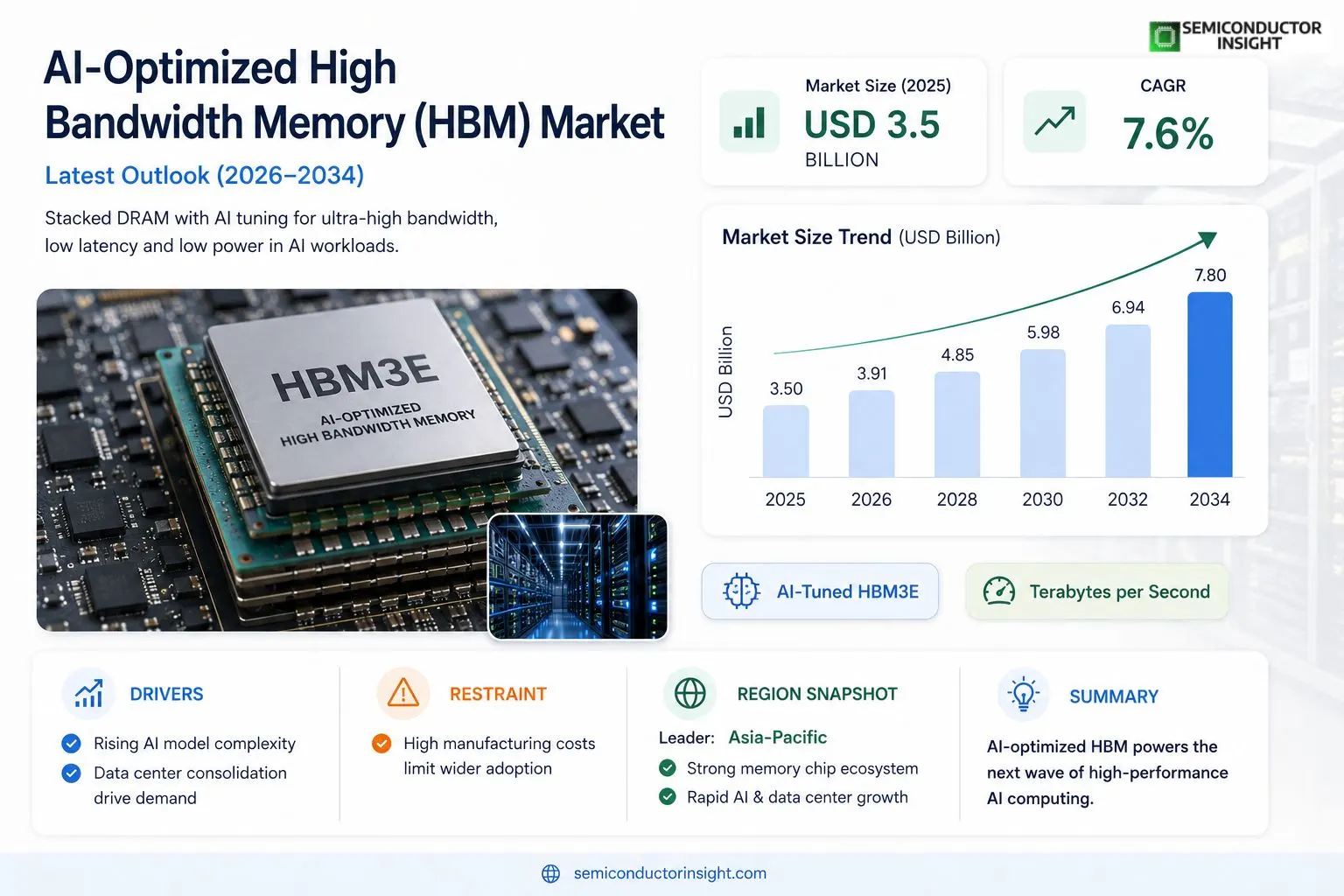
Global AI-Optimized High Bandwidth Memory (HBM) market size was valued at USD 3.5 billion in 2025. The market is projected to grow from USD 3.5 billion in 2025 to USD 7.8 billion by 2034, exhibiting a CAGR of 7.6 % during the forecast period.
AI‑Optimized High Bandwidth Memory (HBM) refers to stacked DRAM architectures that combine ultra‑wide I/O interfaces with on‑chip artificial‑intelligence accelerators or software‑defined tuning layers, delivering terabytes‑per‑second throughput while minimizing latency and power consumption for deep‑learning workloads.The market is experiencing rapid growth because semiconductor manufacturers are investing heavily in next‑generation compute platforms, and cloud providers are scaling AI services that demand higher memory bandwidth. Furthermore, the rollout of GPUs and custom AI chips from companies such as Nvidia, AMD, Samsung and SK Hynix is driving adoption of HBM modules optimized for inference and training workloads. Initiatives by key playersincluding Micron’s launch of AI‑tuned HBM3E in early 2024 and Intel’s partnership with Cadence for co‑design of AI‑aware memory stacksare expected to further accelerate market expansion.
MARKET DRIVERS
Surge in AI Model Complexity
The rapid expansion of deep‑learning architectures has pushed memory bandwidth requirements beyond the capabilities of conventional DDR solutions. Enterprises are adopting AI‑optimized High Bandwidth Memory (HBM) to sustain training speeds for models exceeding 100 billion parameters, creating a clear demand driver.
Data‑Center Consolidation Initiatives
Modern hyperscale data centers are consolidating workloads onto fewer, more powerful accelerator platforms. The integration of AI‑optimized HBM reduces latency and power consumption, enabling higher compute density and lower total cost of ownership.
➤ “Deployments of HBM‑based AI accelerators grew by roughly 45 % year‑over‑year in 2024, outpacing overall AI hardware adoption.”
These trends collectively fuel a projected compound annual growth rate of 32 % for AI‑Optimized High Bandwidth Memory (HBM) Market through 2030.
MARKET CHALLENGES
High Manufacturing Costs
Fabricating stacked silicon dies with TSV (through‑silicon‑via) technology remains capital intensive. Smaller players face barriers to entry, limiting competitive pricing and slowing broader adoption.
Other Challenges
Supply Chain Volatility
Fluctuations in semiconductor wafer availability and logistics constraints can delay HBM shipments, affecting AI project timelines.Additionally, the need for specialized cooling solutions adds operational complexity for data‑center operators, further constraining market penetration.
MARKET RESTRAINTS
Limited Compatibility with Legacy Systems
AI‑optimized HBM modules are designed for next‑generation GPU and custom AI ASICs. Existing legacy servers lack the required interconnect standards, requiring costly upgrades that deter incremental adoption.Moreover, the steep learning curve associated with integrating HBM into existing software stacks slows deployment, acting as an additional restraint on market growth.
MARKET OPPORTUNITIES
Emerging Edge‑AI Applications
Edge devices for autonomous vehicles, robotics, and real‑time video analytics are beginning to require on‑device AI inference with ultra‑low latency. Compact, AI‑optimized HBM solutions enable high‑performance edge computing, opening a new revenue segment.Strategic collaborations between memory manufacturers and AI chip designers are expected to accelerate product roadmaps, further expanding the addressable market for AI‑optimized High Bandwidth Memory (HBM) solutions.
AI-Optimized High Bandwidth Memory (HBM) Market Trends
Rapid Adoption Fueled by AI Compute Demands
AI‑Optimized High Bandwidth Memory (HBM) Market is experiencing accelerated adoption as cloud providers and hyperscale data centers expand deep‑learning services. Stacked DRAM architectures that couple ultra‑wide I/O with on‑chip AI accelerators deliver terabytes‑per‑second throughput while keeping latency and power consumption low. Semiconductor manufacturers are channeling capital into next‑generation compute platforms, and the rollout of GPUs and custom AI chips from leading vendors reinforces the need for memory stacks that can sustain inference and training workloads. This convergence of hardware innovation and AI service scaling creates a clear momentum that reshapes memory provisioning strategies across the industry.
Other Trends
Emergence of AI‑Tuned HBM3E Solutions
Recent product introductions illustrate a shift toward AI‑tuned memory modules. Micron’s launch of an AI‑focused HBM3E variant in early 2024 introduced on‑chip tuning layers that adapt bandwidth allocation based on workload characteristics, reducing power draw for inference tasks. Similarly, Samsung and SK Hynix have announced roadmap updates that embed inference‑aware scheduling logic directly into the memory stack, allowing tighter integration with neural‑network pipelines. These solutions enable system designers to extract higher effective performance without proportionally increasing system cost, positioning AI‑optimized HBM as a preferred choice for both training clusters and edge AI devices.
Strategic Partnerships Accelerating Ecosystem Integration
Collaboration between memory producers and EDA or AI software firms is deepening the ecosystem. Intel’s partnership with Cadence to co‑design AI‑aware memory stacks exemplifies how design‑time tools are being aligned with memory architecture to streamline validation and time‑to‑market. Joint development programs between GPU manufacturers and memory vendors are standardizing interface specifications, reducing integration friction for OEMs. As these alliances mature, AI‑Optimized High Bandwidth Memory (HBM) Market benefits from faster adoption cycles, broader software support, and a more predictable supply chain, reinforcing its role as a foundational component of future AI compute platforms.
COMPETITIVE LANDSCAPEKey Industry Players
AI‑Optimized High Bandwidth Memory (HBM) Competitive Landscape Overview
AI‑optimized HBM market is currently dominated by a handful of semiconductor giants that combine deep‑learning expertise with advanced DRAM stacking capabilities. Samsung and SK Hynix hold the largest share of high‑volume HBM production, supplying both GPU vendors and custom AI accelerators. Micron’s introduction of the AI‑tuned HBM3E in early 2024 has positioned it as a fast‑growing challenger, while Nvidia leverages its own GPU ecosystem to drive demand for specialized HBM modules that support inference at terabyte‑per‑second rates. Intel, through its partnership with Cadence, is also moving up the value chain by co‑designing AI‑aware memory stacks that target data‑center workloads, creating a tiered market structure where tier‑1 memory suppliers partner closely with chipset designers.Beyond the tier‑1 manufacturers, a diverse set of niche players contributes specialized technology and regional reach. AMD, after acquiring Xilinx, offers HBM‑enabled AI accelerators that complement its Radeon Instinct portfolio. Qualcomm’s AI‑focused Snapdragon platforms integrate HBM for edge computing scenarios. GlobalFoundries and TSMC provide advanced packaging services that enable custom HBM solutions for start‑ups and research labs. Additionally, companies such as Cadence, Synopsys, and Marvell deliver design‑automation and IP that enhance AI‑aware memory performance, while Chinese firms like ChangXin Memory Technologies (CXMT) are expanding capacity to address emerging market demand.
List of Key AI-Optimized High Bandwidth Memory (HBM) Companies Profiled
- Samsung Electronics
- SK Hynix
- Micron Technology
- Nvidia Corporation
- Intel Corporation
- Advanced Micro Devices (AMD)
- Qualcomm Inc.
- GlobalFoundries
- TSMC
- Cadence Design Systems
- Synopsys Inc.
- Marvell Technology Group
- ChangXin Memory Technologies (CXMT)
- Broadcom Inc.
- IBM
Segment Analysis:
| Segment Category | Sub-Segments | Key Insights |
| By Type |
|
HBM3E AI‑tuned
|
| By Application |
|
Data‑center AI acceleration
|
| By End User |
|
Cloud service providers
|
| By Integration Architecture |
|
Chiplet‑centric AI accelerators
|
| By Performance Tier |
|
Enterprise‑grade high‑throughput tier
|
Regional Analysis: North America
United States
The data center sector is a primary consumer of AI-Optimized HBM, as these memory modules significantly enhance the performance of AI and machine learning workloads. The increasing complexity of AI models necessitates higher bandwidth and lower latency memory, fueling demand in this segment.
HPC applications, particularly those involving AI and scientific simulations, rely heavily on high-performance memory. AI-Optimized HBM provides the necessary bandwidth to accelerate computationally intensive tasks and improve overall system efficiency within the HPC domain.
The rapid expansion of AI applications, spanning areas like computer vision and natural language processing, is driving significant demand. AI-Optimized HBM directly supports the performance requirements of these applications by providing the high bandwidth needed for large-scale model training and inference.
The increasing integration of AI in automotive systems, particularly for autonomous driving and advanced driver-assistance systems (ADAS), is creating new opportunities. AI-Optimized HBM is crucial for real-time processing of sensor data and enabling sophisticated AI algorithms within vehicles.
Europe
Europe represents a significant and growing market for AI-Optimized HBM, spurred by increasing investments in AI research across various sectors, including automotive, healthcare, and industrial automation. European countries are actively fostering AI innovation through government funding and strategic initiatives. While the market is more fragmented than in North America, the region presents substantial long-term growth potential, particularly in areas where energy efficiency and data privacy are paramount concerns. The focus on sustainable technologies and strong regulatory frameworks are influencing the adoption of advanced memory solutions. The European Union’s commitment to becoming a leader in AI further supports the growth of the HBM market in the region. The AI-Optimized HBM market in Europe is witnessing rising demand from the automotive and industrial sectors.
Asia-Pacific
Asia-Pacific is poised to become the largest and fastest-growing market for AI-Optimized HBM, largely driven by China’s aggressive investments in AI and semiconductor technologies. The region’s burgeoning data center industry, coupled with increasing adoption of AI in various applications, fuels strong demand. Countries like South Korea and Taiwan are key players in the HBM manufacturing ecosystem. The increasing adoption of cloud computing services in Asia-Pacific is also boosting the demand for high-performance memory to support data-intensive workloads. However, geopolitical factors and supply chain complexities pose challenges to market growth. The focus on edge AI is further contributing to the demand for AI-Optimized HBM within the region.
South America
South America is an emerging market for AI-Optimized HBM, with growth primarily driven by the expansion of data centers and increasing adoption of AI in industries like finance and retail. While the market size is relatively small compared to other regions, the region presents significant potential for future growth. Government initiatives to promote technological development and investments in infrastructure are expected to accelerate the adoption of advanced memory solutions. The growing need for data analytics and AI-powered solutions within the region is a key driver for market expansion.
Middle East & Africa
The Middle East & Africa region is an early-stage market for AI-Optimized HBM, with growth primarily driven by increasing investments in digital transformation and the adoption of AI in sectors like oil & gas, healthcare, and finance. The region’s growing data center infrastructure and increasing demand for cloud services are expected to fuel market expansion. The focus on smart city initiatives and the development of AI-powered solutions are also contributing to the demand for high-performance memory. However, the region faces challenges related to infrastructure development and a relatively nascent AI ecosystem.
Report Scope
This market research report provides a comprehensive analysis of the AI-Optimized High Bandwidth Memory (HBM) Market , covering the forecast period 2026–2034. It offers detailed insights into market dynamics, technological advancements, competitive landscape, and key trends shaping the industry.
Key focus areas of the report include:
- Market Overview: The report begins with an overview outlining its current market scenario, key growth indicators, and industry transformation drivers. It discusses macroeconomic factors, demand–supply balance, regulatory landscape, and the strategic role of semiconductors in powering advancements across industries such as automotive, telecommunications, consumer electronics, and industrial automation.
- Market Size & Forecast: Historical data and future projections for revenue, unit shipments, and market value across major regions and segments.
- Segmentation Analysis: Detailed breakdown by product type, technology, application, and end-user industry to identify high-growth segments and investment opportunities.
- Regional Insights: Insights into market performance across North America, Europe, Asia-Pacific, Latin America, and the Middle East & Africa, including country-level analysis where relevant.
- Competitive Landscape: Profiles of leading market participants, including their product offerings, R&D focus, manufacturing capacity, pricing strategies, and recent developments such as mergers, acquisitions, and partnerships.
- Technology Trends & Innovation: Assessment of emerging technologies, integration of AI/IoT, semiconductor design trends, fabrication techniques, and evolving industry standards.
- Market Drivers & Restraints: Evaluation of factors driving market growth along with challenges, supply chain constraints, regulatory issues, and market-entry barriers.
- Stakeholder Insights: Insights for component suppliers, OEMs, system integrators, investors, and policymakers regarding the evolving ecosystem and strategic opportunities.
Primary and secondary research methods are employed, including interviews with industry experts, data from verified sources, and real-time market intelligence to ensure the accuracy and reliability of the insights presented.
FREQUENTLY ASKED QUESTIONS:
What is the current market size of AI-Optimized High Bandwidth Memory (HBM) Market?
-> AI-Optimized High Bandwidth Memory (HBM) Market was valued at USD 3.5 billion in 2025 and is expected to reach USD 7.8 billion by 2034, representing a CAGR of 7.6 % during the forecast period.
Which key companies operate in AI-Optimized High Bandwidth Memory (HBM) Market?
-> Key players include Micron Technology, Intel Corporation, Nvidia Corporation, Advanced Micro Devices (AMD), Samsung Electronics, and SK Hynix, among others.
What are the key growth drivers?
-> Key growth drivers include significant investments by semiconductor manufacturers in next‑generation compute platforms, escalating demand from cloud providers for AI services, and the need for higher memory bandwidth to support advanced GPU and custom AI chip deployments.
Which region dominates the market?
-> Asia‑Pacific hosts several leading memory and chip manufacturers such as Samsung, SK Hynix and Micron’s fabs, making it a dominant and fast‑growing region, while North America remains a major demand hub driven by AI‑chip designers.
What are the emerging trends?
-> Emerging trends include the launch of AI‑tuned HBM3E modules, co‑design collaborations for AI‑aware memory stacks (e.g., Intel with Cadence), and tighter integration of HBM with AI accelerators to enable terabytes‑per‑second throughput for deep‑learning workloads.
Get Sample Report PDF for Exclusive Insights
Report Sample Includes
- Table of Contents
- List of Tables & Figures
- Charts, Research Methodology, and more...
 Download Sample Report PDF