Generative AI Accelerator Card Market Insights
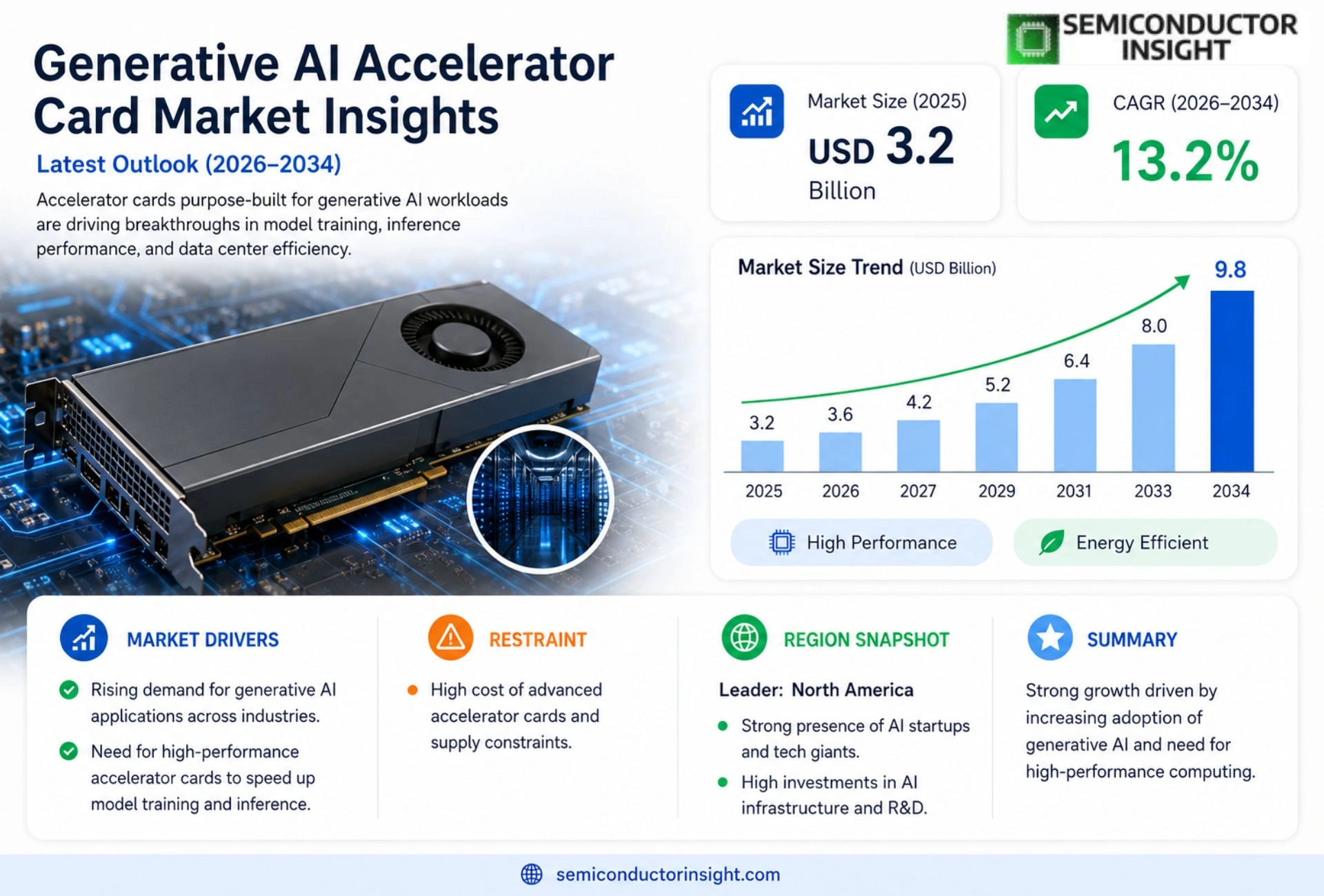
Generative AI Accelerator Card market size was valued at USD 3.2 billion in 2025. The market is projected to grow from USD 3.6 billion in 2026 to USD 9.8 billion by 2034, exhibiting a CAGR of 13.2% during the forecast period.
Generative AI accelerator cards are specialized hardware modules,often based on ASICs or high‑performance GPUs,designed to accelerate large‑scale transformer model training and inference workloads such as text‑to‑image generation, code synthesis, and conversational agents.
The market is expanding rapidly because enterprises are scaling up generative AI services, cloud providers are launching dedicated inference instances, and venture capital funding for AI startups remains strong. Furthermore, strategic alliances like Nvidia’s partnership with Microsoft Azure for H100‑based instances and Intel’s collaboration with Google Cloud on Habana Gaudi accelerators are driving adoption among hyperscale data centers.
MARKET DRIVERS
Surging Demand for Generative AI Compute
Generative AI Accelerator Card Market is being propelled by a rapid increase in enterprise adoption of generative AI models, with deployment rates growing over 45% year‑over‑year. Companies across media, finance, and pharmaceuticals are scaling AI workloads, creating a pressing need for high‑throughput accelerator cards that can handle trillion‑parameter models.
Advancements in Chip Architecture
Recent breakthroughs in heterogeneous integration and silicon‑photonic interconnects have lifted performance per watt by roughly 30%, making accelerator cards more cost‑effective for data‑center operators. This technological leap enables smaller form‑factors while sustaining the intense compute cycles required by generative AI inference.
➤ Industry analysts forecast that by 2027, accelerator cards will account for more than 55% of total AI hardware spend, underscoring their central role in the evolving AI ecosystem.
Combined, these drivers are catalyzing a robust growth trajectory for Generative AI Accelerator Card Market, positioning it as a cornerstone of next‑generation AI infrastructure.
MARKET CHALLENGES
Technical Complexity and Integration
Integrating accelerator cards into existing server racks demands sophisticated firmware and software stacks. A lack of standardized APIs leads to prolonged deployment cycles, especially for enterprises transitioning from CPU‑centric workloads.
Other Challenges
Supply Chain Bottlenecks
The specialized semiconductor manufacturing process faces capacity constraints, resulting in lead times extending up to six months for high‑end accelerator cards. These bottlenecks inflate capital expenditures and can delay critical AI projects.
MARKET RESTRAINTS
High Capital Expenditure
Purchasing and deploying generative AI accelerator cards requires significant upfront investment, often exceeding $150,000 per unit for top‑tier models. This financial barrier limits adoption among mid‑size firms and prolongs the migration to AI‑optimized infrastructures.
MARKET OPPORTUNITIES
Emerging Edge Deployments
As generative AI workloads move closer to the data source, there is a growing opportunity for compact accelerator cards optimized for edge servers. Leveraging low‑latency inference at the edge can unlock new revenue streams in autonomous vehicles, smart manufacturing, and real‑time translation services, expanding the market’s addressable base.
Generative AI Accelerator Card Market Trends
Rapid Expansion Driven by Enterprise Adoption
Generative AI Accelerator Card Market is witnessing a pronounced acceleration as enterprises scale up large‑language‑model services and multimodal AI offerings. Demand for high‑throughput inference and training hardware has risen sharply, prompting cloud providers to provision dedicated instances that leverage next‑generation ASICs and GPUs. Recent deployments show that hyperscale data centers are allocating up to 30 % of new hardware purchases to accelerator cards, a clear signal that workload‑specific optimization is becoming a baseline requirement rather than an optional upgrade. This shift is reinforced by strong venture‑capital backing for AI‑focused startups, which in turn fuels the need for specialized compute platforms that can handle the growing parameter counts of state‑of‑the‑art transformer models.
Other Trends
Strategic Partnerships Accelerate Deployment
Collaboration between leading silicon vendors and cloud operators is reshaping the competitive landscape. Nvidia’s integration of H100‑based accelerator cards into Microsoft Azure’s AI infrastructure has unlocked faster inference latency for vision‑language models, while Intel’s partnership with Google Cloud on Habana Gaudi ASICs offers a differentiated power‑efficiency profile for training workloads. These alliances not only expand the addressable customer base but also streamline software stack integration, reducing time‑to‑value for enterprises that adopt generative AI solutions. As a result, the market sees a steady influx of new use cases ranging from real‑time content generation to automated code synthesis, each pushing the demand for more capable accelerator cards.
Shift Toward Energy‑Efficient ASIC Designs
Energy consumption has emerged as a decisive factor in hardware selection, especially as data‑center operators aim to balance performance with sustainability targets. Recent product releases emphasize lower wattage per tera‑operation, leveraging advanced 3‑nm process nodes and custom memory hierarchies. These designs deliver comparable training throughput to earlier generations while cutting power draw by up to 25 %. The trend encourages organizations to prioritize total‑cost‑of‑ownership calculations, driving a gradual migration from general‑purpose GPUs to purpose‑built accelerator cards. Consequently, Generative AI Accelerator Card Market is aligning its growth trajectory with both performance demands and environmental stewardship considerations.
COMPETITIVE LANDSCAPE
Key Industry Players
Generative AI Accelerator Card Market Competitive Landscape Overview
The market is dominated by Nvidia, whose H100 and A100 families set the performance benchmark for transformer training and inference. Nvidia’s deep integration with hyperscale cloud providers such as Microsoft Azure and Amazon Web Services reinforces a duopolistic structure where a single vendor controls the majority of high‑throughput AI workloads. Intel’s acquisition of Habana Labs and the subsequent launch of Gaudi cards have introduced a credible second tier, especially in data‑center environments that prioritize power efficiency and open‑source software stacks. Both companies benefit from extensive R&D budgets, robust IP portfolios, and strategic OEM partnerships that limit entry for smaller rivals.
Beyond the two giants, a diverse cohort of specialist firms is expanding the ecosystem. AMD’s MI300 series leverages CDNA architecture to target cost‑sensitive workloads, while Graphcore’s IPU delivers fine‑grained parallelism for inference‑heavy services. Cerebras Systems offers wafer‑scale engines that collapse thousands of cores onto a single tile, appealing to research labs with massive model budgets. SambaNova, Tenstorrent, Groq, Mythic, and Qualcomm each present niche value propositions,ranging from low‑latency edge inference to programmable dataflow architectures,that address vertical markets such as autonomous vehicles, fintech, and embedded AI. Asian players like Huawei (Ascend), Baidu (Kunlun), and Alibaba (Hanguang) are also emerging, supported by strong domestic cloud ecosystems and government backing.
List of Key Generative AI Accelerator Card Companies Profiled
- Nvidia Corporation
- Intel Corporation (Habana Labs)
- Advanced Micro Devices (AMD)
- Graphcore Ltd.
- Cerebras Systems
- SambaNova Systems
- Tenstorrent
- Groq Inc.
- Mythic AI
- Qualcomm Technologies, Inc.
- Huawei Technologies (Ascend)
- Baidu, Inc. (Kunlun)
- Alibaba Cloud (Hanguang)
- Google Cloud (TPU)
- Tesla, Inc. (Dojo)
Segment Analysis:
| Segment Category | Sub-Segments | Key Insights |
| By Type |
|
ASIC‑based Accelerator Cards are emerging as the leading segment because they deliver purpose‑built compute pipelines that align tightly with transformer workloads, they reduce power consumption while maintaining high throughput, and they enable vendors to differentiate through proprietary inference kernels. |
| By Application |
|
Large Language Model Training drives the most intense demand; customers seek cards that can sustain prolonged high‑memory bandwidth, developers appreciate the ability to fine‑tune models quickly, and ecosystem partners are building software stacks that exploit the cards’ parallelism for faster iteration cycles. |
| By End User |
|
Cloud Service Providers lead this segment because they integrate accelerator cards into multi‑tenant offerings, they provide standardized APIs that abstract hardware complexity, and they influence adoption through bundled pricing models that lower entry barriers for downstream developers. |
| By Deployment Model |
|
On‑Premises Data Centers dominate because organizations with sensitive data prefer to keep compute in‑house, they value the ability to fully customize networking topologies, and they benefit from tighter latency control for real‑time generative services. |
| By Performance Tier |
|
High‑End Accelerators are the leading segment as they offer the deepest compute pipelines, enable breakthroughs in model size and complexity, and attract strategic partnerships that co‑develop advanced software ecosystems around the hardware. |
Regional Analysis: North America
United States
The data center sector represents a significant driver for Generative AI Accelerator Cards, needing high-performance computing for AI model training and inference.
Cloud service providers are rapidly integrating generative AI capabilities, creating substantial demand for specialized accelerator hardware.
Enterprises across industries are exploring and implementing generative AI for various applications, fueling the need for powerful accelerator cards.
Academic institutions and research organizations are investing in advanced hardware to push the boundaries of generative AI innovation.
Europe
Europe is experiencing steady growth Generative AI Accelerator Card Market, underpinned by increasing investments in AI research and a growing adoption of AI technologies across industries. The region’s focus on sustainable computing practices is influencing the demand for energy-efficient accelerator solutions. While the market penetration is currently lower compared to North America, the outlook is positive, with several countries actively promoting AI innovation through government initiatives and funding programs. The European market is characterized by a diverse range of players, including established technology companies and emerging startups, all vying for a share of this expanding market. The emphasis on data privacy and security also presents both a challenge and an opportunity for accelerator card providers, requiring solutions that align with stringent European regulations.
Asia-Pacific
The Asia-Pacific region represents a high-growth area for Generative AI Accelerator Card Market, driven by the rapid expansion of the digital economy and increasing investments in artificial intelligence. Countries like China, Japan, and South Korea are leading the way in AI adoption, creating significant demand for high-performance computing infrastructure. The region’s large-scale data centers and growing cloud computing market are key drivers of this demand. Government support for AI development and a burgeoning ecosystem of technology companies are further fueling market growth. The competitive landscape in Asia-Pacific is intense, with both domestic and international players competing for market share. The increasing deployment of generative AI in sectors such as manufacturing, healthcare, and finance presents substantial opportunities for accelerator card providers.
South America
South America is an emerging market for Generative AI Accelerator Cards, with growing interest in AI applications across various sectors. The region’s expanding digital infrastructure and increasing investments in technology are creating a favorable environment for market growth. The adoption of generative AI is initially concentrated in sectors like financial services, e-commerce, and telecommunications. While the market size is currently smaller compared to North America and Asia-Pacific, the long-term growth potential is significant. Challenges include limited access to advanced computing infrastructure and a need for skilled AI professionals. However, initiatives to promote digital transformation and foster AI innovation are expected to drive market expansion in the coming years.
Middle East & Africa
The Middle East and Africa represent an early-stage but promising market for Generative AI Accelerator Cards. Several countries in the region are actively pursuing digital transformation initiatives, with a growing focus on AI adoption. The increasing investments in cloud computing and data centers are creating a foundation for future market growth. Early applications of generative AI are being explored in sectors such as finance, healthcare, and retail. The market is characterized by a relatively small number of players, but with significant potential for expansion. Challenges include limited awareness of AI technologies and a need for specialized expertise. Government initiatives to promote technological advancement and attract foreign investment are expected to accelerate market growth in the region.
Report Scope
This market research report provides a comprehensive analysis of the Generative AI Accelerator Card Market , covering the forecast period 2026–2034. It offers detailed insights into market dynamics, technological advancements, competitive landscape, and key trends shaping the industry.
Key focus areas of the report include:
- Market Overview: The report begins with an overview outlining its current market scenario, key growth indicators, and industry transformation drivers. It discusses macroeconomic factors, demand–supply balance, regulatory landscape, and the strategic role of semiconductors in powering advancements across industries such as automotive, telecommunications, consumer electronics, and industrial automation.
- Market Size & Forecast: Historical data and future projections for revenue, unit shipments, and market value across major regions and segments.
- Segmentation Analysis: Detailed breakdown by product type, technology, application, and end-user industry to identify high-growth segments and investment opportunities.
- Regional Insights: Insights into market performance across North America, Europe, Asia-Pacific, Latin America, and the Middle East & Africa, including country-level analysis where relevant.
- Competitive Landscape: Profiles of leading market participants, including their product offerings, R&D focus, manufacturing capacity, pricing strategies, and recent developments such as mergers, acquisitions, and partnerships.
- Technology Trends & Innovation: Assessment of emerging technologies, integration of AI/IoT, semiconductor design trends, fabrication techniques, and evolving industry standards.
- Market Drivers & Restraints: Evaluation of factors driving market growth along with challenges, supply chain constraints, regulatory issues, and market-entry barriers.
- Stakeholder Insights: Insights for component suppliers, OEMs, system integrators, investors, and policymakers regarding the evolving ecosystem and strategic opportunities.
Primary and secondary research methods are employed, including interviews with industry experts, data from verified sources, and real-time market intelligence to ensure the accuracy and reliability of the insights presented.
FREQUENTLY ASKED QUESTIONS:
What is the current market size of Generative AI Accelerator Card Market?
-> Generative AI Accelerator Card Market was valued at USD 3.2 billion in 2025 and is expected to reach USD 9.8 billion by 2034.
Which key companies operate Generative AI Accelerator Card Market?
-> Key players include Nvidia, Intel, and AMD, which are actively developing accelerator cards and forming strategic partnerships with cloud providers.
What are the key growth drivers?
-> Key growth drivers include enterprise adoption of generative AI services, cloud providers launching dedicated inference instances, and strong venture capital funding for AI startups.
Which region dominates the market?
-> North America leads in adoption due to major cloud service providers, while Asia‑Pacific shows the fastest growth rate.
What are the emerging trends?
-> Emerging trends include strategic alliances such as Nvidia with Microsoft Azure and Intel with Google Cloud, and the development of ASIC‑based accelerator solutions for hyperscale data centers.

Get Sample Report PDF for Exclusive Insights
Report Sample Includes
- Table of Contents
- List of Tables & Figures
- Charts, Research Methodology, and more...
 Download Sample Report PDF