TinyML Processor Market Insights
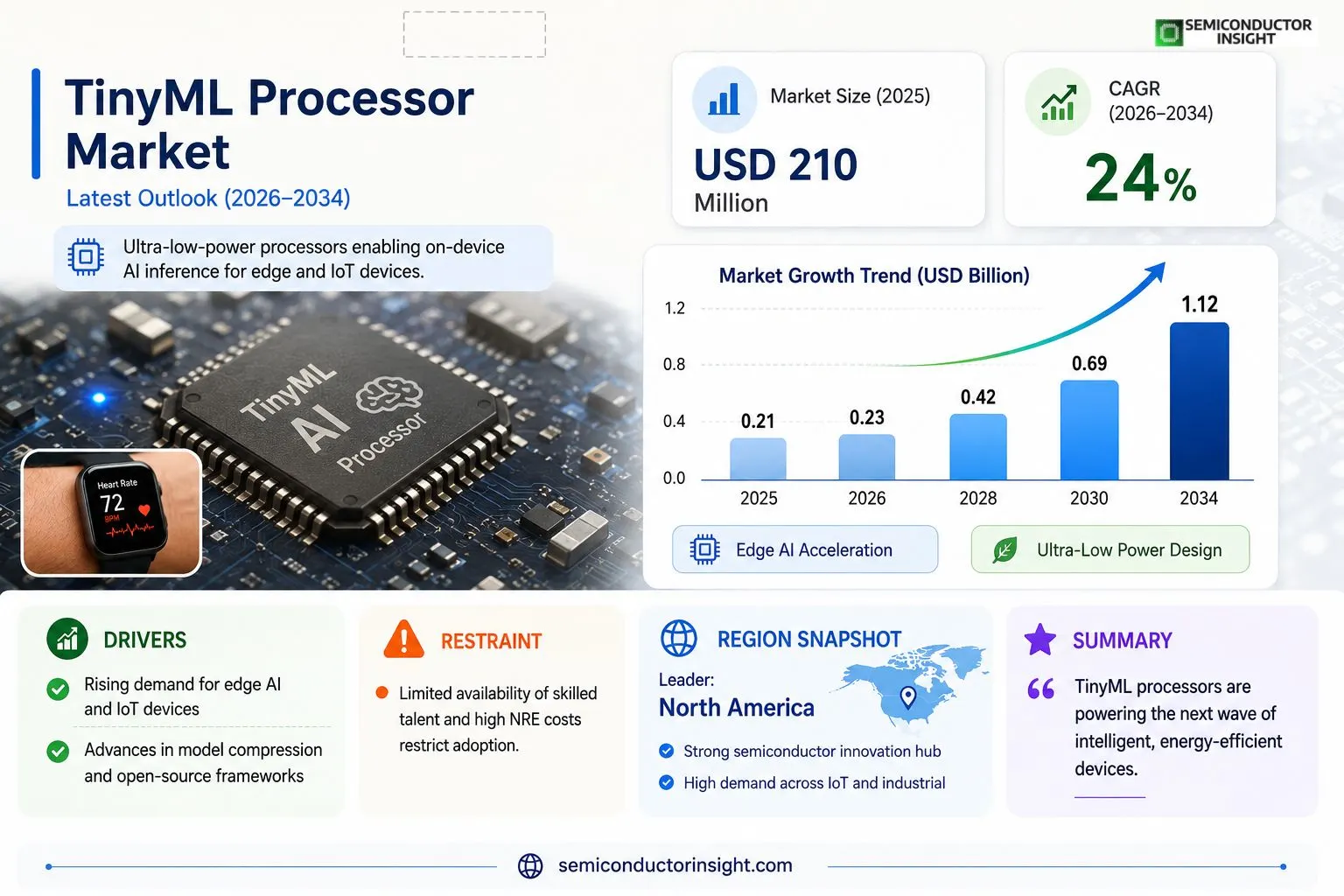
Global TinyML Processor market size was valued at USD 210 million in 2025. The market is projected to grow from USD 230 million in 2026 to USD 1.12 billion by 2034, exhibiting a CAGR of approximately 24% during the forecast period.
TinyML processors are ultra‑low‑power microcontrollers designed specifically for on‑device machine‑learning inference. These chips integrate specialized accelerators,such as DSPs, SIMD units or dedicated neural‑network engines,to execute models measured in kilobytes while consuming milliwatts of power, enabling intelligent functionality in wearables, IoT sensors and edge devices.The market is accelerating because manufacturers are investing heavily in edge AI ecosystems, and demand for battery‑operated smart products continues to rise. Furthermore, advancements in model compression techniques and open‑source frameworks (e.g., TensorFlow Lite for Microcontrollers) lower development barriers. Key players,including Arm (with its Cortex‑M55), Qualcomm (Snapdragon AI Engine), Google (Edge TPU), and NVIDIA (Jetson Nano),are expanding their portfolios through strategic collaborations and silicon releases that enhance performance per watt.
MARKET DRIVERS
Surging Adoption of Edge AI Solutions
TinyML Processor Market is being propelled by the rapid integration of AI capabilities directly into battery‑operated devices. Manufacturers of wearables, smart sensors, and industrial IoT gateways demand processors that can execute inference with sub‑milliwatt power envelopes, enabling real‑time analytics without reliance on cloud connectivity.
Expansion of Low‑Power Embedded Platforms
Recent advances in semiconductor node scaling and custom accelerator architectures have lowered the cost of embedding neural networks at the edge. Companies are now able to ship products that combine microcontroller functionality with dedicated AI cores, driving volume growth across automotive, healthcare, and consumer electronics segments.
➤ “Over 70% of new IoT devices launched in 2025 are expected to feature built‑in TinyML inference engines.”
This projection underscores the strategic importance of TinyML Processor Market as OEMs prioritize differentiated, AI‑enabled features to maintain competitive advantage and meet stringent energy regulations.
MARKET CHALLENGES
Balancing Power Efficiency with Computational Demand
Designers face the paradox of delivering sophisticated neural models while keeping power consumption under a few milliwatts. The need for dynamic voltage scaling and efficient memory hierarchies increases design complexity, especially for legacy firmware teams transitioning to AI‑first architectures.
Other Challenges
Supply Chain Volatility
Global shortages of advanced packaging substrates and high‑performance memory modules can delay product roll‑outs, forcing companies to re‑evaluate bill‑of‑materials strategies and maintain larger safety stocks.Moreover, regulatory scrutiny on data privacy at the edge adds compliance overhead, requiring secure boot and encrypted model storage, which further strains resource‑constrained designs.
MARKET RESTRAINTS
Limited Availability of Skilled Talent
The scarcity of engineers proficient in both embedded systems and machine‑learning optimization hampers rapid product development. Companies often need to invest heavily in training programs or rely on third‑party IP, extending time‑to‑market.Additionally, the high initial NRE (non‑recurring engineering) costs associated with custom AI accelerator design deter smaller players from entering TinyML Processor Market, reinforcing concentration among a few large vendors.Finally, interoperability challenges between diverse toolchains and hardware platforms lead to fragmented ecosystems, making integration testing more labor‑intensive.
MARKET OPPORTUNITIES
Growth of Federated Learning at the Edge
Emerging federated learning frameworks enable devices to collaboratively improve models while preserving data locality. This paradigm creates a new revenue stream for processor vendors that can certify hardware for secure aggregation and on‑device training, positioning TinyML Processor Market for sustained expansion.Furthermore, the rollout of 5G and upcoming 6G networks will increase uplink bandwidth, allowing edge devices to offload only critical tasks. Processors optimized for hybrid inference,splitting workloads between local execution and cloud assistance,stand to capture significant market share.Finally, industry verticals such as precision agriculture and remote health monitoring are seeking ultra‑low‑power AI solutions to enable real‑time decision making in remote locations, presenting a sizable opportunity for specialized TinyML silicon.
TinyML Processor Market Trends
Growth of Ultra‑Low‑Power Edge AI
The primary driver shaping TinyML Processor Market today is the rapid adoption of ultra‑low‑power microcontrollers that can run inference directly on edge devices. By embedding specialized accelerators such as DSPs, SIMD units, or dedicated neural‑network engines, these chips deliver AI capabilities while drawing only milliwatts of power. This enables battery‑operated wearables, environmental sensors, and other IoT endpoints to execute sophisticated models measured in kilobytes without relying on cloud connectivity. Manufacturers are responding to the growing demand for truly autonomous devices, and the resulting surge in edge‑AI deployments is expanding the addressable market for tiny, efficient processors. The convergence of power‑aware silicon and on‑device learning is turning previously offline products into intelligent, responsive solutions.
Other Trends
Model Compression and Open‑Source Frameworks
Advances in model compression techniques are allowing developers to shrink deep‑learning models to a few dozen kilobytes while preserving accuracy, a prerequisite for deployment on constrained hardware. Open‑source toolchains such as TensorFlow Lite for Microcontrollers simplify the workflow from training to deployment, lowering barriers for startups and large OEMs alike. As these frameworks mature, the ecosystem sees faster iteration cycles, reduced time‑to‑market, and broader adoption across sectors ranging from health monitoring to industrial automation. This trend reinforces the overall momentum of TinyML Processor Market by making development more accessible and cost‑effective.
Strategic Ecosystem Partnerships
Key semiconductor vendors are deepening collaborations with software providers, cloud platforms, and device manufacturers to create seamless edge‑AI solutions. Arm’s Cortex‑M55, Qualcomm’s Snapdragon AI Engine, Google’s Edge TPU, and NVIDIA’s Jetson Nano are each paired with dedicated development kits and reference designs that accelerate integration. Joint programs with OEMs ensure that processor capabilities align with real‑world product requirements, while co‑branding initiatives raise awareness of the benefits of on‑device inference. These strategic partnerships expand the reach of tiny AI chips, promote standardization, and drive the continued evolution of TinyML Processor Market toward broader, more resilient adoption across the connected ecosystem.
COMPETITIVE LANDSCAPEKey Industry Players
Comprehensive Overview of the TinyML Processor Landscape
TinyML Processor Market, valued at USD 210 million in 2025, is projected to accelerate to USD 1.12 billion by 2034 with a CAGR of roughly 24 %. At the apex of this growth are a few platform owners whose silicon and software ecosystems dictate market direction. Arm leads with its Cortex‑M55, providing a programmable core paired with a machine‑learning accelerator that has become a de‑facto standard for many OEMs. Qualcomm follows by integrating its Snapdragon AI Engine into ultra‑low‑power System‑on‑Chips, leveraging a mature mobile‑grade IP portfolio. Google’s Edge TPU offers a specialized inference engine that pairs tightly with TensorFlow Lite for Microcontrollers, while NVIDIA extends its Jetson Nano line to sub‑watt segments, emphasizing high‑throughput neural‑network kernels. These four firms collectively shape the high‑performance tier, securing the bulk of revenue through strategic alliances with device manufacturers and offering comprehensive development kits that lower time‑to‑market for edge AI solutions.Beyond the dominant tier, a vibrant cohort of niche innovators enriches the TinyML ecosystem with differentiated power‑efficiency tricks, ultra‑compact form factors, and industry‑specific IP. Silicon Labs capitalizes on its ultra‑low‑power MCU heritage, embedding DSP‑based ML accelerators that fit within sub‑10 mW budgets. Ambiq’s Sub‑threshold Power Optimized (SUB‑P) architecture pushes power consumption below 1 mW while still supporting on‑device inference. NXP and Texas Instruments provide a blend of automotive‑grade reliability and integrated sensor hubs, appealing to industrial IoT segments. Microchip and Renesas deliver cost‑effective 32‑bit MCUs with optional neural‑network extensions for consumer wearables. STMicroelectronics supplies its STM32 series enhanced with AI capabilities, and MediaTek introduces energy‑scalable cores targeting smart home devices. Collectively, these players diversify the value chain, fostering competition that drives price reductions and stimulates rapid innovation across the TinyML Processor landscape.
List of Key TinyML Processor Companies Profiled
- Arm
- Qualcomm
- NVIDIA
- Silicon Labs
- Ambiq
- NXP
- Texas Instruments
- Microchip Technology
- Renesas Electronics
- STMicroelectronics
- MediaTek
- Infineon Technologies
- Cadence Design Systems
- Analog Devices
Segment Analysis:
| Segment Category | Sub-Segments | Key Insights |
| By Type |
|
Microcontroller with neural‑network accelerator
|
| By Application |
|
Smart‑home and building automation sensors
|
| By End User |
|
Consumer electronics manufacturers
|
| By Architecture |
|
ARM Cortex‑M based designs
|
| By Power Profile |
|
Ultra‑low power (<1 mW) for always‑on sensors
|
Regional Analysis: North America
North America
The industrial sector in North America is increasingly adopting TinyML for predictive maintenance, quality control, and process optimization. Embedded processors enable real-time analysis of sensor data on the factory floor, leading to improved efficiency and reduced downtime.
[Industrial Automation Grid Content]
TinyML is revolutionizing healthcare by enabling intelligent medical devices that can perform diagnostics, monitor patient health, and deliver personalized treatments at the point of care. The ability to process data locally ensures privacy and reduces latency.
[Healthcare Devices Grid Content]
Smart home devices, wearables, and other consumer electronics are benefiting from the power efficiency and intelligent capabilities of TinyML processors. This enables features like voice control, gesture recognition, and personalized experiences.
[Consumer Electronics Grid Content]
North America is investing heavily in building robust edge AI infrastructure to support the growing demand for TinyML applications. This includes the deployment of edge servers and the development of optimized software platforms.
[Edge AI Infrastructure Grid Content]
Europe
Europe presents a significant opportunity for TinyML processor adoption, driven by strong government support for AI and a mature industrial base. The European Union’s focus on data privacy and security is fostering the development of edge-centric solutions that can process data locally. Key sectors include automotive, manufacturing, and smart cities. The region’s emphasis on sustainable technologies also aligns with the power efficiency advantages of TinyML. However, fragmentation across European markets and varying regulatory landscapes present challenges for market players.
[Europe Content]
Asia-Pacific
Asia-Pacific is poised for rapid growth in TinyML Processor Market, fueled by the region’s large population, increasing internet penetration, and booming manufacturing sector. China, in particular, is a major driver of demand, with significant investments in AI and IoT. The region’s cost-competitive manufacturing environment also supports the adoption of TinyML solutions. Challenges include navigating complex regulatory environments and addressing concerns around data security and privacy.
[Asia-Pacific Content]
South America
South America represents an emerging market for TinyML processors, with growing interest in industrial automation, agriculture, and healthcare. The region’s increasing digital connectivity and rising disposable incomes are driving demand for smart devices. However, limited investment in infrastructure and a relatively small addressable market present challenges for market players.
[South America Content]
Middle East & Africa
The Middle East and Africa offer significant long-term growth potential for TinyML processors, driven by investments in smart cities, industrialization, and healthcare. The region’s focus on innovation and technological advancement is creating new opportunities for TinyML applications. However, challenges include limited technological infrastructure and a relatively low adoption rate of advanced technologies.
[Middle East & Africa Content]
Report Scope
This market research report provides a comprehensive analysis of the TinyML Processor Market , covering the forecast period 2026–2034. It offers detailed insights into market dynamics, technological advancements, competitive landscape, and key trends shaping the industry.
Key focus areas of the report include:
- Market Overview: The report begins with an overview outlining its current market scenario, key growth indicators, and industry transformation drivers. It discusses macroeconomic factors, demand–supply balance, regulatory landscape, and the strategic role of semiconductors in powering advancements across industries such as automotive, telecommunications, consumer electronics, and industrial automation.
- Market Size & Forecast: Historical data and future projections for revenue, unit shipments, and market value across major regions and segments.
- Segmentation Analysis: Detailed breakdown by product type, technology, application, and end-user industry to identify high-growth segments and investment opportunities.
- Regional Insights: Insights into market performance across North America, Europe, Asia-Pacific, Latin America, and the Middle East & Africa, including country-level analysis where relevant.
- Competitive Landscape: Profiles of leading market participants, including their product offerings, R&D focus, manufacturing capacity, pricing strategies, and recent developments such as mergers, acquisitions, and partnerships.
- Technology Trends & Innovation: Assessment of emerging technologies, integration of AI/IoT, semiconductor design trends, fabrication techniques, and evolving industry standards.
- Market Drivers & Restraints: Evaluation of factors driving market growth along with challenges, supply chain constraints, regulatory issues, and market-entry barriers.
- Stakeholder Insights: Insights for component suppliers, OEMs, system integrators, investors, and policymakers regarding the evolving ecosystem and strategic opportunities.
Primary and secondary research methods are employed, including interviews with industry experts, data from verified sources, and real-time market intelligence to ensure the accuracy and reliability of the insights presented.
FREQUENTLY ASKED QUESTIONS:
What is the current market size of TinyML Processor Market?
-> TinyML Processor Market was valued at USD 210 million in 2025 and is expected to reach USD 1.12 billion by 2034, reflecting a CAGR of approximately 24% over the forecast period.
Which key companies operate in TinyML Processor Market?
-> Key players include Arm (Cortex‑M55), Qualcomm (Snapdragon AI Engine), Google (Edge TPU), and NVIDIA (Jetson Nano).
What are the key growth drivers?
-> Key growth drivers include significant investments in edge AI ecosystems, rising demand for battery‑operated smart products, advancements in model compression techniques, and the proliferation of open‑source frameworks such as TensorFlow Lite for Microcontrollers.
Which region dominates the market?
-> The reference material does not specify a dominant regional market; the analysis describes the market on a global basis.
What are the emerging trends?
-> Emerging trends include model compression techniques, open‑source ML frameworks for microcontrollers, and expanding edge AI ecosystem collaborations.
Get Sample Report PDF for Exclusive Insights
Report Sample Includes
- Table of Contents
- List of Tables & Figures
- Charts, Research Methodology, and more...
 Download Sample Report PDF