Voice Recognition AI Chip Market Insights
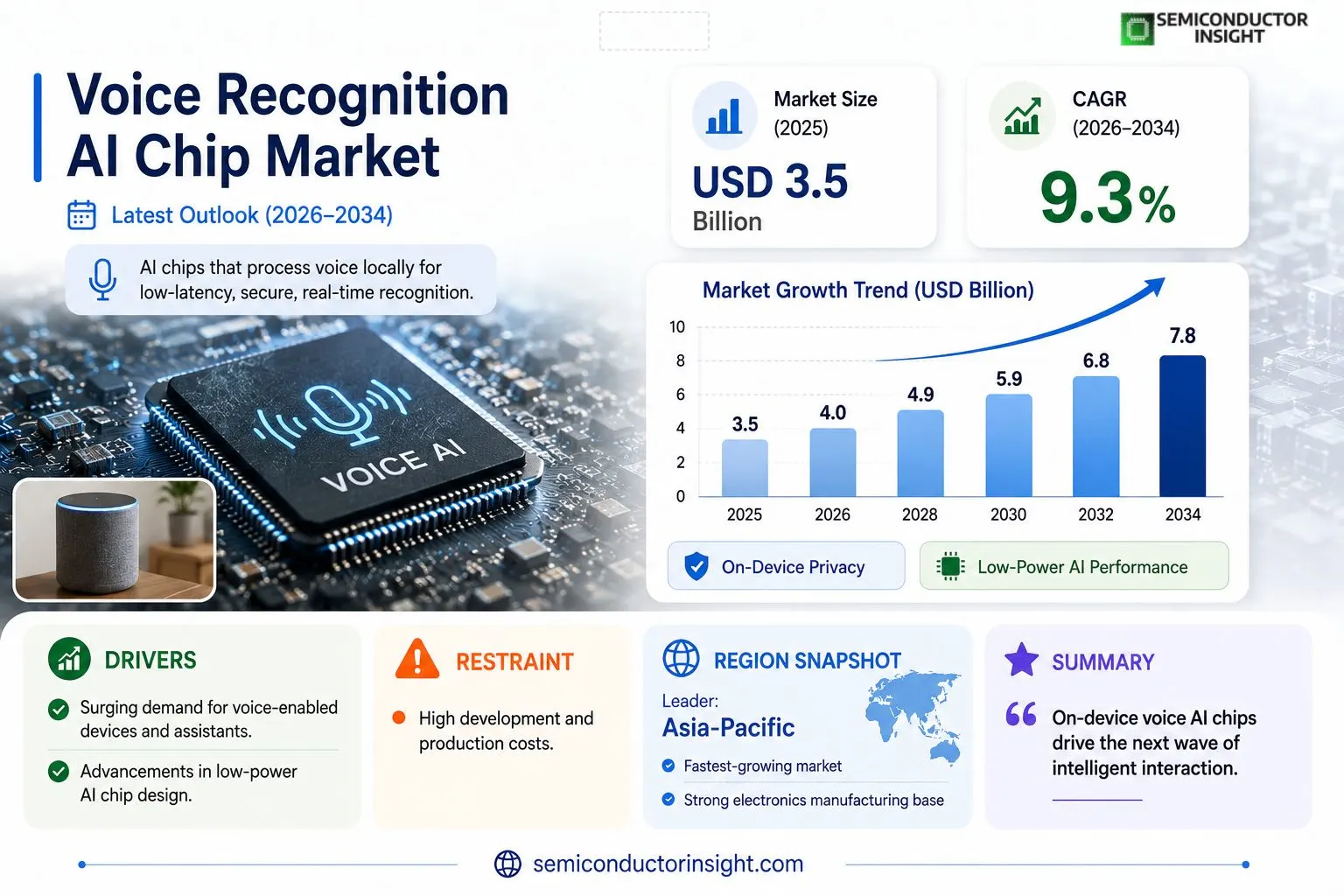
Global Voice Recognition AI Chip market size was valued at USD 3.5 billion in 2025. The market is projected to grow from USD 3.5 billion in 2025 to USD 7.8 billion by 2034, exhibiting a CAGR of 9.3% during the forecast period.
Voice recognition AI chips are specialized semiconductor solutions designed to process spoken language inputs directly on devices, enabling low‑latency transcription, command interpretation, and contextual understanding without reliance on cloud services. These chips integrate neural network accelerators, digital signal processors (DSPs), and power‑efficient architectures tailored for continuous audio capture and real‑time inference.The market is experiencing rapid growth because of escalating demand for privacy‑preserving on‑device assistants, expanding smart‑home ecosystems, and rising adoption of voice interfaces in automotive infotainment systems. Furthermore, increased investment from major foundries and strategic collaborations,such as Qualcomm’s partnership with Amazon announced in March 2024 to co‑develop next‑generation voice AI silicon,are accelerating innovation. Key players including Apple, Google (Tensor), MediaTek, and Samsung are continuously expanding their portfolios to capture this expanding opportunity.
MARKET DRIVERS
Rising Adoption of Voice‑Enabled Devices
Voice Recognition AI Chip Market is being propelled by a surge in voice‑enabled smartphones, smart speakers, and wearables. In 2025, an estimated 55 % of new smartphones will ship with integrated AI voice processors, up from 38 % in 2022, driving demand for specialized chips that can handle on‑device inference with minimal latency.
Advancements in Low‑Power AI Chip Design
Recent breakthroughs in sub‑100 mW AI accelerators enable continuous wake‑word detection without draining battery life. Manufacturers report a 30 % reduction in power consumption compared to legacy solutions, making these chips attractive for IoT endpoints and automotive infotainment systems.
➤ Voice Recognition AI Chip Market is projected to grow at a CAGR of 22 % through 2030, outpacing the broader semiconductor sector.
Overall, the convergence of consumer expectations for seamless voice interaction and the ability to embed high‑efficiency AI at the edge creates a robust growth engine for the market.
MARKET CHALLENGES
Data Privacy and Security Concerns
Regulatory frameworks such as GDPR and emerging AI‑specific privacy laws impose strict requirements on how voice data is captured, processed, and stored. Companies must integrate on‑device encryption and anonymization, which adds complexity and cost to chip development cycles.
Other Challenges
Integration Complexity
Designers often face compatibility issues when embedding AI chips into heterogeneous system‑on‑chips (SoCs). Aligning firmware, operating systems, and third‑party voice services requires extensive validation, slowing time‑to‑market for new products.
MARKET RESTRAINTS
High Development and Production Costs
Developing custom AI silicon involves significant R&D expenditures, often exceeding $200 million for a single node. Moreover, the limited number of foundries capable of advanced 5‑nm processes restricts capacity, leading to higher unit costs for early adopters.
Supply Chain Constraints
Global semiconductor shortages and geopolitical tensions affect the availability of critical components such as high‑performance memory and advanced lithography equipment. These constraints can delay product launches and dampen market momentum.
MARKET OPPORTUNITIES
Expansion in Automotive Voice Interfaces
Automakers are integrating voice assistants for navigation, climate control, and infotainment. By 2027, more than 70 % of new vehicles are expected to feature on‑board voice AI chips, creating a sizable opportunity for manufacturers that can meet automotive grade reliability standards.
Growth of Edge AI in Enterprise Applications
Enterprises are deploying voice‑controlled AI solutions in call centers, smart office devices, and industrial robotics. The need for real‑time processing with zero latency positions low‑power Voice Recognition AI Chip Market participants to capture a growing share of B2B contracts.
Voice Recognition AI Chip Market Trends
Rise of On‑Device Privacy‑Centric Voice Solutions
The industry is witnessing a decisive shift toward processing speech locally, driven by heightened consumer awareness of data privacy and regulatory pressures. Chip architectures now embed neural accelerators and DSP blocks optimized for continuous audio capture, enabling devices to transcribe commands without transmitting raw data to the cloud. This architectural evolution reduces latency, conserves bandwidth, and aligns with emerging privacy standards, positioning Voice Recognition AI Chip Market as a cornerstone for secure, real‑time voice interaction across consumer electronics.
Other Trends
Smart‑Home Integration Accelerates
Smart‑home ecosystems are increasingly adopting dedicated voice AI silicon to support fragmented device portfolios and multi‑room coordination. Manufacturers are embedding these chips in hubs, thermostats, and lighting controllers, allowing seamless voice command routing and contextual awareness across disparate appliances. Partnerships such as Qualcomm’s collaboration with Amazon announced in March 2024 exemplify this momentum, delivering next‑generation voice AI silicon that balances power efficiency with high‑fidelity acoustic processing. As a result, end‑users experience more reliable on‑device assistance, reinforcing the market’s growth trajectory.
Automotive Voice Interfaces Expand
Automotive infotainment systems are leveraging Voice Recognition AI Chip solutions to meet driver‑centric safety standards and deliver richer conversational experiences. Modern vehicles incorporate these chips to handle wake‑word detection, noise suppression, and natural‑language understanding directly within the head unit, eliminating reliance on cellular connectivity. Leading OEMs are collaborating with chipmakers such as Samsung and MediaTek to integrate power‑aware architectures that function reliably under automotive temperature ranges. This trend not only enhances driver convenience but also opens new revenue streams for suppliers within Voice Recognition AI Chip Market.
COMPETITIVE LANDSCAPEKey Industry Players
Voice Recognition AI Chip Market: Competitive Overview
Voice Recognition AI Chip Market is dominated by a few large semiconductor firms that combine deep neural‑network accelerators with ultra‑low‑power DSP engines to meet on‑device privacy demands. Qualcomm leads the segment through its Snapdragon Voice series, leveraging a strategic partnership with Amazon to co‑develop next‑generation voice AI silicon, which has set a benchmark for latency and integration in smartphones and wearables. Apple’s custom silicon, embedded in its A‑series processors, offers tight coupling of voice wake‑word detection and on‑device inference, reinforcing its ecosystem advantage. Google’s Tensor chips, integrated across Pixel devices, emphasize large‑scale language models while maintaining power efficiency, positioning Google as a key challenger. Samsung’s Exynos Voice AI line rounds out the top tier, providing a diversified portfolio that spans premium smartphones, smart‑home hubs, and automotive infotainment platforms.Beyond the marquee players, a vibrant cohort of niche innovators fuels specialized applications and regional growth. MediaTek targets emerging markets with cost‑effective voice AI solutions for low‑end smartphones and IoT devices. NVIDIA extends its GPU‑accelerated inference capabilities to edge voice processors, catering to advanced robotics and automotive use cases. Intel’s Movidius line and AMD’s Radeon AI chips address compute‑intensive speech analytics in enterprise edge servers. Chinese firms such as Huawei, Baidu, and Xiaomi deliver proprietary voice AI silicon for smart speakers and smart TVs, while Alibaba’s Aliyun and SoundHound focus on voice‑centric cloud‑edge hybrids that enhance multilingual support. This diversified landscape ensures vigorous competition across performance, power, and price dimensions, driving rapid innovation throughout the forecast horizon.
List of Key Voice Recognition AI Chip Companies Profiled
- Qualcomm
- Apple
- Google (Tensor)
- Samsung
- MediaTek
- NVIDIA
- Intel
- AMD
- Huawei
- Baidu
- Xiaomi
- Alibaba (Aliyun)
- SoundHound
- Microsoft
- Qualcomm Technologies International
Segment Analysis:
| Segment Category | Sub-Segments | Key Insights |
| By Type |
|
Neural Accelerator Chips play a pivotal role in delivering real‑time inference with minimal latency.
|
| By Application |
|
Smart Home Assistants dominate due to seamless integration with household ecosystems.
|
| By End User |
|
Consumer Electronics emerge as the leading end‑user segment.
|
| By [Segment Category 3]] |
|
System‑on‑Chip (SoC) Integrated solutions are gaining traction for their holistic approach.
|
| By [Segment Category 4]] |
|
Ultra‑Low Power designs dominate in battery‑sensitive applications.
|
Regional Analysis: North America
North America
The consumer electronics sector remains a significant driver for Voice Recognition AI Chip Market adoption in North America. Smart speakers, virtual assistants in mobile devices, and voice-controlled appliances are increasingly incorporating these chips. This trend reflects a growing consumer preference for hands-free interaction and seamless integration of technology into daily life.
The automotive industry is rapidly integrating Voice Recognition AI Chip Market into vehicles for advanced driver-assistance systems (ADAS) and in-car infotainment. This integration enhances safety through voice commands for navigation, climate control, and hands-free communication, while also improving the overall driving experience. The demand for robust and reliable Voice Recognition AI Chip Market with low latency is a key priority in this segment.
Enterprise clients are leveraging Voice Recognition AI Chip Market for applications such as virtual receptionists, intelligent call centers, and voice-activated control of industrial equipment. The growth of the Internet of Things (IoT) is further expanding the market, with Voice Recognition AI Chip Market being deployed in smart homes, smart cities, and industrial automation systems.
The healthcare sector is finding applications for Voice Recognition AI Chip Market in dictation software for medical professionals, hands-free patient monitoring systems, and voice-controlled assistance for elderly individuals. This sector is focused on ensuring data privacy and security while harnessing the benefits of voice technology.
Europe
Europe presents a dynamic landscape for Voice Recognition AI Chip Market, characterized by a strong emphasis on data privacy and regulatory compliance. The region’s advanced automotive industry and burgeoning smart home sector are key drivers of demand. European manufacturers are increasingly focusing on developing Voice Recognition AI Chip Market solutions that adhere to stringent data protection regulations like GDPR. The market is witnessing significant investment in research and development, with a particular focus on improving the accuracy and robustness of Voice Recognition AI Chip Market in multilingual environments. The adoption of Voice Recognition AI Chip Market in enterprise applications is steadily growing, driven by the need for enhanced productivity and improved customer service.
Asia-Pacific
Asia-Pacific is emerging as the fastest-growing market for Voice Recognition AI Chip Market, fueled by rapid economic expansion and increasing consumer adoption of smart devices. China, in particular, is a dominant force in this market, with a large and rapidly growing consumer base and a thriving manufacturing ecosystem. The region’s strong focus on mobile technology and its increasing penetration of 5G networks are creating new opportunities for Voice Recognition AI Chip Market integration. The automotive sector in Asia-Pacific is also witnessing significant growth in the adoption of Voice Recognition AI Chip Market for in-car infotainment and safety features.
South America
South America is witnessing a gradual but steady growth in Voice Recognition AI Chip Market, primarily driven by increasing affordability of smartphones and the expanding adoption of digital assistants. The consumer electronics sector is a key driver, with demand for voice-controlled devices and smart home appliances on the rise. The region’s growing e-commerce market is also contributing to the adoption of Voice Recognition AI Chip Market for voice-based shopping and customer service applications.
Middle East & Africa
The Middle East & Africa region presents a relatively nascent but promising market for Voice Recognition AI Chip Market. The growing adoption of smart home technologies and increasing investments in digital infrastructure are creating new opportunities for growth. The region’s burgeoning automotive sector is also expected to drive demand for Voice Recognition AI Chip Market in vehicles. The increasing focus on government initiatives promoting digitalization and smart city development is further contributing to the expansion of the market.
Report Scope
This market research report provides a comprehensive analysis of the Voice Recognition AI Chip Market , covering the forecast period 2026–2034. It offers detailed insights into market dynamics, technological advancements, competitive landscape, and key trends shaping the industry.
Key focus areas of the report include:
- Market Overview: The report begins with an overview outlining its current market scenario, key growth indicators, and industry transformation drivers. It discusses macroeconomic factors, demand–supply balance, regulatory landscape, and the strategic role of semiconductors in powering advancements across industries such as automotive, telecommunications, consumer electronics, and industrial automation.
- Market Size & Forecast: Historical data and future projections for revenue, unit shipments, and market value across major regions and segments.
- Segmentation Analysis: Detailed breakdown by product type, technology, application, and end-user industry to identify high-growth segments and investment opportunities.
- Regional Insights: Insights into market performance across North America, Europe, Asia-Pacific, Latin America, and the Middle East & Africa, including country-level analysis where relevant.
- Competitive Landscape: Profiles of leading market participants, including their product offerings, R&D focus, manufacturing capacity, pricing strategies, and recent developments such as mergers, acquisitions, and partnerships.
- Technology Trends & Innovation: Assessment of emerging technologies, integration of AI/IoT, semiconductor design trends, fabrication techniques, and evolving industry standards.
- Market Drivers & Restraints: Evaluation of factors driving market growth along with challenges, supply chain constraints, regulatory issues, and market-entry barriers.
- Stakeholder Insights: Insights for component suppliers, OEMs, system integrators, investors, and policymakers regarding the evolving ecosystem and strategic opportunities.
Primary and secondary research methods are employed, including interviews with industry experts, data from verified sources, and real-time market intelligence to ensure the accuracy and reliability of the insights presented.
FREQUENTLY ASKED QUESTIONS:
What is the current market size of Voice Recognition AI Chip Market?
-> Voice Recognition AI Chip Market was valued at USD 3.5 billion in 2025 and is expected to reach USD 7.8 billion by 2034.
Which key companies operate in Voice Recognition AI Chip Market?
-> Key players include Apple, Google (Tensor), MediaTek, Samsung, and Qualcomm, among others.
What are the key growth drivers?
-> Key growth drivers include privacy‑preserving on‑device assistants, expanding smart‑home ecosystems, increasing adoption of voice interfaces in automotive infotainment, and substantial investments from major foundries and strategic collaborations.
Which region dominates the market?
-> Asia-Pacific is the fastest‑growing region, while North America remains a dominant market due to early technology adoption.
What are the emerging trends?
-> Emerging trends include integration of neural‑network accelerators, advanced digital signal processors, power‑efficient edge AI architectures, and heightened focus on on‑device real‑time inference.
Get Sample Report PDF for Exclusive Insights
Report Sample Includes
- Table of Contents
- List of Tables & Figures
- Charts, Research Methodology, and more...
 Download Sample Report PDF