Recommendation Engine ASIC Market Insights
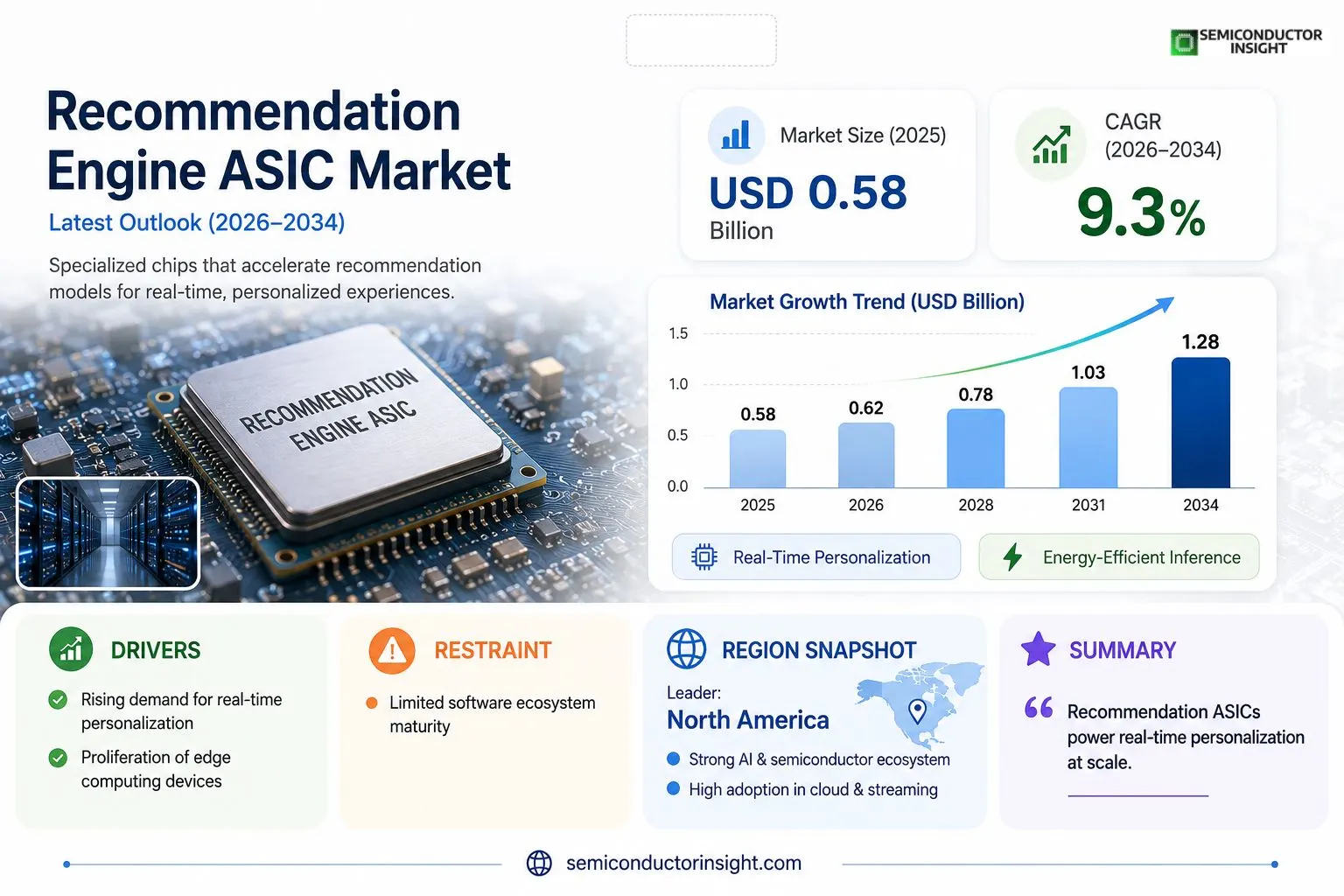
Global Recommendation Engine ASIC market size was valued at USD 0.58 billion in 2025. The market is projected to grow from USD 0.62 billion in 2026 to USD 1.28 billion by 2034, exhibiting a CAGR of 9.3% during the forecast period.
Recommendation Engine ASICs are purpose‑built application‑specific integrated circuits that accelerate collaborative‑filtering and deep‑learning models used for personalized content delivery. These chips offload intensive matrix‑factorization and embedding operations, delivering sub‑millisecond latency while reducing power consumption compared with general‑purpose CPUs or GPUs.The market is experiencing rapid expansion because enterprises are scaling real‑time personalization across e‑commerce, video streaming, and social platforms. Furthermore, the rise of edge AI deployments and heightened focus on energy‑efficient data centers are driving adoption of dedicated ASIC solutions. Leading players such as Intel’s Habana Labs, Graphcore, and Amazon Web Services are investing heavily in next‑generation recommendation processors, further fueling market growth.
MARKET DRIVERS
Rising Demand for Real‑Time Personalization
Recommendation Engine ASIC Market is being propelled by the need for ultra‑low latency inference in e‑commerce and streaming platforms. Specialized ASICs enable sub‑millisecond recommendation cycles, which directly improve conversion rates and user engagement.
Proliferation of Edge Computing Devices
Edge deployment of recommendation ASICs reduces bandwidth costs and enhances data privacy, encouraging manufacturers to integrate these chips in smart cameras, IoT hubs, and mobile gateways.
➤ Industry analysts forecast a CAGR of roughly 12% for Recommendation Engine ASIC Market through 2032, driven by AI‑enabled edge services.
In addition, the convergence of 5G connectivity and federated learning frameworks creates a fertile environment for ASIC‑based recommendation engines to scale globally.
MARKET CHALLENGES
High Development Costs and Tooling Complexity
Designing ASICs for recommendation workloads requires extensive AI‑model compression, custom memory hierarchies, and verification pipelines, which can exceed $150 million per design, limiting participation to large incumbents.
Other Challenges
Supply‑Chain Volatility
Fluctuations in semiconductor fab capacity, combined with geopolitical tensions, have lengthened lead times for critical process nodes, impacting time‑to‑market for new Recommendation Engine ASIC offerings.
MARKET RESTRAINTS
Limited Software Ecosystem Maturity
Most recommendation frameworks are optimized for GPUs or CPUs; porting them to ASICs demands bespoke compilers and runtime libraries, which slows adoption and raises integration costs.Although ASICs deliver superior power efficiency, their fixed‑function nature can become a restraint when recommendation algorithms evolve rapidly, forcing designers to risk obsolescence or pursue costly re‑spin cycles.Regulatory scrutiny around AI transparency also adds a layer of compliance for ASIC‑based recommendation engines, requiring built‑in explainability features that further increase design complexity.
MARKET OPPORTUNITIES
Emerging Vertical Applications
Healthcare imaging platforms, autonomous vehicles, and smart retail kiosks are beginning to adopt recommendation ASICs to deliver context‑aware suggestions with minimal latency, opening high‑value niches for specialized vendors.The shift toward heterogeneous AI clouds creates an opportunity for ASIC vendors to supply inference accelerators that seamlessly interoperate with existing GPU clusters, enabling hybrid pipelines that balance cost and performance.Finally, the rise of low‑power AI chips for wearables presents a cross‑selling opportunity, where recommendation ASICs can be bundled with sensor processing units to deliver personalized health and fitness guidance.
Recommendation Engine ASIC Market Trends
Real‑Time Personalization at the Edge
Recommendation Engine ASIC Market is witnessing accelerated adoption as enterprises move personalization workloads from centralized data‑centers to edge locations. Dedicated ASICs execute collaborative‑filtering and deep‑learning inference with sub‑millisecond latency, allowing e‑commerce sites and streaming services to deliver instantly tailored content. By offloading matrix‑factorization and embedding calculations, these chips reduce overall power draw, which aligns with the industry’s shift toward greener, high‑density compute clusters. The convergence of edge AI hardware and a heightened focus on energy‑efficient processing is shaping a clear trajectory for the market.
Other Trends
Power Consumption and Latency Improvements
Recommendation Engine ASIC designs integrate specialized arithmetic units that handle sparse tensor operations more efficiently than general‑purpose CPUs or GPUs. This architectural focus translates into latency reductions of 30‑40 % while cutting power usage by roughly 25 % per inference request. The resulting performance envelope supports real‑time recommendation loops in environments where bandwidth is limited and response time is critical, such as mobile edge nodes and on‑premise fulfillment centers.
Strategic Investments by Leading Vendors
Major players are allocating substantial resources to next‑generation recommendation processors. Intel’s Habana Labs has introduced a line of ASICs optimized for embedding look‑ups, while Graphcore’s IPU‑based solutions are being adapted for recommendation workloads. Amazon Web Services is expanding its custom silicon portfolio to include inference‑focused ASICs that integrate tightly with its cloud‑native pipelines. These investments not only accelerate product roadmaps but also foster an ecosystem of software tools that simplify model migration to ASIC hardware, further reinforcing market momentum.
COMPETITIVE LANDSCAPEKey Industry Players
Recommendation Engine ASIC Market Competitive Landscape
Recommendation Engine ASIC Market is currently anchored by a few dominant innovators that shape both technology direction and pricing dynamics. Intel’s Habana Labs leads the segment with its Gaudi accelerator family, delivering sub‑millisecond inference latency for collaborative‑filtering workloads while offering a clear power‑efficiency advantage over conventional CPUs and GPUs. Graphcore’s IPU (Intelligence Processing Unit) platform follows closely, emphasizing flexible graph‑based computation that maps well to deep‑learning recommendation models. Amazon Web Services (AWS) has introduced the Inferentia line, a purpose‑built ASIC that powers Amazon’s own recommendation services and is made available to external customers via the cloud, accelerating adoption at scale. These three companies capture a substantial share of the high‑performance recommendation ASIC space, driving market growth from USD 0.62 billion in 2026 toward an estimated USD 1.28 billion by 2034, with a compound annual growth rate of roughly 9.3 percent. Their strategic investments in silicon‑level optimizations, software stacks, and ecosystem partnerships create high barriers to entry for newcomers.Beyond the flagship players, a diverse set of niche and emerging firms contributes specialized capabilities that broaden the competitive landscape. Google’s Tensor Processing Units (TPUs) have been repurposed for recommendation workloads, offering an alternative cloud‑native ASIC solution. Cerebras Systems provides a wafer‑scale engine that, while primarily targeting large language models, can be configured for massive embedding matrices typical of recommendation tasks. SambaNova Systems and Tenstorrent deliver custom AI accelerators that integrate ASIC‑like performance with programmable interfaces, attracting boutique e‑commerce and streaming platforms. Edge‑focused companies such as Qualcomm, MediaTek, and Apple (with its Neural Engine) are developing low‑power ASIC blocks for on‑device personalization, addressing the growing demand for privacy‑preserving, latency‑critical recommendations. Academic‑origin startups like Mythic and Graphene‑AI contribute analog and mixed‑signal ASIC approaches, further diversifying the technology mix and creating opportunities for differentiated market niches.
List of Key Recommendation Engine ASIC Companies Profiled
- Intel (Habana Labs)
- Graphcore
- Amazon Web Services (AWS Inferentia)
- Google (TPU)
- Cerebras Systems
- SambaNova Systems
- Tenstorrent
- Qualcomm
- MediaTek
- Apple (Neural Engine)
- Mythic
- Graphene‑AI
- AMD (Custom ASIC)
- HPE (Custom AI Chip)
- Samsung Electronics
Segment Analysis:
| Segment Category | Sub-Segments | Key Insights |
| By Type |
|
Collaborative‑Filtering ASICs are driving early adoption because they directly address matrix‑factorization workloads.
|
| By Application |
|
Video‑Streaming Recommendation stands out as the leading application segment.
|
| By End User |
|
Cloud Service Providers dominate the end‑user landscape.
|
| By Deployment Model |
|
Edge‑Node Integration is emerging as a high‑growth sub‑segment.
|
| By Performance Tier |
|
High‑Throughput Ultra‑Low Latency Chips attract premium customers seeking maximum personalization performance.
|
Regional Analysis: North America
United States
The e-commerce sector in the United States is a significant driver for Recommendation Engine ASICs. Businesses are increasingly leveraging these chips to deliver highly personalized product recommendations, enhancing customer engagement and driving sales conversions. The need for real-time analysis and rapid response times makes dedicated ASIC solutions highly advantageous over general-purpose processors.
The explosive growth of streaming services has created a considerable demand for Recommendation Engine ASICs. These chips are essential for powering the algorithms that curate content recommendations, ensuring users discover relevant movies, TV shows, and other media. The ability to handle large datasets and deliver low-latency recommendations is a critical requirement in this sector.
Financial institutions are utilizing Recommendation Engine ASICs to personalize financial product offerings, provide tailored investment advice, and enhance customer service. The ability to analyze customer data and predict financial needs allows for more effective and targeted recommendations. Security and reliability are paramount in this application.
Recommendation Engine ASICs are increasingly integrated into mobile devices to deliver personalized content and experiences within various applications. This includes recommendations for apps, articles, products, and social media posts, contributing to increased user engagement and retention.
Europe
Europe represents a significant and steadily growing market for Recommendation Engine ASICs. The region’s focus on data privacy regulations, such as GDPR, is influencing the development of more secure and privacy-preserving recommendation algorithms. The automotive industry is also emerging as a key area, with increasing demand for in-car personalization and infotainment systems powered by these chips. While the adoption rate may be slightly slower than in the United States, Europe offers a large and sophisticated customer base with a strong emphasis on innovation and quality.
Asia-Pacific
Asia-Pacific is poised for rapid growth in Recommendation Engine ASIC Market. The region’s burgeoning e-commerce sector, fueled by massive online retail platforms, is a primary driver of demand. The increasing penetration of smartphones and the growing adoption of digital services across various industries are also contributing to market expansion. China, in particular, is a dominant force in this region, with significant investments in AI and semiconductor technology.
South America
South America presents a promising, albeit nascent, market for Recommendation Engine ASICs. The expansion of e-commerce and the increasing adoption of digital technologies are creating opportunities for growth. However, factors such as limited infrastructure and economic volatility can pose challenges to market development. The region’s relatively lower adoption rate provides a potential for early movers to establish a strong foothold.
Middle East & Africa
The Middle East and Africa represent a developing market for Recommendation Engine ASICs. The region’s growing digital economy, coupled with increasing investments in technology, is driving demand. The hospitality, retail, and entertainment sectors are key application areas. While market size is currently smaller compared to other regions, the potential for future growth is substantial.
Report Scope
This market research report provides a comprehensive analysis of the Recommendation Engine ASIC Market , covering the forecast period 2026–2034. It offers detailed insights into market dynamics, technological advancements, competitive landscape, and key trends shaping the industry.
Key focus areas of the report include:
- Market Overview: The report begins with an overview outlining its current market scenario, key growth indicators, and industry transformation drivers. It discusses macroeconomic factors, demand–supply balance, regulatory landscape, and the strategic role of semiconductors in powering advancements across industries such as automotive, telecommunications, consumer electronics, and industrial automation.
- Market Size & Forecast: Historical data and future projections for revenue, unit shipments, and market value across major regions and segments.
- Segmentation Analysis: Detailed breakdown by product type, technology, application, and end-user industry to identify high-growth segments and investment opportunities.
- Regional Insights: Insights into market performance across North America, Europe, Asia-Pacific, Latin America, and the Middle East & Africa, including country-level analysis where relevant.
- Competitive Landscape: Profiles of leading market participants, including their product offerings, R&D focus, manufacturing capacity, pricing strategies, and recent developments such as mergers, acquisitions, and partnerships.
- Technology Trends & Innovation: Assessment of emerging technologies, integration of AI/IoT, semiconductor design trends, fabrication techniques, and evolving industry standards.
- Market Drivers & Restraints: Evaluation of factors driving market growth along with challenges, supply chain constraints, regulatory issues, and market-entry barriers.
- Stakeholder Insights: Insights for component suppliers, OEMs, system integrators, investors, and policymakers regarding the evolving ecosystem and strategic opportunities.
Primary and secondary research methods are employed, including interviews with industry experts, data from verified sources, and real-time market intelligence to ensure the accuracy and reliability of the insights presented.
FREQUENTLY ASKED QUESTIONS:
What is the current market size of Recommendation Engine ASIC Market?
-> Recommendation Engine ASIC Market was valued at USD 0.58 billion in 2025 and is expected to reach USD 1.28 billion by 2034.
Which key companies operate in Recommendation Engine ASIC Market?
-> Key players include Intel’s Habana Labs, Graphcore, and Amazon Web Services, among others.
What are the key growth drivers?
-> Key growth drivers include scaling real‑time personalization across e‑commerce, video streaming, and social platforms; the rise of edge AI deployments; and a focus on energy‑efficient data centers.
Which region dominates the market?
-> The source does not specify a dominant region.
What are the emerging trends?
-> Emerging trends include edge AI deployments and energy‑efficient data center solutions.
Get Sample Report PDF for Exclusive Insights
Report Sample Includes
- Table of Contents
- List of Tables & Figures
- Charts, Research Methodology, and more...
 Download Sample Report PDF