Computer Vision AI Chip Market Insights
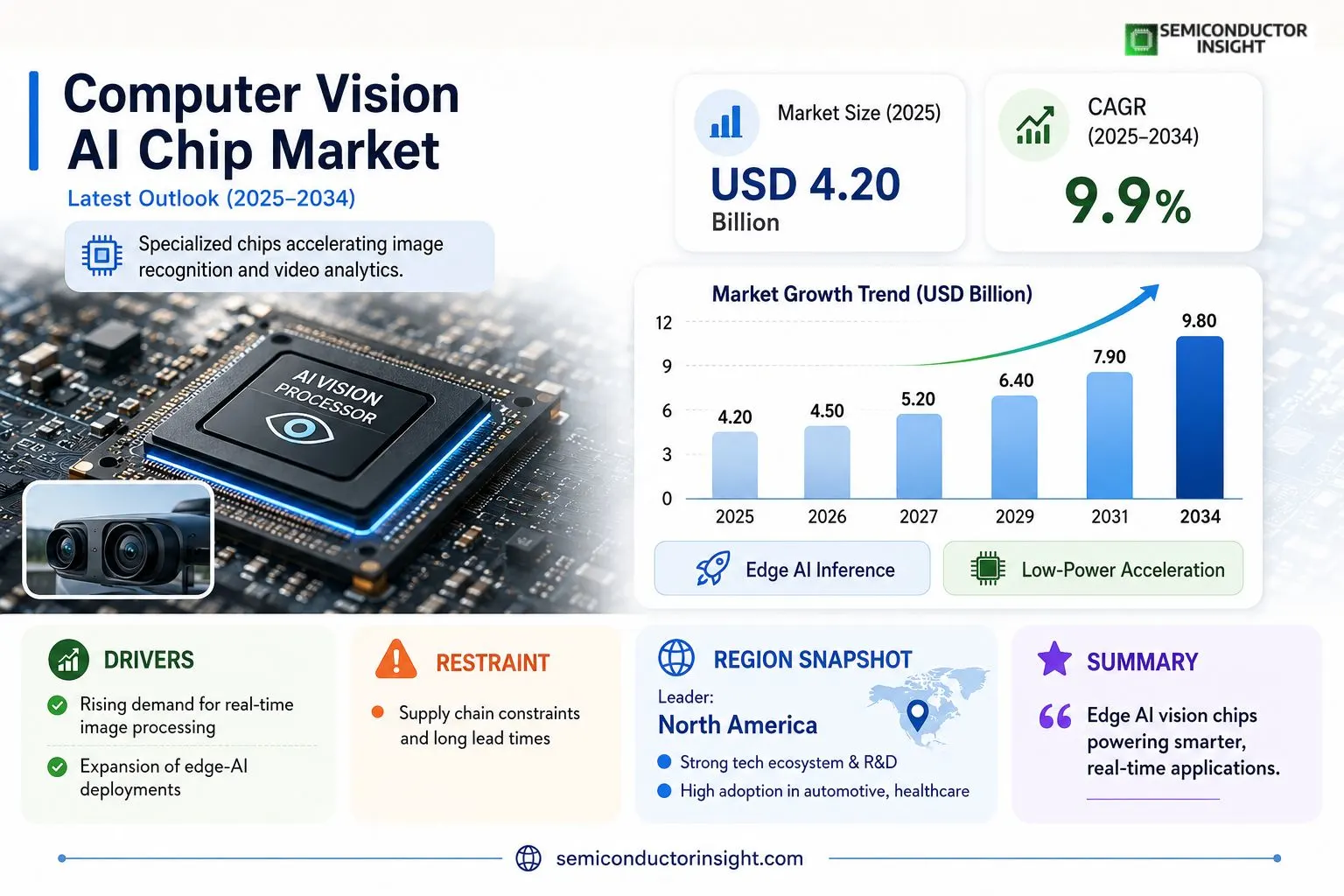
Global Computer Vision AI Chip market size was valued at USD 4.20 billion in 2025. The market is projected to grow from USD 4.50 billion in 2025 to USD 9.80 billion by 2034, exhibiting a CAGR of 9.9% during the forecast period.
Computer Vision AI chips are purpose‑built semiconductor devices that accelerate image‑recognition, object‑detection and video‑analytics algorithms using parallel processing architectures such as GPUs, TPUs and dedicated neural‑network accelerators.
These chips enable real‑time inference on edge devices and data‑center servers, supporting applications ranging from autonomous driving and industrial inspection to retail analytics and augmented reality.The market is experiencing rapid growth because enterprises are investing heavily in intelligent automation while rising demand for high‑resolution cameras fuels chipset adoption.
Furthermore, advancements in low‑power design allow deployment on battery‑operated devices, expanding addressable markets.
Key players such as NVIDIA, Intel (Mobileye), Qualcomm Snapdragon Vision, Google Coral and Ambarella are accelerating innovation through strategic partnerships,e.g., NVIDIA’s collaboration with major automotive OEMs to integrate its Jetson platform into next‑generation driver assistance systems.
MARKET DRIVERS
Rising Demand for Real‑Time Image Processing
Computer Vision AI Chip Market is being propelled by the proliferation of smart cameras in autonomous vehicles, industrial automation, and retail analytics. As manufacturers seek sub‑second latency, dedicated vision chips are replacing generic GPUs, delivering up to 3‑times lower power consumption while maintaining high inference accuracy.
Expansion of Edge‑AI Deployments
Edge‑AI solutions are expected to represent over 55% of total chip shipments by 2027, driven by privacy regulations and bandwidth constraints. Companies that embed vision‑optimized silicon at the edge can process video streams locally, reducing cloud‑transfer costs by an estimated 40%.
➤ “Specialized vision processors enable up to 10× faster object‑detection inference compared with conventional CPUs, a key factor for safety‑critical applications.”
In addition, the surge in augmented‑reality (AR) and mixed‑reality (MR) headsets is creating new revenue streams, with forecasts indicating that vision‑centric chips will capture $2.3 billion of the market by 2028.
MARKET CHALLENGES
High Development Costs and Design Complexity
Designing ASICs for computer‑vision workloads requires extensive expertise in both semiconductor fabrication and deep‑learning algorithm optimization. The upfront investment often exceeds $120 million, deterring smaller players and slowing the rate of new product introductions.
Other Challenges
Power‑Efficiency Constraints
Even though vision chips are more efficient than general‑purpose processors, maintaining high performance under strict power envelopes,especially for battery‑operated drones and wearables,remains a technical hurdle that limits broader adoption.
MARKET RESTRAINTS
Supply‑Chain Vulnerabilities
Global semiconductor supply constraints, particularly in advanced node capacities, continue to restrict the scaling of vision‑specific silicon. Lead times of 12‑18 months for high‑volume orders are common, causing manufacturers to postpone launch cycles and constrain market growth.
MARKET OPPORTUNITIES
Emerging Applications in Healthcare Imaging
AI‑enabled diagnostic devices are adopting computer‑vision chips to achieve real‑time analysis of ultrasound and X‑ray images at the point of care. This trend opens a lucrative niche, with projected revenues reaching $1.5 billion by 2029, as hospitals prioritize faster, on‑device decision support to improve patient outcomes.
Computer Vision AI Chip Market Trends
Edge‑enabled Real ‑time Inference
The most visible shift in Computer Vision AI Chip Market is the migration of high‑performance image‑recognition workloads from centralized data centers to edge devices. Manufacturers are integrating dedicated neural‑network accelerators into cameras, drones, and wearable sensors, enabling inference latency below 10 ms. This capability supports time‑critical applications such as autonomous navigation, industrial defect detection, and retail foot‑traffic analytics, where decisions must be made locally without reliance on cloud connectivity.
Other Trends
Low‑Power Design Advances
Power efficiency has become a decisive factor as customers target battery‑operated and ultra‑compact platforms. Recent silicon architectures combine voltage‑scaling techniques with sparsity‑aware computation, reducing typical power draw to under 500 mW for full‑HD video streams. The resulting extension of operational life encourages broader adoption in remote monitoring stations and portable inspection tools, expanding the addressable market beyond traditional server environments.
Strategic Partnerships Driving Innovation
Key ecosystem players are forming alliances that accelerate time‑to‑market for new solutions. Collaborative programs between chipset vendors and automotive OEMs integrate vision processors directly into advanced driver‑assistance systems, while partnerships with cloud providers embed edge‑optimised libraries into development toolchains. These joint efforts streamline software stack compatibility, lower integration costs, and create standardized evaluation benchmarks that improve customer confidence.
Collectively, the trend toward on‑device intelligence, combined with power‑saving breakthroughs and coordinated industry collaborations, is reshaping the competitive landscape. Companies that prioritize scalable IP cores, robust development ecosystems, and cross‑sector alliances are positioned to capture the growing demand for real‑time visual understanding across manufacturing, transportation, and consumer experiences.
COMPETITIVE LANDSCAPEKey Industry Players
Computer Vision AI Chip Market Competitive Landscape
Computer Vision AI Chip Market is dominated by a handful of large semiconductor innovators that combine deep‑learning expertise with advanced packaging. NVIDIA leads the space with its Jetson and Drive platforms, leveraging GPU‑centric architectures to deliver high‑throughput inference for autonomous vehicles and edge analytics. Intel’s Mobileye division, backed by Intel’s broader AI roadmap, provides purpose‑built Vision Processing Units (VPUs) that prioritize low‑latency perception in automotive and industrial contexts. Qualcomm’s Snapdragon Vision series extends AI acceleration to mobile and IoT devices, while Google’s Coral line offers Tensor Processing Units (TPUs) optimized for on‑device inference. These tier‑1 players benefit from extensive ecosystem partnerships, substantial R&D budgets, and the ability to ship high‑volume, low‑cost silicon, establishing a market structure where scale and integration capabilities are primary competitive levers.
Beyond the dominant firms, a vibrant cohort of niche specialists is expanding the functional breadth of computer‑vision chips. Ambarella supplies video‑centric processors that excel in high‑resolution automotive and surveillance applications. Horizon Robotics focuses on AI‑enabled edge computing for smart cities and robotics. Syntiant delivers ultra‑low‑power neural‑compute solutions for voice‑activated wearables that increasingly incorporate vision capabilities. Lattice Semiconductor’s sensAI line targets low‑cost, FPGA‑based vision acceleration, while Cambricon, a Chinese AI chip pioneer, provides ASICs tailored for deep‑learning workloads in data‑center environments. Additional contributors including Mythic, PerceptIn, GreenWaves Technologies, and BrainChip round out the ecosystem, offering differentiated architectures that address power‑constrained, real‑time inference niches and regional market segments.
List of Key Computer Vision AI Chip Companies Profiled
- NVIDIA
- Intel (Mobileye)
- Qualcomm
- Google Coral
- Ambarella
- Horizon Robotics
- Syntiant
- Lattice Semiconductor
- Cambricon
- Mythic
- PerceptIn
- GreenWaves Technologies
- BrainChip
- Tenstorrent
- Visionify
Segment Analysis:
| Segment Category | Sub-Segments | Key Insights |
| By Type |
|
GPU‑based Vision Chips
|
| By Application |
|
Autonomous Vehicles
|
| By End User |
|
Automotive OEMs
|
| By Architecture |
|
Neural‑Network Specific Accelerators
|
| By Deployment Model |
|
Edge Devices
|
Regional Analysis: North America
North America
The automotive sector is a major driver of demand for computer vision AI chips, with applications in object detection, lane keeping, and pedestrian recognition. Regulatory pressures and consumer expectations are accelerating the deployment of advanced driver-assistance systems (ADAS) and autonomous driving technologies, creating a significant market opportunity. Chip manufacturers are actively developing specialized hardware optimized for the demanding processing requirements of autonomous vehicle applications.
Computer vision AI chips are playing an increasingly vital role in healthcare, enabling faster and more accurate medical image analysis. Applications include disease detection, robotic surgery guidance, and personalized medicine. The ability to quickly process and analyze medical images is improving patient outcomes and reducing healthcare costs.
The demand for computer vision in industrial automation is soaring, thanks to its ability to enhance quality control, streamline manufacturing processes, and improve safety. Applications range from defect detection and predictive maintenance to robotic process automation and supply chain optimization. The integration of computer vision AI with edge computing is enabling real-time decision-making on the factory floor.
Smartphones, security cameras, and other consumer electronics are increasingly incorporating computer vision capabilities. This trend is driving demand for compact and power-efficient AI chips that can perform real-time image and video processing. The proliferation of connected devices is further expanding the market for these types of chips.
Europe
Europe’s Computer Vision AI Chip Market is gaining momentum, fueled by strong government support for technological advancement and a growing emphasis on industrial digitalization. Countries like Germany, France, and the UK are investing heavily in AI research and development, creating a favorable environment for chip manufacturers. The automotive industry in Europe is a major driver, with significant investments in autonomous driving and advanced driver-assistance systems. Furthermore, European companies are focusing on developing solutions for smart cities, healthcare, and manufacturing, leveraging the power of computer vision. The region benefits from access to a skilled workforce and a strong network of research institutions, fostering innovation in the field. Challenges include navigating complex regulatory landscapes and ensuring data privacy compliance.
Asia-Pacific
Asia-Pacific represents the largest and fastest-growing market for Computer Vision AI Chips. China is the dominant force, driven by massive investments in AI infrastructure and a rapidly expanding domestic market. The region’s strong manufacturing base and low labor costs further contribute to its attractiveness as a hub for chip production. Key applications in Asia-Pacific include surveillance systems, retail analytics, and industrial automation. Government initiatives promoting AI innovation and the digitization of industries are fueling demand for these chips. The region is also witnessing a surge in the development of edge AI solutions, catering to the needs of diverse applications. Competition in the Asia-Pacific market is intense, with both domestic and international players vying for market share.
South America
Computer Vision AI Chip Market in South America is in its early stages of development but holds significant potential. Increased adoption of smart surveillance systems, retail analytics, and agricultural technology is driving demand. The growing focus on infrastructure development and industrial automation presents further opportunities for chip manufacturers. While the market is relatively small compared to other regions, its growth rate is expected to be substantial in the coming years. Challenges include limited access to funding and a less developed technological infrastructure. Middle East & Africa
The Middle East & Africa region presents a nascent but promising market for Computer Vision AI Chips. Government initiatives aimed at digital transformation, smart cities development, and increased security spending are creating opportunities. Applications are focused on surveillance, retail analytics, and healthcare. While the market is currently small, with significant potential for growth, the region faces challenges related to infrastructure development, regulatory frameworks, and limited technological expertise.
Report Scope
This market research report provides a comprehensive analysis of the Computer Vision AI Chip Market , covering the forecast period 2026–2034. It offers detailed insights into market dynamics, technological advancements, competitive landscape, and key trends shaping the industry.
Key focus areas of the report include:
- Market Overview: The report begins with an overview outlining its current market scenario, key growth indicators, and industry transformation drivers. It discusses macroeconomic factors, demand–supply balance, regulatory landscape, and the strategic role of semiconductors in powering advancements across industries such as automotive, telecommunications, consumer electronics, and industrial automation.
- Market Size & Forecast: Historical data and future projections for revenue, unit shipments, and market value across major regions and segments.
- Segmentation Analysis: Detailed breakdown by product type, technology, application, and end-user industry to identify high-growth segments and investment opportunities.
- Regional Insights: Insights into market performance across North America, Europe, Asia-Pacific, Latin America, and the Middle East & Africa, including country-level analysis where relevant.
- Competitive Landscape: Profiles of leading market participants, including their product offerings, R&D focus, manufacturing capacity, pricing strategies, and recent developments such as mergers, acquisitions, and partnerships.
- Technology Trends & Innovation: Assessment of emerging technologies, integration of AI/IoT, semiconductor design trends, fabrication techniques, and evolving industry standards.
- Market Drivers & Restraints: Evaluation of factors driving market growth along with challenges, supply chain constraints, regulatory issues, and market-entry barriers.
- Stakeholder Insights: Insights for component suppliers, OEMs, system integrators, investors, and policymakers regarding the evolving ecosystem and strategic opportunities.
Primary and secondary research methods are employed, including interviews with industry experts, data from verified sources, and real-time market intelligence to ensure the accuracy and reliability of the insights presented.
FREQUENTLY ASKED QUESTIONS:
What is the current market size of Computer Vision AI Chip Market?
-> Computer Vision AI Chip Market was valued at USD 4.20 billion in 2025 and is expected to reach USD 9.80 billion by 2034, reflecting a CAGR of 9.9 % over the forecast period.
Which key companies operate in Computer Vision AI Chip Market?
-> Key players include NVIDIA, Intel (Mobileye), Qualcomm Snapdragon Vision, Google Coral, and Ambarella.
What are the key growth drivers?
-> Key growth drivers include enterprise investment in intelligent automation, rising demand for high‑resolution cameras, and advances in low‑power chip design enabling battery‑operated edge devices.
Which region dominates the market?
-> The source does not specify a single dominant region; market activity is observed globally with notable interest in North America, Europe, and Asia‑Pacific.
What are the emerging trends?
-> Emerging trends include edge‑AI inference, integration of AI/IoT for real‑time analytics, and development of ultra‑low‑power neural‑network accelerators.

Get Sample Report PDF for Exclusive Insights
Report Sample Includes
- Table of Contents
- List of Tables & Figures
- Charts, Research Methodology, and more...
 Download Sample Report PDF