Large Language Model (LLM) ASIC Market Insights
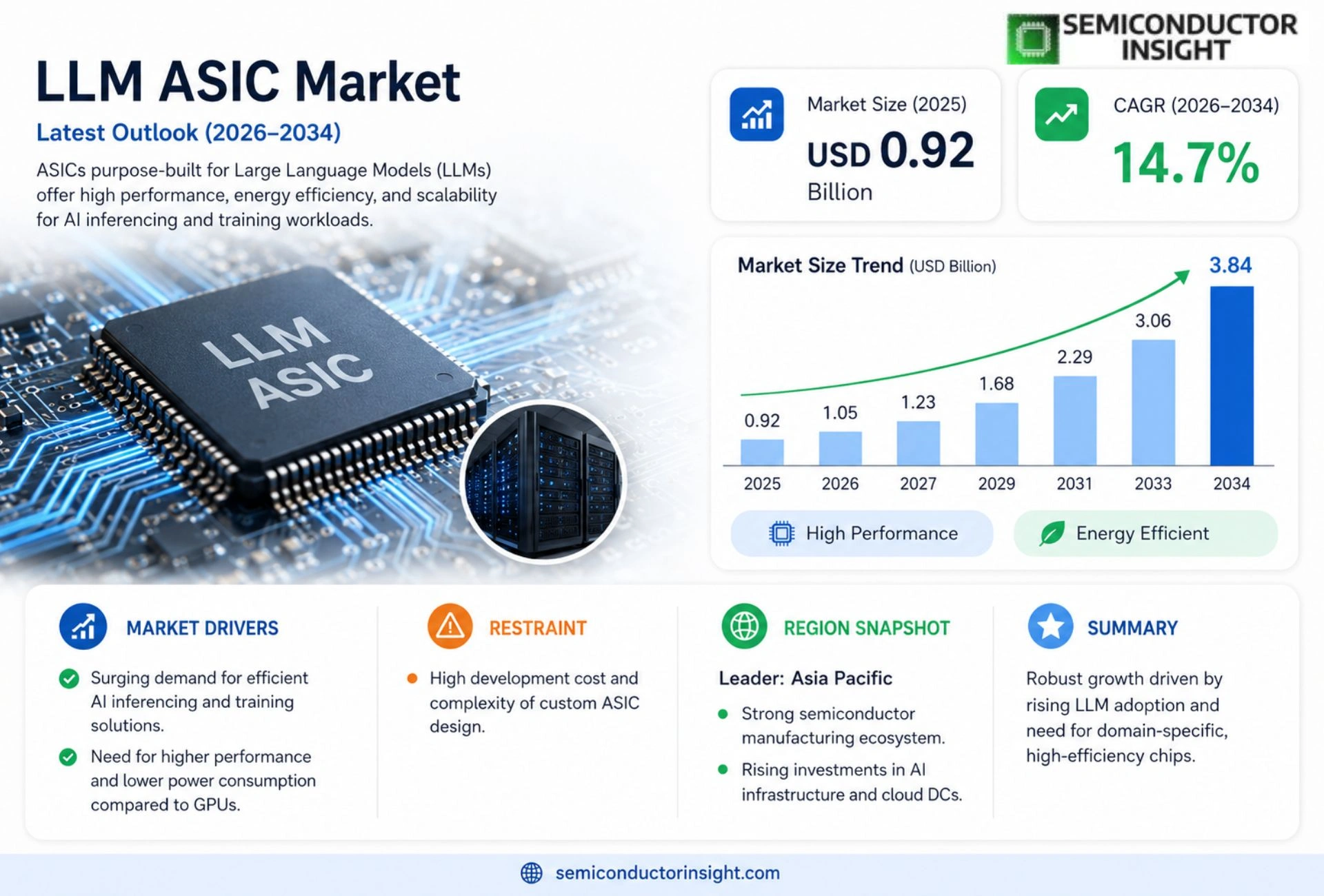
Global Large Language Model (LLM) ASIC market size was valued at USD 0.92 billion in 2025. The market is projected to grow from USD 1.05 billion in 2026 to USD 3.84 billion by 2034, exhibiting a CAGR of 14.7% during the forecast period.
LLM ASICs are purpose‑built application‑specific integrated circuits designed to accelerate transformer‑based language models such as GPT‑4 or PaLM‑2. These chips optimize matrix multiplication, attention mechanisms and high‑bandwidth memory access, delivering orders‑of‑magnitude higher inference throughput while reducing power consumption compared with general‑purpose GPUs.
The market is experiencing rapid growth because enterprise AI adoption is soaring and data centers are seeking energy‑efficient compute solutions. Furthermore, rising investment from cloud providers and semiconductor firms,e.g., Graphcore’s IPU 3 series launch in 2023 and Cerebras’ Wafer‑Scale Engine 2 rollout,are expanding supply capacity. Meanwhile, collaborations between AI startups and foundries accelerate time‑to‑market, further fueling demand for specialized LLM hardware.
MARKET DRIVERS
Rising Demand for High‑Performance LLM Inference
Large Language Model (LLM) ASIC Market is propelled by enterprises that require low‑latency, energy‑efficient inference for models exceeding hundreds of billions of parameters. Specialized silicon can sustain >200 TOPS per watt, addressing the compute bottleneck in cloud and edge AI services.
Cost Efficiency and Scale‑out Capabilities
ASIC‑based solutions deliver up to 60 % lower total cost of ownership compared with GPU clusters, enabling hyperscalers to expand LLM workloads while preserving margin. The ability to scale out across thousands of nodes is a decisive advantage for AI‑first organizations.
➤ Deployments of custom LLM ASICs are projected to double each year through 2028, reflecting accelerated adoption across AI‑driven enterprises.
Regulatory incentives for greener computing further reinforce demand, as energy‑aware hardware aligns with corporate sustainability objectives and carbon‑reduction pledges.
MARKET CHALLENGES
Complexity of ASIC Design for LLMs
Designing ASICs that efficiently execute LLM workloads requires deep expertise in both model architecture and silicon engineering, driving up R&D spend and extending product development cycles.
Other Challenges
Manufacturing Capacity Constraints
Foundry lead times have stretched beyond 12 months, limiting the ability of vendors to satisfy rapid demand spikes, especially for large‑scale data‑center rollouts.
Supply‑chain volatility for advanced packaging materials adds further uncertainty, compelling manufacturers to maintain higher inventory buffers, which in turn raises operational costs.
MARKET RESTRAINTS
High Capital Expenditure for Tooling
Initial investment in mask sets, verification environments, and design‑for‑test infrastructure can exceed $150 million, deterring mid‑size players from entering Large Language Model (LLM) ASIC Market.
Long payback periods, often exceeding five years, make it challenging for organizations with limited financial flexibility to justify the upfront spend.
Additionally, the rapid evolution of LLM architectures means that silicon designed for today’s models may become sub‑optimal within a short horizon, increasing the risk of obsolescence.
MARKET OPPORTUNITIES
Edge‑Optimized LLM ASICs
Emerging opportunities exist for ASICs that can run compact LLMs on edge devices, unlocking new revenue streams in autonomous robotics, AR/VR, and telecom edge computing where latency and privacy are critical.
Partnerships between semiconductor firms and AI startups are accelerating the development of ultra‑low‑power LLM accelerators, targeting power envelopes below 5 W for on‑device inference.
Regional incentives in North America and Asia‑Pacific for advanced semiconductor manufacturing further support the establishment of dedicated LLM ASIC production lines, positioning the market for robust growth through 2032.
Large Language Model (LLM) ASIC Market Trends
Accelerated Inference Efficiency Driving Growth
Large Language Model (LLM) ASIC Market is witnessing a decisive shift toward hardware that can sustain the compute intensity of transformer‑based language models. By integrating specialized matrix multiplication units, attention engines, and high‑bandwidth memory interfaces, these ASICs deliver inference throughput that surpasses conventional GPU solutions while consuming a fraction of the power. Enterprise AI initiatives are scaling rapidly, prompting data‑center operators to replace general‑purpose accelerators with purpose‑built silicon that aligns with latency‑critical workloads such as real‑time translation and conversational agents. This transition is reinforced by a growing preference for low‑TCO compute platforms, where the cost savings from reduced energy bills and higher utilization rates become a compelling business case.
Other Trends
Supply Expansion through New Chip Introductions
Recent product launches illustrate how supply is keeping pace with demand. Graphcore’s IPU 3 series introduced in 2023 offers a fine‑grained parallelism architecture optimized for sparse attention patterns, while Cerebras’ Wafer‑Scale Engine 2 expands chip size to improve bandwidth‑to‑compute ratios for massive LLM deployments. These advancements are complemented by strategic collaborations between AI‑focused startups and established foundries, accelerating time‑to‑market and reducing design‑cycle risk. The cumulative effect is a broader portfolio of ASIC options, enabling customers to match silicon characteristics more precisely to model sizes ranging from hundreds of millions to hundreds of billions of parameters.
Energy‑Efficient Compute as a Competitive Differentiator
Power efficiency has emerged as a decisive factor in differentiating hardware vendors. LLM ASICs achieve power reductions of up to 60 % compared with leading GPU offerings when running identical inference workloads. This efficiency translates into lower operational expenditures for hyperscale cloud providers, where electricity and cooling represent substantial cost components. Moreover, environmentally driven procurement policies are encouraging organizations to select platforms that align with sustainability goals. As a result, manufacturers are prioritizing innovations such as on‑chip voltage scaling and advanced packaging techniques that further shrink the energy envelope, reinforcing the market’s momentum toward specialized, energy‑conscious silicon.
COMPETITIVE LANDSCAPE
Key Industry Players
Large Language Model (LLM) ASIC Market Competitive Overview
Large Language Model (LLM) ASIC Market is still nascent but already exhibits a clear hierarchy of players. Cerebras Systems, with its Wafer‑Scale Engine 2, commands the top tier by delivering a single‑chip solution that can host models comparable to GPT‑4 while maintaining power efficiency. Google’s Tensor Processing Units (TPU v5) are closely competitive, leveraging Google’s massive data‑center footprint to provide scalable inference for transformer workloads. Intel’s Habana Labs, through the Gaudi 2 family, and Amazon’s Trainium ASIC further solidify the front‑line, each targeting high‑throughput, low‑latency serving for cloud providers. Collectively, these firms account for the majority of projected revenue, which the market insight predicts will expand from $0.92 billion in 2025 to $3.84 billion by 2034 at a 14.7 % CAGR. Their market structure is characterized by deep integration with cloud ecosystems, extensive software stacks, and strategic partnerships with foundries such as TSMC, enabling rapid capacity scaling to meet soaring enterprise AI demand.
Beyond the dominant tier, a vibrant set of niche innovators is shaping the competitive landscape through differentiated architectures and specialized use cases. Graphcore’s IPU 3 series emphasizes fine‑grained parallelism for model training, while SambaNova Systems offers the DataScale 2 accelerator that blends ASIC efficiency with programmable cores for rapid model iteration. Tenstorrent pursues a high‑density tensor core design aimed at edge data‑center deployments, and Groq’s Tensor Streaming Processor targets deterministic latency for real‑time LLM inference. Chinese firms such as Baidu (Kunlun) and Alibaba (Hanguang 800) are deploying proprietary ASICs within their cloud services to reduce reliance on foreign suppliers. Samsung and Qualcomm are leveraging mature process nodes to deliver AI‑centric chips that balance performance with cost for hyperscale operators. Smaller players like Mythic, which focuses on analog compute, and Xilinx with its Versal AI Core, provide alternative pathways for power‑constrained workloads. While each of these companies captures a modest share individually, together they enrich the ecosystem with competitive pressure and innovation that will broaden adoption across varied market segments.
List of Key LLM ASIC Companies Profiled
- Cerebras Systems
- Google TPU
- Intel Habana Labs
- Amazon Trainium
- Graphcore
- SambaNova Systems
- Tenstorrent
- Groq
- Baidu Kunlun
- Alibaba Hanguang 800
- Samsung AI Chip
- Qualcomm AI ASIC
- Mythic AI
- AMD MI250
- Xilinx Versal AI Core
Segment Analysis:
| Segment Category | Sub-Segments | Key Insights |
| By Type |
|
Transformer‑Optimized ASICs
|
| By Application |
|
Inference Acceleration
|
| By End User |
|
Cloud Service Providers
|
| By Deployment Model |
|
On‑Premise Data Center
|
| By Ecosystem Partner |
|
Semiconductor Foundries
|
Regional Analysis: North America
North America
The increasing reliance on cloud-based AI services is a primary driver for LLM ASIC adoption in North America. Cloud providers are actively investing in custom hardware to enhance the performance and efficiency of their LLM offerings.
North American enterprises are rapidly integrating LLMs into their operations for tasks such as natural language processing, data analysis, and customer service, generating significant demand for specialized ASIC solutions.
Significant government and private sector investments in AI research and development in North America are driving innovation in LLM ASIC design and manufacturing.
The development of autonomous vehicles and robotics in North America necessitates powerful and efficient LLM ASICs for real-time decision-making and environmental perception.
Europe
Europe is witnessing substantial growth in the LLM ASIC market, fueled by a strong emphasis on data privacy, security, and sustainable AI. While the adoption rate may be slightly slower than in North America, the region possesses a deep talent pool in microelectronics and a supportive regulatory environment for AI innovation. European institutions are actively promoting the development of energy-efficient LLM ASICs to align with their sustainability goals. The focus is on developing customized solutions tailored to the specific needs of European industries, such as manufacturing, finance, and healthcare. Key players in Europe are collaborating on research projects to advance the capabilities of LLM ASICs and explore new applications. The European Union’s AI Act is expected to further shape the development and deployment of LLM ASICs in the region.
Asia-Pacific
Asia-Pacific presents a dynamic and rapidly expanding market for LLM ASICs, primarily driven by the massive data generation and consumption occurring in countries like China, India, and Japan. The region’s large population and increasing digital penetration are creating significant demand for LLM-powered applications. Government initiatives supporting AI development, coupled with substantial investments from both public and private sectors, are accelerating market growth. Asia-Pacific is also witnessing the emergence of local LLM ASIC design houses and manufacturing capabilities, reducing reliance on foreign suppliers. The focus is on developing cost-effective solutions capable of handling the scale of data processing required for large language models. Competition in the Asia-Pacific market is intense, with numerous players vying for market share.
South America
The LLM ASIC market in South America is still in its nascent stages, but it holds considerable long-term potential. Growing internet penetration and increasing adoption of cloud services are creating a favorable environment for AI applications. The region’s demand for LLM ASICs is primarily driven by sectors such as e-commerce, fintech, and telecommunications. However, challenges remain, including limited investment in AI research and development and a shortage of skilled talent. Government initiatives aimed at promoting digital transformation and technological innovation are expected to spur growth in the coming years. The adoption of LLM ASICs in South America is likely to be gradual, with early adopters focusing on specific use cases.
Middle East & Africa
The Middle East and Africa represent an emerging market for LLM ASICs, with considerable growth potential driven by increasing investments in technology and digital infrastructure. The region’s growing adoption of AI in sectors such as finance, healthcare, and government services is creating demand for specialized hardware. Government initiatives focused on promoting technological innovation and economic diversification are further fueling market growth. While the market is currently small, the long-term outlook is positive, with the potential for significant investment and development. Challenges include limited access to skilled talent and infrastructure constraints in some areas. The adoption of LLM ASICs in the Middle East and Africa is expected to accelerate as the region continues its digital transformation journey.
Report Scope
This market research report provides a comprehensive analysis of the Large Language Model (LLM) ASIC Market , covering the forecast period 2026–2034. It offers detailed insights into market dynamics, technological advancements, competitive landscape, and key trends shaping the industry.
Key focus areas of the report include:
- Market Overview: The report begins with an overview outlining its current market scenario, key growth indicators, and industry transformation drivers. It discusses macroeconomic factors, demand–supply balance, regulatory landscape, and the strategic role of semiconductors in powering advancements across industries such as automotive, telecommunications, consumer electronics, and industrial automation.
- Market Size & Forecast: Historical data and future projections for revenue, unit shipments, and market value across major regions and segments.
- Segmentation Analysis: Detailed breakdown by product type, technology, application, and end-user industry to identify high-growth segments and investment opportunities.
- Regional Insights: Insights into market performance across North America, Europe, Asia-Pacific, Latin America, and the Middle East & Africa, including country-level analysis where relevant.
- Competitive Landscape: Profiles of leading market participants, including their product offerings, R&D focus, manufacturing capacity, pricing strategies, and recent developments such as mergers, acquisitions, and partnerships.
- Technology Trends & Innovation: Assessment of emerging technologies, integration of AI/IoT, semiconductor design trends, fabrication techniques, and evolving industry standards.
- Market Drivers & Restraints: Evaluation of factors driving market growth along with challenges, supply chain constraints, regulatory issues, and market-entry barriers.
- Stakeholder Insights: Insights for component suppliers, OEMs, system integrators, investors, and policymakers regarding the evolving ecosystem and strategic opportunities.
Primary and secondary research methods are employed, including interviews with industry experts, data from verified sources, and real-time market intelligence to ensure the accuracy and reliability of the insights presented.
FREQUENTLY ASKED QUESTIONS:
What is the current market size of Large Language Model (LLM) ASIC Market?
-> Large Language Model (LLM) ASIC Market was valued at USD 0.92 billion in 2025 and is expected to reach USD 3.84 billion by 2034.
Which key companies operate Large Language Model (LLM) ASIC Market?
-> Key players include Graphcore, Cerebras Systems, Nvidia, Intel (Habana Labs), AMD, and Google (TPU), among others.
What are the key growth drivers?
-> Key growth drivers include surging enterprise AI adoption, demand for energy‑efficient compute in data centers, and increased investment from cloud providers and semiconductor firms.
Which region dominates the market?
-> North America holds the largest market share, while Asia‑Pacific is the fastest‑growing region.
What are the emerging trends?
-> Emerging trends include wafer‑scale engine designs, 3D‑stacked memory integration, and hybrid ASIC‑FPGA solutions for LLM inference acceleration.

Get Sample Report PDF for Exclusive Insights
Report Sample Includes
- Table of Contents
- List of Tables & Figures
- Charts, Research Methodology, and more...
 Download Sample Report PDF