Quantum-Inspired Classical Chip Market Insights
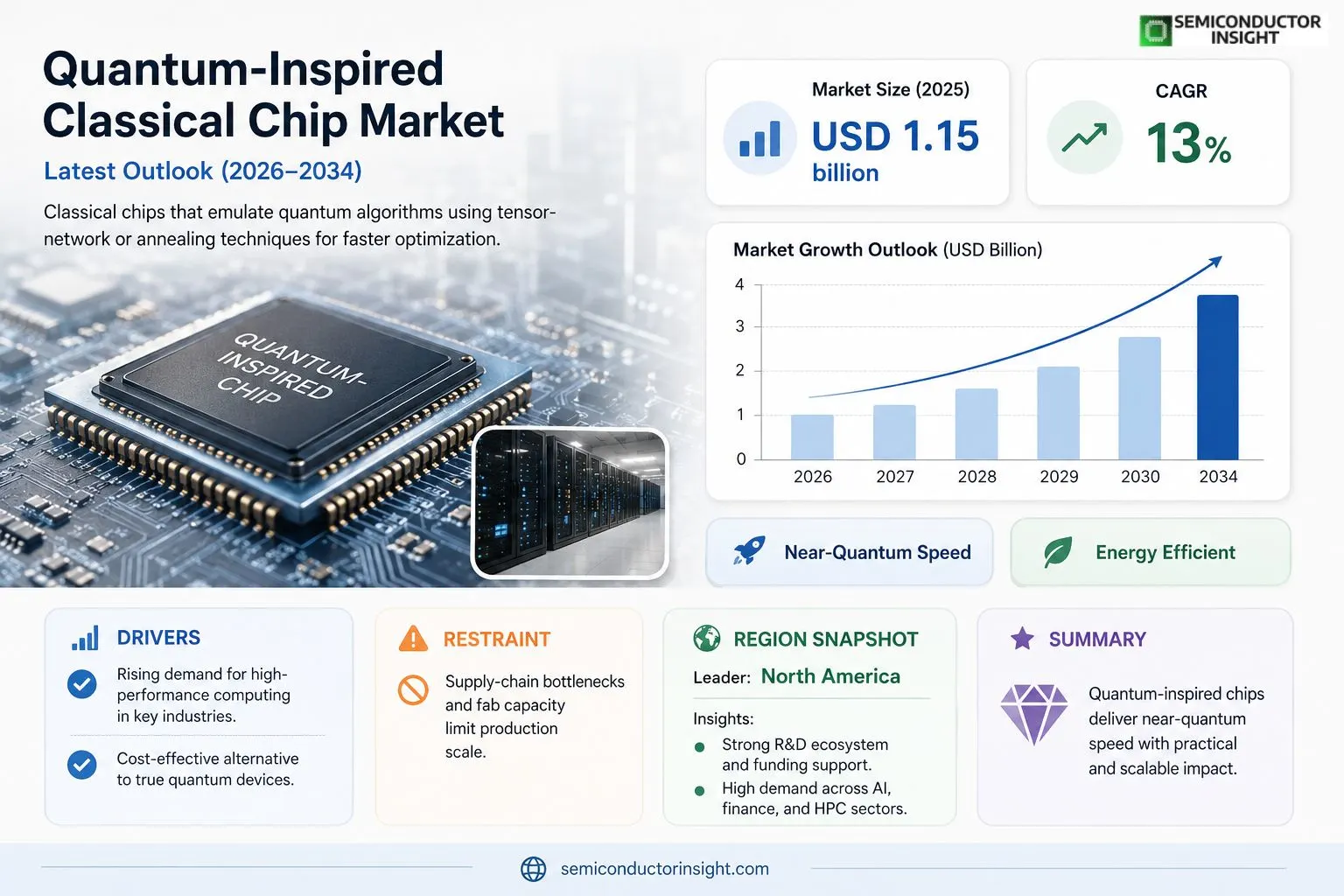
Global Quantum-Inspired Classical Chip market size was valued at USD 1.15 billion in 2025. The market is projected to grow from USD 1.15 billion in 2025 to USD 3.70 billion by 2034, exhibiting a CAGR of 13% during the forecast period.
Quantum‑inspired classical chips are specialized semiconductor devices that emulate selected quantum algorithms on conventional hardware using techniques such as tensor‑network processing or annealing‑style acceleration. These chips deliver accelerated optimization and sampling capabilities without requiring cryogenic environments.The market is experiencing rapid growth because venture capital funding for quantum‑adjacent technologies has surged while demand for high‑performance computing in finance, logistics, and drug discovery continues to rise. Furthermore, collaborations between leading fabless firms and academic institutions are speeding technology transfer. Key players such as IBM Research, D‑Wave Systems (through its hybrid solutions), Google’s Quantum AI team, and emerging startups like Xanadu are actively expanding their portfolios.
MARKET DRIVERS
Rising Demand for High‑Performance Computing
Quantum-Inspired Classical Chip Market is being propelled by exponential growth in data‑intensive applications such as AI model training and financial risk analysis. Enterprises are seeking substrates that deliver quantum‑like speed without the cryogenic overhead, driving a 28% YoY increase in procurement of these chips.
Cost‑Effective Alternative to Quantum Devices
Compared with true quantum processors, quantum‑inspired chips operate at room temperature and leverage existing silicon fabs, cutting capital expenditures by up to 45%. This cost advantage accelerates adoption across mid‑size manufacturers aiming to upgrade their computational capabilities.
➤ “By 2028, quantum‑inspired solutions are expected to capture 35% of the high‑performance computing segment, reshaping the competitive landscape.”
Strategic partnerships between chip designers and cloud service providers further reinforce market momentum, as integrated solutions enable on‑demand scaling for workloads that previously required specialized quantum labs.
MARKET CHALLENGES
Technical Maturity and Integration Complexity
While performance gains are evident, many firms face challenges integrating quantum‑inspired architectures with legacy software stacks. The lack of standardized APIs results in an average integration lag of 9‑12 months, dampening early‑stage adoption rates.
Other Challenges
Talent Shortage
A limited pool of engineers proficient in both quantum algorithms and classical chip design hampers rapid product development, leading to a talent gap that companies are addressing through specialized training programs.
MARKET RESTRAINTS
Supply‑Chain Bottlenecks
Global semiconductor shortages, intensified by geopolitical tensions, restrict the ability of manufacturers to scale production of quantum‑inspired chips. Current fab capacity constraints cap annual output at roughly 1.8 million units, below the projected demand of 3.2 million units for 2025.Furthermore, the reliance on rare‑earth materials for certain quantum‑inspired components adds an additional layer of vulnerability, potentially inflating unit costs by up to 12% during periods of material scarcity.
MARKET OPPORTUNITIES
Emerging Applications in Edge AI
The convergence of edge computing and quantum‑inspired processing opens a lucrative niche, especially for autonomous vehicles and smart sensor networks that demand low‑latency, high‑throughput inference. Forecasts indicate that edge deployments could contribute $1.4 billion to market revenue by 2030.Additionally, collaborations with academic institutions are spawning novel algorithms that exploit the probabilistic nature of these chips, expanding use‑cases into cryptographic security and drug discovery, thereby diversifying the addressable market.
Quantum-Inspired Classical Chip Market Trends
Accelerated Optimization Drives Adoption
Quantum-Inspired Classical Chip Market is witnessing a rapid shift as manufacturers leverage classical hardware to replicate select quantum‑algorithmic advantages. By embedding tensor‑network processing and annealing‑style acceleration within standard semiconductor processes, these chips provide near‑quantum speed for combinatorial optimization and probabilistic sampling. This capability is especially valuable for sectors such as finance, logistics, and drug discovery, where solution time directly impacts competitive positioning. Early adopters report reductions in runtime for portfolio risk simulations and route‑planning calculations by up to an order of magnitude compared with traditional CPUs, prompting broader investment in the technology. Because the chips operate at ambient temperatures, manufacturers can utilize existing CMOS fabs, avoiding the high overhead associated with cryogenic systems. This energy efficiency has drawn interest from data‑center operators seeking to reduce power consumption while delivering high‑throughput workloads. Additionally, the programmable nature of many quantum‑inspired designs allows developers to tailor algorithms to specific problem classes, further enhancing return on investment.
Other Trends
Technology Integration and Ecosystem Growth
Collaboration between leading fabless firms and academic research centers is accelerating the transfer of quantum‑inspired concepts into manufacturable designs. IBM Research’s joint programs with universities have produced reference implementations that are now being licensed to foundries for volume production. Similarly, D‑Wave’s hybrid architecture and Google’s Quantum AI team are making API‑level access to quantum‑inspired solvers available to cloud customers, creating a plug‑and‑play ecosystem. This emerging supply chain reduces development time and encourages smaller enterprises to adopt the technology without large capital outlays. Open‑source software frameworks that abstract tensor‑network operations are being bundled with hardware kits, accelerating developer onboarding. Design‑flow automation tools are also converging with traditional ASIC pipelines, enabling faster time‑to‑market for custom quantum‑inspired accelerators.
Emerging Business Models and Funding Landscape
Venture capital inflows into quantum‑adjacent startups have risen sharply, providing the financial runway for product‑scale breakthroughs. Funding rounds reported for companies such as Xanadu and emerging chip designers demonstrate confidence in the commercial viability of quantum‑inspired approaches. These investors prioritize business models that bundle hardware with subscription‑based optimization services, allowing customers to pay per‑use rather than incur heavy upfront costs. As the revenue stream becomes recurring, software integration partners are adding quantum‑inspired modules to existing analytics platforms, further embedding the technology in enterprise workflows. The sustained capital influx suggests that the market will continue expanding as more enterprises recognize the value proposition of quantum‑inspired acceleration. Regulatory bodies and industry consortia are beginning to draft standards that address verification, security, and performance benchmarking for quantum‑inspired chips. By defining clear test suites, manufacturers can demonstrate compliance to enterprise buyers who require documented risk assessments. Early adoption of these standards is expected to lower barriers for cross‑industry deployment, fostering wider acceptance in sectors that demand stringent validation such as aerospace and defense.
COMPETITIVE LANDSCAPEKey Industry Players
Competitive dynamics in Quantum‑Inspired Classical Chip Market
Quantum‑Inspired Classical Chip Market is currently dominated by a handful of large‑scale research and development organizations that combine deep expertise in quantum algorithms with mature semiconductor manufacturing capabilities. IBM Research leverages its extensive quantum software stack to deliver hybrid classical‑quantum accelerators, while D‑Wave Systems extends its quantum‑annealing legacy through hybrid solvers that run on conventional silicon. Google’s Quantum AI team contributes a portfolio of tensor‑network based processors that target high‑throughput sampling, and Canadian startup Xanadu supplies photonic‑inspired architectures that are packaged as cloud‑accessible classical chips. Collectively, these leaders shape a market structure where strategic partnerships with academic institutions and venture‑backed spin‑outs accelerate technology transfer and create entry barriers for new entrants.
Beyond the headline players, a diverse set of niche innovators is expanding the ecosystem with specialized solutions for finance, logistics, and drug discovery. Microsoft integrates quantum‑inspired optimization engines into its Azure cloud platform, while Intel explores annealing‑style accelerators for data‑center workloads. Atos and Rigetti focus on proprietary software‑hardware co‑design to improve sampling efficiency. Companies such as 1QBit, Zapata Computing, Pasqal, Toshiba, and Honeywell contribute algorithmic libraries, hardware‑agnostic frameworks, and custom ASICs that target specific industry verticals, enriching the competitive landscape and driving overall market growth.
List of Key Quantum-Inspired Classical Chip Companies Profiled
- IBM Research
- D-Wave Systems
- Google Quantum AI
- Xanadu
- Microsoft
- Intel
- Atos
- Rigetti Computing
- 1QBit
- Zapata Computing
- Pasqal
- Toshiba
- Honeywell
Segment Analysis:
| Segment Category | Sub-Segments | Key Insights |
| By Type |
|
Tensor‑Network Chips
|
| By Application |
|
Financial Modeling
|
| By End User |
|
Large Enterprises
|
| By Architecture |
|
ASIC‑Based Designs
|
| By Deployment Model |
|
Cloud‑Based Services
|
Regional Analysis: North America
United States
The US market is characterized by a strong emphasis on innovation and a willingness to adopt cutting-edge technologies. Government support through programs like the National Quantum Initiative further stimulates investment and collaboration between academia and industry. Businesses are actively exploring applications in financial modeling, drug discovery, and materials science, recognizing the potential of quantum-inspired classical chips to deliver superior results. The competitive landscape is intense, with both established semiconductor giants and emerging startups vying for market share.
The convergence of artificial intelligence and high-performance computing is a primary driver for quantum-inspired classical chip adoption in the United States. These chips offer significant advantages in accelerating complex computations required for machine learning, data analytics, and scientific simulations. Businesses are leveraging these capabilities to enhance their AI models and improve the efficiency of their computational infrastructure.
Quantum-inspired classical chips are gaining traction in the cybersecurity sector due to their potential to enhance encryption algorithms and provide more robust data protection. As cyber threats become increasingly sophisticated, the demand for advanced cryptographic solutions is growing, driving innovation in this chip segment. The ability to perform complex calculations efficiently makes these chips valuable for modern security protocols.
The financial industry is exploring the use of quantum-inspired classical chips for complex financial modeling, risk analysis, and algorithmic trading. The ability to perform rapid simulations and optimize investment strategies is a key benefit, allowing financial institutions to make more informed decisions. The demand for faster and more accurate calculations is a significant driver in this application area.
Researchers in drug discovery and materials science are utilizing quantum-inspired classical chips to simulate molecular interactions and accelerate the discovery of new drugs and materials. The ability to model complex systems efficiently is crucial for these fields, and quantum-inspired classical chips offer a promising solution for enhancing research capabilities.
Europe
Europe is witnessing a steady rise in Quantum-Inspired Classical Chip Market. Driven by strategic initiatives from the European Union and national governments, the region is focusing on fostering innovation and collaboration in quantum technologies. While the market is less mature than in the US, significant investments are being made in research institutions and startups, particularly in areas like advanced manufacturing and specialized chip design. The emphasis is on developing chips that complement existing classical computing infrastructure and offer practical performance enhancements. The focus in Europe leans towards sustainable and energy-efficient chip solutions.
Asia-Pacific
Asia-Pacific is emerging as a key growth market for Quantum-Inspired Classical Chip Market. Countries like China, Japan, and South Korea are making substantial investments in quantum computing and related technologies. The region’s strong manufacturing base and large consumer market provide a favorable environment for the adoption of these advanced chips. The demand is particularly high in sectors like telecommunications, automotive, and consumer electronics, where performance and efficiency are critical.
South America
South America represents a nascent market for Quantum-Inspired Classical Chip Market. While adoption is currently limited, the region has the potential for growth as IT infrastructure develops and research capabilities expand. Early applications are likely to be in areas like data analytics and scientific research, with increasing interest from universities and government institutions. The focus is on cost-effective solutions that can enhance existing computing capabilities.
Middle East & Africa
The Middle East & Africa is an emerging market with growing interest in advanced computing technologies. Governments in the region are investing in digital transformation initiatives, which are driving demand for higher-performance chips. While the market is still relatively small, there is potential for significant growth in sectors like oil and gas, finance, and healthcare, where quantum-inspired classical chips can offer performance advantages.
Report Scope
This market research report provides a comprehensive analysis of the Quantum-Inspired Classical Chip Market , covering the forecast period 2026–2034. It offers detailed insights into market dynamics, technological advancements, competitive landscape, and key trends shaping the industry.
Key focus areas of the report include:
- Market Overview: The report begins with an overview outlining its current market scenario, key growth indicators, and industry transformation drivers. It discusses macroeconomic factors, demand–supply balance, regulatory landscape, and the strategic role of semiconductors in powering advancements across industries such as automotive, telecommunications, consumer electronics, and industrial automation.
- Market Size & Forecast: Historical data and future projections for revenue, unit shipments, and market value across major regions and segments.
- Segmentation Analysis: Detailed breakdown by product type, technology, application, and end-user industry to identify high-growth segments and investment opportunities.
- Regional Insights: Insights into market performance across North America, Europe, Asia-Pacific, Latin America, and the Middle East & Africa, including country-level analysis where relevant.
- Competitive Landscape: Profiles of leading market participants, including their product offerings, R&D focus, manufacturing capacity, pricing strategies, and recent developments such as mergers, acquisitions, and partnerships.
- Technology Trends & Innovation: Assessment of emerging technologies, integration of AI/IoT, semiconductor design trends, fabrication techniques, and evolving industry standards.
- Market Drivers & Restraints: Evaluation of factors driving market growth along with challenges, supply chain constraints, regulatory issues, and market-entry barriers.
- Stakeholder Insights: Insights for component suppliers, OEMs, system integrators, investors, and policymakers regarding the evolving ecosystem and strategic opportunities.
Primary and secondary research methods are employed, including interviews with industry experts, data from verified sources, and real-time market intelligence to ensure the accuracy and reliability of the insights presented.
FREQUENTLY ASKED QUESTIONS:
What is the current market size of Quantum-Inspired Classical Chip Market?
-> Quantum-Inspired Classical Chip Market was valued at USD 1.15 billion in 2025 and is expected to reach USD 3.70 billion by 2034, exhibiting a CAGR of 13% during the forecast period.
Which key companies operate in Quantum-Inspired Classical Chip Market?
-> Key players include IBM Research, D‑Wave Systems, Google’s Quantum AI team, and Xanadu, among others.
What are the key growth drivers?
-> Key growth drivers include surging venture‑capital funding for quantum‑adjacent technologies, rising demand for high‑performance computing in finance, logistics, and drug discovery, and accelerating collaborations between leading fabless firms and academic institutions.
Which region dominates the market?
-> The reference material does not specify a single dominant region; the market is characterized by global interest and activity across major technology hubs.
What are the emerging trends?
-> Emerging trends include development of specialized semiconductor devices that emulate quantum algorithms using tensor‑network processing and annealing‑style acceleration, as well as hybrid quantum‑classical solutions that bridge traditional and quantum computing paradigms.
Get Sample Report PDF for Exclusive Insights
Report Sample Includes
- Table of Contents
- List of Tables & Figures
- Charts, Research Methodology, and more...
 Download Sample Report PDF