Tensor Processing Unit (TPU) Market Insights
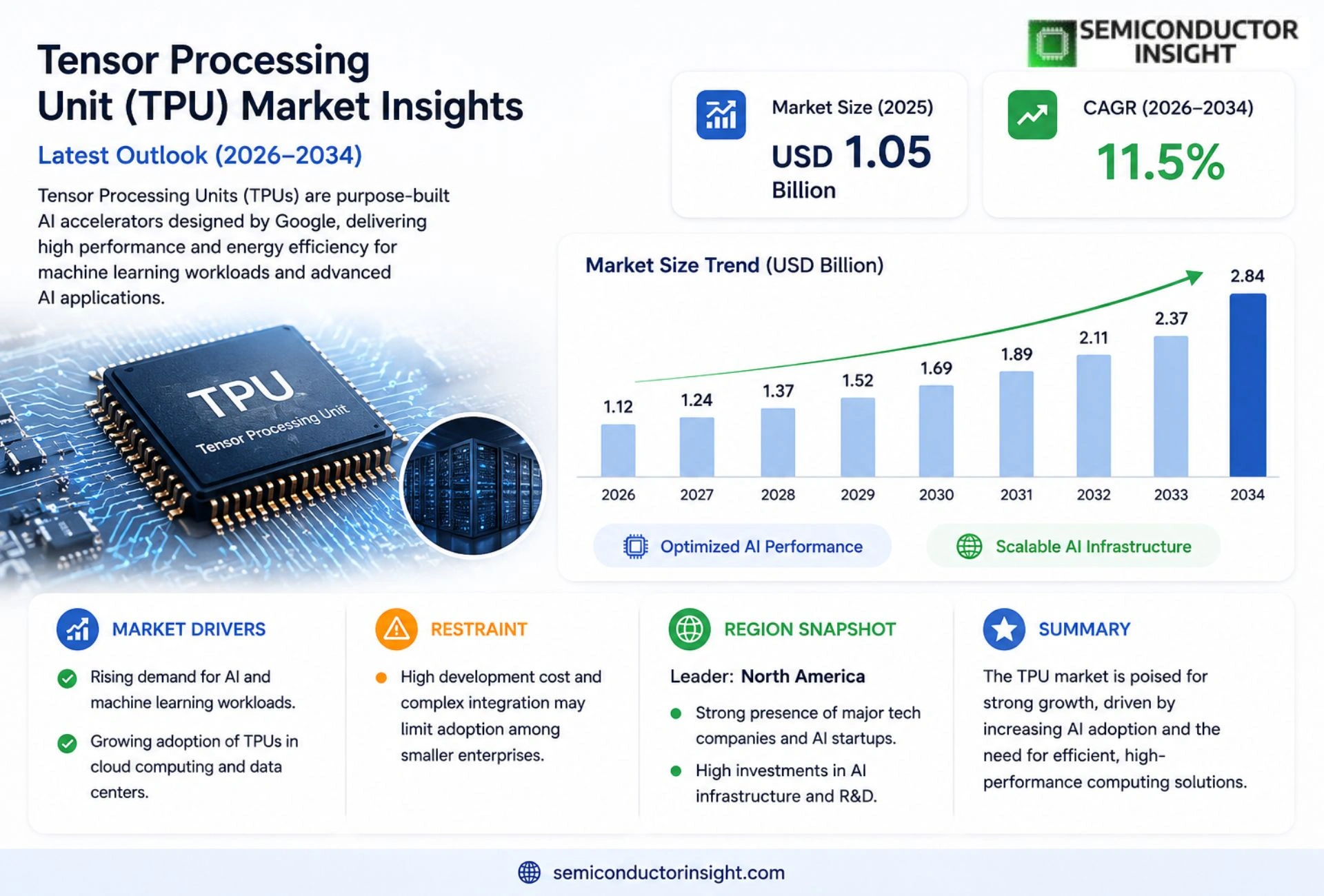
Tensor Processing Unit (TPU) market size was valued at USD 1.05 billion in 2025. The market is projected to grow from USD 1.12 billion in 2026 to USD 2.84 billion by 2034, exhibiting a CAGR of approximately 11.5% during the forecast period.
Tensor Processing Units are application‑specific integrated circuits designed by Alphabet’s Google Cloud to accelerate machine‑learning workloads, particularly deep‑neural‑network inference and training tasks.
The market is accelerating because enterprises are scaling AI services in the cloud while edge deployments demand low‑latency inference chips; furthermore, strategic investments by Google and collaborations with hyperscale data‑center operators are expanding supply chains, driving broader adoption across sectors such as healthcare, automotive, and finance.
MARKET DRIVERS
Increasing Demand for High‑Performance AI Inference
Enterprises across cloud, automotive, and healthcare sectors are scaling AI models that require ultra‑low latency and high throughput. Tensor Processing Unit (TPU) Market growth is propelled by the need for specialized silicon that can accelerate matrix operations far beyond general‑purpose CPUs.
Cloud Service Providers Expanding TPU Offerings
Leading providers such as Google Cloud are integrating next‑generation TPUs into their services, enabling customers to run large language models without on‑premise hardware investments. This **service‑centric** approach drives adoption and creates a subscription‑based revenue stream.
➤ “Specialized accelerators are becoming the backbone of AI workloads, and TPUs are at the forefront of this shift.”
Combined, these dynamics foster a robust pipeline of AI projects that rely on the efficiency and scalability of Tensor Processing Units, reinforcing the market’s upward trajectory.
MARKET CHALLENGES
High Capital Expenditure for Custom ASIC Development
Designing and fabricating TPUs involves substantial R&D spend and access to advanced semiconductor fabs. Smaller firms often lack the financial bandwidth to invest, limiting broader market penetration.
Other Challenges
Talent Scarcity
Skilled engineers proficient in hardware description languages and AI workload optimization are in short supply, creating bottlenecks in product rollout and maintenance.
MARKET RESTRAINTS
Compatibility with Existing Software Ecosystems
Many organizations have entrenched software stacks built around GPUs and CPUs. Transitioning to TPUs often requires rewriting code and re‑training models, introducing friction that slows adoption.
Regulatory scrutiny around data locality and processing standards can also constrain deployment of TPUs in highly regulated industries, where certification processes are lengthy.
Finally, supply‑chain volatility for semiconductor raw materials adds uncertainty to production timelines, potentially delaying time‑to‑market for new TPU generations.
MARKET OPPORTUNITIES
Edge AI and Internet‑of‑Things Integration
Emerging use cases like autonomous drones, smart cameras, and industrial IoT nodes demand on‑device inference with minimal power draw. TPUs designed for edge environments present a high‑growth niche with relatively low competition.
Additionally, the rise of multi‑modal AI models,combining text, vision, and speech,creates an opportunity for TPU vendors to offer differentiated architectures that handle diverse tensor shapes efficiently.
Strategic partnerships with AI software platforms can further accelerate market reach, enabling seamless deployment of pre‑optimized TPU kernels across a broader developer base.
Tensor Processing Unit (TPU) Market Trends
Edge‑Focused Low‑Latency Inference
The most visible shift in the Tensor Processing Unit (TPU) Market is the migration of inference workloads from centralized data‑centers to edge locations. Enterprises that deploy AI‑driven video analytics, autonomous vehicles, and real‑time fraud detection require sub‑millisecond response times, prompting hardware designers to optimize TPUs for power‑efficient, low‑latency operation. Recent product releases feature integrated memory hierarchies and on‑chip networking that reduce data movement, enabling edge nodes to execute deep‑neural‑network models without reliance on cloud round‑trips. This trend is reinforcing a feedback loop: as edge developers demand more capable chips, manufacturers accelerate silicon updates, which in turn expands the range of feasible edge applications.
Other Trends
Cloud‑Native AI Acceleration
Parallel to the edge movement, cloud service providers are embedding TPUs within their managed AI platforms to meet surging demand for large‑scale model training. By offering pay‑as‑you‑go access to specialized TPU clusters, providers lower the barrier for organizations to experiment with transformers and generative models. The integration of TPUs with container orchestration tools allows dynamic scaling, and recent software stacks provide seamless migration of workloads between on‑premise and cloud environments. This cloud‑native approach not only speeds time‑to‑insight but also drives broader adoption of TPUs across sectors that previously relied on GPUs.
Strategic Partnerships Expanding Supply Chains
Another defining trend is the formation of strategic alliances between TPU designers and semiconductor fabs, as well as hyperscale data‑center operators. Collaborative agreements focus on co‑development of next‑generation process nodes that improve performance‑per‑watt and reduce manufacturing lead times. In addition, joint ventures with regional system integrators are establishing localized distribution channels, which help meet the diverse regulatory and latency requirements of markets such as healthcare, automotive, and finance. These partnerships are consolidating TPU ecosystem, fostering a more resilient supply chain, and accelerating market penetration without relying on a single source of silicon.
COMPETITIVE LANDSCAPE
Key Industry Players
Tensor Processing Unit (TPU) Market Competitive Overview
TPU market is anchored by Alphabet’s Google Cloud, which remains the unequivocal leader in both hardware generation and deployment scale. Google’s successive TPU iterations (v2, v3, v4) have cemented a dominant position in hyperscale data‑center AI workloads, driving the bulk of the market’s $1.05 billion valuation in 2025. This concentration creates a classic two‑tier structure: a primary, vertically integrated player that controls silicon design, cloud services, and ecosystem tools, and a secondary tier of specialist ASIC firms and cloud‑service rivals that target niche workloads or differentiated performance‑per‑watt characteristics. The market’s projected CAGR of ~11.5 % through 2034 reflects expanding demand for low‑latency inference at the edge and continued migration of AI training to dedicated hardware, reinforcing Google’s strategic advantage while opening space for challengers to capture specific segments.
Beyond Google, a growing cohort of manufacturers is shaping a diversified competitive landscape. Graphcore (UK) offers the Intelligence Processing Unit (IPU) optimized for graph‑based neural networks, while Cerebras Systems supplies the massive Wafer‑Scale Engine that rivals TPU throughput for large‑model training. Intel’s Habana Labs pushes the Gaudi line for data‑center AI, and Nvidia’s CUDA‑compatible GPUs continue to compete on flexibility. Emerging ASIC innovators such as Tenstorrent, SambaNova Systems, and Mythic target edge‑AI and inference acceleration. Cloud giants Amazon (AWS Trainium) and Microsoft (Project Brainwave) are also developing proprietary chips to reduce reliance on third‑party silicon. Asian incumbents Huawei (Ascend) and Qualcomm (Edge TPU) broaden the ecosystem with solutions for telecom and IoT deployments, respectively, contributing to a multi‑vendor market that balances scale, specialization, and geographic reach.
List of Key Tensor Processing Unit (TPU) Companies Profiled
- Alphabet – Google Cloud (TPU)
- Graphcore
- Cerebras Systems
- Habana Labs (Intel)
- Tenstorrent
- SambaNova Systems
- Mythic
- Huawei – Ascend
- Qualcomm (Edge TPU)
- Amazon Web Services – Trainium
- Microsoft – Project Brainwave
- AMD – Instinct AI Accelerators
Segment Analysis:
| Segment Category | Sub-Segments | Key Insights |
| By Type |
|
Cloud TPU
|
| By Application |
|
AI Inference
|
| By End User |
|
Large Enterprises
|
| By Deployment |
|
Cloud Data Centers
|
| By Industry |
|
Healthcare
|
Regional Analysis: North America
North America
The expansion of cloud services and the increasing adoption of artificial intelligence are primary drivers of TPU demand in North America. Large cloud providers are heavily investing in TPU infrastructure to offer scalable and cost-effective AI solutions to their customers.
North America’s robust data center ecosystem and the growing need for high-performance computing for complex AI models are fueling TPU adoption. Enterprises are increasingly deploying TPUs in their own data centers to accelerate AI training and inference workloads.
The rising demand for edge AI applications, such as autonomous vehicles and industrial automation, is creating new opportunities for TPU deployment. TPUs enable efficient and low-latency AI processing at the edge, catering to the specific requirements of these applications.
Significant government and academic investments in AI research and development in North America are driving innovation in TPU technology and expanding its applications across various industries.
Europe
The European market for Tensor Processing Units is witnessing steady growth, driven by increasing investments in artificial intelligence and high-performance computing across various sectors. Several European countries are actively promoting AI research and development, creating a favorable ecosystem for TPU adoption. The focus is on leveraging TPUs for applications in areas such as industrial automation, healthcare, and financial services. While the market is relatively fragmented compared to North America, there is growing interest from both established technology vendors and emerging startups. Concerns around data privacy and security are key considerations influencing TPU deployment in Europe.
Asia-Pacific
Asia-Pacific is emerging as the fastest-growing market for Tensor Processing Units, fueled by rapid advancements in artificial intelligence and the proliferation of cloud computing services. Countries like China, Japan, and South Korea are leading the charge in TPU adoption, driven by strong government support and significant investments from both public and private sectors. The demand for TPUs is particularly high in applications such as computer vision, natural language processing, and autonomous vehicles. The competitive landscape is intense, with both domestic and international players vying for market share.
South America
The Tensor Processing Unit market in South America is still in its nascent stages, but it holds significant potential for growth. The increasing adoption of cloud services and the growing demand for AI solutions across industries are expected to drive market expansion in the coming years. Key applications are emerging in areas such as e-commerce, financial technology, and logistics. While the market is currently characterized by relatively low adoption rates, the long-term outlook for TPUs in South America is positive, supported by increasing investments in digital infrastructure and technological innovation.
Middle East & Africa
The Middle East and Africa represent a relatively untapped market for Tensor Processing Units, with significant growth opportunities in the long term. The region is witnessing increasing investments in digital transformation initiatives and the adoption of AI technologies across various sectors, including healthcare, finance, and retail. The demand for TPUs is expected to rise as cloud computing services become more prevalent and AI applications become more widespread. However, challenges such as limited infrastructure and data availability could hinder market growth in the short term.
Report Scope
This market research report provides a comprehensive analysis of the Tensor Processing Unit (TPU) Market ,covering the forecast period 2026–2034. It offers detailed insights into market dynamics, technological advancements, competitive landscape, and key trends shaping the industry.
Key focus areas of the report include:
- Market Overview: The report begins with an overview outlining its current market scenario, key growth indicators, and industry transformation drivers. It discusses macroeconomic factors, demand–supply balance, regulatory landscape, and the strategic role of semiconductors in powering advancements across industries such as automotive, telecommunications, consumer electronics, and industrial automation.
- Market Size & Forecast: Historical data and future projections for revenue, unit shipments, and market value across major regions and segments.
- Segmentation Analysis: Detailed breakdown by product type, technology, application, and end-user industry to identify high-growth segments and investment opportunities.
- Regional Insights: Insights into market performance across North America, Europe, Asia-Pacific, Latin America, and the Middle East & Africa, including country-level analysis where relevant.
- Competitive Landscape: Profiles of leading market participants, including their product offerings, R&D focus, manufacturing capacity, pricing strategies, and recent developments such as mergers, acquisitions, and partnerships.
- Technology Trends & Innovation: Assessment of emerging technologies, integration of AI/IoT, semiconductor design trends, fabrication techniques, and evolving industry standards.
- Market Drivers & Restraints: Evaluation of factors driving market growth along with challenges, supply chain constraints, regulatory issues, and market-entry barriers.
- Stakeholder Insights: Insights for component suppliers, OEMs, system integrators, investors, and policymakers regarding the evolving ecosystem and strategic opportunities.
Primary and secondary research methods are employed, including interviews with industry experts, data from verified sources, and real-time market intelligence to ensure the accuracy and reliability of the insights presented.
FREQUENTLY ASKED QUESTIONS:
What is the current market size of Tensor Processing Unit (TPU) Market?
-> Tensor Processing Unit (TPU) market size was valued at USD 1.05 billion in 2025. The market is projected to grow from USD 1.12 billion in 2026 to USD 2.84 billion by 2034.
Which key companies operate in Tensor Processing Unit (TPU) Market?
-> Key players include Google (Alphabet), major hyperscale cloud providers, and semiconductor partners collaborating on ASIC designs.
What are the key growth drivers?
-> Key growth drivers include enterprises scaling AI services in the cloud and rising demand for low‑latency inference chips in edge deployments.
Which region dominates the market?
-> North America currently leads due to early cloud adoption, while Asia‑Pacific shows the fastest growth trajectory.
What are the emerging trends?
-> Emerging trends include integration of TPUs in edge devices, development of next‑generation AI accelerators, and expanding adoption across healthcare, automotive, and finance sectors.

Get Sample Report PDF for Exclusive Insights
Report Sample Includes
- Table of Contents
- List of Tables & Figures
- Charts, Research Methodology, and more...
 Download Sample Report PDF